PUBLISHER: Mordor Intelligence | PRODUCT CODE: 2124020

PUBLISHER: Mordor Intelligence | PRODUCT CODE: 2124020
Europe Coffee Pods And Capsules - Market Share Analysis, Industry Trends & Statistics, Growth Forecasts (2026 - 2031)
According to Mordor Intelligence, the Europe coffee pods and capsules market size was valued at USD 17.09 billion in 2025, increased to USD 18.12 billion in 2026, and is projected to reach USD 24.31 billion by 2031, registering a CAGR of 6.05% during the forecast period.
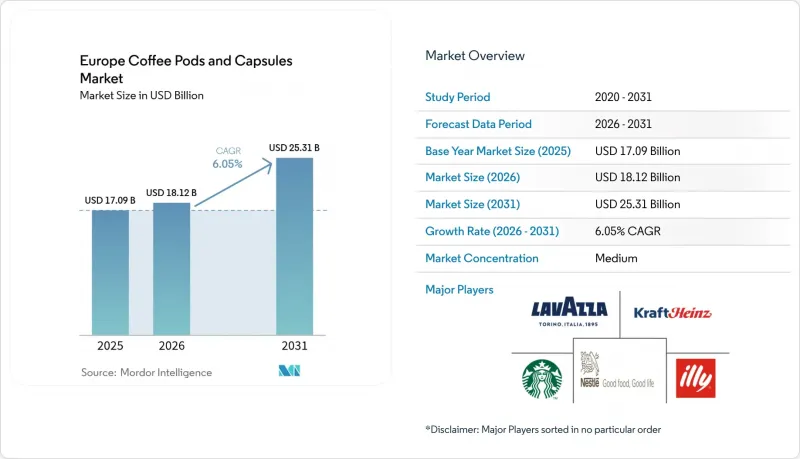
This report is Segmented by Product Type (Pods and Capsules), by Flavor (Plain and Flavored), Packaging Type (Aluminium, Plastic, and Compostable/Biodegradable), Coffee Roast (Light Roast, Medium Roast, and Dark Roast), Distribution Channel (On-Trade and Off-Trade), and Geography (United Kingdom, Germany, Italy, and More). The Market Forecasts are Provided in Both Value (USD) and Volume (Tons).
Europe Coffee Pods And Capsules Market Trends and Insights
Strong established coffee culture across Europe
One of the key drivers of the Europe coffee pods and capsules market is the region's strong coffee culture, where coffee consumption is a daily habit rather than an occasional indulgence. Coffee is an integral part of various daily activities, including morning routines, workplace breaks, social gatherings, and after-meal traditions, creating consistent demand for convenient brewing solutions. Single-serve pods and capsules align well with this behavior, enabling consumers to prepare espresso-style beverages quickly while ensuring consistent taste and aroma. This makes them a practical alternative to visiting cafes. The format is particularly appealing to households seeking cafe-quality beverages without requiring specialized brewing skills or equipment. According to the Centre for the Promotion of Imports, Europe accounted for 30.7% of global coffee consumption in 2023/2024, amounting to approximately 3.26 million tons [1]. This high and stable consumption level drives frequent use of single-serve machines, leading to recurring purchases of pods and capsules.
Growing consumer preference for premium coffee experiences
Consumers are increasingly inclined toward premium coffee experiences both at home and in workplaces. In Europe, there is a growing demand for cafe-style beverages such as espresso, cappuccino, and latte, offering consistent flavor, aroma, and crema quality without the need for barista skills or complex equipment. Single-serve pods and capsules cater to this demand by providing pre-measured, hermetically sealed coffee grounds and pressure-controlled extraction, allowing users to prepare specialty beverages quickly while ensuring standardized taste. Consequently, capsule machines are increasingly perceived not just as convenient appliances but as accessible solutions for premium coffee preparation. This trend toward premiumization is further driven by a rising appreciation for coffee origin, roast profiles, and quality differentiation. Consumers are showing heightened interest in single-origin beans, limited-edition blends, organic and ethically sourced coffee, as well as decaffeinated specialty options.
Environmental concerns over packaging waste
A significant challenge for the Europe coffee pods and capsules market is the ongoing concern about packaging waste associated with single-serve formats. Traditional capsules are often composed of multi-layer plastics or mixed materials that are difficult to separate and recycle through standard household systems. This has led many consumers to associate these products with increased landfill waste. As environmental awareness and zero-waste lifestyles continue to grow across Europe, some consumers are reluctant to adopt or maintain the use of capsule machines. Instead, they are opting for alternatives such as whole-bean coffee, ground coffee, or reusable brewing methods that generate less packaging waste. Even in regions with recycling programs, participation remains inconsistent, as consumers are required to collect used capsules, clean them, and return them to designated collection points rather than disposing of them through regular waste systems.
Other drivers and restraints analyzed in the detailed report include:
- Increasing demand for single-serve coffee solutions
- Sustainability innovations in capsule materials
- Intense competition from traditional brewing methods
For complete list of drivers and restraints, kindly check the Table Of Contents.
Segment Analysis
Capsules accounted for 62.32% of the total market share in 2025, primarily due to their alignment with the region's preference for premium yet convenient coffee consumption. Designed for high-pressure extraction systems, capsules closely replicate traditional espresso preparation, enabling households and offices to produce cafe-style beverages such as espresso, lungo, cappuccino, and latte with minimal skill or preparation time. Their ability to consistently deliver crema, aroma, and flavor has positioned capsules as a direct substitute for coffee shop purchases, especially as consumers increasingly recreate specialty coffee experiences at home. Furthermore, capsule systems offer a wide product variety, including single-origin coffees, roast intensities, flavored variants, decaffeinated options, and even non-coffee beverages, broadening their appeal beyond traditional coffee drinkers.
Coffee pods are projected to expand at a CAGR of 7.07% through 2031, driven by changing consumer attitudes toward sustainability and system flexibility. Pods, typically soft, paper-based, or biodegradable single-serve formats used in open brewing machines, are increasingly favored by environmentally conscious consumers due to their significantly lower packaging waste and ease of disposal or composting compared to multi-material capsules. Many European households are adopting pods as a transitional option between traditional filter coffee and fully automated machines, as pod brewers provide portion control and convenience while maintaining a more traditional coffee taste profile.
Plain coffee accounted for 73.23% of total sales in 2025, reflecting Europe's strong coffee-drinking traditions and daily consumption habits. In major coffee-consuming countries, consumers generally prefer the natural taste and aroma of roasted beans over sweetened or dessert-style beverages. Single-serve systems are commonly used as part of a daily routine, such as morning or workday consumption, rather than for occasional indulgence. Plain coffee variants allow consumers to experience roast intensity, body, and origin characteristics, aligning with the region's increasing appreciation for specialty and premium coffee. Capsules and pods, designed with airtight sealing to preserve freshness, help maintain authentic flavor notes and crema formation, reinforcing consumer trust in unflavored options.
Flavored coffee varieties are projected to grow at a CAGR of 8.05% during the forecast period, driven by evolving consumption occasions and the rising popularity of cafe-style beverages at home. Younger consumers and occasional coffee drinkers are increasingly drawn to indulgent and seasonal flavors such as caramel, vanilla, hazelnut, chocolate, and dessert-inspired blends. Single-serve pods and capsules facilitate flavor innovation by enabling manufacturers to precisely dose aroma compounds without the need for syrups or barista preparation, allowing users to create specialty beverages instantly. For example, in November 2024, Little's Coffee launched Toffee Nut-flavored Nespresso-compatible pods, which are distributed through major supermarkets and online platforms, including Tesco, Sainsbury's, Ocado, Amazon, and the company's website.
Complete Report Scope:
- By Product Type
- Pods
- Capsules
- By Flavor
- Plain
- Flavored
- By Packaging Material
- Aluminium
- Plastic
- Compostable/Biodegradable
- By Coffee Roast
- Light Roast
- Medium Roast
- Dark Roast
- By Distribution Channel
- On-trade
- Off-trade
- Supermarkets/Hypermarkets
- Specialty Stores
- Online Retail Stores
- Other Distribution Channels
- By Geography
- Germany
- United Kingdom
- Italy
- France
- Spain
- Netherlands
- Poland
- Belgium
- Sweden
- Rest of Europe
List of Companies Covered in this Report:
- Nestle S.A.
- Luigi Lavazza S.p.A.
- Illycaffe S.p.A.
- The Kraft Heinz Company
- JDE Peet's N.V.
- Starbucks Corporation
- Caffe Borbone S.r.l.
- Tchibo GmbH
- Melitta Group
- Kruger GmbH & Co. KG
- Keurig Dr Pepper Inc.
- Strauss Group Ltd.
- Bewley's Ltd.
- Kimbo S.p.A.
- Dualit Ltd.
- Colonna Coffee
- Caffitaly System S.p.A.
- Bestpresso Inc.
- Halo Coffee
- Cafes Novell S.A.
Additional Benefits:
- The market estimate (ME) sheet in Excel format
- 3 months of analyst support
TABLE OF CONTENTS
1 INTRODUCTION
- 1.1 Study Assumptions and Market Definition
- 1.2 Scope of the Study
2 RESEARCH METHODOLOGY
3 EXECUTIVE SUMMARY
4 MARKET LANDSCAPE
- 4.1 Market Overview
- 4.2 Market Drivers
- 4.2.1 Strong established coffee culture across Europe
- 4.2.2 Growing consumer preference for premium coffee experiences
- 4.2.3 Increasing demand for single-serve coffee solutions
- 4.2.4 Sustainability innovations in capsule materials
- 4.2.5 Interest in flavored and specialty coffee varieties
- 4.2.6 Technological advancements in brewing systems
- 4.3 Market Restraints
- 4.3.1 Environmental concerns over packaging waste
- 4.3.2 Intense competition from traditional brewing methods
- 4.3.3 Supply chain disruptions from geopolitical tensions
- 4.3.4 Stringent EU regulations on packaging sustainability
- 4.4 Consumer Behaviour Analysis
- 4.5 Regulatory Landscape
- 4.6 Technological Outlook
- 4.7 Porter's Five Forces Analysis
- 4.7.1 Threat of New Entrants
- 4.7.2 Bargaining Power of Buyers
- 4.7.3 Bargaining Power of Suppliers
- 4.7.4 Threat of Substitutes
- 4.7.5 Intensity of Competitive Rivalry
5 MARKET SIZE AND GROWTH FORECASTS (VALUE AND VOLUME)
- 5.1 By Product Type
- 5.1.1 Pods
- 5.1.2 Capsules
- 5.2 By Flavor
- 5.2.1 Plain
- 5.2.2 Flavored
- 5.3 By Packaging Material
- 5.3.1 Aluminium
- 5.3.2 Plastic
- 5.3.3 Compostable/Biodegradable
- 5.4 By Coffee Roast
- 5.4.1 Light Roast
- 5.4.2 Medium Roast
- 5.4.3 Dark Roast
- 5.5 By Distribution Channel
- 5.5.1 On-trade
- 5.5.2 Off-trade
- 5.5.2.1 Supermarkets/Hypermarkets
- 5.5.2.2 Specialty Stores
- 5.5.2.3 Online Retail Stores
- 5.5.2.4 Other Distribution Channels
- 5.6 By Geography
- 5.6.1 Germany
- 5.6.2 United Kingdom
- 5.6.3 Italy
- 5.6.4 France
- 5.6.5 Spain
- 5.6.6 Netherlands
- 5.6.7 Poland
- 5.6.8 Belgium
- 5.6.9 Sweden
- 5.6.10 Rest of Europe
6 COMPETITIVE LANDSCAPE
- 6.1 Market Concentration
- 6.2 Strategic Moves
- 6.3 Market Share Analysis
- 6.4 Company Profiles (includes Global level Overview, Market level overview, Core Segments, Financials as available, Strategic Information, Market Rank/Share for key companies, Products and Services, and Recent Developments)
- 6.4.1 Nestle S.A.
- 6.4.2 Luigi Lavazza S.p.A.
- 6.4.3 Illycaffe S.p.A.
- 6.4.4 The Kraft Heinz Company
- 6.4.5 JDE Peet's N.V.
- 6.4.6 Starbucks Corporation
- 6.4.7 Caffe Borbone S.r.l.
- 6.4.8 Tchibo GmbH
- 6.4.9 Melitta Group
- 6.4.10 Kruger GmbH & Co. KG
- 6.4.11 Keurig Dr Pepper Inc.
- 6.4.12 Strauss Group Ltd.
- 6.4.13 Bewley's Ltd.
- 6.4.14 Kimbo S.p.A.
- 6.4.15 Dualit Ltd.
- 6.4.16 Colonna Coffee
- 6.4.17 Caffitaly System S.p.A.
- 6.4.18 Bestpresso Inc.
- 6.4.19 Halo Coffee
- 6.4.20 Cafes Novell S.A.
7 MARKET OPPORTUNITIES AND FUTURE OUTLOOK

