PUBLISHER: Mordor Intelligence | PRODUCT CODE: 2124022

PUBLISHER: Mordor Intelligence | PRODUCT CODE: 2124022
ASEAN Construction Equipment Rental - Market Share Analysis, Industry Trends & Statistics, Growth Forecasts (2026 - 2031)
According to Mordor Intelligence, the ASEAN construction equipment rental market size was valued at USD 5.05 billion in 2025 and estimated to grow from USD 5.4 billion in 2026 to reach USD 7.57 billion by 2031, at a CAGR of 6.98% during the forecast period (2026-2031).
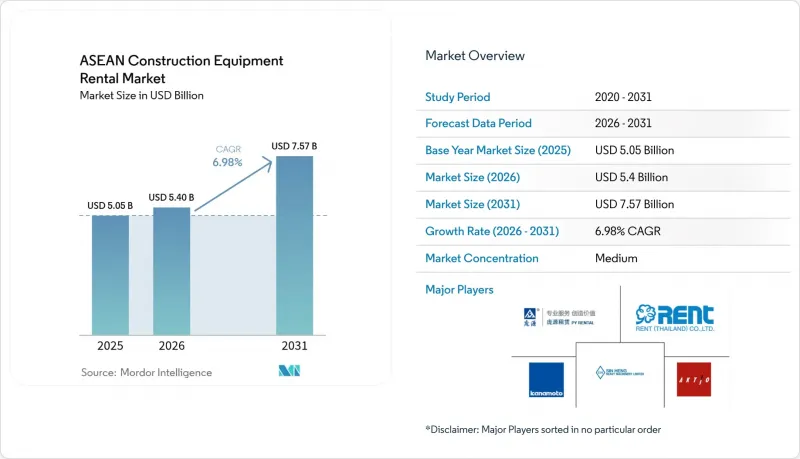
This report is Segmented by Vehicle Type (Earthmoving Equipment and More), Propulsion (IC Engine, Hybrid Drive, and Electric Drive), End-User Industry (Infrastructure, Commercial Real-Estate, and More), Rental Duration (Short-Term and Long-Term), and Geography. The Market Forecasts are Provided in Terms of Value (USD).
ASEAN Construction Equipment Rental Market Trends and Insights
Infrastructure-Led Stimulus Programs
Consistent public spending in the ASEAN construction equipment rental market fuels steady work backlogs in transport, energy, and urban projects. Indonesia's PSN has allocated a significant budget for key initiatives, focusing on roads, ports, and water projects that heavily rely on expansive earthmoving fleets. Vietnam's proactive approach is evident as it has already disbursed a substantial portion of its public-investment budget for the year, a move that bolsters longer rental contracts. Meanwhile, Thailand has earmarked considerable funds for transport links over the next few years, driving up the demand for concrete pavers and compaction equipment. The OECD projects that Indonesia will require a massive investment in climate-resilient infrastructure within the next decade. This forecast highlights the urgency and signals a growing need for specialty machinery, particularly in drainage and flood protection, within rental fleets. Adding to the momentum, the Asian Development Bank points to a significant infrastructure gap across Asia through the decade's end, suggesting a robust, multi-year demand for diversified rental portfolios .
Expansion of Industrial Parks & Logistics Hubs
In recent times, Vietnam has attracted substantial foreign direct investment and initiated the development of a significant logistics space in Bac Ninh. As ASEAN plans to expand its industrial land over the next few years, this ensures a consistent demand for equipment like piling rigs, telehandlers, and temporary power units. Meanwhile, Malaysia and Indonesia are becoming hotspots for electronics assemblers aiming for diversified supply chains, leading to multistage buildouts reliant on adaptable rental agreements. The ASEAN construction equipment rental market is witnessing a surge in demand for precision lifting tools, clean-room compatible gear, and compact earthmovers, fueled by nearshoring and e-commerce-driven warehouse and factory constructions.
Short Project Cycles Causing Utilization Volatility
In the ASEAN construction equipment rental market, construction timelines are compressed, and idle-time spikes emerge, eroding margins. This is due to a combination of stop-start approvals, seasonal monsoons, and financing delays. In Thailand, budget approvals frequently push into the latter part of fiscal quarters. This results in simultaneous mobilizations, putting a strain on rental supply. Recently, a major construction company reported significant profits but fell short of its revenue targets due to delayed project starts, underscoring the volatility's impact on equipment planning. To navigate these challenges, rental companies either maintain larger idle inventories or impose higher premiums during slack periods, ultimately inflating project costs.
Other drivers and restraints analyzed in the detailed report include:
- Growing Contractor Preference for OPEX over CAPEX
- Digital Fleet-Management & Telematics Integration
- Persistently High Import Tariffs on Used Machinery
For complete list of drivers and restraints, kindly check the Table Of Contents.
Segment Analysis
Due to Indonesia's land-development drives and Malaysia's industrial-park grading, earthmoving equipment captured 46.05% of the ASEAN construction equipment rental market in 2025. Concrete and road machinery should post a 7.09% CAGR through 2031 as Thailand's capex push accelerates paving and surface works. Skid-steer and compact track loaders gain favor in Singapore's cramped sites, while vibratory rollers stay essential for expressway sub-grades across Vietnam.
Electric and hybrid powertrains emerge in concrete mixers and small loaders, supported by Singapore's job-site chargers and Thailand's pilot battery-swap depots. Komatsu unit deliveries fell in 2024, yet parts revenue climbed, showing high fleet utilization that sustains aftermarket rentals. Precision lifting cranes support Vietnam's multi-story logistics builds, and demand for specialty dredging excavators rises for Indonesia's flood-control projects.
Internal combustion systems retained a 72.40% share of the ASEAN construction equipment rental market in 2025, as diesel power remains unrivaled for remote or heavy-duty. Electric units, however, are forecast to grow 7.04% CAGR through 2031, led by Singapore mandates for low-emission sites and Thai pilots of battery concrete trucks. Hybrid drives serve bridge applications where long runtimes are essential, yet fuel savings are prized.
Battery density improvements and clustered charging depots allow rental firms to rotate electric fleets efficiently. H&E Equipment Services reports one-third of its active rental units are electric, validating operating-cost savings. Diesel engines stay prevalent in Indonesian mining projects lacking grid power, while gasoline engines shrink to small tools as battery parity approaches.
Complete Report Scope:
- By Vehicle Type
- Earthmoving Equipment
- Excavators
- Loaders
- Bulldozers
- Skid-steer & Compact Track Loaders
- Material Handling Equipment
- Cranes (Crawler, Mobile, Tower)
- Forklifts & Telehandlers
- Concrete & Road Construction Machinery
- Compaction Equipment
- Earthmoving Equipment
- By Propulsion
- IC Engine
- Diesel
- Gasoline
- Hybrid Drive
- Electric Drive
- IC Engine
- By End-User Industry
- Infrastructure
- Commercial Real-Estate
- Industrial & Logistics
- Mining & Quarrying
- Oil & Gas
- Other Specialised Sectors
- By Rental Duration
- Short-term
- Long-term
- By Country
- Indonesia
- Thailand
- Vietnam
- Singapore
- Malaysia
- Philippines
- Cambodia
- Laos
- Myanmar
- Brunei
List of Companies Covered in this Report:
- Kanamoto Co. Ltd
- Aktio Corp.
- Sin Heng Heavy Machinery Ltd
- Nishio Rent All Co. Ltd
- Tat Hong Holdings Ltd
- Guzent Inc.
- Superkrane Mitra Utama
- Rent (Thailand) Co. Ltd
- Asia Machinery Solutions Vietnam Co. Ltd
- Shanghai Pangyuan Machinery Rental Co. Ltd
- United Tractors Tbk
- Hexindo Adiperkasa Tbk
- Multicrane Perkasa
- UMW Equipment Division
- Coates Hire Indonesia
- Multicore Machinery (Philippines)
- Nikken Corporation
- Caterpillar Rental Services (SEA)
- Komatsu Rental Asia
- Zoomlion Leasing (SEA)
Additional Benefits:
- The market estimate (ME) sheet in Excel format
- 3 months of analyst support
TABLE OF CONTENTS
1 Introduction
- 1.1 Study Assumptions & Market Definition
- 1.2 Scope of the Study
2 Research Methodology
3 Executive Summary
4 Market Landscape
- 4.1 Market Overview
- 4.2 Market Drivers
- 4.2.1 Infrastructure-Led Stimulus Programmes
- 4.2.2 Expansion of Industrial Parks & Logistics Hubs
- 4.2.3 Growing Contractor Preference for OPEX Over CAPEX
- 4.2.4 Digital Fleet-Management & Telematics Integration
- 4.2.5 Early-Stage Electrified Equipment Pilots in Singapore & Thailand
- 4.2.6 ESG-Linked Green-Financing Incentives for Rental Fleets
- 4.3 Market Restraints
- 4.3.1 Short Project Cycles Causing Utilization Volatility
- 4.3.2 Persistently High Import Tariffs on Used Machinery
- 4.3.3 Fragmented Equipment-Maintenance Ecosystem
- 4.3.4 Slow Homologation of Battery-Electric Heavy Machines
- 4.4 Value / Supply-Chain Analysis
- 4.5 Regulatory Landscape
- 4.6 Technological Outlook
- 4.7 Porter's Five Forces
- 4.7.1 Threat of New Entrants
- 4.7.2 Bargaining Power of Buyers/Consumers
- 4.7.3 Bargaining Power of Suppliers
- 4.7.4 Threat of Substitute Products
- 4.7.5 Intensity of Competitive Rivalry
5 Market Size & Growth Forecasts (Value (USD))
- 5.1 By Vehicle Type
- 5.1.1 Earthmoving Equipment
- 5.1.1.1 Excavators
- 5.1.1.2 Loaders
- 5.1.1.3 Bulldozers
- 5.1.1.4 Skid-steer & Compact Track Loaders
- 5.1.2 Material Handling Equipment
- 5.1.2.1 Cranes (Crawler, Mobile, Tower)
- 5.1.2.2 Forklifts & Telehandlers
- 5.1.3 Concrete & Road Construction Machinery
- 5.1.4 Compaction Equipment
- 5.1.1 Earthmoving Equipment
- 5.2 By Propulsion
- 5.2.1 IC Engine
- 5.2.1.1 Diesel
- 5.2.1.2 Gasoline
- 5.2.2 Hybrid Drive
- 5.2.3 Electric Drive
- 5.2.1 IC Engine
- 5.3 By End-User Industry
- 5.3.1 Infrastructure
- 5.3.2 Commercial Real-Estate
- 5.3.3 Industrial & Logistics
- 5.3.4 Mining & Quarrying
- 5.3.5 Oil & Gas
- 5.3.6 Other Specialised Sectors
- 5.4 By Rental Duration
- 5.4.1 Short-term
- 5.4.2 Long-term
- 5.5 By Country
- 5.5.1 Indonesia
- 5.5.2 Thailand
- 5.5.3 Vietnam
- 5.5.4 Singapore
- 5.5.5 Malaysia
- 5.5.6 Philippines
- 5.5.7 Cambodia
- 5.5.8 Laos
- 5.5.9 Myanmar
- 5.5.10 Brunei
6 Competitive Landscape
- 6.1 Market Concentration
- 6.2 Strategic Moves
- 6.3 Market Share Analysis
- 6.4 Company Profiles (includes Global Level Overview, Market Level Overview, Core Segments, Financials as Available, Strategic Information, Market Rank/Share for Key Companies, Products and Services, SWOT Analysis, and Recent Developments)
- 6.4.1 Kanamoto Co. Ltd
- 6.4.2 Aktio Corp.
- 6.4.3 Sin Heng Heavy Machinery Ltd
- 6.4.4 Nishio Rent All Co. Ltd
- 6.4.5 Tat Hong Holdings Ltd
- 6.4.6 Guzent Inc.
- 6.4.7 Superkrane Mitra Utama
- 6.4.8 Rent (Thailand) Co. Ltd
- 6.4.9 Asia Machinery Solutions Vietnam Co. Ltd
- 6.4.10 Shanghai Pangyuan Machinery Rental Co. Ltd
- 6.4.11 United Tractors Tbk
- 6.4.12 Hexindo Adiperkasa Tbk
- 6.4.13 Multicrane Perkasa
- 6.4.14 UMW Equipment Division
- 6.4.15 Coates Hire Indonesia
- 6.4.16 Multicore Machinery (Philippines)
- 6.4.17 Nikken Corporation
- 6.4.18 Caterpillar Rental Services (SEA)
- 6.4.19 Komatsu Rental Asia
- 6.4.20 Zoomlion Leasing (SEA)
7 Market Opportunities & Future Outlook
- 7.1 White-space & Unmet-need Assessment

