PUBLISHER: Mordor Intelligence | PRODUCT CODE: 2124038

PUBLISHER: Mordor Intelligence | PRODUCT CODE: 2124038
Smart Beacon - Market Share Analysis, Industry Trends & Statistics, Growth Forecasts (2026 - 2031)
According to Mordor Intelligence, smart beacon market size in 2026 is estimated at USD 5.08 billion, growing from 2025 value of USD 4.2 billion with 2031 projections showing USD 13.07 billion, growing at 20.85% CAGR over 2026-2031.
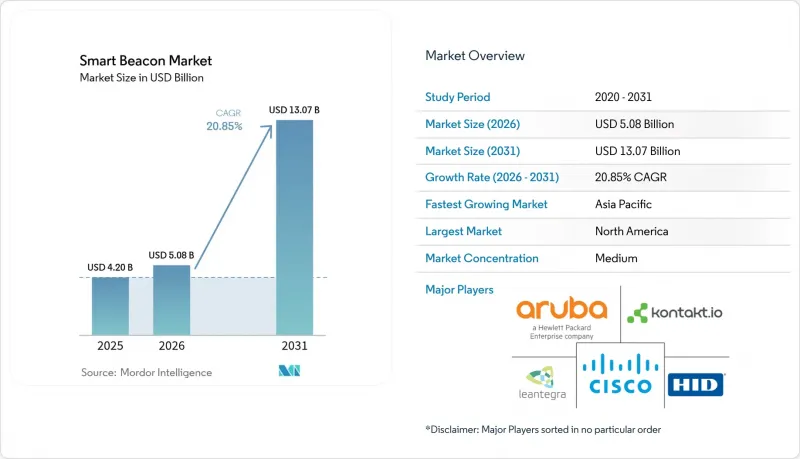
This report Segments by Standard Type (iBeacon, Eddystone and AltBeacon), Connectivity (Bluetooth Low Energy (BLE), Wi-Fi (802. 11mc/FTM) and Ultra-Wideband Assisted), End-User Industry (Retail and Malls, Transportation and Logistics and More), Application (Proximity Marketing and Couponing, Asset and Personnel Tracking and More), and Geography. The Market Forecasts are Provided in Terms of Value (USD).
Global Smart Beacon Market Trends and Insights
Growing Demand for Spatial Analytics in Retail Foot-Fall Optimisation
Retailers have progressed from static heat maps to dynamic orchestration engines that adapt promotions in real time as shoppers dwell near specific shelves. GameStop deployed beacons across 100 stores to surface game-specific content and combat showrooming, translating location cues into targeted upsell prompts. Macy's Black Friday "Walk in and Win" campaign blended digital scratch-off games with in-store positioning, boosting app installs and capturing granular path-to-purchase data. Telstra Retail validated 95% foot-traffic counting accuracy by fusing edge AI with identity masking, satisfying privacy expectations while preserving insight quality. These examples show that differentiated spatial intelligence can raise conversion, manage staffing, and refine assortment decisions, sustaining investment even as overall retail traffic fluctuates.
Surge in Beacon-Enabled Supply-Chain Visibility
Asset visibility has shifted from convenience to operational mandate. Sky Warehouse embeds beacons on cargo pallets to cut search time and prevent misplacement, improving dock-to-dock flow metrics. Beijing's vehicle-road-cloud pilot uses 7,000 5G-A macro cells and dense beacon clusters to orchestrate autonomous freight within logistics parks, proving that centimetre-level indoor accuracy can extend outdoor V2X continuity. Link Labs logged a 30% reduction in equipment search time and 15% fewer duplicate purchases across multi-facility hospital systems after rolling out its beacon-based RTLS platform. Siemens Logistics integrates beacon data with baggage-handling software to balance conveyor load and save energy. These cases underline why supply-chain operators are emerging as a dominant demand pool within the smart beacon market.
Scarcity of Skilled BLE RF Engineers for Large-Scale Rollouts
The United States alone faces a projected 67,000 semiconductor-engineering shortfall by 2030, and BLE RF expertise is among the rarest subsets. McKinsey notes that only 43,500 of the 48,000 new technician roles needed by 2030 may be filled, creating a bottleneck that inflates project timelines and wages. A 2024 workforce survey found 53% of semiconductor employees contemplating resignation within six months, compounding churn. Beacon rollouts in hospitals or factories require precise antenna tuning, channel-interference mitigation, and power calibration that automated design tools cannot yet replicate. Vendors struggling to secure seasoned RF talent risk cost overruns and client dissatisfaction, limiting near-term uptake despite robust underlying demand.
Other drivers and restraints analyzed in the detailed report include:
- Energy-Harvesting, Battery-Free Beacons Cut Lifetime TCO
- Integration with Matter and Unified Smart-Building Protocols
- Privacy-by-Design Mandates Restrict Passive Data Capture
For complete list of drivers and restraints, kindly check the Table Of Contents.
Segment Analysis
iBeacon accounted for 60.35% of 2025 revenue, reflecting Apple's early push and embedded support within its mobile OS ecosystem. Eddystone, however, is growing at a 27.12% CAGR as enterprises favour Google's web-centric Physical Web model that removes the friction of mandatory app downloads. The smart beacon market size for Eddystone deployments is forecast to expand sharply as building-management platforms embed native support and as Matter bridges multiple radio stacks. AltBeacon maintains a loyal base among industrial users seeking vendor-neutral frameworks.
A deeper look reveals platform strategy is the true differentiator. Apple's consolidation of Ultra-Wideband and BLE in a single radio front end enables secure access control and spatial computing scenarios unavailable when iBeacon launched. Google counters by making broadcast URLs discoverable in Chrome and Android Quick Settings, empowering public-space operators to push context without cultivating native apps. This dual trajectory encourages enterprises to adopt multi-standard stacks, intensifying demand for gateway devices that translate among iBeacon, Eddystone, and AltBeacon payloads inside the broader smart beacon market.
Bluetooth Low Energy retained 81.20% market share in 2025 thanks to unrivalled chipset availability and sub-milliwatt power draw that keeps battery-based tags alive for years. Yet Wi-Fi 802.11mc fine-time-measurement is rising at a 28.67% CAGR as hospitals, airports, and warehouses seek centimetres-grade accuracy without deploying additional radios; existing Wi-Fi access points only need firmware upgrades. The smart beacon market share for BLE will remain the largest through 2031, but its dominance will narrow as hybrid BLE + Wi-Fi tags proliferate.
Ultra-Wideband plays a specialist role where security and sub-10 cm accuracy justify higher bill-of-materials, such as infant-abduction prevention or automated guided vehicles. Meanwhile, Bluetooth SIG's new channel-sounding extension promises sub-meter precision over standard BLE, blunting Wi-Fi's accuracy advantage. Connectivity decisions now revolve around latency tolerance, battery life expectations, and capital budget rather than any single protocol's technical merit, diversifying revenue streams within the smart beacon market.
Complete Report Scope:
- By Standard Type
- iBeacon
- Eddystone
- AltBeacon
- By Connectivity
- Bluetooth Low Energy (BLE)
- Wi-Fi (802.11mc/FTM)
- Ultra-Wideband Assisted
- By Application
- Proximity Marketing and Couponing
- Indoor Navigation and Way-finding
- Asset and Personnel Tracking
- Occupancy and Environment Monitoring
- By End-User Industry
- Retail and Malls
- Transportation and Logistics
- Aviation and Airports
- Healthcare Facilities
- Sports and Entertainment Venues
- Automotive OEMs
- Smart Construction Sites
- By Geography
- North America
- United States
- Canada
- Mexico
- Europe
- Germany
- United Kingdom
- France
- Rest of Europe
- Asia-Pacific
- China
- Japan
- South Korea
- Australia
- Rest of Asia-Pacific
- South America
- Brazil
- Argentina
- Rest of South America
- Middle East and Africa
- Middle East
- Saudi Arabia
- United Arab Emirates
- Rest of Middle East
- Africa
- South Africa
- Kenya
- Nigeria
- Rest of Africa
- Middle East
- North America
Geography Analysis
North America captured 33.10% of global revenue in 2025 on the back of early retail rollouts and stringent healthcare compliance that mandates asset location auditing. United States hospitals such as Stanford Health integrate beacons with nurse-call platforms to automate staff-response metrics, while Canadian smart-building retrofits in Toronto and Vancouver leverage beacons to synchronize HVAC and lighting for LEED certifications. Adoption remains steady, though privacy legislation and iOS background-scanning limits may temper growth relative to emerging regions.
Asia-Pacific posts the fastest 24.05% CAGR through 2031. China's 500-plus smart-city pilots integrate 2.57 billion IoT endpoints that anchor dense beacon meshes for public transit, safety monitoring, and retail analytics. South Korea's USD 4.6 billion Smart K-Cities initiative and 48 private 5G networks deliver low-latency backbones ideal for centimeter-grade positioning. Japan's medical MaaS segment, valued at JPY 17.6 billion (USD 117 million) in 2025, exemplifies healthcare-focused demand. Combined, these factors place Asia-Pacific at the forefront of scaling the smart beacon market.
Europe advances on the strength of privacy-compliant smart-building investments. Germany pushes factory digitalization under Industrie 4.0, deploying beacons in intralogistics zones, while the United Kingdom retrofits historical infrastructure with Bluetooth-based visitor guidance tools that respect GDPR. The EU's Cyber Resilience Act sets a harmonized security baseline that vendors must meet, raising entry thresholds but also building trust in mission-critical deployments. Collectively, these trajectories ensure balanced global contributions while confirming Asia-Pacific as the growth engine.
- Aruba Networks Hewlett Packard Enterprise Development LP
- Cisco Systems Inc.
- HID Global Corporation
- Kontakt.io Inc.
- Gimbal Inc.
- Accent Systems S.L.
- Sensoro Co., Ltd.
- Fujitsu Components Ltd.
- Jaalee Technology Co., Ltd.
- Estimote Inc.
- BlueCats Pty Ltd.
- Radius Networks Inc.
- Quuppa Oy
- BlueVision Wireless Ltd.
- Wiliot Inc.
- Minew Technologies Co., Ltd.
- Onyx Beacon Inc.
- Beaconinside GmbH
- Zebra Technologies Corporation
- Samsung Electronics Co., Ltd. (SmartThings)
Additional Benefits:
- The market estimate (ME) sheet in Excel format
- 3 months of analyst support
TABLE OF CONTENTS
1 INTRODUCTION
- 1.1 Study Assumptions and Market Definition Scope of the Study
2 RESEARCH METHODOLOGY
3 EXECUTIVE SUMMARY
4 MARKET LANDSCAPE
- 4.1 Market Overview
- 4.2 Market Drivers
- 4.2.1 Growing demand for spatial analytics in retail foot-fall optimisation
- 4.2.2 Surge in beacon-enabled supply-chain visibility (logistics, aviation)
- 4.2.3 Energy-harvesting, battery-free beacons cut lifetime TCO (under-reported)
- 4.2.4 Integration with Matter and unified smart-building protocols (under-reported)
- 4.3 Market Restraints
- 4.3.1 Scarcity of skilled BLE RF engineers for large-scale roll-outs
- 4.3.2 Privacy-by-design mandates restrict passive data capture
- 4.3.3 2.4 GHz spectrum congestion in dense IoT estates (under-reported)
- 4.3.4 Slow OS-level support for background scanning post-iOS 15 (under-reported)
- 4.4 Value / Supply-Chain Analysis
- 4.5 Regulatory Landscape
- 4.6 Technological Outlook
- 4.7 Porter's Five Forces Analysis
- 4.7.1 Threat of New Entrants
- 4.7.2 Bargaining Power of Buyers/Consumers
- 4.7.3 Bargaining Power of Suppliers
- 4.7.4 Threat of Substitute Products
- 4.7.5 Intensity of Competitive Rivalry
5 MARKET SIZE AND GROWTH FORECASTS (VALUE)
- 5.1 By Standard Type
- 5.1.1 iBeacon
- 5.1.2 Eddystone
- 5.1.3 AltBeacon
- 5.2 By Connectivity
- 5.2.1 Bluetooth Low Energy (BLE)
- 5.2.2 Wi-Fi (802.11mc/FTM)
- 5.2.3 Ultra-Wideband Assisted
- 5.3 By Application
- 5.3.1 Proximity Marketing and Couponing
- 5.3.2 Indoor Navigation and Way-finding
- 5.3.3 Asset and Personnel Tracking
- 5.3.4 Occupancy and Environment Monitoring
- 5.4 By End-User Industry
- 5.4.1 Retail and Malls
- 5.4.2 Transportation and Logistics
- 5.4.3 Aviation and Airports
- 5.4.4 Healthcare Facilities
- 5.4.5 Sports and Entertainment Venues
- 5.4.6 Automotive OEMs
- 5.4.7 Smart Construction Sites
- 5.5 By Geography
- 5.5.1 North America
- 5.5.1.1 United States
- 5.5.1.2 Canada
- 5.5.1.3 Mexico
- 5.5.2 Europe
- 5.5.2.1 Germany
- 5.5.2.2 United Kingdom
- 5.5.2.3 France
- 5.5.2.4 Rest of Europe
- 5.5.3 Asia-Pacific
- 5.5.3.1 China
- 5.5.3.2 Japan
- 5.5.3.3 South Korea
- 5.5.3.4 Australia
- 5.5.3.5 Rest of Asia-Pacific
- 5.5.4 South America
- 5.5.4.1 Brazil
- 5.5.4.2 Argentina
- 5.5.4.3 Rest of South America
- 5.5.5 Middle East and Africa
- 5.5.5.1 Middle East
- 5.5.5.1.1 Saudi Arabia
- 5.5.5.1.2 United Arab Emirates
- 5.5.5.1.3 Rest of Middle East
- 5.5.5.2 Africa
- 5.5.5.2.1 South Africa
- 5.5.5.2.2 Kenya
- 5.5.5.2.3 Nigeria
- 5.5.5.2.4 Rest of Africa
- 5.5.5.1 Middle East
- 5.5.1 North America
6 COMPETITIVE LANDSCAPE
- 6.1 Market Concentration
- 6.2 Strategic Moves
- 6.3 Market Share Analysis
- 6.4 Company Profiles (includes Global level Overview, Market level overview, Core Segments, Financials as available, Strategic Information, Market Rank/Share for key companies, Products and Services, and Recent Developments)
- 6.4.1 Aruba Networks Hewlett Packard Enterprise Development LP
- 6.4.2 Cisco Systems Inc.
- 6.4.3 HID Global Corporation
- 6.4.4 Kontakt.io Inc.
- 6.4.5 Gimbal Inc.
- 6.4.6 Accent Systems S.L.
- 6.4.7 Sensoro Co., Ltd.
- 6.4.8 Fujitsu Components Ltd.
- 6.4.9 Jaalee Technology Co., Ltd.
- 6.4.10 Estimote Inc.
- 6.4.11 BlueCats Pty Ltd.
- 6.4.12 Radius Networks Inc.
- 6.4.13 Quuppa Oy
- 6.4.14 BlueVision Wireless Ltd.
- 6.4.15 Wiliot Inc.
- 6.4.16 Minew Technologies Co., Ltd.
- 6.4.17 Onyx Beacon Inc.
- 6.4.18 Beaconinside GmbH
- 6.4.19 Zebra Technologies Corporation
- 6.4.20 Samsung Electronics Co., Ltd. (SmartThings)
7 MARKET OPPORTUNITIES AND FUTURE OUTLOOK
- 7.1 White-space and Unmet-Need Assessment

