PUBLISHER: Mordor Intelligence | PRODUCT CODE: 2124041

PUBLISHER: Mordor Intelligence | PRODUCT CODE: 2124041
Wireless Testing - Market Share Analysis, Industry Trends & Statistics, Growth Forecasts (2026 - 2031)
According to Mordor Intelligence, the wireless testing market size is expected to grow from USD 16.19 billion in 2025 to USD 18.16 billion in 2026 and is forecast to reach USD 32.29 billion by 2031 at 12.18% CAGR over 2026-2031.
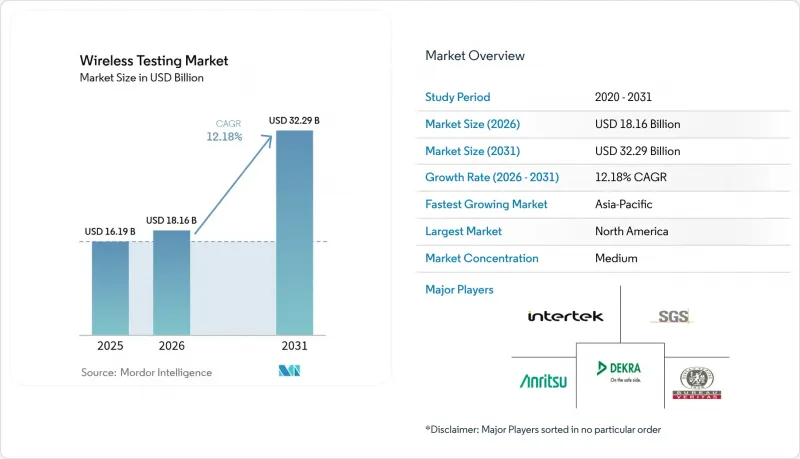
This report is Segmented by Offering (Equipment [Wireless Device Testing and Wireless Network Testing] and Services), Technology (Bluetooth, Wi-Fi, GPS/GNSS, 4G/LTE, 5G, and Other [2G, 3G, Zigbee, UWB Etc. ]), Application (Consumer Electronics, Automotive, IT and Telecommunication, Energy and Power, Medical Devices, Aerospace and Defense, Other Applications), and Geography
Global Wireless Testing Market Trends and Insights
Rapid Expansion of 5G Infrastructure
Global operators plan to invest USD 259 billion in 5G roll-outs across Asia-Pacific alone by 2030, pushing the wireless testing market toward ultra-wideband, multi-antenna calibration environments that can benchmark massive-MIMO throughput and beam-forming accuracy in near-real time. Japan's NTT DOCOMO, KDDI, and SoftBank together budget more than USD 13 billion to reach nationwide population coverage, forcing test labs to simulate network-slicing latency and Open RAN interoperability within temperature-controlled chambers that mirror local climatic extremes. These operators now demand holistic validation that covers RF metrics, cloud-native core integration, and service-level key performance indicators. Vendors able to blend channel emulation, traffic generation, and cybersecurity scanning inside a single over-the-air test cycle are capturing premium contracts. As 5G-Advanced capabilities such as non-terrestrial networking materialize, scenario-based testing that blends satellite and terrestrial links is becoming table-stakes, pulling fresh revenue into the wireless testing market.
AI-Driven Self-Healing Networks Needing Predictive Test Analytics
Network orchestration suites now embed large-language-model agents that autonomously tune cell parameters, recover from outages, and reroute traffic, all without human triggers. Test strategies, therefore, pivot from static regression scripts to behavioural prediction under stochastic traffic loads. VIAVI Solutions and Northeastern University illustrate this shift by running a city-scale digital twin that spots anomalies minutes before they degrade throughput. Certification workflows must certify AI decision-paths, training-data integrity, and model bias across thousands of simulated failure events. This complexity lifts average engagement sizes, with buyers asking for continuous validation as a service rather than once-off device approvals. Providers that combine hardware-in-the-loop, containerized emulation, and explainable-AI dashboards are driving new benchmarks for wireless testing market competitiveness.
High Cost of Advanced Test Equipment and Skilled Labour
Advanced 5G channel emulators and millimeter-wave signal generators now surpass USD 1 million per station, with lifetime support contracts adding 40% to ownership cost over five years. As test complexity rises, certified RF engineers command six-figure salaries that many domestic labs in emerging economies cannot match. Market leaders such as Keysight generated USD 4.98 billion in fiscal 2024 revenue, underscoring scale advantages that allow bulk component sourcing and multi-site asset utilization. Smaller competitors left to rent time on shared chambers face thin margins and elongated payback periods. This cost asymmetry encourages industry consolidation, with acquisition-driven platforms integrating regional labs into global networks to pool talent and equipment.
Other drivers and restraints analyzed in the detailed report include:
- Growing Demand for Cloud Computing and IoT Devices
- Surge in Private 5G/Industrial Wireless Networks
- RF-Component Supply-Chain Volatility Delaying Calibration Cycles
For complete list of drivers and restraints, kindly check the Table Of Contents.
Segment Analysis
Equipment generated USD 11.5 billion in 2025, equal to 71.02% of wireless testing market share, but its grip is loosening as managed testing services outpace at an 11.05% CAGR through 2031. Capital-intensive signal generators, over-the-air chambers, and channel emulators form the backbone of every lab, yet buyers increasingly question ownership when firmware refresh cycles arrive annually. The wireless testing market size attributable to managed services will therefore close the gap as customers prioritize fast certification turnarounds over capital budgets. Tier-one vendors help this transition by bundling cloud-linked analytics dashboards, enabling remote monitoring of pass-fail metrics in near real time. In parallel, government-funded facilities such as the USD 21.7 million VALOR lab in Arizona open subscription-based access to specialty Open-RAN interoperability suites, accelerating the shift toward outcome-based engagements. For equipment makers, rental programs and usage-based pricing mitigate cannibalization while keeping utilization rates high.
Professional service providers leverage AI-assisted test-script generation and automated report templates to slash project cycle times. This agility resonates with start-ups launching multi-standard IoT gadgets that must secure global market entry within months. Meanwhile, established handset brands still purchase top-end gear to protect intellectual property, ensuring the equipment segment retains sizable absolute revenue even as its share declines. Overall, dual-track demand sustains the wireless testing market while encouraging hybrid business models that blend hardware leasing, managed compliance, and continuous regression testing on shared infrastructure.
Complete Report Scope:
- By Offering
- Equipment
- Wireless Device Testing
- Oscilloscopes
- Signal Generators
- Spectrum Analysers
- Network Analysers
- Wireless Network Testing
- Network Testers
- Network Scanners
- OTA Testers
- Wireless Device Testing
- Services
- Testing and Certification
- Managed Testing Services
- Calibration and Support
- Equipment
- By Technology
- Bluetooth
- Wi-Fi
- GPS/GNSS
- 4G/LTE
- 5G
- Other (2G, 3G, Zigbee, UWB etc.)
- By Application
- Consumer Electronics
- Automotive
- IT and Telecommunication
- Energy and Power
- Medical Devices
- Aerospace and Defence
- Other Applications
- By Geography
- North America
- United States
- Canada
- Mexico
- South America
- Brazil
- Argentina
- Rest of South America
- Europe
- Germany
- United Kingdom
- France
- Italy
- Spain
- Russia
- Rest of Europe
- Asia-Pacific
- China
- India
- Japan
- South Korea
- Rest of Asia-Pacific
- Middle East and Africa
- Middle East
- GCC
- Turkey
- Rest of Middle East
- Africa
- South Africa
- Egypt
- Nigeria
- Rest of Africa
- Middle East
- North America
Geography Analysis
North America commanded 32.18% revenue in 2025 thanks to early 5G rollouts, large defense budgets, and an entrenched ecosystem of tier-one equipment vendors. Keysight's USD 4.98 billion 2024 revenue underlines the depth of local R&D expenditure that continually spins off next-generation oscilloscopes and channel emulators. Federal support strengthens domestic labs, exemplified by the National Telecommunications and Information Administration backing VIAVI's Open-RAN test center with USD 21.7 million, guaranteeing local access to future-proof validation environments. Automotive and aerospace primes further amplify demand by integrating secure private 5G networks inside production campuses, a trend that funnels complex compliance projects into regional service providers.
Asia-Pacific is shaping up as the fastest-growing territory, with a projected 12.63% CAGR. China Mobile, China Unicom, and China Telecom together plan more than USD 3 billion in 5G-Advanced upgrades during 2025, including 400,000 base-station refits that each require acceptance measurements for beamforming and edge-computing latency. Japan's operators allocate an additional USD 14 billion for dense-urban coverage and Open-RAN pilots, creating parallel streams of lab and field-test activity. Manufacturing-heavy economies such as South Korea and Taiwan overlay private mid-band grids across chip fabs, spawning intricate coexistence checks between Wi-Fi 7, 5G, and industrial TSN protocols. Consequently, regional certification houses invest in multi-standard chambers and AI-enabled log-analysis engines to absorb surging workload, ensuring the wireless testing market maintains double-digit growth.
Europe retains a pivotal role by anchoring global regulatory frameworks. The Radio Equipment Directive's August 2025 cybersecurity clauses mandate security vetting alongside RF and EMC checks, broadening test engagement scope and extending project timetables. Germany hosts leading manufacturers such as Rohde & Schwarz, which reported EUR 2.93 billion (USD 3.13 billion) in fiscal 2024 revenue and continues expanding turnkey Bluetooth and Wi-Fi suites. Nordic countries pioneer private 5G ports and mining sites, stimulating over-the-air interference studies under arctic conditions. Southern Europe accelerates smart-meter deployments, linking energy-sector needs with telecom test architectures. Together, these initiatives stabilize European demand and feed global standardization efforts that ultimately harmonize testing criteria, benefiting the wider wireless testing market.
- Keysight Technologies Inc.
- Rohde and Schwarz GmbH and Co KG
- Anritsu Corporation
- VIAVI Solutions Inc.
- SGS SA
- Bureau Veritas SA
- Intertek Group plc
- DEKRA SE
- UL Solutions Inc.
- TUV SUD AG
- TUV Rheinland AG
- TUV Nord AG
- National Instruments (NI)
- Spirent Communications plc
- Teledyne LeCroy Inc.
- Fortive (Tektronix)
- EXFO Inc.
- LitePoint (Teradyne)
- Cobham Limited
- Emite
- Tektronix
Additional Benefits:
- The market estimate (ME) sheet in Excel format
- 3 months of analyst support
TABLE OF CONTENTS
1 INTRODUCTION
- 1.1 Study Assumptions and Market Definition
- 1.2 Scope of the Study
2 RESEARCH METHODOLOGY
3 EXECUTIVE SUMMARY
4 MARKET LANDSCAPE
- 4.1 Market Overview
- 4.2 Market Drivers
- 4.2.1 Increasing adoption of smartphones and smart wearables
- 4.2.2 Growing demand for cloud computing and IoT devices
- 4.2.3 Rapid expansion of 5G infrastructure
- 4.2.4 Regulatory mandates for device certification and safety
- 4.2.5 Surge in private 5G/industrial wireless networks
- 4.2.6 AI-driven self-healing networks needing predictive test analytics
- 4.3 Market Restraints
- 4.3.1 Lack of standardisation in connectivity protocols
- 4.3.2 High cost of advanced test equipment and skilled labour
- 4.3.3 RF-component supply-chain volatility delaying calibration cycles
- 4.3.4 Heightened cybersecurity compliance lengthening test approvals
- 4.4 Value/Supply-Chain Analysis
- 4.5 Regulatory Landscape
- 4.6 Technological Outlook
- 4.6.1 6G, AI-based automation, digital twins
- 4.7 Porter's Five Forces Analysis
- 4.7.1 Bargaining Power of Suppliers
- 4.7.2 Bargaining Power of Consumers
- 4.7.3 Threat of New Entrants
- 4.7.4 Threat of Substitutes
- 4.7.5 Intensity of Competitive Rivalry
- 4.8 Impact of COVID-19 and macro-economic shocks
5 MARKET SIZE AND GROWTH FORECASTS (VALUE)
- 5.1 By Offering
- 5.1.1 Equipment
- 5.1.1.1 Wireless Device Testing
- 5.1.1.1.1 Oscilloscopes
- 5.1.1.1.2 Signal Generators
- 5.1.1.1.3 Spectrum Analysers
- 5.1.1.1.4 Network Analysers
- 5.1.1.2 Wireless Network Testing
- 5.1.1.2.1 Network Testers
- 5.1.1.2.2 Network Scanners
- 5.1.1.2.3 OTA Testers
- 5.1.1.1 Wireless Device Testing
- 5.1.2 Services
- 5.1.2.1 Testing and Certification
- 5.1.2.2 Managed Testing Services
- 5.1.2.3 Calibration and Support
- 5.1.1 Equipment
- 5.2 By Technology
- 5.2.1 Bluetooth
- 5.2.2 Wi-Fi
- 5.2.3 GPS/GNSS
- 5.2.4 4G/LTE
- 5.2.5 5G
- 5.2.6 Other (2G, 3G, Zigbee, UWB etc.)
- 5.3 By Application
- 5.3.1 Consumer Electronics
- 5.3.2 Automotive
- 5.3.3 IT and Telecommunication
- 5.3.4 Energy and Power
- 5.3.5 Medical Devices
- 5.3.6 Aerospace and Defence
- 5.3.7 Other Applications
- 5.4 By Geography
- 5.4.1 North America
- 5.4.1.1 United States
- 5.4.1.2 Canada
- 5.4.1.3 Mexico
- 5.4.2 South America
- 5.4.2.1 Brazil
- 5.4.2.2 Argentina
- 5.4.2.3 Rest of South America
- 5.4.3 Europe
- 5.4.3.1 Germany
- 5.4.3.2 United Kingdom
- 5.4.3.3 France
- 5.4.3.4 Italy
- 5.4.3.5 Spain
- 5.4.3.6 Russia
- 5.4.3.7 Rest of Europe
- 5.4.4 Asia-Pacific
- 5.4.4.1 China
- 5.4.4.2 India
- 5.4.4.3 Japan
- 5.4.4.4 South Korea
- 5.4.4.5 Rest of Asia-Pacific
- 5.4.5 Middle East and Africa
- 5.4.5.1 Middle East
- 5.4.5.1.1 GCC
- 5.4.5.1.2 Turkey
- 5.4.5.1.3 Rest of Middle East
- 5.4.5.2 Africa
- 5.4.5.2.1 South Africa
- 5.4.5.2.2 Egypt
- 5.4.5.2.3 Nigeria
- 5.4.5.2.4 Rest of Africa
- 5.4.5.1 Middle East
- 5.4.1 North America
6 COMPETITIVE LANDSCAPE
- 6.1 Market Concentration
- 6.2 Strategic Moves
- 6.3 Market Share Analysis
- 6.4 Company Profiles (includes Global level Overview, Market level overview, Core Segments, Financials as available, Strategic Information, Market Rank/Share for key companies, Products and Services, and Recent Developments)
- 6.4.1 Keysight Technologies Inc.
- 6.4.2 Rohde and Schwarz GmbH and Co KG
- 6.4.3 Anritsu Corporation
- 6.4.4 VIAVI Solutions Inc.
- 6.4.5 SGS SA
- 6.4.6 Bureau Veritas SA
- 6.4.7 Intertek Group plc
- 6.4.8 DEKRA SE
- 6.4.9 UL Solutions Inc.
- 6.4.10 TUV SUD AG
- 6.4.11 TUV Rheinland AG
- 6.4.12 TUV Nord AG
- 6.4.13 National Instruments (NI)
- 6.4.14 Spirent Communications plc
- 6.4.15 Teledyne LeCroy Inc.
- 6.4.16 Fortive (Tektronix)
- 6.4.17 EXFO Inc.
- 6.4.18 LitePoint (Teradyne)
- 6.4.19 Cobham Limited
- 6.4.20 Emite
- 6.4.21 Tektronix
7 MARKET OPPORTUNITIES AND FUTURE OUTLOOK
- 7.1 White-space and Unmet-need Assessment

