PUBLISHER: Mordor Intelligence | PRODUCT CODE: 2124045

PUBLISHER: Mordor Intelligence | PRODUCT CODE: 2124045
Smart Greenhouse - Market Share Analysis, Industry Trends & Statistics, Growth Forecasts (2026 - 2031)
According to Mordor Intelligence, the smart greenhouse market size was valued at USD 2.04 billion in 2025 and is estimated to grow from USD 2.23 billion in 2026 to reach USD 3.38 billion by 2031, at a CAGR of 8.67% during the forecast period (2026-2031).
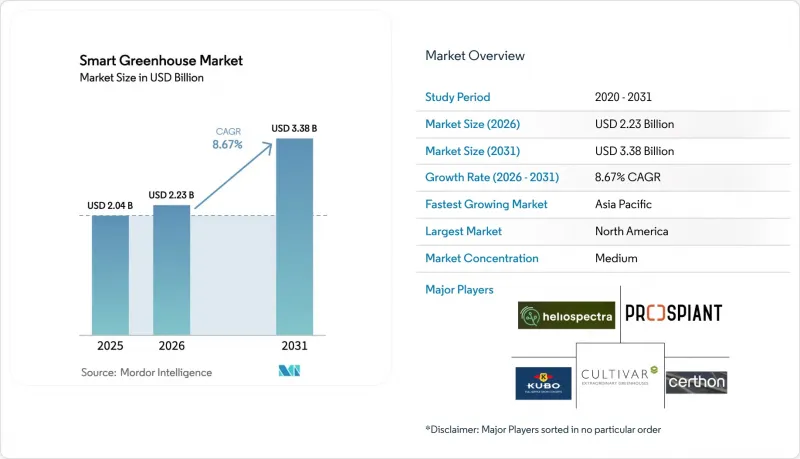
This report is Segmented by Type (Hydroponic, and Non-Hydroponic), Technology (LED Grow Lights, HVAC and Climate Control, Material Handling and Robotics, Control Systems and Analytics Platforms, and Others), Offering (Hardware, Software, and Services), End-User (Commercial Growers, Research and Academic Institutes, and More), and Geography. The Market Forecasts are Provided in Terms of Value (USD).
Global Smart Greenhouse Market Trends and Insights
Rapid IoT and AI Integration in Controlled-Environment Agriculture
Edge-processed sensor data now enables sub-minute climate adjustments, materially lowering crop-stress episodes and labour inputs. Argus Control Systems' Axia platform, operational since 2025, demonstrates how on-premises analytics reduce network latency and energy peaks. Priva's Connected installations surpassed 500 commercial sites by late 2025, combining weather-based forecasting with fertigation algorithms that cut water use by 30%. The International Energy Agency quantified a 15-25% greenhouse gas energy saving from AI-driven optimization in its 2025 assessment. These gains arrive alongside rising cybersecurity awareness; an IEEE study in 2025 highlighted unencrypted sensor gateways as a growing risk vector. Growers now segment operational-technology networks and adopt ISO 27001 controls, strengthening the long-term attractiveness of data-centric platforms.
Escalating Demand for Pesticide-Free Produce
Retail buyers in the United States, Germany, and France are prioritizing pesticide-free certification as residue-testing coverage widens. Controlled-environment agriculture can virtually eliminate soil-borne pathogens, aligning with the European Union mandate to halve chemical pesticide application by 2030. The Food and Agriculture Organization confirmed near-zero pesticide profiles for hydroponic lettuce, tomato, and strawberry crops in its 2024 technical note. Supermarkets refine category margins by positioning greenhouse vegetables as premium, gaining 20-40% price uplift versus field-grown equivalents. Urban centers where farmers' markets are scarce further accelerate this trend, sustaining premium elasticity despite broader inflationary pressure.
High Upfront Capital Expenditure for Smart Facilities
Fully automated smart greenhouses cost as much as USD 1,500 per square meter once HVAC, LEDs, fertigation, and analytics are included. Traditional lenders hesitate in emerging markets where payback periods stretch beyond seven years. The International Finance Corporation highlighted lease-to-own contracts and revenue-sharing structures as alternate pathways but noted that supportive legal frameworks remain patchy. Energy intensity adds further uncertainty; a temperate-zone hectare may draw 300 MWh annually, exposing growers to volatile tariff regimes.
Other drivers and restraints analyzed in the detailed report include:
- Population-Driven Food-Supply Gap
- Urban-Centric Vertical-Farming Investments
- Scarcity Of Greenhouse-Automation Talent
For complete list of drivers and restraints, kindly check the Table Of Contents.
Segment Analysis
Hydroponic configurations accounted for 57.23% of the smart greenhouse market share in 2025, reflecting their ability to recycle up to 90% of irrigation water in desert and Mediterranean climates. The smart greenhouse market size for hydroponic systems is projected to widen at a 9.79% CAGR through 2031 on the back of subsidies in the Middle East and Southern Europe. Netafim reported 12,000 hectares of hydroponic deployments worldwide by the end of 2025, with particularly swift uptake in the United Arab Emirates where water costs exceed USD 2 per m3. Soil-based and hybrid models persist in organic-certified farms and research institutes analyzing soil microbiomes, yet they incur higher hand-weeding and pest-management bills. Aeroponics, which suspends roots in nutrient mist, promises an incremental 25% water saving but remains niche due to equipment complexity and elevated power draw.
Hydroponic adoption also benefits from reduced regulatory burden. Under the European Union Sustainable Use of Pesticides Directive, closed-loop nutrient systems enjoy simplified reporting obligations compared with soil cultivation, trimming compliance costs. In parallel, venture capital directed toward aeroponic and aquaponic start-ups exceeded USD 200 million in 2025, signalling investor confidence that water-centric formats will underpin the next wave of high-density urban production.
LED grow lights captured 38.56% of technology revenue in 2025, yet the strongest growth to 2031 will stem from control systems and analytics platforms, projected at 10.31% CAGR. The smart greenhouse market size attached to decision-support software has expanded as growers digitize pest-scouting, weather forecasting, and energy management. Priva's Blue ID controller links climate sensors, fertigation pumps, and smart meters under a single dashboard and trimmed disease-related crop loss by 18% in Dutch trials. Meanwhile, Signify's tuneable-spectrum LEDs lifted tomato yields by 12% in Wageningen University tests, illustrating hardware's continual but incremental impact. Robotics for transplanting and harvesting remain at pilot stage yet promise labour savings once unit costs fall below USD 45,000 per robot.
A convergent trend sees growers embracing standardized communication protocols such as MQTT and OPC-UA, which allow plug-and-play integration of disparate sensors, HVAC drives, and lighting arrays. As interoperability grows, the competitive edge shifts from individual components to the cohesiveness of the full data loop, reinforcing the premium placed on robust analytics suites.
Complete Report Scope:
- By Type
- Hydroponic
- Non-Hydroponic (Soil-Based and Others)
- By Technology
- LED Grow Lights
- HVAC and Climate Control
- Material Handling and Robotics
- Control Systems and Analytics Platforms
- Other Technologies
- By Offering
- Hardware
- Software
- Services (Integration, Maintenance, Training)
- By End-User
- Commercial Growers
- Research and Academic Institutes
- Retail/Community Gardens
- Urban/Vertical Farms
- By Geography
- North America
- United States
- Canada
- Mexico
- South America
- Brazil
- Argentina
- Rest of South America
- Europe
- United Kingdom
- Germany
- France
- Italy
- Spain
- Rest of Europe
- Asia Pacific
- China
- Japan
- India
- South Korea
- Australia
- Rest of Asia Pacific
- Middle East and Africa
- Middle East
- Saudi Arabia
- United Arab Emirates
- Turkey
- Rest of Middle East
- Africa
- South Africa
- Egypt
- Nigeria
- Rest of Africa
- Middle East
- North America
Geography Analysis
Asia Pacific will pace global expansion with a 10.53% CAGR to 2031, propelled by China's CNY 10 billion subsidy program for peri-urban smart greenhouses. Japan supplies 15% of domestic lettuce demand via plant factories situated within metropolitan rings, while India incentivizes polyhouse upgrades through the National Horticulture Mission.
North America, holding 34.79% revenue in 2025, benefits from cannabis legalization and consumer preference for locally grown vegetables. The United States Department of Agriculture documented an 18% uptick in controlled-environment acreage from 2022-2025. Canada's CAD 50 million (USD 37 million) Greenhouse Innovation Fund supports heat-recovery retrofits aimed at cutting natural-gas use by 25% by 2030.
Europe's mature supply chains center on the Netherlands, which exported EUR 9.2 billion (USD 10.1 billion) in greenhouse produce during 2024. Energy-price volatility after 2025 accelerated the adoption of geothermal wells and heat-storage aquifers. South America's growth is moderate, led by Brazilian and Argentine operators battling erratic rainfall. The Middle East and Africa remain smaller yet strategically vital: Saudi Arabia's National Center for Agriculture Technologies is piloting solar-desalination greenhouses to cut water usage below 5 L kg-1 of produce.
- Heliospectra AB
- Prospiant Inc.
- Cultivar Greenhouse Ltd
- Kubo Greenhouse Projects BV
- Certhon Group
- Argus Control Systems Ltd
- Netafim Ltd
- Sensaphone Inc.
- Luiten Greenhouses
- Agra Tech Inc.
- Greenhouse Megastore (BFG Supply)
- Logiqs B.V.
- Priva Holding BV
- Nexus Corporation
- Greentech Agro LLC
- Ridder Group
- Motorleaf
- Autogrow Systems Ltd
- Signify N.V.
- LumiGrow Inc.
Additional Benefits:
- The market estimate (ME) sheet in Excel format
- 3 months of analyst support
TABLE OF CONTENTS
1 INTRODUCTION
- 1.1 Study Assumptions and Market Definition
- 1.2 Scope of the Study
2 RESEARCH METHODOLOGY
3 EXECUTIVE SUMMARY
4 MARKET LANDSCAPE
- 4.1 Market Overview
- 4.2 Market Drivers
- 4.2.1 Rapid IoT and AI Integration in Controlled-Environment Agriculture
- 4.2.2 Escalating Demand for Pesticide-Free Produce
- 4.2.3 Population-Driven Food-Supply Gap
- 4.2.4 Urban-Centric Vertical-Farming Investments
- 4.2.5 Solar-Powered Greenhouse Micro-Grids Slash Operating Costs
- 4.2.6 Carbon-Credit Programmes Rewarding CEA Efficiency
- 4.3 Market Restraints
- 4.3.1 High Upfront Capital Expenditure for Smart Facilities
- 4.3.2 Scarcity of Greenhouse-Automation Talent
- 4.3.3 Battery-Supply Volatility for Off-Grid Systems
- 4.3.4 Edge-Device Cybersecurity Vulnerabilities
- 4.4 Industry Value-Chain Analysis
- 4.5 Regulatory Landscape
- 4.6 Technological Outlook
- 4.7 Porter's Five Forces Analysis
- 4.7.1 Bargaining Power of Suppliers
- 4.7.2 Bargaining Power of Buyers
- 4.7.3 Threat of New Entrants
- 4.7.4 Threat of Substitutes
- 4.7.5 Intensity of Competitive Rivalry
- 4.8 Impact of Macroeconomic Factors on the Market
5 MARKET SIZE AND GROWTH FORECASTS (VALUE)
- 5.1 By Type
- 5.1.1 Hydroponic
- 5.1.2 Non-Hydroponic (Soil-Based and Others)
- 5.2 By Technology
- 5.2.1 LED Grow Lights
- 5.2.2 HVAC and Climate Control
- 5.2.3 Material Handling and Robotics
- 5.2.4 Control Systems and Analytics Platforms
- 5.2.5 Other Technologies
- 5.3 By Offering
- 5.3.1 Hardware
- 5.3.2 Software
- 5.3.3 Services (Integration, Maintenance, Training)
- 5.4 By End-User
- 5.4.1 Commercial Growers
- 5.4.2 Research and Academic Institutes
- 5.4.3 Retail/Community Gardens
- 5.4.4 Urban/Vertical Farms
- 5.5 By Geography
- 5.5.1 North America
- 5.5.1.1 United States
- 5.5.1.2 Canada
- 5.5.1.3 Mexico
- 5.5.2 South America
- 5.5.2.1 Brazil
- 5.5.2.2 Argentina
- 5.5.2.3 Rest of South America
- 5.5.3 Europe
- 5.5.3.1 United Kingdom
- 5.5.3.2 Germany
- 5.5.3.3 France
- 5.5.3.4 Italy
- 5.5.3.5 Spain
- 5.5.3.6 Rest of Europe
- 5.5.4 Asia Pacific
- 5.5.4.1 China
- 5.5.4.2 Japan
- 5.5.4.3 India
- 5.5.4.4 South Korea
- 5.5.4.5 Australia
- 5.5.4.6 Rest of Asia Pacific
- 5.5.5 Middle East and Africa
- 5.5.5.1 Middle East
- 5.5.5.1.1 Saudi Arabia
- 5.5.5.1.2 United Arab Emirates
- 5.5.5.1.3 Turkey
- 5.5.5.1.4 Rest of Middle East
- 5.5.5.2 Africa
- 5.5.5.2.1 South Africa
- 5.5.5.2.2 Egypt
- 5.5.5.2.3 Nigeria
- 5.5.5.2.4 Rest of Africa
- 5.5.5.1 Middle East
- 5.5.1 North America
6 COMPETITIVE LANDSCAPE
- 6.1 Market Concentration
- 6.2 Strategic Moves
- 6.3 Market Share Analysis
- 6.4 Company Profiles (includes Global level Overview, Market level overview, Core Segments, Financials as available, Strategic Information, Market Rank/Share for key companies, Products and Services, and Recent Developments)
- 6.4.1 Heliospectra AB
- 6.4.2 Prospiant Inc.
- 6.4.3 Cultivar Greenhouse Ltd
- 6.4.4 Kubo Greenhouse Projects BV
- 6.4.5 Certhon Group
- 6.4.6 Argus Control Systems Ltd
- 6.4.7 Netafim Ltd
- 6.4.8 Sensaphone Inc.
- 6.4.9 Luiten Greenhouses
- 6.4.10 Agra Tech Inc.
- 6.4.11 Greenhouse Megastore (BFG Supply)
- 6.4.12 Logiqs B.V.
- 6.4.13 Priva Holding BV
- 6.4.14 Nexus Corporation
- 6.4.15 Greentech Agro LLC
- 6.4.16 Ridder Group
- 6.4.17 Motorleaf
- 6.4.18 Autogrow Systems Ltd
- 6.4.19 Signify N.V.
- 6.4.20 LumiGrow Inc.
7 MARKET OPPORTUNITIES AND FUTURE OUTLOOK
- 7.1 White-Space and Unmet-Need Assessment

