PUBLISHER: Mordor Intelligence | PRODUCT CODE: 2124050

PUBLISHER: Mordor Intelligence | PRODUCT CODE: 2124050
United States Gaming Console And Accessories - Market Share Analysis, Industry Trends & Statistics, Growth Forecasts (2026 - 2031)
According to Mordor Intelligence, the United States gaming console and accessories market size in 2026 is estimated at USD 15.12 billion, growing from 2025 value of USD 13.56 billion with 2031 projections showing USD 26.05 billion, growing at 11.48% CAGR over 2026-2031.
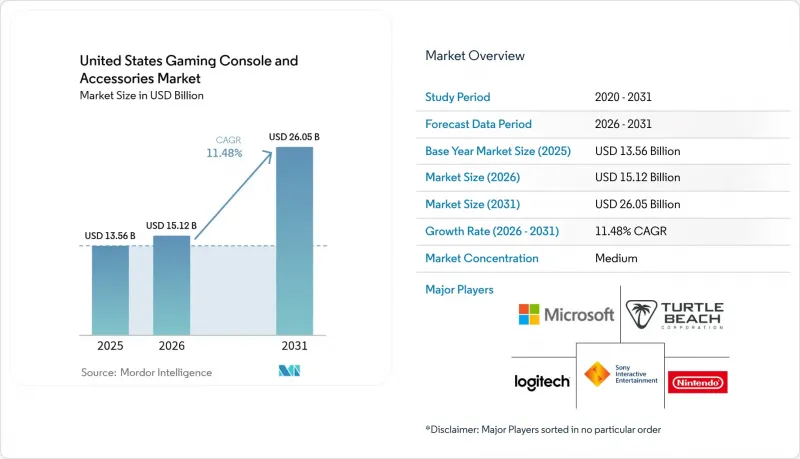
This report is Segmented by Type (Gaming Console, and Accessories), Console Type (Home Console, Handheld Console, and Hybrid Console), Accessories Type (Controller Gamepads, Headsets, and More), Distribution Channel (Online Stores, and Offline Retail), and Price Range (Below USD 300, USD 300-499, Above USD 500). The Market Forecasts are Provided in Terms of Value (USD).
United States Gaming Console And Accessories Market Trends and Insights
Launch of New AAA Gaming Content With High Graphic Requirements
Blockbuster releases continue to drive demand forward by setting technical floors that entry-level consoles struggle to reach. The upcoming Grand Theft Auto VI emphasizes real-time ray tracing and 60fps 4K output, which favors the PlayStation 5 Pro class of hardware. Unreal Engine 5 adoption embeds Nanite geometry and Lumen lighting as baseline expectations, effectively shortening replacement cycles. Lessons from the 2016 mid-generation upgrade of the PlayStation 4 Pro show that content-driven refreshes can deliver incremental revenue without cannibalizing the existing base. Platform roadmaps now target 18- to 24-month optimization windows that align with AAA pipelines, signaling a structural linkage between engine capability and hardware cadence. This alignment strengthens the United States gaming console and accessories market by allowing publishers to justify premium hardware SKUs through tangible visual improvements.
Integration of 3D and AR/VR Gaming
Virtual reality is shifting from a niche to a mainstream market as standalone headsets from Meta prove their scalability without requiring tethered support. Sony's PlayStation VR2 crossed the 2 million unit mark by mid-2024, validating console-attached VR when exclusive content anchors buyer motivation. Eye-tracking, foveated rendering, and haptic controllers set new immersion standards that third-party makers now aim to surpass with adaptive triggers and force-feedback gloves. Razer's 2025 Immersive Ecosystem launch underscores multi-sensory ambitions that extend beyond visuals. Nintendo has escalated R&D efforts around augmented overlays that blend digital layers onto hybrid gameplay, signaling a deeper future convergence. Regulatory discussions at the Federal Trade Commission regarding accessory interoperability could further catalyze the adoption of open standards, creating wider addressability for accessory innovators.
Increasing Threat From Cloud Gaming Services
Streaming removes hardware prerequisites by delivering console-grade experiences on commoditized devices. Xbox Cloud Gaming surpassed 100 million reachable screens by early 2025, including smart TVs, streaming sticks, and handheld devices. PlayStation added PS5 streaming options for subscribers, signalling internal hedging against dedicated box erosion. Nvidia's GeForce Now evidences traction by offering bring-your-own-library flexibility. Latency remains the chief brake, with sub-50 ms round-trips still limited to dense urban fiber nodes, easing pressure on console vendors in suburban or rural regions. Nonetheless, every incremental network improvement inches consumers toward a platform-agnostic future that could slow hardware sell-through within the United States gaming console and accessories market.
Other drivers and restraints analyzed in the detailed report include:
- Rapid Adoption of 4K and 8K Televisions Driving Console Upgrades
- Expansion of First-Party Exclusive Titles Fueling Hardware Sales
- Rising Demand for Mobile-Based Gaming Platforms
For complete list of drivers and restraints, kindly check the Table Of Contents.
Segment Analysis
Accessories delivered 33.42% of value in 2025 and are projected to climb at 12.31% through 2031, outstripping console hardware. Gamepads, headsets, and VR add-ons reach obsolescence sooner than the base device because wear, competitive standards, and gift cycles renew purchase intent. Sony reported an average 2.3 peripheral attach rate per PlayStation 5 in fiscal 2024, rising from 1.9 the prior year. Logitech and Razer each posted double-digit segment gains despite flat broader revenue, confirming the impulse-buy dynamic. The United States gaming console and accessories market registers enthusiastic uptake when branded colorways or esports tie-ins appear, which keeps accessory refresh churn high.
Premiumization also bolsters accessory revenue as enthusiasts pay for low-latency connections, magnet-trigger modules, and spatial audio. Custom design labs on official Xbox storefronts monetize willingness to personalize. Third-party vendors exploit gaps by offering modular paddles, hot-swap sticks, or adaptive kits for players with disabilities. This layered product regime provides sustainable growth even if console unit sales plateau, making accessories the structural growth driver inside the United States gaming console and accessories market.
Home systems still held a 71.86% share in 2025, thanks to the dominance of the PlayStation 5 and Xbox Series X. However, hybrid and VR-ready models are climbing at a rate of 12.55% annually. Nintendo Switch pioneered the docked-portable schema and surpassed 143 million global units by fiscal 2024, with the United States as its largest single territory. Switch 2 debuted in June 2025 and moved 3.5 million units in four days worldwide, underscoring the appetite for portability without performance sacrifice. Sony's rumored handheld aims to extend the PlayStation ecosystem in a similar vein.
Handheld growth also hinges on remote play streams that convert phones into thin clients. VR-ready consoles experience an uplift from improved PlayStation VR2 attach rates, with software per headset increasing to 3.2 titles. These shifts diversify the United States gaming console and accessories market by placing capable hardware in both living rooms and travel bags while widening the funnel for complementary gear.
Complete Report Scope:
- By Type
- Gaming Console
- Accessories
- By Console Type
- Home Console
- Handheld Console
- Hybrid Console
- By Accessories Type
- Controller Gamepads
- Headsets
- Steering Wheels and Flight Sticks
- VR Accessories
- Others
- By Distribution Channel
- Online Stores
- Offline Retail
- By Price Range
- Below USD 300
- USD 300-499
- Above USD 500
List of Companies Covered in this Report:
- Sony Interactive Entertainment LLC
- Microsoft Corporation
- Nintendo of America Inc.
- Logitech International SA
- Turtle Beach Corporation
- Razer Inc.
- Corsair Gaming Inc.
- Mad Catz Global Limited
- Backbone Labs Inc.,
- Performance Designed Products LLC
- PowerA (ACCELL CORPORATION)
- Astro Gaming LLC
- SteelSeries ApS
- HyperX Gaming Division of HP Inc.
- SCUF Gaming International LLC
- Thrustmaster - Guillemot Corporation SA
- Hori USA Inc.
- GameSir Technology Co. Ltd.,
- 8BitDo Technology Co. Ltd.
Additional Benefits:
- The market estimate (ME) sheet in Excel format
- 3 months of analyst support
TABLE OF CONTENTS
1 INTRODUCTION
- 1.1 Study Assumptions and Market Definition
- 1.2 Scope of the Study
2 RESEARCH METHODOLOGY
3 EXECUTIVE SUMMARY
4 MARKET LANDSCAPE
- 4.1 Market Overview
- 4.2 Market Drivers
- 4.2.1 Launch of New AAA Gaming Content With High Graphic Requirements
- 4.2.2 Integration of 3D and AR/VR Gaming
- 4.2.3 Rapid Adoption of 4K and 8K Televisions Driving Console Upgrades
- 4.2.4 Expansion of First-Party Exclusive Titles Fueling Hardware Sales
- 4.2.5 Rise of Esports Collegiate Programs Boosting Accessory Demand
- 4.2.6 Introduction of Modular, Repairable Console Designs Aligning With Right-to-Repair Laws
- 4.3 Market Restraints
- 4.3.1 Increasing Threat From Cloud Gaming Services
- 4.3.2 Rising Demand for Mobile-Based Gaming Platforms
- 4.3.3 Semiconductor Supply Constraints Causing Console Shortages
- 4.3.4 Growing Scrutiny Over E-Waste Leading to Accessory Recycling Costs
- 4.4 Industry Value Chain Analysis
- 4.5 Porter's Five Forces Analysis
- 4.5.1 Threat of New Entrants
- 4.5.2 Bargaining Power of Buyers or Consumers
- 4.5.3 Bargaining Power of Suppliers
- 4.5.4 Threat of Substitute Products
- 4.5.5 Intensity of Competitive Rivalry
- 4.6 Impact of Macroeconomic Factors on the Market
- 4.7 Regulatory Landscape
- 4.8 Overall Gaming Market Scenario in United States
- 4.9 Demographic Analysis of Gaming Population by Age and Gender
5 MARKET SIZE AND GROWTH FORECASTS (VALUE)
- 5.1 By Type
- 5.1.1 Gaming Console
- 5.1.2 Accessories
- 5.2 By Console Type
- 5.2.1 Home Console
- 5.2.2 Handheld Console
- 5.2.3 Hybrid Console
- 5.3 By Accessories Type
- 5.3.1 Controller Gamepads
- 5.3.2 Headsets
- 5.3.3 Steering Wheels and Flight Sticks
- 5.3.4 VR Accessories
- 5.3.5 Others
- 5.4 By Distribution Channel
- 5.4.1 Online Stores
- 5.4.2 Offline Retail
- 5.5 By Price Range
- 5.5.1 Below USD 300
- 5.5.2 USD 300-499
- 5.5.3 Above USD 500
6 COMPETITIVE LANDSCAPE
- 6.1 Market Concentration
- 6.2 Strategic Moves
- 6.3 Market Share Analysis
- 6.4 Company Profiles (includes Global Level Overview, Market Level Overview, Core Segments, Financials as Available, Strategic Information, Market Rank or Share for Key Companies, Products and Services, and Recent Developments)
- 6.4.1 Sony Interactive Entertainment LLC
- 6.4.2 Microsoft Corporation
- 6.4.3 Nintendo of America Inc.
- 6.4.4 Logitech International SA
- 6.4.5 Turtle Beach Corporation
- 6.4.6 Razer Inc.
- 6.4.7 Corsair Gaming Inc.
- 6.4.8 Mad Catz Global Limited
- 6.4.9 Backbone Labs Inc.,
- 6.4.10 Performance Designed Products LLC
- 6.4.11 PowerA (ACCELL CORPORATION)
- 6.4.12 Astro Gaming LLC
- 6.4.13 SteelSeries ApS
- 6.4.14 HyperX Gaming Division of HP Inc.
- 6.4.15 SCUF Gaming International LLC
- 6.4.16 Thrustmaster - Guillemot Corporation SA
- 6.4.17 Hori USA Inc.
- 6.4.18 GameSir Technology Co. Ltd.,
- 6.4.19 8BitDo Technology Co. Ltd.
7 MARKET OPPORTUNITIES AND FUTURE OUTLOOK
- 7.1 White-Space and Unmet-Need Assessment

