PUBLISHER: Mordor Intelligence | PRODUCT CODE: 2124053

PUBLISHER: Mordor Intelligence | PRODUCT CODE: 2124053
North America Commercial LED Lighting - Market Share Analysis, Industry Trends & Statistics, Growth Forecasts (2026 - 2031)
According to Mordor Intelligence, the North America commercial LED lighting market size is projected to expand from USD 8.58 billion in 2025 and USD 10.03 billion in 2026 to USD 19.72 billion by 2031, registering a CAGR of 14.48% between 2026 and 2031.
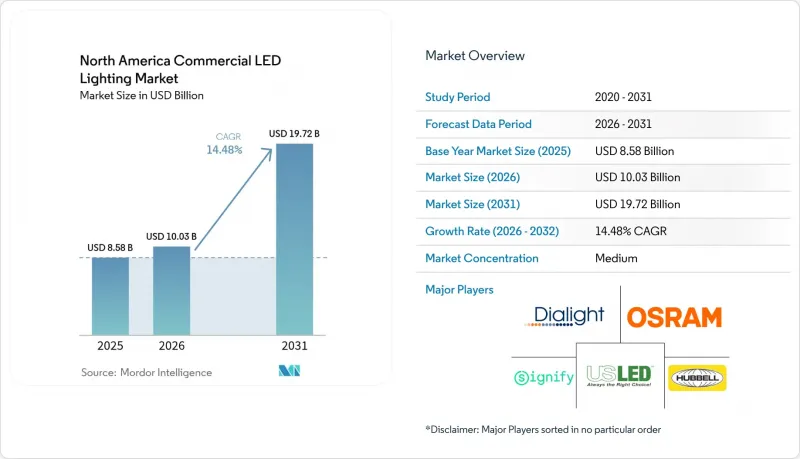
This report is Segmented by Application (Retail Stores, Office, Hospitality, Architectural, Healthcare Facilities, Educational Institutions, Industrial and Warehouse, and More), Form Factor (Troffers, and More), Distribution Channel (Direct Sales, and More), Installation Type (New Construction, and Retrofit), and Geography. The Market Forecasts are Provided in Terms of Value (USD).
North America Commercial LED Lighting Market Trends and Insights
Stringent Energy-Efficiency Regulations and Building Codes
New federal and provincial standards eliminate most legacy lamps, so owners replace fluorescents even when payback modelling is incomplete. U.S. rules finalized in 2024 ban halogen and incandescent options, while Canada's 2025 code lifts minimum efficacy thresholds. Mexico's NOM-030-ENER sets LED-equivalent baselines in public buildings. As catalogue lines for non-compliant products disappear, distributors standardize on LEDs, making code-driven conversions the default in healthcare and education.
Declining LED Luminaire Prices and Total-Cost-of-Ownership Advantage Accelerate Commercial Adoption
Rapid cost compression across LED packages and drivers lowers upfront fixture prices, enabling projects to justify payback periods shorter than two years in many commercial retrofits. Contemporary troffer designs deliver 110 lm/W efficacy 40% higher than fluorescent references, while extending rated life to roughly 85,000 hours; maintenance cycles drop proportionally, cutting operating expenses for facility managers. High-bay conversions record energy savings of 50-70% in distribution centers, generating six-figure annual utility reductions in large venues. Utility incentives across multiple U.S. states further shave 10-15% from capital costs, tipping financing decisions decisively toward LED. Together, these economic levers reinforce the North America Commercial LED Lighting market's momentum in the short term as payback math becomes compelling even for budget-constrained property owners.
As package commoditization intensifies, manufacturers are increasingly compelled to either scale up or bundle their software offerings to remain competitive. This trend is driven by the need to differentiate products in a market where price sensitivity and standardization are prevalent. Meanwhile, smaller distributors face mounting challenges from online competitors who provide direct-to-contractor pricing, offering convenience and cost savings to end users. This dynamic is accelerating a wave of consolidation within the industry, as smaller players struggle to maintain profitability and market share. A notable instance of this trend is Signify, whose declining margins highlight the growing pressures faced across the sector, reflecting the broader challenges of maintaining profitability amidst shifting market dynamics.
Other drivers and restraints analyzed in the detailed report include:
- Growth of Smart, Connected, and IoT-Enabled Lighting Creates New Value Propositions
- Shift Toward Human-Centric and Wellness-Focused Lighting Drives Premium Segment Growth
- Price Erosion Squeezing Vendor Margins Intensifies Competitive Pressure
- High Retrofit and Installation Costs in Legacy Facilities Limit Market Penetration
For complete list of drivers and restraints, kindly check the Table Of Contents.
Segment Analysis
Agricultural and horticulture installations are forecast to grow fastest at a 14.89% CAGR, benefiting from spectrum-tuned fixtures that support vertical farms. This niche already shows 66% LED penetration, yet supplemented greenhouses remain largely untapped. Office installations, although holding 27.43% of 2025 revenue, slow as hybrid work reduces density. Healthcare and retail adopt high-CRI fixtures for patient comfort and merchandising, respectively. Industrial warehouses adopt high-bay LEDs topping 180 lumens per watt, while educational sites prioritize daylight harvesting to satisfy ASHRAE 90.1.
Niche segments such as architectural facades command premium rates for 3D-printed metal optics. Downstream, the North America commercial LED lighting market size for vertical farming is projected to rise rapidly, while offices maintain the largest North America commercial LED lighting market share through 2031.
Track lights are set to post a 14.94% CAGR, propelled by museums and retailers needing beam flexibility and colour fidelity. Troffers, with 23.17% of 2025 revenue, continue large-scale replacements but see limited price upside. High-bay fixtures exceed 100,000 lumens for cold-storage; downlights tighten colour bins to half a MacAdam ellipse for uniform ceilings. Linear strips and suspended systems provide continuous-line aesthetics.
The North America commercial LED lighting market size for track lights will therefore widen, while troffers keep the highest North America commercial LED lighting market share based on installed base.
Complete Report Scope:
- By Application
- Retail Stores (Showrooms, Malls, Shops)
- Office
- Hospitality (Restaurants, Casinos, Hotels)
- Architectural (Decorative)
- Healthcare Facilities
- Educational Institutions
- Industrial and Warehouse
- Outdoor Commercial (Parking, Facades)
- Agricultural and Horticulture (Vertical Farm)
- By Form Factor
- Troffers
- Downlights
- High-Bay
- Track Lights
- Suspended Pendants
- Panel Lights
- Linear Strips
- Flood and Area Lights
- Other Form Factors
- By Distribution Channel
- Direct Sales
- Retail / Wholesale
- ESCO / Lighting-as-a-Service Providers
- Online / E-Commerce
- By Installation Type
- New Construction
- Retrofit
- By Country
- United States
- Canada
- Mexico
List of Companies Covered in this Report:
- Signify Holding
- Acuity Brands Inc.
- Hubbell Inc.
- Cree Lighting
- Dialight plc
- US LED Ltd.
- Osram Licht AG
- Technical Consumer Products Inc.
- Current Lighting Solutions LLC
- Zumtobel Group
- Lutron Electronics Co. Inc.
- Legrand SA
- Leviton Manufacturing Co. Inc.
- Samsung Electronics America
- LG Innotek USA Inc.
- Nichia America Corp.
- Orion Energy Systems Inc.
- Energy Focus Inc.
- Digital Lumens Inc.
- Fagerhult Group
- Revolution Lighting Technologies
- Cooper Lighting Solutions
- Lumileds Holding BV
Additional Benefits:
- The market estimate (ME) sheet in Excel format
- 3 months of analyst support
TABLE OF CONTENTS
1 INTRODUCTION
- 1.1 Study Assumptions and Market Definition
- 1.2 Scope of the Study
2 RESEARCH METHODOLOGY
3 EXECUTIVE SUMMARY
4 MARKET LANDSCAPE
- 4.1 Market Overview
- 4.2 Industry Value-Chain Analysis
- 4.3 Regulatory Landscape
- 4.4 Technological Outlook
- 4.5 Impact of Macroeconomic Factors on the Market
- 4.6 Market Drivers
- 4.6.1 Stringent Energy-Efficiency Regulations and Building Codes
- 4.6.2 Declining LED Luminaire Prices and Total Cost-of-Ownership Advantage
- 4.6.3 Growth of Smart, Connected and IoT-Enabled Lighting Systems
- 4.6.4 Shift Toward Human-Centric and Wellness-Focused Lighting in Workplaces
- 4.6.5 Corporate Net-Zero and ESG Targets Accelerating Retrofit Demand
- 4.6.6 Demand from Indoor Vertical Farming and Micro-Fulfillment Centers
- 4.6.7 Emergence of Utility Incentive Programs Targeting Mid-Size Businesses
- 4.6.8 Microgrid and On-Site Renewable Integration Favoring DC-Powered LED Systems
- 4.7 Market Restraints
- 4.7.1 Price Erosion Squeezing Vendor Margins
- 4.7.2 High Retrofit and Installation Costs in Legacy Facilities
- 4.7.3 Critical Component Shortages (Phosphors, Drivers, ICs)
- 4.7.4 Competition from OLED and Micro-LED Illumination Panels
- 4.7.5 Complexity of Lighting Controls Interoperability Standards
- 4.8 Porter's Five Forces Analysis
- 4.8.1 Bargaining Power of Buyers
- 4.8.2 Bargaining Power of Suppliers
- 4.8.3 Threat of New Entrants
- 4.8.4 Threat of Substitutes
- 4.8.5 Industry Rivalry
5 MARKET SIZE AND GROWTH FORECASTS (VALUE)
- 5.1 By Application
- 5.1.1 Retail Stores (Showrooms, Malls, Shops)
- 5.1.2 Office
- 5.1.3 Hospitality (Restaurants, Casinos, Hotels)
- 5.1.4 Architectural (Decorative)
- 5.1.5 Healthcare Facilities
- 5.1.6 Educational Institutions
- 5.1.7 Industrial and Warehouse
- 5.1.8 Outdoor Commercial (Parking, Facades)
- 5.1.9 Agricultural and Horticulture (Vertical Farm)
- 5.2 By Form Factor
- 5.2.1 Troffers
- 5.2.2 Downlights
- 5.2.3 High-Bay
- 5.2.4 Track Lights
- 5.2.5 Suspended Pendants
- 5.2.6 Panel Lights
- 5.2.7 Linear Strips
- 5.2.8 Flood and Area Lights
- 5.2.9 Other Form Factors
- 5.3 By Distribution Channel
- 5.3.1 Direct Sales
- 5.3.2 Retail / Wholesale
- 5.3.3 ESCO / Lighting-as-a-Service Providers
- 5.3.4 Online / E-Commerce
- 5.4 By Installation Type
- 5.4.1 New Construction
- 5.4.2 Retrofit
- 5.5 By Country
- 5.5.1 United States
- 5.5.2 Canada
- 5.5.3 Mexico
6 COMPETITIVE LANDSCAPE
- 6.1 Market Concentration
- 6.2 Strategic Moves
- 6.3 Market Share Analysis
- 6.4 Company Profiles (includes Global Level Overview, Market Level Overview, Core Segments, Financials as available, Strategic Information, Market Rank/Share, Products and Services, Recent Developments)
- 6.4.1 Signify Holding
- 6.4.2 Acuity Brands Inc.
- 6.4.3 Hubbell Inc.
- 6.4.4 Cree Lighting
- 6.4.5 Dialight plc
- 6.4.6 US LED Ltd.
- 6.4.7 Osram Licht AG
- 6.4.8 Technical Consumer Products Inc.
- 6.4.9 Current Lighting Solutions LLC
- 6.4.10 Zumtobel Group
- 6.4.11 Lutron Electronics Co. Inc.
- 6.4.12 Legrand SA
- 6.4.13 Leviton Manufacturing Co. Inc.
- 6.4.14 Samsung Electronics America
- 6.4.15 LG Innotek USA Inc.
- 6.4.16 Nichia America Corp.
- 6.4.17 Orion Energy Systems Inc.
- 6.4.18 Energy Focus Inc.
- 6.4.19 Digital Lumens Inc.
- 6.4.20 Fagerhult Group
- 6.4.21 Revolution Lighting Technologies
- 6.4.22 Cooper Lighting Solutions
- 6.4.23 Lumileds Holding BV
7 MARKET OPPORTUNITIES AND FUTURE OUTLOOK
- 7.1 White-Space and Unmet-Need Assessment

