PUBLISHER: Mordor Intelligence | PRODUCT CODE: 2124054

PUBLISHER: Mordor Intelligence | PRODUCT CODE: 2124054
Automated Border Control - Market Share Analysis, Industry Trends & Statistics, Growth Forecasts (2026 - 2031)
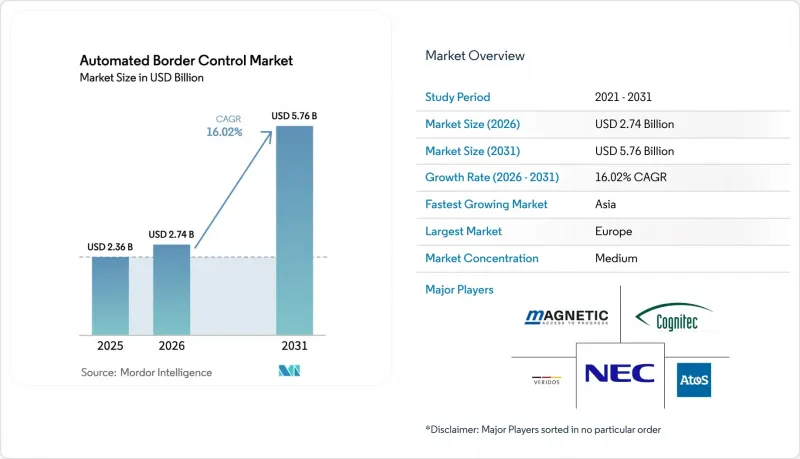
According to Mordor Intelligence, the automated border control market size was valued at USD 2.36 billion in 2025 and estimated to grow from USD 2.74 billion in 2026 to reach USD 5.76 billion by 2031, at a CAGR of 16.02% during the forecast period (2026-2031).
This report is Segmented by Type (ABC E-Gates, and ABC Kiosks), Offerings (Hardware, and More), Solution Model (Fully Automated, and More), Mode of Operation (One-Step Process, and More), End-Use Application (Airports, and More), Deployment (On-Premises, and Cloud-Based), Throughput Capacity (Less Than 200 Passengers/Hour, and More), and Geography. The Market Forecasts are Provided in Terms of Value (USD).
Global Automated Border Control Market Trends and Insights
Mandatory EU Entry/Exit System Driving ABC Gate Installations
Scheduled for October 2025, the EES obliges 29 Schengen states to enroll third-country nationals' biometrics through automated kiosks and e-gates. Member states have six months to achieve compliance after European Commission approval, stretching procurement into 2026 and beyond.Suppliers must enable direct integration with eu-LISA databases, prompting rapid upgrades from legacy gates to interoperable smart lanes. The regulation is already influencing adjacent markets as non-EU airports replicate EES technical specifications to maintain visa-waiver reciprocity.
Heightened Government Focus on Counter-Terrorism and Border-Security Funding
The United States allocated USD 60.8 billion in discretionary funding for homeland security in 2025, including USD 127 million channelled to Customs and Border Protection technology. Canada earmarked CAD 355.4 million (USD 262 million) for traveller modernization projects. These budgets prioritise AI-enabled threat detection, cloud analytics, and multi-modal biometrics, underlining how fiscal stimulus accelerates the automated border control market.
Biometric Data-Privacy Concerns under GDPR and Similar Laws
Strict retention rules oblige vendors to partition databases and deploy edge masking, inflating development cost and elongating certification cycles. The EU delayed the EES partly to finalise data-protection impact assessments, illustrating regulatory friction. North American agencies now publish privacy impact statements as standard, adding transparency but also administrative overhead. Although compliance raises barriers to entry, it ultimately favours incumbents with proven governance frameworks, shaping competitive dynamics in the automated border control market.
Other drivers and restraints analyzed in the detailed report include:
- AI-Powered Facial Recognition Improving Throughput at Mega-Airports
- Rising Adoption of Contactless Biometrics for Pandemic-Resilient Travel Hubs
- High Up-front CAPEX for Emerging-Nation Border Points
For complete list of drivers and restraints, kindly check the Table Of Contents.
Segment Analysis
E-gates generated 65.95% of 2025 revenue, anchoring the automated border control market size at major hubs through high throughput and a compact footprint. Standardisation of ICAO compliance and multi-biometric modules has lowered integration risk, encouraging airports to bundle e-gates into terminal refresh programs. Modular designs shorten installation time, letting operators phase works without shutting lanes, a critical advantage during peak travel seasons.
Kiosks, registering a 17.12% CAGR, appeal to operators seeking flexible deployment in space-constrained settings or during leasehold upgrades. Units can be relocated if passenger flows shift, offering agility unmatched by fixed e-gate arrays. Software updates delivered over secure networks extend functionality across the installed base, ensuring continuous alignment with evolving risk models. As more land ports pilot kiosk programs, vendors address ruggedisation and weatherproofing, widening application scope and enlarging the automated border control market.
Hardware captured 60.85% of 2025 revenue, reflecting the upfront cost of biometric cameras, document readers, and obstruction-detect sensors. Precision optics and high-durability materials underpin mean-time-between-failure metrics demanded by regulators. Yet software is scaling 16.18% annually, outstripping headline growth. Cloud-native analytics offload heavy computation from edge devices, lowering hardware spec and operating temperature requirements. Authorities value real-time dashboards that correlate traveller risk scores with lane-level performance, letting duty managers re-allocate staff dynamically.
Subscription models are replacing perpetual licences, converting capital outlay into predictable operating expense. SaaS features like continuous threat-intel feeds and AIOps-based predictive maintenance elevate lifecycle performance, reinforcing the strategic gravity of software within the automated border control market.
Fully automated lanes processed 70.35% of travellers in 2025 by combining document scanning, facial capture, and database checks in one pass. Operators cite labour-cost avoidance and predictable cycle times as core benefits. Semi-automated architectures, however, post a 16.46% CAGR because they let officers intervene when anomalies surface. Malaysia's forthcoming Automatic Biometric Identification System embeds a human-in-the-loop layer for exceptional vetting.This dual-path strategy supports risk-based operations while sustaining throughput. It also positions vendors to monetise analytics modules that guide inspectors to outlier cases.
Complete Report Scope:
- By Type
- ABC E-gates
- ABC Kiosks
- By Offerings
- Hardware
- Document Authentication System (DAS)
- Biometric Verification System (BVS)
- Face Recognition
- Fingerprint Recognition
- Iris Recognition
- Palm and Vein Recognition
- Software
- Border Management Software
- Middleware and SDKs
- Analytics and Reporting
- Services
- Installation and Integration
- Maintenance and Support
- Consultancy and Training
- Hardware
- By Solution Model
- Fully Automated
- Semi-Automated
- By Mode of Operation
- One-Step Process
- Two-Step Process
- By End-Use Application
- Airports
- Land Ports
- Seaports
- Rail Terminals
- By Deployment
- On-Premises
- Cloud-Based
- By Throughput Capacity
- Less than 200 Passengers/Hour
- 200-400 Passengers/Hour
- Above 400 Passengers/Hour
- By Geography
- North America
- United States
- Canada
- Mexico
- South America
- Brazil
- Argentina
- Rest of South America
- Europe
- United Kingdom
- Germany
- France
- Italy
- Spain
- Rest of Europe
- Asia Pacific
- China
- Japan
- South Korea
- India
- Australia and New Zealand
- Rest of Asia Pacific
- Middle East
- Saudi Arabia
- United Arab Emirates
- Turkey
- Rest of Middle East
- Africa
- South Africa
- Egypt
- Kenya
- Rest of Africa
- North America
Geography Analysis
Europe held 42.95% of 2025 revenue. Member states pour capital into EES-compliant kiosks and gates to avoid fines and passenger disruption. The Czech Republic alone ordered 58 kiosks and 94 e-towers from secunet for airport and land checks secunet. The UK allocated GBP 3.5 million (USD 4.7 million) to retrofit port lanes.Germany, France, Italy, and Spain each launched multiyear tenders, compelling vendors to ramp European assembly lines and local support teams.
Asia registers an 18.02% CAGR and will surpass Europe on annual installations by 2028. Singapore moved all checkpoints to automated lanes, processing 1.5 million travellers in 15 days. China's Gongbei Port added 20 "card-free" channels for Guangdong-Hong Kong-Macao integration. India scaled Fast-Track Immigration to 21 airports after a successful Delhi pilot that enrolled 18,400 users. Japan commissioned NEC kiosks at Haneda to support 60 million-visitor targets.North America ranks third by spend but leads in per-site budgets. The Infrastructure Investment and Jobs Act funds 50 land-port modernisations. Canada invests CAD 1.3 billion (USD 959 million) in border security, including CAD 355.4 million for traveller modernisation. The automated border control market thus benefits from stable federal appropriations that guarantee contract visibility for prime contractors and niche biometric firms.
- Thales Group
- IDEMIA Group
- SITA Group
- Vision-Box
- NEC Corporation
- Secunet Security Networks AG
- Gunnebo AB
- Atos SE
- ELCOVISION Technology
- Collins Aerospace
- Veridos GmbH
- Cognitec Systems GmbH
- HID Global Corporation
- Cominfosec Inc.
- Accenture plc
- Magnetic Autocontrol GmbH
- Dormakaba Holding AG
- Dermalog Identification Systems GmbH
- BioID GmbH
- Panasonic Connect Co., Ltd.
- Crossmatch Technologies Inc.
- Siemens Logistics
- ZKTeco Co., Ltd.
- Tascent Inc.
- Regula Baltija Ltd.
- Fujitsu Ltd.
Additional Benefits:
- The market estimate (ME) sheet in Excel format
- 3 months of analyst support
TABLE OF CONTENTS
1 INTRODUCTION
- 1.1 Study Assumptions and Market Definition
- 1.2 Scope of the Study
2 RESEARCH METHODOLOGY
3 EXECUTIVE SUMMARY
4 MARKET LANDSCAPE
- 4.1 Market Overview
- 4.2 Market Drivers
- 4.2.1 Increasing Passenger Traffic Requiring Seamless Border Processing in Europe and APAC
- 4.2.2 Heightened Government Focus on Counter-Terrorism and Border-Security Funding in North America
- 4.2.3 Rising Adoption of Contactless Biometrics for Pandemic-Resilient Travel Hubs
- 4.2.4 Mandatory EU Entry/Exit System (EES) Driving ABC Gate Installations
- 4.2.5 AI-Powered Facial Recognition Improving Throughput at Mega-Airports
- 4.2.6 Airline-Airport A-CDM Programs Accelerating ABC Deployment in Asia
- 4.3 Market Restraints
- 4.3.1 Biometric Data-Privacy Concerns under GDPR and Similar Laws
- 4.3.2 High Up-front CAPEX for Emerging-Nation Border Points
- 4.3.3 Downtime Risks from Spoofing/Liveness-Detection Failures
- 4.3.4 Legacy IT and Passport Databases Limiting Integration in Developing Regions
- 4.4 Industry Ecosystem Analysis
- 4.5 Regulatory Outlook
- 4.6 Technological Outlook
- 4.7 Porter's Five Forces Analysis
- 4.7.1 Bargaining Power of Suppliers
- 4.7.2 Bargaining Power of Consumers
- 4.7.3 Threat of New Entrants
- 4.7.4 Threat of Substitute
- 4.7.5 Intensity of Competitive Rivalry
5 MARKET SIZE AND GROWTH FORECASTS (VALUE)
- 5.1 By Type
- 5.1.1 ABC E-gates
- 5.1.2 ABC Kiosks
- 5.2 By Offerings
- 5.2.1 Hardware
- 5.2.1.1 Document Authentication System (DAS)
- 5.2.1.2 Biometric Verification System (BVS)
- 5.2.1.2.1 Face Recognition
- 5.2.1.2.2 Fingerprint Recognition
- 5.2.1.2.3 Iris Recognition
- 5.2.1.2.4 Palm and Vein Recognition
- 5.2.2 Software
- 5.2.2.1 Border Management Software
- 5.2.2.2 Middleware and SDKs
- 5.2.2.3 Analytics and Reporting
- 5.2.3 Services
- 5.2.3.1 Installation and Integration
- 5.2.3.2 Maintenance and Support
- 5.2.3.3 Consultancy and Training
- 5.2.1 Hardware
- 5.3 By Solution Model
- 5.3.1 Fully Automated
- 5.3.2 Semi-Automated
- 5.4 By Mode of Operation
- 5.4.1 One-Step Process
- 5.4.2 Two-Step Process
- 5.5 By End-Use Application
- 5.5.1 Airports
- 5.5.2 Land Ports
- 5.5.3 Seaports
- 5.5.4 Rail Terminals
- 5.6 By Deployment
- 5.6.1 On-Premises
- 5.6.2 Cloud-Based
- 5.7 By Throughput Capacity
- 5.7.1 Less than 200 Passengers/Hour
- 5.7.2 200-400 Passengers/Hour
- 5.7.3 Above 400 Passengers/Hour
- 5.8 By Geography
- 5.8.1 North America
- 5.8.1.1 United States
- 5.8.1.2 Canada
- 5.8.1.3 Mexico
- 5.8.2 South America
- 5.8.2.1 Brazil
- 5.8.2.2 Argentina
- 5.8.2.3 Rest of South America
- 5.8.3 Europe
- 5.8.3.1 United Kingdom
- 5.8.3.2 Germany
- 5.8.3.3 France
- 5.8.3.4 Italy
- 5.8.3.5 Spain
- 5.8.3.6 Rest of Europe
- 5.8.4 Asia Pacific
- 5.8.4.1 China
- 5.8.4.2 Japan
- 5.8.4.3 South Korea
- 5.8.4.4 India
- 5.8.4.5 Australia and New Zealand
- 5.8.4.6 Rest of Asia Pacific
- 5.8.5 Middle East
- 5.8.5.1 Saudi Arabia
- 5.8.5.2 United Arab Emirates
- 5.8.5.3 Turkey
- 5.8.5.4 Rest of Middle East
- 5.8.6 Africa
- 5.8.6.1 South Africa
- 5.8.6.2 Egypt
- 5.8.6.3 Kenya
- 5.8.6.4 Rest of Africa
- 5.8.1 North America
6 COMPETITIVE LANDSCAPE
- 6.1 Market Concentration
- 6.2 Strategic Moves
- 6.3 Market Share Analysis
- 6.4 Company Profiles (includes Global level Overview, Market level overview, Core Segments, Financials as available, Strategic Information, Market Rank/Share for key companies, Products and Services, and Recent Developments)
- 6.4.1 Thales Group
- 6.4.2 IDEMIA Group
- 6.4.3 SITA Group
- 6.4.4 Vision-Box
- 6.4.5 NEC Corporation
- 6.4.6 Secunet Security Networks AG
- 6.4.7 Gunnebo AB
- 6.4.8 Atos SE
- 6.4.9 ELCOVISION Technology
- 6.4.10 Collins Aerospace
- 6.4.11 Veridos GmbH
- 6.4.12 Cognitec Systems GmbH
- 6.4.13 HID Global Corporation
- 6.4.14 Cominfosec Inc.
- 6.4.15 Accenture plc
- 6.4.16 Magnetic Autocontrol GmbH
- 6.4.17 Dormakaba Holding AG
- 6.4.18 Dermalog Identification Systems GmbH
- 6.4.19 BioID GmbH
- 6.4.20 Panasonic Connect Co., Ltd.
- 6.4.21 Crossmatch Technologies Inc.
- 6.4.22 Siemens Logistics
- 6.4.23 ZKTeco Co., Ltd.
- 6.4.24 Tascent Inc.
- 6.4.25 Regula Baltija Ltd.
- 6.4.26 Fujitsu Ltd.
7 MARKET OPPORTUNITIES AND FUTURE OUTLOOK
- 7.1 White-space and Unmet-Need Assessment

