PUBLISHER: Mordor Intelligence | PRODUCT CODE: 2124062

PUBLISHER: Mordor Intelligence | PRODUCT CODE: 2124062
Subdermal Contraceptive Implants - Market Share Analysis, Industry Trends & Statistics, Growth Forecasts (2026 - 2031)
According to Mordor Intelligence, the subdermal contraceptive implants market size was valued at USD 1.01 billion in 2025 and is estimated to grow from USD 1.05 billion in 2026 to reach USD 1.28 billion by 2031, at a CAGR of 4.05% during the forecast period (2026-2031).
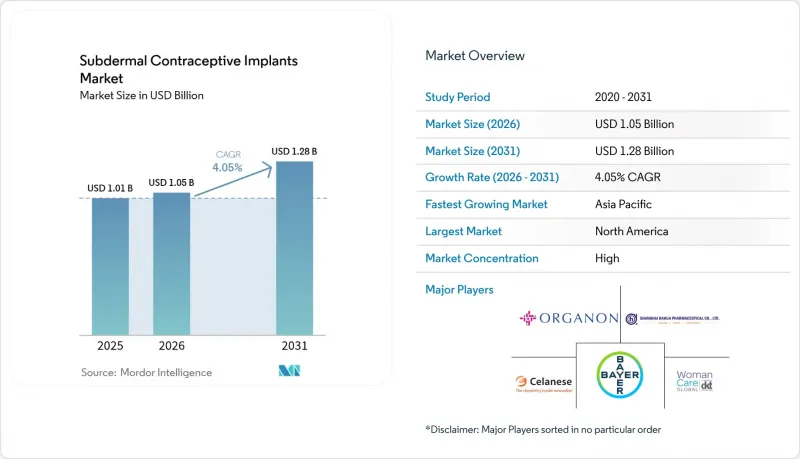
This report is Segmented by Type (Single-Rod Implants, Double-Rod Implants, Others), Hormone (Etonogestrel, Levonorgestrel), End User (Hospitals, Gynecology & Obstetrics Clinics, Family Planning & Reproductive Health Centers, and More), and Geography (North America, Europe, Asia-Pacific, Middle East & Africa, South America). The Market Forecasts are Provided in Terms of Value (USD).
Global Subdermal Contraceptive Implants Market Trends and Insights
Rising Unintended Pregnancy Rates & Demand for LARC
Global unintended pregnancies totaled 121 million in 2024, representing 48% of all pregnancies, and 257 million women in low- and middle-income countries still lack access to modern methods. Long-acting reversible options already account for 21% of modern method use, up from 16% in 2019, because users prefer "set-and-forget" protection without daily adherence burdens. Ministries of health now channel up to 50% of contraceptive budgets to implants and intrauterine devices, recognizing that a single USD 15 donor-priced implant averts more pregnancies over three years than 36 cycles of oral pills costing USD 1.50 each. Uptake among adolescents and women with no prior births is rising, challenging earlier clinical norms and expanding the overall addressable pool. These dynamics underpin enduring demand for the subdermal contraceptive implants market during and beyond the forecast horizon.
Favorable Government Family-Planning Initiatives & Subsidies
India's Mission Parivar Vikas trained 50,000 auxiliary nurse midwives and achieved 2.1 million insertions in fiscal 2024 after waiving user fees. Indonesia's universal health coverage reimburses USD 25 per insertion, triple the rate for injectables, to nudge providers toward LARC, resulting in 1.8 million implants procured in 2024. The Philippines secured USD 120 million in Asian Development Bank financing to distribute 1.5 million implants through rural health units, aiming to increase modern prevalence by 10 percentage points by 2028. These initiatives shorten manufacturers' payback periods and spur localized production, thereby fueling medium-term growth in the subdermal contraceptive implants market.
Adverse-Event Concerns & Litigation
Consolidated lawsuits covering 3,200 injury claims prompted Organon and Bayer to reserve USD 150 million for settlements in 2024. The U.K. regulator now requires ultrasound confirmation within 48 hours, adding USD 50 compliance cost per case. Rising malpractice premiums forced 12 U.S. states' ambulatory centers to discontinue implant services, lengthening rural wait times to eight weeks. Although redesigned applicators cut malposition dramatically, ongoing litigation tempers provider enthusiasm and weighs on the subdermal contraceptive implants market CAGR.
Other drivers and restraints analyzed in the detailed report include:
- Superior Efficacy & Cost-Effectiveness of Implants
- Miniaturized Ultra-Thin Single-Insertion Devices
- High Upfront Cost in Out-of-Pocket Markets
For complete list of drivers and restraints, kindly check the Table Of Contents.
Segment Analysis
Double-rod levonorgestrel implants are projected to expand at a 5.09% CAGR through 2031, outpacing the overall subdermal contraceptive implants market size for this metric. These systems benefit from unit prices of USD 8-10 in donor tenders, versus USD 12-15 for single-rod generics. Shanghai Dahua's Sino-implant (II) secured a 4.5-million-unit contract with Nigeria in 2024, demonstrating momentum in budget-constrained settings. Single-rod etonogestrel devices still dominate premium segments, maintaining 66.82% market share in 2025 owing to Organon's entrenched training network and malpractice offsets. As biosimilars launch post-2027, price gaps between rod formats will narrow, and convenience features could re-shape the competitive hierarchy within the subdermal contraceptive implants market.
The cost-performance trade-off also influences procedural logistics: double-rod insertion requires a 4-millimeter incision and longer chair time, which mildly elevates infection risk. Yet public programs prioritize budget impact over marginal convenience, ensuring continued tender dominance. Venture-backed biodegradable polymer implants, currently under 2% share, attracted USD 45 million in 2024 funding, hinting at a future pivot toward removal-free platforms. Collectively, these factors will guide procurement decisions and sustain diversified growth avenues within the subdermal contraceptive implants industry.
Complete Report Scope:
- By Type
- Single-Rod Implants
- Double-Rod Implants
- Others
- By Hormone
- Etonogestrel
- Levonorgestrel
- By End User
- Hospitals
- Gynecology & Obstetrics Clinics
- Family Planning & Reproductive Health Centers
- Ambulatory Surgical Centers
- Other End Users
- By Geography
- North America
- United States
- Canada
- Mexico
- Europe
- Germany
- United Kingdom
- France
- Italy
- Spain
- Rest of Europe
- Asia-Pacific
- China
- Japan
- India
- Australia
- South Korea
- Rest of Asia-Pacific
- Middle East & Africa
- GCC
- South Africa
- Rest of Middle East & Africa
- South America
- Brazil
- Argentina
- Rest of South America
- North America
Geography Analysis
North America generated 45.08% of 2025 revenue, buoyed by Medicaid expansion and commercial insurers' removal of cost-sharing for LARC. Immediate postpartum protocols, now a Tier 1 quality metric, lifted U.S. insertions to 1.8 million in 2024, equal to 11 implants per 1,000 women of reproductive age. Patent cliffs from 2027 will invite biosimilars, likely trimming average selling prices but boosting overall subdermal contraceptive implants market size as lower out-of-pocket costs spark incremental uptake.
Asia-Pacific is the fastest-growing region, projected at a 7.13% CAGR to 2031, driven by India, Indonesia, and the Philippines, where collective demand will top 6.5 million units by 2028. China approved domestic levonorgestrel production in 2024 and targets 500,000 annual insertions by 2027, aiming to reverse a 12% drop in modern method use among rural women since 2020. Rapid urbanization, smartphone penetration, and government subsidies together accelerate market penetration, underscoring Asia-Pacific's pivotal role in reshaping the global subdermal contraceptive implants market share landscape.
The U.K.'s flat volume of 420,000 implants in fiscal 2024 illustrates maturity. Nonetheless, litigation-driven safety mandates could create opportunities for digital insertion-tracking tools. Middle East & Africa combined accounted for 12% of 2025 volume and will grow at a 6.2% CAGR on the back of UNFPA and USAID procurement in Ethiopia, Kenya, Nigeria, and Tanzania, markets where unmet need surpasses 25%. South America, with 8% revenue share, grapples with fiscal austerity; Brazil's public distribution fell 9% in 2024 as budgets pivoted to vaccination campaigns, underscoring macroeconomic sensitivities within the subdermal contraceptive implants industry.
- Afaxys Pharma
- Bayer
- Cipla
- The Cooper Companies
- Celanese
- DKT WomanCare Global
- Endoceutics Inc.
- Exeltis Healthcare
- Gedeon Richter Plc
- Glenmark Pharma Ltd.
- Helm AG
- HLL Lifecare Ltd.
- Hologic
- Lupin
- Meril Life Sciences
- Mylan Laboratories Ltd.
- Organon
- Pregna International Ltd.
- Richter-Helm BioLogics GmbH
- Shanghai Dahua Pharmaceutical Co. Ltd.
- Theramex HQ UK Ltd.
- Viatris
Additional Benefits:
- The market estimate (ME) sheet in Excel format
- 3 months of analyst support
TABLE OF CONTENTS
1 Introduction
- 1.1 Study Assumptions & Market Definition
- 1.2 Scope of the Study
2 Research Methodology
3 Executive Summary
4 Market Landscape
- 4.1 Market Overview
- 4.2 Market Drivers
- 4.2.1 Rising Unintended Pregnancy Rates & Demand For LARC
- 4.2.2 Favorable Government Family-Planning Initiatives & Subsidies
- 4.2.3 Superior Efficacy & Cost-Effectiveness of Implants
- 4.2.4 Growing NGO Procurement in Emerging Markets
- 4.2.5 Miniaturized Ultra-Thin Single-Insertion Devices
- 4.2.6 Digital Insertion-Tracking Apps Boost Provider Confidence
- 4.3 Market Restraints
- 4.3.1 Adverse-Event Concerns & Litigation
- 4.3.2 High Upfront Cost in Out-of-Pocket Markets
- 4.3.3 Cold-Chain Constraints in Tropical Regions
- 4.3.4 Religious Activist Opposition to Hormonal Contraception
- 4.4 Regulatory Landscape
- 4.5 Technological Outlook
- 4.6 Porter's Five Forces Analysis
- 4.6.1 Threat of New Entrants
- 4.6.2 Bargaining Power of Buyers
- 4.6.3 Bargaining Power of Suppliers
- 4.6.4 Threat of Substitute Products
- 4.6.5 Intensity of Competitive Rivalry
5 Market Size & Growth Forecasts
- 5.1 By Type
- 5.1.1 Single-Rod Implants
- 5.1.2 Double-Rod Implants
- 5.1.3 Others
- 5.2 By Hormone
- 5.2.1 Etonogestrel
- 5.2.2 Levonorgestrel
- 5.3 By End User
- 5.3.1 Hospitals
- 5.3.2 Gynecology & Obstetrics Clinics
- 5.3.3 Family Planning & Reproductive Health Centers
- 5.3.4 Ambulatory Surgical Centers
- 5.3.5 Other End Users
- 5.4 By Geography
- 5.4.1 North America
- 5.4.1.1 United States
- 5.4.1.2 Canada
- 5.4.1.3 Mexico
- 5.4.2 Europe
- 5.4.2.1 Germany
- 5.4.2.2 United Kingdom
- 5.4.2.3 France
- 5.4.2.4 Italy
- 5.4.2.5 Spain
- 5.4.2.6 Rest of Europe
- 5.4.3 Asia-Pacific
- 5.4.3.1 China
- 5.4.3.2 Japan
- 5.4.3.3 India
- 5.4.3.4 Australia
- 5.4.3.5 South Korea
- 5.4.3.6 Rest of Asia-Pacific
- 5.4.4 Middle East & Africa
- 5.4.4.1 GCC
- 5.4.4.2 South Africa
- 5.4.4.3 Rest of Middle East & Africa
- 5.4.5 South America
- 5.4.5.1 Brazil
- 5.4.5.2 Argentina
- 5.4.5.3 Rest of South America
- 5.4.1 North America
6 Competitive Landscape
- 6.1 Market Concentration
- 6.2 Market Share Analysis
- 6.3 Company Profiles (includes Global Level Overview, Market Level Overview, Core Segments, Financials as Available, Strategic Information, Market Rank/Share for Key Companies, Products & Services, and Recent Developments)
- 6.3.1 Afaxys Pharma
- 6.3.2 Bayer AG
- 6.3.3 Cipla Ltd.
- 6.3.4 CooperSurgical Inc.
- 6.3.5 Celanese
- 6.3.6 DKT WomanCare Global
- 6.3.7 Endoceutics Inc.
- 6.3.8 Exeltis Healthcare
- 6.3.9 Gedeon Richter Plc
- 6.3.10 Glenmark Pharma Ltd.
- 6.3.11 Helm AG
- 6.3.12 HLL Lifecare Ltd.
- 6.3.13 Hologic Inc.
- 6.3.14 Lupin Ltd.
- 6.3.15 Meril Life Sciences
- 6.3.16 Mylan Laboratories Ltd.
- 6.3.17 Organon & Co.
- 6.3.18 Pregna International Ltd.
- 6.3.19 Richter-Helm BioLogics GmbH
- 6.3.20 Shanghai Dahua Pharmaceutical Co. Ltd.
- 6.3.21 Theramex HQ UK Ltd.
- 6.3.22 Viatris Inc.
7 Market Opportunities & Future Outlook
- 7.1 White-space & Unmet-Need Assessment

