PUBLISHER: Mordor Intelligence | PRODUCT CODE: 2124075

PUBLISHER: Mordor Intelligence | PRODUCT CODE: 2124075
Ceramic Membranes - Market Share Analysis, Industry Trends & Statistics, Growth Forecasts (2026 - 2031)
According to Mordor Intelligence, the ceramic membranes market size is expected to increase from USD 8.84 billion in 2025 to USD 9.62 billion in 2026 and reach USD 14.68 billion by 2031, growing at a CAGR of 8.82% over 2026-2031.
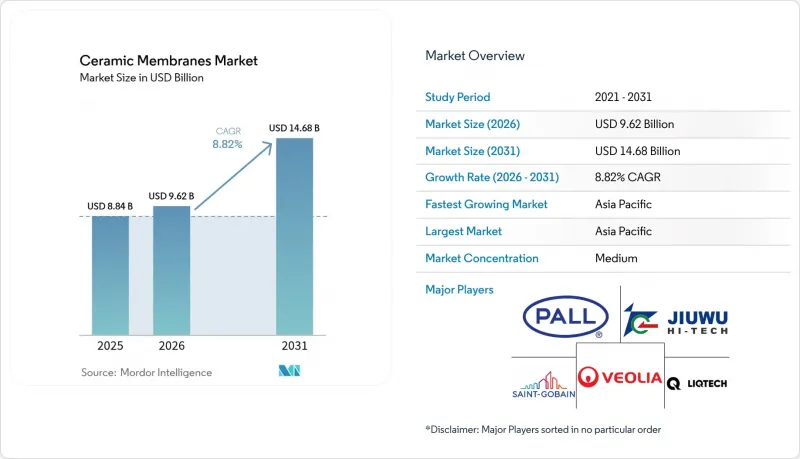
This report is Segmented by Material Type (Alumina, Silica, Titania, Zirconium Oxide, Silicon Carbide, and Others), End-User Industry (Water and Wastewater Treatment, Food and Beverage, Chemical Industry, Pharmaceutical, and Others), and Geography (Asia-Pacific, North America, Europe, South America, and the Middle East and Africa). The Market Forecasts are Provided in Terms of Value (USD).
Global Ceramic Membranes Market Trends and Insights
Rising Demand for Water & Wastewater Treatment Infrastructure
Emerging-economy governments are funding decentralized systems that operate with minimal operator input. India's Jal Jeevan Mission allocated USD 50 billion to rural water supply and specified ceramic microfiltration for 60% of new installations because backwash intervals stretch to 72 hours versus 24 hours for polymeric cartridges. China's zero-liquid-discharge mandate for coal-chemical parks drove 1.8 million m2 of ceramic area installations across 340 plants in 2024-2025. Middle-Eastern plants, such as ACWA Power's Taweelah facility, now front-load RO with 120,000 m2 of alumina tubes, cutting chemical dosing by 35%. U.S. nutrient-removal retrofits in Maryland and Virginia adopted ceramic membranes to meet 3 mg/L total nitrogen limits without footprint expansion. Collectively, these programs lift public-sector spending, anchoring longer-term demand for the ceramic membrane market.
Stringent Industrial Effluent Regulations Worldwide
Across regions, regulators are tightening discharge limits that polymeric systems struggle to meet. The US EPA's 2024 Organic-Chemicals ELGs limit BOD to 10 mg/L and turbidity to 0.5 NTU; ceramic membranes comply without flocculation, avoiding sludge-haul costs that exceed USD 80 per dry ton. Europe's revised Industrial Emissions Directive now favors cleaning-in-place cycles under 30 minutes, a benchmark ceramics reach with 2% caustic at 80°C. China's pharmaceutical standard GB 31962-2015 caps COD at 50 mg/L, prompting 22 API plants in Zhejiang to switch to ceramic units in 2025 to avoid CNY 500,000 penalties per incident. These simultaneous policy moves add a durable 2.1-point lift to the forecast CAGR for the ceramic membrane market.
Prevalence of Low-Pressure Polymeric Alternatives in Low-TDS Uses
In low-turbidity surface water, polymeric hollow-fiber capital still undercuts ceramics. A 2025 American Water Works Association survey put polymeric microfiltration at USD 420 per m3/day versus USD 680 for ceramics. New PES modules tolerate 500 ppm sodium hypochlorite, narrowing the chemical-resistance gap. Sixty-two percent of North American utilities in a 2025 Water Environment Federation poll ranked the lowest 10-year NPV above the longest life. Retrofitting older low-pressure plants can add USD 150,000-300,000 in ancillary upgrades per train, muting the ceramic membrane market's near-term upside in these settings.
Other drivers and restraints analyzed in the detailed report include:
- Longer Service-Life & Lower Lifecycle Cost vs. Polymeric Membranes
- Expansion of Dairy & Beverage Protein-Concentration Processes
- Limited Operator Expertise at Municipal Utilities
For complete list of drivers and restraints, kindly check the Table Of Contents.
Segment Analysis
Alumina captured 44.12% of 2025 revenue, making it the anchor of the ceramic membrane market share. Silicon-carbide follows in abrasive service, but titania variants are set to grow fastest at 9.80% CAGR on semiconductor and pharma demand for 50 nm cut-offs. The ceramic membrane market size for alumina-based elements is projected to reach USD 6.5 billion by 2031 as domestic Chinese capacity pushes unit prices below USD 200/m2. Cost differentials persist, titania commands USD 320-400/m2 due to phase-control firing, yet its photocatalytic self-cleaning provides a premium in high-purity operations. Emerging glass-ceramic composites promise mid-range cost and broad pH tolerance, hinting at future share redistribution.
Price and durability advantages keep alumina firmly ahead through 2031, but the application mix is diversifying. Silicon-carbide's Mohs 9.5 hardness makes it indispensable for mining tailings and shale-gas produced water. Zirconia serves solvent-rich organic nanofiltration, though its yttria stabilization cost caps volume under 6%. ISO 19749 test updates covering photocatalytic activity will help titania suppliers differentiate on fouling resistance, maintaining a high single-digit growth trajectory inside the ceramic membrane market.
Complete Report Scope:
- By Material Type
- Alumina
- Silica
- Titania
- Zirconium Oxide
- Silicon Carbide
- Others (Glassy Materials, Magnesia, carbon, Glass-Ceramic composites, etc.)
- By End-user Industry
- Water and Wastewater Treatment
- Food and Beverage
- Chemical Industry
- Pharmaceutical
- Others (Biotechnology, Textile, Petrochemical, etc.)
- By Geography
- Asia-Pacific
- China
- India
- Japan
- South Korea
- Malaysia
- Thailand
- Indonesia
- Vietnam
- Rest of Asia-Pacific
- North America
- United States
- Canada
- Mexico
- Europe
- Germany
- United Kingdom
- France
- Italy
- Spain
- NORDIC Countries
- Turkey
- Russia
- Rest of Europe
- South America
- Brazil
- Argentina
- Colombia
- Rest of South America
- Middle-East and Africa
- Saudi Arabia
- Qatar
- United Arab Emirates
- Nigeria
- Egypt
- South Africa
- Rest of Middle-East and Africa
- Asia-Pacific
Geography Analysis
Asia-Pacific held 52.98% of 2025 revenue and will grow at 10.02% CAGR through 2031 on synchronized infrastructure build-outs, stricter discharge limits, and localized manufacturing. China's 14th Five-Year Plan earmarked CNY 180 billion for industrial wastewater upgrades, and domestic suppliers such as JIUWU now quote 30% below imports. India's Jal Jeevan Mission specs ceramics for 60% of village plants, raising the ceramic membrane market's addressable volume across South Asia. Japan, South Korea, and Taiwan fund high-reuse industrial parks, further cementing regional dominance.
North America's 2025 market share was lifted by Clean Water Act compliance, Indigenous water-system funding, and shale-gas produced-water recycling. Milwaukee, Newark, and Flint pilot ceramic plants to remove particulate lead, potentially opening a USD 900 million municipal retrofit pool by 2028. Canada's CAD 1.9 billion remote-community program likewise favors ceramics thanks to freeze-thaw durability. Mexico's Bajio industrial corridor added 14 ceramic wastewater plants in 2025, cementing a continental manufacturing-hub trend.
Europe's 2025 market value was impacted by regulatory momentum trumping budget headwinds. Germany subsidizes Baltic runoff nutrient removal, the UK funds AMP8 phosphorus cuts, and the Netherlands fast-tracks PVDF swap-outs. Southern Europe lags on capex, but high-salinity niches still pull in ceramic bids. Latin America and Middle East-Africa together form a 7% sliver, yet billion-dollar desalination retrofits in Saudi Arabia and UAE telegraph high-growth pockets inside the global ceramic membrane market.
- ALSYS
- atech innovations GmbH
- Ceraflo Pte Ltd
- GEA Group Aktiengesellschaft
- JIUWU HI-TECH
- Kovalus Separation Solutions
- LiqTech Holding A/S
- Membracon
- METAWATER. CO. LTD
- Nanostone
- Pall Corporation
- Qua Group LLC
- Saint-Gobain
- Sterlitech Corporation
- TAMI Industries
- Veolia
Additional Benefits:
- The market estimate (ME) sheet in Excel format
- 3 months of analyst support
TABLE OF CONTENTS
1 Introduction
- 1.1 Study Assumptions and Market Definition
- 1.2 Scope of the Study
2 Research Methodology
3 Executive Summary
4 Market Landscape
- 4.1 Market Overview
- 4.2 Market Drivers
- 4.2.1 Rising Demand for Water & Wastewater Treatment Infrastructure
- 4.2.2 Stringent Industrial Effluent Regulations Worldwide
- 4.2.3 Longer Service-Life & Lower Lifecycle Cost vs. Polymeric Membranes
- 4.2.4 Expansion of Dairy & Beverage Protein-Concentration Processes
- 4.2.5 Pending PVDF-based Membrane Restrictions Driving Ceramic Adoption
- 4.3 Market Restraints
- 4.3.1 Prevalence of Low-Pressure Polymeric Alternatives in Low-TDS Uses
- 4.3.2 Limited Operator Expertise at Municipal Utilities
- 4.3.3 Scarcity of Large-Scale Ceramic Tube Suppliers Outside Asia
- 4.4 Value Chain Analysis
- 4.5 Porter's Five Forces
- 4.5.1 Bargaining Power of Suppliers
- 4.5.2 Bargaining Power of Buyers
- 4.5.3 Threat of New Entrants
- 4.5.4 Threat of Substitutes
- 4.5.5 Degree of Competition
5 Market Size and Growth Forecasts (Value)
- 5.1 By Material Type
- 5.1.1 Alumina
- 5.1.2 Silica
- 5.1.3 Titania
- 5.1.4 Zirconium Oxide
- 5.1.5 Silicon Carbide
- 5.1.6 Others (Glassy Materials, Magnesia, carbon, Glass-Ceramic composites, etc.)
- 5.2 By End-user Industry
- 5.2.1 Water and Wastewater Treatment
- 5.2.2 Food and Beverage
- 5.2.3 Chemical Industry
- 5.2.4 Pharmaceutical
- 5.2.5 Others (Biotechnology, Textile, Petrochemical, etc.)
- 5.3 By Geography
- 5.3.1 Asia-Pacific
- 5.3.1.1 China
- 5.3.1.2 India
- 5.3.1.3 Japan
- 5.3.1.4 South Korea
- 5.3.1.5 Malaysia
- 5.3.1.6 Thailand
- 5.3.1.7 Indonesia
- 5.3.1.8 Vietnam
- 5.3.1.9 Rest of Asia-Pacific
- 5.3.2 North America
- 5.3.2.1 United States
- 5.3.2.2 Canada
- 5.3.2.3 Mexico
- 5.3.3 Europe
- 5.3.3.1 Germany
- 5.3.3.2 United Kingdom
- 5.3.3.3 France
- 5.3.3.4 Italy
- 5.3.3.5 Spain
- 5.3.3.6 NORDIC Countries
- 5.3.3.7 Turkey
- 5.3.3.8 Russia
- 5.3.3.9 Rest of Europe
- 5.3.4 South America
- 5.3.4.1 Brazil
- 5.3.4.2 Argentina
- 5.3.4.3 Colombia
- 5.3.4.4 Rest of South America
- 5.3.5 Middle-East and Africa
- 5.3.5.1 Saudi Arabia
- 5.3.5.2 Qatar
- 5.3.5.3 United Arab Emirates
- 5.3.5.4 Nigeria
- 5.3.5.5 Egypt
- 5.3.5.6 South Africa
- 5.3.5.7 Rest of Middle-East and Africa
- 5.3.1 Asia-Pacific
6 Competitive Landscape
- 6.1 Market Concentration
- 6.2 Strategic Moves
- 6.3 Market Share(%)/Ranking Analysis
- 6.4 Company Profiles (includes Global Overview, Market Overview, Core Segments, Financials, Strategic Information, Products and Services, Recent Developments)
- 6.4.1 ALSYS
- 6.4.2 atech innovations GmbH
- 6.4.3 Ceraflo Pte Ltd
- 6.4.4 GEA Group Aktiengesellschaft
- 6.4.5 JIUWU HI-TECH
- 6.4.6 Kovalus Separation Solutions
- 6.4.7 LiqTech Holding A/S
- 6.4.8 Membracon
- 6.4.9 METAWATER. CO. LTD
- 6.4.10 Nanostone
- 6.4.11 Pall Corporation
- 6.4.12 Qua Group LLC
- 6.4.13 Saint-Gobain
- 6.4.14 Sterlitech Corporation
- 6.4.15 TAMI Industries
- 6.4.16 Veolia
7 Market Opportunities and Future Outlook
- 7.1 White-space and Unmet-need Assessment

