PUBLISHER: Mordor Intelligence | PRODUCT CODE: 2124078

PUBLISHER: Mordor Intelligence | PRODUCT CODE: 2124078
Iodine - Market Share Analysis, Industry Trends & Statistics, Growth Forecasts (2026 - 2031)
According to Mordor Intelligence, the iodine market size is projected to expand from 45.23 kilotons in 2025 and 47.70 kilotons in 2026 to 62.26 kilotons by 2031, registering a CAGR of 5.47% between 2026 to 2031.
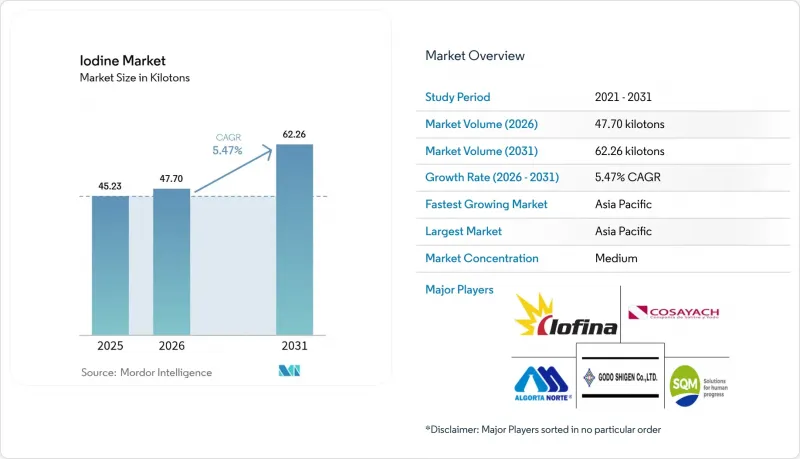
This report is Segmented by Source (Caliche Ore, Underground Brine, Seaweed, and Recycling), Form (Organic Compounds, Elementals and Isotopes, and Inorganic Salts and Complexes), End-User Industry (Medical, Animal Feed, Biocides, Fluorochemicals, Nylon, and More), and Geography (Asia-Pacific, North America, Europe, South America, and Middle-East and Africa). The Market Forecasts are Provided in Terms of Volume (Tons).
Global Iodine Market Trends and Insights
Rising Demand for X-Ray/CT Contrast Media
Roughly 75 million diagnostic exams per year use iodinated contrast agents, and about 48% of U.S. CT scans require contrast enhancement. GE Healthcare invested USD 30 million in its Cork, Ireland plant during 2024 to secure additional supply as global contrast demand is expected to double within a decade. Photon-counting CT technology lowers per-patient iodine usage by around 10% per 5 keV energy bin, yet absolute volumes keep rising as screening programs expand. SQM signed multi-year feedstock contracts with pharmaceutical intermediaries to lock in medical-grade output at premium pricing, insulating revenue from commodity swings. The WHO lists iodinated contrast agents on its essential medicines inventory, guaranteeing baseline procurement even in low-income health systems.
Government-Mandated Salt Iodization Programs
Roughly 88% of households used iodized salt in 2024, up from 86% in 2020, yet more than 2 billion people remain at risk of deficiency. India's 2024 mandate for double fortification with iodine and iron has lifted per-kilogram iodine loading, expanding the iodine market across rural retail channels. Southeast Asian and Sub-Saharan regulators are tightening compliance audits, raising the technical threshold for suppliers that must now document ISO 9001 traceability. Low-purity grades funneled into fortification create a price floor that stabilizes producer cash flows during cyclical downturns in higher-spec segments. UNICEF's bulk procurement favors vendors with proven logistics, elevating barriers for small regional entrants.
Volatile Pricing Linked to Chilean Caliche Output Swings
Chile supplies roughly 60% of world iodine, and 2024 precipitation events in the Atacama Desert curtailed ore processing, pushing spot prices to USD 38,000 t-1 from USD 27,000 t-1 the prior year. Asia-Pacific buyers face 8-12-week transit windows, and strategic stockpiles seldom exceed 60 days, magnifying volatility. Underground brine output is scaling at a 5.56% CAGR but remains an order of magnitude smaller than caliche, limiting near-term diversification. Producers with long-term offtake contracts are better cushioned, yet converters in contrast media and catalysts report margin compression when spot jumps exceed USD 5,000 t-1. Weather risk and nitrate-mining cycles therefore remain the leading supply-side drag on the iodine market.
Other drivers and restraints analyzed in the detailed report include:
- Expansion of LCD/OLED Polarizer Film Manufacturing
- Regulatory Push for Low-Carbon Fluorochemical Routes
- Toxicity and Specialized Handling Costs for Bulk Iodine
For complete list of drivers and restraints, kindly check the Table Of Contents.
Segment Analysis
Caliche ore still held 50.88% of the iodine market share in 2025, anchored by SQM's 16,200 t output, yet underground brine is growing faster at a 5.56% CAGR, reflecting end-users' pursuit of supply diversity. The iodine market size attributable to brine is projected to rise as operators such as Iofina commission new wells in the U.S. Permian Basin.
Brine production bypasses nitrate-mining cycles and exploits flowback water that would otherwise be reinjected, lowering marginal extraction costs despite iodine grades below 0.1 g L-1. Japanese firms extracting brine at roughly 1,000-fold seawater concentration supply 30% of global volume, proving commercial viability. Recycling-led by GE Healthcare's take-back network-recovered 18% of iodine used in contrast agents during 2025, signaling white-space for closed-loop growth. Seaweed now accounts for low supply because of labor intensity and low yields.
Complete Report Scope:
- By Source
- Caliche Ore
- Underground Brine
- Seaweed
- Recycling
- By Form
- Organic Compounds
- Elementals and Isotopes
- Inorganic Salts and Complexes
- By End-user Industry
- Medical (X-ray contrast media, pharmaceuticals, iodophors and povidone-iodine)
- Animal Feed
- Biocides
- Optical Polarizing Films
- Fluorochemicals
- Nylon
- Other End-user Industries
- By Geography
- Asia-Pacific
- China
- Japan
- India
- South Korea
- Rest of Asia-Pacific
- North America
- United States
- Canada
- Mexico
- Europe
- Germany
- United Kingdom
- France
- Italy
- Rest of Europe
- South America
- Brazil
- Argentina
- Rest of South America
- Middle-East and Africa
- Saudi Arabia
- South Africa
- Rest of Middle-East and Africa
- Asia-Pacific
Geography Analysis
Asia-Pacific led the iodine market with 34.31% of world demand in 2025 and is expanding at a 6.89% CAGR through 2031. China's LCD polarizer film production and India's double-fortified salt program underpin the region's volume gains. Japan, sourcing brine at 0.1 g L-1, remains a pivotal supplier to downstream processors across the bloc.
North America benefits from rising brine output, notably Iofina's additional 170-220 t yr-1 Permian plant slated for H2 2026. Europe remains contrast-media-centric; GE Healthcare's Cork expansion reinforces supply security yet faces headwinds from stricter dairy residue caps.
South America supplies majority of global iodine via Chilean caliche, but weather disruptions and water scarcity inject volatility. UNICEF-led iodization drives incremental demand across Sub-Saharan Africa, though logistics barriers persist.
- Algorta Norte S.A.
- Calibre Chemicals Pvt. Ltd.
- Cosayach
- Deep Water Chemicals
- Eskay Iodine
- Glide Chem Private Limited
- GODO SHIGEN Co., Ltd.
- Infinium Pharmachem Limited
- Iochem Corporation
- Iofina plc
- ISE CHEMICALS CORPORATION
- K&O Energy Group Inc.
- Nippoh Chemicals Co. Ltd
- Parad Corporation Pvt Ltd
- Proto Chemical Industries
- Salvi Chemical Industries Ltd
- Samrat Pharmachem Limited
- SQM
- TOHO EARTHTECH,INC
- Woodward Iodine LLC
Additional Benefits:
- The market estimate (ME) sheet in Excel format
- 3 months of analyst support
TABLE OF CONTENTS
1 Introduction
- 1.1 Study Assumptions and Market Definition
- 1.2 Scope of the Study
2 Research Methodology
3 Executive Summary
4 Market Landscape
- 4.1 Market Overview
- 4.2 Market Drivers
- 4.2.1 Rising Demand for X-Ray/CT Contrast Media
- 4.2.2 Government-Mandated Salt Iodization Programs
- 4.2.3 Expansion of LCD/OLED Polarizer Film Manufacturing
- 4.2.4 Rapid Adoption of Iodine-Based Electrolytes in Next-Gen Aqueous Batteries
- 4.2.5 Regulatory Push for Low-Carbon Fluorochemical Routes That Require Iodine Catalysts
- 4.3 Market Restraints
- 4.3.1 Volatile Pricing Linked to Chilean Caliche Output Swings
- 4.3.2 Toxicity and Specialised Handling Costs for Bulk Iodine
- 4.3.3 Tightening EU Limits on Residual Iodine in Dairy Products
- 4.4 Value Chain Analysis
- 4.5 Porter's Five Forces
- 4.5.1 Bargaining Power of Suppliers
- 4.5.2 Bargaining Power of Buyers
- 4.5.3 Threat of New Entrants
- 4.5.4 Threat of Substitutes
- 4.5.5 Degree of Competition
5 Market Size and Growth Forecasts (Volume)
- 5.1 By Source
- 5.1.1 Caliche Ore
- 5.1.2 Underground Brine
- 5.1.3 Seaweed
- 5.1.4 Recycling
- 5.2 By Form
- 5.2.1 Organic Compounds
- 5.2.2 Elementals and Isotopes
- 5.2.3 Inorganic Salts and Complexes
- 5.3 By End-user Industry
- 5.3.1 Medical (X-ray contrast media, pharmaceuticals, iodophors and povidone-iodine)
- 5.3.2 Animal Feed
- 5.3.3 Biocides
- 5.3.4 Optical Polarizing Films
- 5.3.5 Fluorochemicals
- 5.3.6 Nylon
- 5.3.7 Other End-user Industries
- 5.4 By Geography
- 5.4.1 Asia-Pacific
- 5.4.1.1 China
- 5.4.1.2 Japan
- 5.4.1.3 India
- 5.4.1.4 South Korea
- 5.4.1.5 Rest of Asia-Pacific
- 5.4.2 North America
- 5.4.2.1 United States
- 5.4.2.2 Canada
- 5.4.2.3 Mexico
- 5.4.3 Europe
- 5.4.3.1 Germany
- 5.4.3.2 United Kingdom
- 5.4.3.3 France
- 5.4.3.4 Italy
- 5.4.3.5 Rest of Europe
- 5.4.4 South America
- 5.4.4.1 Brazil
- 5.4.4.2 Argentina
- 5.4.4.3 Rest of South America
- 5.4.5 Middle-East and Africa
- 5.4.5.1 Saudi Arabia
- 5.4.5.2 South Africa
- 5.4.5.3 Rest of Middle-East and Africa
- 5.4.1 Asia-Pacific
6 Competitive Landscape
- 6.1 Market Concentration
- 6.2 Strategic Moves
- 6.3 Market Share(%)/Ranking Analysis
- 6.4 Company Profiles (includes Global Overview, Market Overview, Core Segments, Financials, Strategic Information, Products and Services, Recent Developments)
- 6.4.1 Algorta Norte S.A.
- 6.4.2 Calibre Chemicals Pvt. Ltd.
- 6.4.3 Cosayach
- 6.4.4 Deep Water Chemicals
- 6.4.5 Eskay Iodine
- 6.4.6 Glide Chem Private Limited
- 6.4.7 GODO SHIGEN Co., Ltd.
- 6.4.8 Infinium Pharmachem Limited
- 6.4.9 Iochem Corporation
- 6.4.10 Iofina plc
- 6.4.11 ISE CHEMICALS CORPORATION
- 6.4.12 K&O Energy Group Inc.
- 6.4.13 Nippoh Chemicals Co. Ltd
- 6.4.14 Parad Corporation Pvt Ltd
- 6.4.15 Proto Chemical Industries
- 6.4.16 Salvi Chemical Industries Ltd
- 6.4.17 Samrat Pharmachem Limited
- 6.4.18 SQM
- 6.4.19 TOHO EARTHTECH,INC
- 6.4.20 Woodward Iodine LLC
7 Market Opportunities and Future Outlook
- 7.1 White-space and Unmet-Need Assessment

