PUBLISHER: Mordor Intelligence | PRODUCT CODE: 2124079

PUBLISHER: Mordor Intelligence | PRODUCT CODE: 2124079
Impact Modifier - Market Share Analysis, Industry Trends & Statistics, Growth Forecasts (2026 - 2031)
According to Mordor Intelligence, the impact modifier market size is projected to expand from USD 4.61 billion in 2025 and USD 4.88 billion in 2026 to USD 6.63 billion by 2031, registering a CAGR of 6.31% between 2026 to 2031.
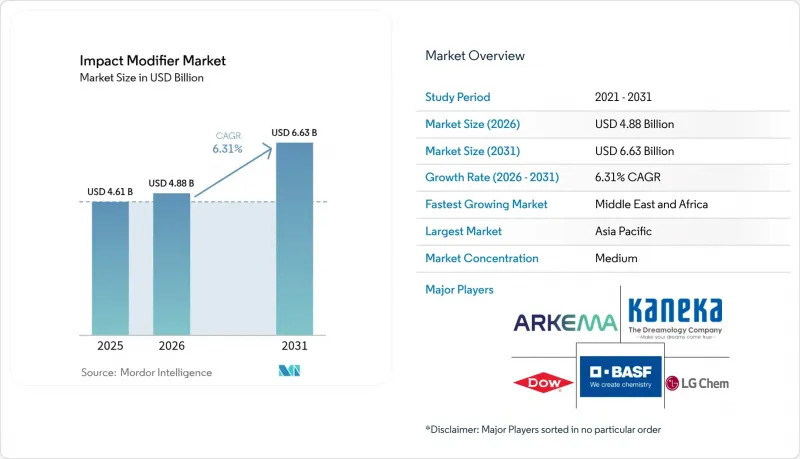
This report is Segmented by Type (Acrylonitrile Butadiene Styrene, Acrylic Impact Modifiers, Acrylonitrile Styrene Acrylate, and More), Application (Polyvinyl Chloride, Nylon, and More), End-User Industry (Packaging, Construction, Automotive, and More), and Geography (Asia-Pacific, North America, Europe, South America, and Middle and Africa). The Market Forecasts are Provided in Terms of Value (USD).
Global Impact Modifier Market Trends and Insights
Growing Packaging Demand
Global e-commerce has tightened package-drop durability standards, lifting impact-modified resin offtake for rigid clamshells and tubs by 7.2% year over year in 2025. Acrylic grades permit clear PET trays to retain transparency after repeated freeze-thaw cycles, a performance essential for North American meal-kit services that expanded 22% in 2025. Reusable-container legislation in 89 countries channels demand toward ethylene-propylene-diene-monomer (EPDM) modifiers that withstand 500 dish-washer cycles at 75°C. Food-contact rules published by the U.S. FDA in 2025 cap residual acrylate monomers at 50 parts per billion, prompting producers to adopt super-critical CO2 extraction that raises manufacturing cost by USD 0.18 per kilogram. Larger producers with in-house extraction systems are therefore capturing share from contract blenders unable to absorb the added expense.
PVC Pipe & Profile Boom
Municipal programs across India, Indonesia and Vietnam accelerated the switch from galvanized iron to PVC, citing installed costs of USD 42 per meter for PVC versus USD 68 for ductile iron and a 50-year service-life guarantee. Chlorinated polyethylene (CPE) modifiers captured 62% of the pressure-pipe segment in 2025 because they retain weld-line strength above 85% of base-resin values, enabling joints to pass ISO 13953 hydrostatic tests at 2.5 MPa. China's 14th Five-Year Plan earmarked CNY 4.8 trillion (USD 670 billion) for urban water networks, absorbing 780,000 metric tons of impact-modified PVC in 2025. In Europe, triple-glazed PVC window profiles satisfying the Passive House 0.8 W/m2K standard consumed 290,000 metric tons of acrylonitrile-styrene-acrylate (ASA) in 2025. Certification under the EU Construction Products Regulation 2024 lifted third-party testing expenditure by EUR 0.09 per kilogram, favoring vertically integrated compounders able to amortize the added cost.
Raw-Material Price Volatility
Styrene spot prices swung between USD 950 per metric ton in January 2025 and USD 1,280 in September, a 35% intra-year spread triggered by Asian cracker outages and derivative-demand dips. Butadiene touched USD 1,520 per metric ton in Q4 2025 as U.S. Gulf Coast crackers favored ethane feedstocks that yield 40% less butadiene per ton of ethylene. Non-integrated compounders lacking long-term monomer contracts absorbed USD 0.41 per kilogram cost upticks, yet downstream PVC-pipe extruders kept pass-through below 3% because public tenders in India cap annual escalation at inflation plus one point. Vertically integrated producers representing 38% of global capacity preserved margins by internalizing feedstock swings, widening the competitive gap.
Other drivers and restraints analyzed in the detailed report include:
- Construction-Led Resin Uptake in APAC
- Automotive Lightweighting & Safety Focus
- Tightening VOC & PVC Regulations
For complete list of drivers and restraints, kindly check the Table Of Contents.
Segment Analysis
ABS commanded 33.48% of the impact modifiers market in 2025 on the back of cost-effective toughness for appliance housings and automotive interiors. Within this segment, ABS contributed USD 1.54 billion to the impact modifiers market size, reflecting broad acceptance where opaque finishes and 15 kJ/m2 notched Izod impact strength are sufficient. Acrylic grades, though smaller, are growing at 6.42% CAGR because transparent PVC window profiles and PET clamshells demand weather-stable clarity after 500-hour QUV exposure. MBS occupied 22% of rigid-PVC pipe consumption in 2025 but faces price pressure as Chinese exporters undercut European equivalents by 14%.
Acrylonitrile-styrene-acrylate (ASA) expands for outdoor siding and automotive exterior panels where -30°C impact retention and UV durability are decisive. CPE secured a share owing to its ability to maintain ductility at 2.5 MPa hydrostatic stress for potable-water pipes. EPDM remains niche, yet its dishwasher-cycle endurance aligns with reusable-container mandates. Maleic-anhydride-grafted acrylic variants launched in 2025 now reclaim 92% of virgin toughness in PCR PVC, attracting a USD 0.90 per kilogram premium over standard grades.
Complete Report Scope:
- By Type
- Acrylonitrile Butadiene Styrene (ABS)
- Acrylic Impact Modifiers (AIM)
- Acrylonitrile Styrene Acrylate (ASA)
- Methacrylate-Butadiene- Styrene (MBS)
- Ethylene Propylene Diene Monomer (EPDM)
- Chlorinated Polyethylene (CPE)
- Other Types
- By Application
- Polyvinyl Chloride (PVC)
- Nylon
- Polybutylene Terephthalate (PBT)
- Engineering Plastics
- Other Applications
- By End-user Industry
- Packaging
- Construction
- Automotive
- Consumer Goods
- Electrical and Electronics
- Other End-user Industries
- By Geography
- Asia-Pacific
- China
- India
- Japan
- South Korea
- ASEAN Countries
- Rest of Asia-Pacific
- North America
- United States
- Canada
- Mexico
- Europe
- Germany
- United Kingdom
- France
- Spain
- Italy
- Russia
- NORDIC Countries
- Rest of Europe
- South America
- Brazil
- Argentina
- Rest of South America
- Middle-East and Africa
- Saudi Arabia
- South Africa
- Rest of Middle-East and Africa
- Asia-Pacific
Geography Analysis
Asia-Pacific controlled 47.26% of the impact modifiers market in 2025 and will compound at 6.35% through 2031. China alone produced 6.8 million metric tons of PVC pipes for Belt-and-Road projects, while India's affordable-housing scheme consumed 470,000 metric tons of impact-modified PVC conduit. ASEAN nations placed 12,400 kilometers of rural water pipelines in 2025, with Vietnam and Thailand leading installations. Japan and South Korea filed 47 patents for carbon-fiber-compatible modifiers targeting mass-production BEV battery enclosures from 2027. Regulatory tightening under GB 18581 forced over one-third of Chinese modifier plants to install VOC oxidizers, consolidating capacity among integrated majors.
North America's share expanded as the US EPA fuel-economy rule accelerated steel-to-polymer substitution. Canada upgraded potable-water systems, while Mexico's USD 18 billion automotive near-shoring boom widened engineering-plastic demand. California's Safer Consumer Products framework introduced additional testing layers for styrene-based additives, momentarily delaying rigid-packaging launches.
Europe faces margin pressure from ECHA's 2025 phthalate restrictions and the 30% PCR requirement under the Packaging and Packaging Waste Regulation. Germany, France and Italy jointly absorbed the majority of regional volumes, predominantly window-profile extrusion that must meet the Passive House 0.8 W/m2 K threshold.
South America represented the lowest demand, with Brazil's 7.8 million-unit housing shortfall fueling PVC uptake, and Argentina's lithium operations specifying impact-modified liners for evaporation ponds. The Middle East and Africa are forecast to post the quickest CAGR as Saudi Arabia's USD 3.2 trillion Vision 2030 pipeline specifies impact-modified polymers for 1.5 million homes and 8,500 kilometers of roads. Differential standards persist: SASO allows 120 mg/kg residual styrene versus the EU cap of 100 mg/kg, enabling Gulf producers to underprice European exporters by up to 12% for non-food applications.
- Arkema
- BASF
- SI Group, Inc.
- Akdeniz Kimya
- CLARIANT
- Dow
- Evonik Industries
- Formosa Plastics Corporation
- INEOS Styrolution Group GmbH
- Kaneka Corporation
- LANXESS
- LG Chem
- Mitsubishi Chemical Corporation
- Shandong Novista Chemicals Co.,Ltd.
- Plastics Color Corporation
- Shandong Ruifeng Chemical Cp.Ltd
- SONGWON
- Sundow Polymers Co., Ltd.
- Wacker Chemie AG
Additional Benefits:
- The market estimate (ME) sheet in Excel format
- 3 months of analyst support
TABLE OF CONTENTS
1 Introduction
- 1.1 Study Assumptions & Market Definition
- 1.2 Scope of the Study
2 Research Methodology
3 Executive Summary
4 Market Landscape
- 4.1 Market Overview
- 4.2 Market Drivers
- 4.2.1 Growing packaging demand
- 4.2.2 PVC pipe & profile boom
- 4.2.3 Construction-led resin uptake in APAC
- 4.2.4 Automotive lightweighting & safety focus
- 4.2.5 Recycled-content plastics need compatibilizer-IM hybrids
- 4.3 Market Restraints
- 4.3.1 Raw-material price volatility (styrene, acrylates)
- 4.3.2 Tightening VOC & PVC regulations
- 4.3.3 Processing issues with high-recycle resin streams
- 4.4 Value Chain Analysis
- 4.5 Porter's Five Forces
- 4.5.1 Bargaining Power of Suppliers
- 4.5.2 Bargaining Power of Buyers
- 4.5.3 Threat of New Entrants
- 4.5.4 Threat of Substitute Products
- 4.5.5 Degree of Competition
5 Market Size & Growth Forecasts (Value )
- 5.1 By Type
- 5.1.1 Acrylonitrile Butadiene Styrene (ABS)
- 5.1.2 Acrylic Impact Modifiers (AIM)
- 5.1.3 Acrylonitrile Styrene Acrylate (ASA)
- 5.1.4 Methacrylate-Butadiene- Styrene (MBS)
- 5.1.5 Ethylene Propylene Diene Monomer (EPDM)
- 5.1.6 Chlorinated Polyethylene (CPE)
- 5.1.7 Other Types
- 5.2 By Application
- 5.2.1 Polyvinyl Chloride (PVC)
- 5.2.2 Nylon
- 5.2.3 Polybutylene Terephthalate (PBT)
- 5.2.4 Engineering Plastics
- 5.2.5 Other Applications
- 5.3 By End-user Industry
- 5.3.1 Packaging
- 5.3.2 Construction
- 5.3.3 Automotive
- 5.3.4 Consumer Goods
- 5.3.5 Electrical and Electronics
- 5.3.6 Other End-user Industries
- 5.4 By Geography
- 5.4.1 Asia-Pacific
- 5.4.1.1 China
- 5.4.1.2 India
- 5.4.1.3 Japan
- 5.4.1.4 South Korea
- 5.4.1.5 ASEAN Countries
- 5.4.1.6 Rest of Asia-Pacific
- 5.4.2 North America
- 5.4.2.1 United States
- 5.4.2.2 Canada
- 5.4.2.3 Mexico
- 5.4.3 Europe
- 5.4.3.1 Germany
- 5.4.3.2 United Kingdom
- 5.4.3.3 France
- 5.4.3.4 Spain
- 5.4.3.5 Italy
- 5.4.3.6 Russia
- 5.4.3.7 NORDIC Countries
- 5.4.3.8 Rest of Europe
- 5.4.4 South America
- 5.4.4.1 Brazil
- 5.4.4.2 Argentina
- 5.4.4.3 Rest of South America
- 5.4.5 Middle-East and Africa
- 5.4.5.1 Saudi Arabia
- 5.4.5.2 South Africa
- 5.4.5.3 Rest of Middle-East and Africa
- 5.4.1 Asia-Pacific
6 Competitive Landscape
- 6.1 Market Concentration
- 6.2 Strategic Moves
- 6.3 Market Share(%)/Ranking Analysis
- 6.4 Company Profiles (includes Global level Overview, Market level overview, Core Segments, Financials as available, Strategic Information,Products & Services, and Recent Developments)
- 6.4.1 Arkema
- 6.4.2 BASF
- 6.4.3 SI Group, Inc.
- 6.4.4 Akdeniz Kimya
- 6.4.5 CLARIANT
- 6.4.6 Dow
- 6.4.7 Evonik Industries
- 6.4.8 Formosa Plastics Corporation
- 6.4.9 INEOS Styrolution Group GmbH
- 6.4.10 Kaneka Corporation
- 6.4.11 LANXESS
- 6.4.12 LG Chem
- 6.4.13 Mitsubishi Chemical Corporation
- 6.4.14 Shandong Novista Chemicals Co.,Ltd.
- 6.4.15 Plastics Color Corporation
- 6.4.16 Shandong Ruifeng Chemical Cp.Ltd
- 6.4.17 SONGWON
- 6.4.18 Sundow Polymers Co., Ltd.
- 6.4.19 Wacker Chemie AG
7 Market Opportunities & Future Outlook
- 7.1 White-space and Unmet-Need Assessment

