PUBLISHER: Mordor Intelligence | PRODUCT CODE: 2124080

PUBLISHER: Mordor Intelligence | PRODUCT CODE: 2124080
Purging Compound - Market Share Analysis, Industry Trends & Statistics, Growth Forecasts (2026 - 2031)
According to Mordor Intelligence, the purging compound market size is projected to expand from 25.32 kilotons in 2025 and 26.78 kilotons in 2026 to 35.43 kilotons by 2031, registering a CAGR of 5.76% between 2026 to 2031.
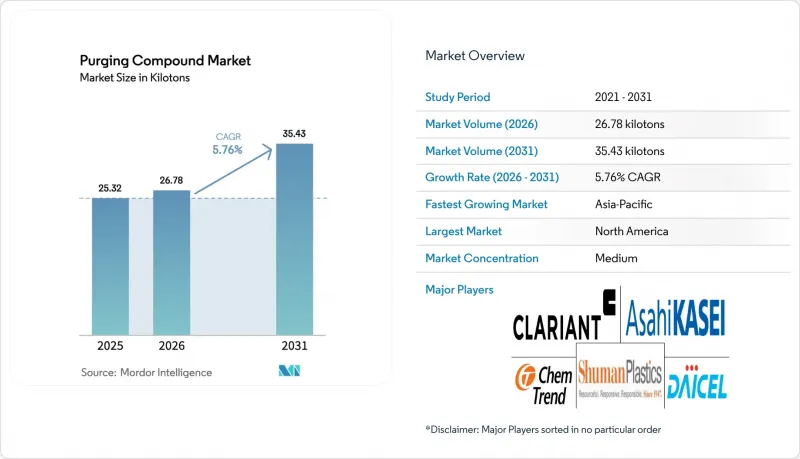
This report is Segmented by Type (Mechanical Purge, Chemical Purge, and Liquid Purge), Process (Injection Molding, Extrusion, and Blow Molding), Application (Automotive and Transportation, Industrial, Consumer Goods, Electronics, and Other Applications), and Geography (Asia-Pacific, North America, Europe, South America, and Middle-East and Africa). The Market Forecasts are Provided in Terms of Volume (Tons).
Global Purging Compound Market Trends and Insights
Rapid Adoption of High-Temperature Engineering Polymers
Processing temperatures above 350 °C for polyetherimide, polyphenylene sulfide, and polyethersulfone accelerate polymer degradation that standard purges cannot remove. BASF's Ultrason PESU lowered processing temperature requirements by about 12.5% in 2024, yet flame-retardant polyamides and polycarbonates still leave carbonized residues on screw flights. Battery enclosures molded under IEC 62660-3 safety norms demand contamination-free conditions to avoid electrical shorts. Processors note purge cycles are 20% longer for these polymers, which lifts volumetric demand. SABIC's USD 220 million ULTEM facility in Singapore added 50% capacity in 2024, enhancing regional availability and stimulating the purging compound market.
Shorter Color and Resin Change-Over Intervals
Industry 4.0 platforms compress change-over windows from hours to minutes, requiring purging compounds capable of cleaning in fewer screw rotations. Asaclean field trials in 2024 demonstrated 47% faster color changes and 67% scrap savings when compared with virgin-resin flushing. Engel's e-victory electric molding machines embed automated purge programs that inject compounds at preset temperature thresholds, reducing operator error. Tier 1 suppliers molding 15-20 color variants per shift gain economic leverage, which in turn enlarges the purging compound market.
Volatile Prices of Specialty Resins and Additives
Price spikes for carrier resins and antioxidant packages compress margins and discourage inventory build-up. BASF lifted Ultraform polyoxymethylene prices by USD 350 per ton in March 2025 amid feedstock inflation. Antioxidant costs rose 10% in March 2024 following outages at Asian suppliers, while the U.S. Producer Price Index for plastic resins logged a negative 1.1% twelve-month change in September 2025, highlighting volatility. Converters in currency-depreciating regions often extend purge intervals or revert to re-grind, dampening short-term demand.
Other drivers and restraints analyzed in the detailed report include:
- Rising Demand for Bio-Based / Low-VOC Purging Chemistries
- Surge in Micro-Lot Packaging and Medical Disposables
- High Unit Price Versus Re-Grind / Virgin Resin
For complete list of drivers and restraints, kindly check the Table Of Contents.
Segment Analysis
Mechanical purges accounted for 55.49% of the purging compound market size in 2025 and are set to expand at a 6.08% CAGR through 2031. Their blend of carrier resin and mineral fillers forms an abrasive slurry that detaches carbonized deposits even at processing temperatures above 300 °C. Chem-Trend's Ultra Purge 3615 demonstrated 85% scrap reduction in 2024 field trials, reinforcing the performance advantage over passive flushing. Chemical purges, though gaining ground where mold-surface integrity is critical, currently hold just under one-third of demand. Liquid purges occupy a niche in hot-runner systems with narrow channels. European sustainability rules are nudging suppliers to replace petro-based carriers with bio-attributed resins, a pivot led by BASF's biomass-balanced Ultrason PESU. The push for low-VOC plants further favors mechanical purges with minimal solvent content, positioning them to defend leadership even as alternative chemistries mature.
Demand differentials arise from process temperature, residue tenacity, and change-over frequency. Injection-molding lines running high-temperature polyamides favor mechanical grades because chemical foaming agents can leave gas pockets inside manifolds. Extrusion processors shift toward chemical grades during long runs to avoid abrasive barrel wear, yet still maintain mechanical products for transition between dark and light colors. Market entrants focusing on bio-based abrasive fillers promise 30% carbon-footprint savings, although price premiums of 15% mean penetration will stay limited to brand owners with explicit climate targets.
Complete Report Scope:
- By Type
- Mechanincal Purge
- Chemcial Purge
- Liquid Purge
- By Process
- Injection Molding
- Extrusion
- Blow Molding
- By Application
- Automotive and Transportation
- Construction
- Industrial
- Consumer Goods
- Electronics
- Other Applications
- By Geography
- Asia-Pacific
- China
- India
- Japan
- South Korea
- ASEAN Countries
- Rest of Asia-Pacific
- North America
- United States
- Canada
- Mexico
- Europe
- Germany
- United Kingdom
- France
- Italy
- Spain
- NORDIC Countries
- Rest of Europe
- South America
- Brazil
- Argentina
- Rest of South America
- Middle-East and Africa
- Saudi Arabia
- South Africa
- Rest of Middle-East and Africa
- Asia-Pacific
Geography Analysis
North America maintained a commanding 50.12% purging compound market share in 2025, thanks to its concentration of advanced automotive and medical molding hubs that value quality over cost. Formosa Plastics' 249,000 ton polypropylene plant started in Texas during Q3 2024, boosting regional resin availability and directly increasing compound use during qualification trials. United States processors comply with FDA biocompatibility rules and EPA air-quality standards that encourage low-VOC purges, whereas Canadian suppliers of surgical disposables echo similar contamination tolerances. Mexico's automotive clusters serving Ford, General Motors, and Volkswagen rely on purging compounds to minimize cosmetic rejects in instrument panels.
Asia-Pacific represents the fastest-growing node with a 6.18% CAGR through 2031, driven by Chinese electric-vehicle momentum, India's USD 2.4 billion advanced chemistry cell incentive, and ASEAN contract manufacturing for electronics. BASF's Zhanjiang Verbund site moved a 1 million-ton ethylene cracker online in November 2025, enlarging downstream polyethylene streams and spurring regional demand for compatible purging compounds. Japan's precision molding sector demands liquid purges suitable for narrow hot-runner channels, while South Korea's share of global semiconductor equipment sales ensures continuous use of chemical purges in chip-packaging injection systems. In India, price sensitivity limits premium adoption, yet exporters to Europe must demonstrate compliance with EU microplastic rules, stimulating gradual uptake.
In Europe, Germany, France, and Italy together molded over half of the region's 52.8 million-ton plastics output in 2023. The EU REACH Regulation 2023/2055 accelerates transition from abrasive mechanical grades to chemical variants that dissolve residues without generating particulate emissions. South America and the Middle East and Africa remain emerging markets for the purging compound market, with Brazil's Braskem and Saudi Arabia's SABIC bundling compounds alongside resins, though lower contamination standards and higher price sensitivity slow progress. IMCD Group's 2024 acquisition of Protea Chemicals expanded technical support in sub-Saharan Africa, hinting at gradual penetration.
- 3M
- Asahi Kasei Corporation
- BASF
- Calsak Corporation
- Chem-Trend L.P.
- CLARIANT
- Daicel Corporation
- Dow Chemical Company
- Formosa Plastics Corporation
- Kuraray Co. Ltd
- Purge Right
- RapidPurge
- Shuman Plastics, Inc.
- Ultra System SA
- VELOX GmbH (IMCD Group)
Additional Benefits:
- The market estimate (ME) sheet in Excel format
- 3 months of analyst support
TABLE OF CONTENTS
1 Introduction
- 1.1 Study Assumptions and Market Definition
- 1.2 Scope of the Study
2 Research Methodology
3 Executive Summary
4 Market Landscape
- 4.1 Market Overview
- 4.2 Market Drivers
- 4.2.1 Rapid Adoption of High-Temperature Engineering Polymers
- 4.2.2 Shorter Color and Resin Change-Over Intervals in Industry 4.0 Plants
- 4.2.3 Rising Demand for Bio-Based / Low-VOC Purging Chemistries
- 4.2.4 Surge in Micro-Lot Packaging and Medical Disposables
- 4.2.5 OEM Qualification Norms for E-Mobility Parts
- 4.3 Market Restraints
- 4.3.1 Volatile Prices of Specialty Resins and Additives
- 4.3.2 High Unit Price Versus Re-Grind/Virgin Resin
- 4.3.3 Regulatory Scrutiny on Micro-Plastic Abrasion
- 4.4 Value Chain Analysis
- 4.5 Porter's Five Forces
- 4.5.1 Threat of New Entrants
- 4.5.2 Bargaining Power of Buyers
- 4.5.3 Bargaining Power of Suppliers
- 4.5.4 Threat of Substitutes
- 4.5.5 Degree of Competition
- 4.6 Raw Material Analysis
5 Market Size and Growth Forecasts (Volume)
- 5.1 By Type
- 5.1.1 Mechanincal Purge
- 5.1.2 Chemcial Purge
- 5.1.3 Liquid Purge
- 5.2 By Process
- 5.2.1 Injection Molding
- 5.2.2 Extrusion
- 5.2.3 Blow Molding
- 5.3 By Application
- 5.3.1 Automotive and Transportation
- 5.3.2 Construction
- 5.3.3 Industrial
- 5.3.4 Consumer Goods
- 5.3.5 Electronics
- 5.3.6 Other Applications
- 5.4 By Geography
- 5.4.1 Asia-Pacific
- 5.4.1.1 China
- 5.4.1.2 India
- 5.4.1.3 Japan
- 5.4.1.4 South Korea
- 5.4.1.5 ASEAN Countries
- 5.4.1.6 Rest of Asia-Pacific
- 5.4.2 North America
- 5.4.2.1 United States
- 5.4.2.2 Canada
- 5.4.2.3 Mexico
- 5.4.3 Europe
- 5.4.3.1 Germany
- 5.4.3.2 United Kingdom
- 5.4.3.3 France
- 5.4.3.4 Italy
- 5.4.3.5 Spain
- 5.4.3.6 NORDIC Countries
- 5.4.3.7 Rest of Europe
- 5.4.4 South America
- 5.4.4.1 Brazil
- 5.4.4.2 Argentina
- 5.4.4.3 Rest of South America
- 5.4.5 Middle-East and Africa
- 5.4.5.1 Saudi Arabia
- 5.4.5.2 South Africa
- 5.4.5.3 Rest of Middle-East and Africa
- 5.4.1 Asia-Pacific
6 Competitive Landscape
- 6.1 Market Concentration
- 6.2 Strategic Moves
- 6.3 Market Share/Ranking Analysis
- 6.4 Company Profiles (includes Global level Overview, Market level overview, Core Segments, Financials as available, Strategic Information, Market Rank/Share, Products and Services, Recent Developments)
- 6.4.1 3M
- 6.4.2 Asahi Kasei Corporation
- 6.4.3 BASF
- 6.4.4 Calsak Corporation
- 6.4.5 Chem-Trend L.P.
- 6.4.6 CLARIANT
- 6.4.7 Daicel Corporation
- 6.4.8 Dow Chemical Company
- 6.4.9 Formosa Plastics Corporation
- 6.4.10 Kuraray Co. Ltd
- 6.4.11 Purge Right
- 6.4.12 RapidPurge
- 6.4.13 Shuman Plastics, Inc.
- 6.4.14 Ultra System SA
- 6.4.15 VELOX GmbH (IMCD Group)
7 Market Opportunities and Future Outlook
- 7.1 White-space and Unmet-need Assessment

