PUBLISHER: Mordor Intelligence | PRODUCT CODE: 2124082

PUBLISHER: Mordor Intelligence | PRODUCT CODE: 2124082
Squalene - Market Share Analysis, Industry Trends & Statistics, Growth Forecasts (2026 - 2031)
According to Mordor Intelligence, the squalene market size is expected to grow from USD 173.20 million in 2025 to USD 182.14 million in 2026 and is forecast to reach USD 243.28 million by 2031 at 5.96% CAGR over 2026-2031.
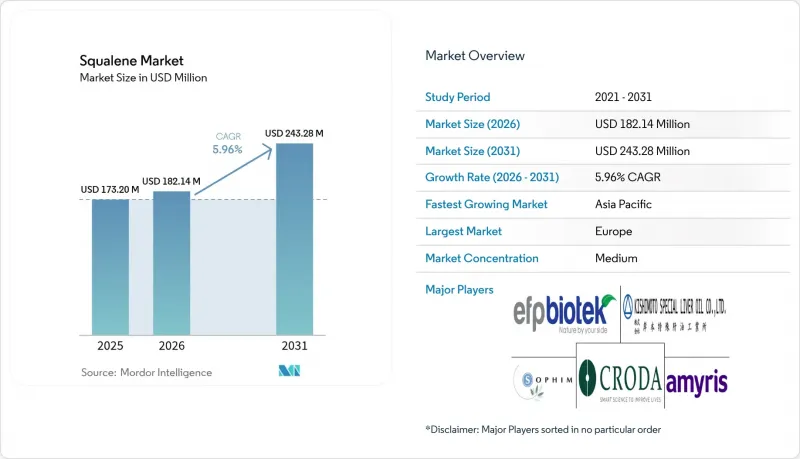
This report is Segmented by Source (Animal Source, Vegetable Source, Biosynthetic and Other Sources), Purity Grade (Cosmetic Grade, Pharmaceutical (GMP) Grade, and Food Grade), End-User Industry (Cosmetics, Pharmaceuticals, Food and Other End-User Industries), and Geography (Asia-Pacific, North America, Europe, South America, The Middle-East and Africa). The Market Forecasts are Provided in Terms of Value (USD).
Global Squalene Market Trends and Insights
Clean-Beauty Boom Boosting Plant and Bio-Fermented Supply
Growing consumer insistence on transparent, cruelty-free labels is forcing cosmetic majors to abandon shark-derived squalene, a shift that has catalyzed capital allocation into olive, amaranth, and fermentation routes. Enzymatic extraction now recovers 0.5-1.0% of squalene from vegetable feedstock, roughly double solvent yields, tightening the squalene market supply chain and improving sustainability credentials. Evonik's PhytoSquene, launched in 2023 and compliant with European Pharmacopoeia, illustrates how clean-beauty preferences dovetail with pharmaceutical-grade requirements. French refiner Sophim raised USD 21.5 million in 2023 to double olive-based capacity, responding to cosmetics and food players willing to pay 20-30% premiums for verified plant origin. Major beauty retailers now oblige suppliers to state squalene provenance on labels, effectively excluding shark sources even where law does not yet impose an outright ban. Industry observers expect shark-oil's contribution to global supply to fall below 10% by 2028 as brands preempt reputational risk.
Accelerating Use in Next-Gen Vaccine Adjuvants
Squalene-containing adjuvants such as MF59 and Sepivac SWE have validated safety at scale, encouraging government stockpiles for pandemic-preparedness. Seqirus's MF59 appears in more than 100 million administered flu vaccine doses, providing a regulatory benchmark that late-stage COVID-19 and universal influenza candidates are following. Microfluidic manufacturing, demonstrated in 2024, shortens batch time to seven hours and delivers 200-liter GMP emulsions, producing material for 5 million doses while lowering capital intensity for contract manufacturers by 40%. These efficiencies position decentralized facilities in emerging markets to meet surging demand without heavy investment. Early-phase oncology immunotherapies are also trialing squalene adjuvant systems that stimulate T-cell responses, hinting at broader pharmaceutical uptake. If regulatory approvals accelerate, pharmaceutical-grade offtake could exceed current forecasts and stretch capacity in the squalene market.
Climate-Linked Volatility in Olive and Amaranth Feedstock Pricing
Mediterranean droughts cut Spanish and Italian olive yields during 2023-2024, lifting feedstock costs and squeezing refiners without long-term contracts. Amaranth harvests in the Andes fluctuate 20-30% year on year, compelling processors to carry costly inventory buffers. Meanwhile, 16% of global vegetable oil now flows into biodiesel, diverting raw materials that could otherwise become squalene. The dual shocks of climate and biofuel demand can compress cosmetic-grade margins by 15-25% within a quarter. Unless drought-resistant cultivars scale quickly, price volatility will remain a near-term headwind for the squalene market.
Other drivers and restraints analyzed in the detailed report include:
- Synthetic-Biology Cost Curve Crossing Shark-Oil Pricing
- Regulatory Tailwinds Banning Shark-Sourced Ingredients
- Global Fermentation-Grade Sugar Price Spikes (Biofuel Competition)
For complete list of drivers and restraints, kindly check the Table Of Contents.
Segment Analysis
Vegetable-source squalene represented 38.22% of squalene market share in 2025 and is projected to advance at a 6.96% CAGR, outperforming animal-derived supply. Expansion by olive refiners in Spain and France and amaranth processors in Argentina and Peru is supported by capital aimed at meeting GMP requirements for both cosmetic and pharmaceutical channels. The squalene market size for vegetable source is therefore set to climb steadily as retail mandates solidify plant-only positioning in prestige beauty.
Biosynthetic is growing already indispensable for vaccine adjuvants. Amyris's 1.8 million-liter Barra Bonita footprint anchors global supply agreements with Croda, which uses the feedstock for pharmaceutical-grade emulsions. Ongoing metabolic-engineering breakthroughs promise even greater yields that can trim cost curves further. Conversely, animal-source share is shrinking under CITES trade limits and consumer backlash. As more jurisdictions legislate origin labeling, shark-oil segments will continue to decline, reinforcing a structural pivot toward sustainable feedstocks in the squalene market.
Complete Report Scope:
- By Source
- Vegetable Source
- Animal Source
- Biosynthetic
- Other Sources
- By Purity Grade
- Cosmetic Grade
- Pharmaceutical (GMP) Grade
- Food Grade
- By End-user Industry
- Cosmetics
- Pharmaceuticals
- Food
- Other End-user Industries
- By Geography
- Asia-Pacific
- China
- India
- Japan
- South Korea
- Malaysia
- Thailand
- Indonesia
- Vietnam
- Rest of Asia-Pacific
- North America
- United States
- Canada
- Mexico
- Europe
- Germany
- United Kingdom
- France
- Italy
- Spain
- NORDIC Countries
- Russia
- Turkey
- Rest of Europe
- South America
- Brazil
- Argentina
- Colombia
- Rest of South America
- Middle-East and Africa
- Saudi Arabia
- United Arab Emirates
- Qatar
- Egypt
- Nigeria
- South Africa
- Rest of Middle-East and Africa
- Asia-Pacific
Geography Analysis
Europe held 42.08% squalene market share in 2025, anchored by legacy olive supply chains in Spain, Italy, and France and by GMP plants serving vaccine hubs. The EU cosmetics rulebook obliges INCI transparency, favoring plant or biosynthetic inputs over shark derivatives, and regional refiners such as Sophim have expanded to capture both cosmetic and food verticals. Evonik's PhytoSquene award underscores Europe's commitment to pharmaceutical-grade innovation.
North America benefits from clean-beauty enthusiasm and government assessments framing biosynthetic squalene as a strategic asset. Nearshoring of vegetable refining into Mexico adds logistical resilience, while U.S. firms monitor potential regulatory shifts that could mirror Europe's stricter stance on animal sourcing.
Asia-Pacific is the fastest-growing region, advancing at 6.79% CAGR through 2031. Chinese, Indian, and Korean brands are incorporating plant-based and biosynthetic squalene into affordable SKUs, widening addressable volume. India's vaccine-manufacturing expansion seeks cost-effective GMP squalene, and local fermentation clusters can meet both domestic and export demand. Japanese and South-Korean premium brands employ squalene to cement skin-compatible reputations, while Southeast Asian nations explore palm and coconut-based extraction despite lower yields.
South America merges Brazil's fermentation leadership with Argentina's and Peru's amaranth agriculture. Amyris's plant signals export potential if feedstock costs stabilize. Middle-East and Africa currently import most requirements, yet vaccine facility build-outs in Saudi Arabia and Egypt imply future pharmaceutical-grade demand.
- Aasha Biochem
- Amyris
- Arista Industries, Inc.
- Croda International Plc
- efpbiotek
- Evonik Industries AG
- GIHI CHEMICALS CO., LIMITED
- KISHIMOTO SPECIAL LIVER OIL CO., LTD.
- KURARAY CO., LTD.
- Oleicfat SL
- ROELMI HPC
- SeaDragon
- Seppic
- Sophim
- Unilong Industry Co., Ltd.
- Vestan
Additional Benefits:
- The market estimate (ME) sheet in Excel format
- 3 months of analyst support
TABLE OF CONTENTS
1 Introduction
- 1.1 Study Assumptions and Market Definition
- 1.2 Scope of the Study
2 Research Methodology
3 Executive Summary
4 Market Landscape
- 4.1 Market Overview
- 4.2 Market Drivers
- 4.2.1 Clean-beauty boom boosting plant and bio-fermented supply
- 4.2.2 Accelerating use in next-gen vaccine adjuvants
- 4.2.3 Synthetic-biology cost curve crossing shark-oil pricing
- 4.2.4 Regulatory tailwinds banning shark-sourced ingredients
- 4.2.5 Emerging oncology nano-delivery trials adopting high-purity squalene
- 4.3 Market Restraints
- 4.3.1 Climate-linked volatility in olive and amaranth feedstock pricing
- 4.3.2 Global fermentation-grade sugar price spikes (biofuel competition)
- 4.3.3 Pharmaceutical-grade capacity bottlenecks for lipid adjuvants
- 4.4 Value Chain Analysis
- 4.5 Porter's Five Forces
- 4.5.1 Bargaining Power of Suppliers
- 4.5.2 Bargaining Power of Buyers
- 4.5.3 Threat of New Entrants
- 4.5.4 Threat of Substitutes
- 4.5.5 Degree of Competition
5 Market Size and Growth Forecasts (Value)
- 5.1 By Source
- 5.1.1 Vegetable Source
- 5.1.2 Animal Source
- 5.1.3 Biosynthetic
- 5.1.4 Other Sources
- 5.2 By Purity Grade
- 5.2.1 Cosmetic Grade
- 5.2.2 Pharmaceutical (GMP) Grade
- 5.2.3 Food Grade
- 5.3 By End-user Industry
- 5.3.1 Cosmetics
- 5.3.2 Pharmaceuticals
- 5.3.3 Food
- 5.3.4 Other End-user Industries
- 5.4 By Geography
- 5.4.1 Asia-Pacific
- 5.4.1.1 China
- 5.4.1.2 India
- 5.4.1.3 Japan
- 5.4.1.4 South Korea
- 5.4.1.5 Malaysia
- 5.4.1.6 Thailand
- 5.4.1.7 Indonesia
- 5.4.1.8 Vietnam
- 5.4.1.9 Rest of Asia-Pacific
- 5.4.2 North America
- 5.4.2.1 United States
- 5.4.2.2 Canada
- 5.4.2.3 Mexico
- 5.4.3 Europe
- 5.4.3.1 Germany
- 5.4.3.2 United Kingdom
- 5.4.3.3 France
- 5.4.3.4 Italy
- 5.4.3.5 Spain
- 5.4.3.6 NORDIC Countries
- 5.4.3.7 Russia
- 5.4.3.8 Turkey
- 5.4.3.9 Rest of Europe
- 5.4.4 South America
- 5.4.4.1 Brazil
- 5.4.4.2 Argentina
- 5.4.4.3 Colombia
- 5.4.4.4 Rest of South America
- 5.4.5 Middle-East and Africa
- 5.4.5.1 Saudi Arabia
- 5.4.5.2 United Arab Emirates
- 5.4.5.3 Qatar
- 5.4.5.4 Egypt
- 5.4.5.5 Nigeria
- 5.4.5.6 South Africa
- 5.4.5.7 Rest of Middle-East and Africa
- 5.4.1 Asia-Pacific
6 Competitive Landscape
- 6.1 Market Concentration
- 6.2 Strategic Moves
- 6.3 Market Share(%)/Ranking Analysis
- 6.4 Company Profiles (includes Global level Overview, Market level overview, Core Segments, Financials as available, Strategic Information, Products and Services, and Recent Developments)
- 6.4.1 Aasha Biochem
- 6.4.2 Amyris
- 6.4.3 Arista Industries, Inc.
- 6.4.4 Croda International Plc
- 6.4.5 efpbiotek
- 6.4.6 Evonik Industries AG
- 6.4.7 GIHI CHEMICALS CO., LIMITED
- 6.4.8 KISHIMOTO SPECIAL LIVER OIL CO., LTD.
- 6.4.9 KURARAY CO., LTD.
- 6.4.10 Oleicfat SL
- 6.4.11 ROELMI HPC
- 6.4.12 SeaDragon
- 6.4.13 Seppic
- 6.4.14 Sophim
- 6.4.15 Unilong Industry Co., Ltd.
- 6.4.16 Vestan
7 Market Opportunities and Future Outlook
- 7.1 White-space and Unmet-need Assessment
- 7.2 Microbial Strains for Improved Productivity and Yields of Squalene

