PUBLISHER: Mordor Intelligence | PRODUCT CODE: 2124106

PUBLISHER: Mordor Intelligence | PRODUCT CODE: 2124106
Current Sensor - Market Share Analysis, Industry Trends & Statistics, Growth Forecasts (2026 - 2031)
According to Mordor Intelligence, the current sensor market size is expected to grow from USD 3.89 billion in 2025 to USD 4.25 billion in 2026 and is forecast to reach USD 6.57 billion by 2031 at 9.13% CAGR over 2026-2031.
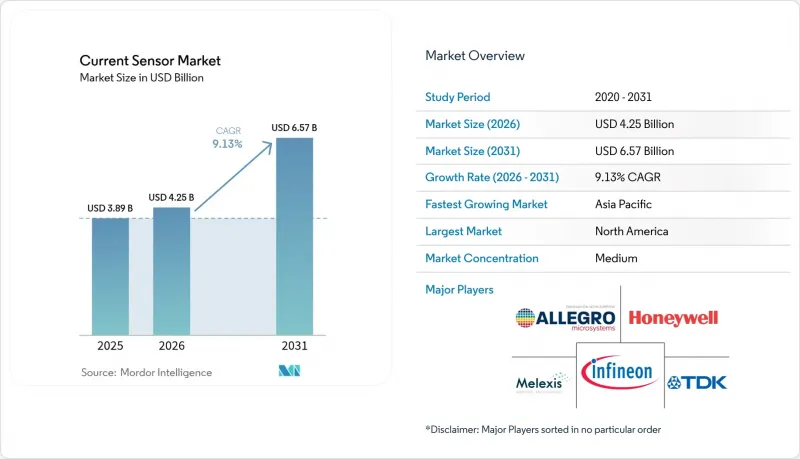
This report is Segmented by Sensor Type (Hall-Effect Sensors, Fiber-Optic Current Sensors, Inductive/CT Sensors, and More), Isolation Technology (Open-Loop Isolated, and More), Current Range (600A), End-User Industry (Automotive and Transportation, Industrial Automation and Robotics, Energy and Power, and More), and Geography
Global Current Sensor Market Trends and Insights
Proliferation of Battery-Powered and Renewable-Energy Systems
Utility-scale solar and storage projects installed multiple monitoring points-DC combiner boxes, inverter inputs, and grid-tie links-creating a multiplier effect on sensor demand per megawatt. Bidirectional vehicle-to-grid (V2G) interfaces required sub-1% accuracy when measuring charge and discharge currents, pressuring traditional Hall-effect devices and boosting fiber-optic adoption for their electromagnetic immunity. Asia-Pacific installations paired renewable-energy mandates with EV incentives, compounding sensor demand across automotive, industrial, and grid markets. Distributed-energy deployments also favored non-intrusive Rogowski coils for retrofit accuracy checks. Integrators increasingly specified digital interfaces, so field data fed directly into predictive-maintenance platforms.
Acceleration of EV Electrification and ADAS Integration
Premium EVs migrated to 800 V architectures, compelling sensors to sustain >=5 kV isolation while delivering microsecond response times. A single battery-electric vehicle already required up to 50 current measurement points spanning traction inverters, battery-management systems (BMS), and thermal loops. ADAS actuators in steer-by-wire and brake-by-wire modules added redundant sensing channels for ISO 26262 compliance. TMR solutions gained share through superior temperature stability and lower quiescent current, positioning suppliers like Allegro MicroSystems to replace legacy Hall-effect parts in powertrain and chassis domains. SiC inverters, switching above 100 kHz, stretched bandwidth expectations beyond conventional current transformers, spurring investment in integrated sensing within power modules.
Average-Selling-Price Erosion in Hall-Effect Sensors
Chinese fabs flooded commodity automotive grades, squeezing gross margins and triggering consolidation among incumbent suppliers. Tier-1 integrators centralized procurement to extract volume discounts, accelerating a race-to-bottom dynamic in the entry-level Hall-effect tier. Vendors attempted to differentiate through system-in-package features-diagnostics or digital interfaces-but price gaps still widened. Many niche manufacturers pivoted toward TMR or fiber-optic portfolios; however, the steep R&D commitment and lengthy automotive qualification deterred smaller firms. Integrated module strategies partly countered price pressure by bundling sensor plus MCU supervision within power stages, aligning with OEM value-based sourcing models.
Other drivers and restraints analyzed in the detailed report include:
- Functional-Safety Mandates (ISO 26262, IEC 61508)
- High-Frequency GaN/SiC Power-Electronics Miniaturization
- Supply-Chain Tightness for High-Permeability Core Alloys
For complete list of drivers and restraints, kindly check the Table Of Contents.
Segment Analysis
Hall-effect devices captured 47.55% revenue in 2025 due to mature production lines and proven reliability across traction inverters and industrial drives. Yet their bandwidth ceiling and thermal drift propelled designers toward TMR and fiber-optic options. Fiber-optic sensors recorded a 12.21% CAGR for 2026-2031 as renewable-energy installers specified galvanic-free measurement in high-voltage switchyards. TMR delivered 10X sensitivity over legacy Hall-effect, enabling low-ohmic drop in BMS shunt replacements and cutting standby power in battery packs.
Advanced EV inverters integrated a co-packaged TMR die for instantaneous phase-current feedback that met 1 MHz bandwidth targets. The current sensor market size for fibre-optic devices is forecast to reach USD 1,012 million by 2031 amid HVDC expansion. Inductive CTs retained a foothold above 1,000 A, while Rogowski coils addressed retrofit audits without interrupting conductors. The transition accelerated as power-density roadmaps demanded non-saturating, low-profile options suitable for tight module footprints.
Open-loop architectures dominated with 56.58% share, balancing cost and safety for 400 V EV packs and 600 V solar inverters. Closed-loop devices-leveraging magnetic feedback for +-0.5% accuracy-posted an 11.12% CAGR as designers sharpened efficiency metrics. These sensors offset ambient temperature drift in onboard chargers and servo drives, ensuring regulators met eco-design standards in Europe. Current sensor market share for closed-loop options is expected to climb toward 41.05% by 2031.
Non-isolated shunt sensors thrived in emerging 48 V mild-hybrid platforms where galvanic isolation was non-mandatory. However, pack-level voltages creeping toward 60 V threatened their addressable window, inciting suppliers to pair shunts with digital isolators in hybrid packages. The convergence of analog front-end, sigma-delta converter, and isolation channel in a single IC redefined BOM costs and shrank PCB real estate, strengthening the closed-loop value proposition.
Complete Report Scope:
- By Sensor Type
- Hall-Effect Sensors
- Fiber-Optic Current Sensors
- Inductive / CT Sensors
- Fluxgate Sensors
- Rogowski-Coil Sensors
- By Isolation Technology
- Open-Loop (Isolated)
- Closed-Loop (Isolated)
- Non-Isolated (Shunt-based)
- By Current Range
- <50 A
- 50 - 200 A
- 200 - 600 A
- >600 A
- By End-User Industry
- Automotive and Transportation
- Industrial Automation and Robotics
- Energy and Power (Solar, Wind, ESS)
- Consumer Electronics
- Telecom and Data-Centers
- Medical Devices
- By Geography
- North America
- United States
- Canada
- Mexico
- South America
- Brazil
- Argentina
- Rest of South America
- Europe
- Germany
- United Kingdom
- France
- Italy
- Russia
- Rest of Europe
- Asia-Pacific
- China
- Japan
- South Korea
- India
- ASEAN
- Rest of Asia-Pacific
- Middle East and Africa
- Middle East
- Saudi Arabia
- United Arab Emirates
- Turkey
- Rest of Middle East
- Africa
- South Africa
- Nigeria
- Rest of Africa
- Middle East
- North America
Geography Analysis
Asia-Pacific led with 46.27% revenue in 2025 because China scaled EV output and maintained dominant semiconductor packaging capacity. Governments funded renewables, prompting domestic fiber-optic sensor startups to emerge. Japan leveraged precision-manufacturing heritage to commercialize advanced TMR products, while South Korea integrated current sensing in SiC power-module export lines.
North America ranked second. Hyperscale data-center spending and Inflation Reduction Act incentives for clean-energy projects spurred sensor procurement. United States reshoring programs favored local fabrication of safety-critical components destined for grid infrastructure and defense. Canada's push for battery-raw-material autonomy underpinned regional sensor demand tied to mining electrification.
Europe pursued stringent CO2 targets and functional-safety mandates, sustaining high ASPs for automotive-grade closed-loop devices. Germany and France hosted key R&D hubs linking sensor design with GaN inverter start-ups. The Middle East and Africa recorded emerging demand via solar-park investments, whereas Latin America's growth followed automotive assembly clusters in Mexico and Brazil. Across regions, the current sensor market size co-moved with battery manufacturing footprints and renewable-energy capex.
- Allegro MicroSystems Inc.
- TDK Corporation (TDK-Micronas GmbH)
- Asahi Kasei Microdevices Corp.
- Infineon Technologies AG
- Tamura Corporation
- Melexis NV
- Honeywell International Inc.
- Texas Instruments Inc.
- Sensitec GmbH
- LEM International SA
- Pulse Electronics Corp.
- ACEINNA Inc.
- Vacuumschmelze GmbH & Co KG
- MagnTek Microelectronics Co. Ltd.
- NewJapanRadio Co. Ltd.
- Murata Manufacturing Co. Ltd.
- Onsemi Corp.
- ROHM Semiconductor Co. Ltd.
- Sensata Technologies Inc.
- NK Technologies
- ABB Ltd.
- CR Magnetics Inc.
- Eaton Corp. plc
- LEMKEN AG
- Topworx Inc.
- Schneider Electric SE
Additional Benefits:
- The market estimate (ME) sheet in Excel format
- 3 months of analyst support
TABLE OF CONTENTS
1 INTRODUCTION
- 1.1 Study Assumptions and Market Definition
- 1.2 Scope of the Study
2 RESEARCH METHODOLOGY
3 EXECUTIVE SUMMARY
4 MARKET LANDSCAPE
- 4.1 Market Overview
- 4.2 Market Drivers
- 4.2.1 Proliferation of battery-powered and renewable energy systems
- 4.2.2 Acceleration of EV electrification and ADAS integration
- 4.2.3 Functional-safety mandates (ISO 26262, IEC 61508)
- 4.2.4 Surge in bidirectional on-board charger (V2G) deployments
- 4.2.5 High-frequency GaN/SiC power-electronics miniaturization
- 4.2.6 Data-center power monitoring for AI workloads
- 4.3 Market Restraints
- 4.3.1 Average-selling-price erosion in Hall-effect sensors
- 4.3.2 Accuracy drift vs. shunt / CT alternatives
- 4.3.3 Supply-chain tightness for high-permeability core alloys
- 4.3.4 Cyber-security compliance costs in smart-grid metering
- 4.4 Evaluation of Critical Regulatory Framework
- 4.5 Value Chain Analysis
- 4.6 Technological Outlook
- 4.7 Porter's Five Forces
- 4.7.1 Bargaining Power of Suppliers
- 4.7.2 Bargaining Power of Buyers
- 4.7.3 Threat of New Entrants
- 4.7.4 Threat of Substitutes
- 4.7.5 Competitive Rivalry
- 4.8 Impact Assessment of Key Stakeholders
- 4.9 Key Use Cases and Case Studies
- 4.10 Impact on Macroeconomic Factors of the Market
- 4.11 Investment Analysis
5 MARKET SEGMENTATION
- 5.1 By Sensor Type
- 5.1.1 Hall-Effect Sensors
- 5.1.2 Fiber-Optic Current Sensors
- 5.1.3 Inductive / CT Sensors
- 5.1.4 Fluxgate Sensors
- 5.1.5 Rogowski-Coil Sensors
- 5.2 By Isolation Technology
- 5.2.1 Open-Loop (Isolated)
- 5.2.2 Closed-Loop (Isolated)
- 5.2.3 Non-Isolated (Shunt-based)
- 5.3 By Current Range
- 5.3.1 <50 A
- 5.3.2 50 - 200 A
- 5.3.3 200 - 600 A
- 5.3.4 >600 A
- 5.4 By End-User Industry
- 5.4.1 Automotive and Transportation
- 5.4.2 Industrial Automation and Robotics
- 5.4.3 Energy and Power (Solar, Wind, ESS)
- 5.4.4 Consumer Electronics
- 5.4.5 Telecom and Data-Centers
- 5.4.6 Medical Devices
- 5.5 By Geography
- 5.5.1 North America
- 5.5.1.1 United States
- 5.5.1.2 Canada
- 5.5.1.3 Mexico
- 5.5.2 South America
- 5.5.2.1 Brazil
- 5.5.2.2 Argentina
- 5.5.2.3 Rest of South America
- 5.5.3 Europe
- 5.5.3.1 Germany
- 5.5.3.2 United Kingdom
- 5.5.3.3 France
- 5.5.3.4 Italy
- 5.5.3.5 Russia
- 5.5.3.6 Rest of Europe
- 5.5.4 Asia-Pacific
- 5.5.4.1 China
- 5.5.4.2 Japan
- 5.5.4.3 South Korea
- 5.5.4.4 India
- 5.5.4.5 ASEAN
- 5.5.4.6 Rest of Asia-Pacific
- 5.5.5 Middle East and Africa
- 5.5.5.1 Middle East
- 5.5.5.1.1 Saudi Arabia
- 5.5.5.1.2 United Arab Emirates
- 5.5.5.1.3 Turkey
- 5.5.5.1.4 Rest of Middle East
- 5.5.5.2 Africa
- 5.5.5.2.1 South Africa
- 5.5.5.2.2 Nigeria
- 5.5.5.2.3 Rest of Africa
- 5.5.5.1 Middle East
- 5.5.1 North America
6 COMPETITIVE LANDSCAPE
- 6.1 Market Concentration
- 6.2 Strategic Moves
- 6.3 Market Share Analysis
- 6.4 Company Profiles {(includes Global level Overview, Market level overview, Core Segments, Financials as available, Strategic Information, Market Rank/Share for key companies, Products and Services, and Recent Developments)}
- 6.4.1 Allegro MicroSystems Inc.
- 6.4.2 TDK Corporation (TDK-Micronas GmbH)
- 6.4.3 Asahi Kasei Microdevices Corp.
- 6.4.4 Infineon Technologies AG
- 6.4.5 Tamura Corporation
- 6.4.6 Melexis NV
- 6.4.7 Honeywell International Inc.
- 6.4.8 Texas Instruments Inc.
- 6.4.9 Sensitec GmbH
- 6.4.10 LEM International SA
- 6.4.11 Pulse Electronics Corp.
- 6.4.12 ACEINNA Inc.
- 6.4.13 Vacuumschmelze GmbH & Co KG
- 6.4.14 MagnTek Microelectronics Co. Ltd.
- 6.4.15 NewJapanRadio Co. Ltd.
- 6.4.16 Murata Manufacturing Co. Ltd.
- 6.4.17 Onsemi Corp.
- 6.4.18 ROHM Semiconductor Co. Ltd.
- 6.4.19 Sensata Technologies Inc.
- 6.4.20 NK Technologies
- 6.4.21 ABB Ltd.
- 6.4.22 CR Magnetics Inc.
- 6.4.23 Eaton Corp. plc
- 6.4.24 LEMKEN AG
- 6.4.25 Topworx Inc.
- 6.4.26 Schneider Electric SE
7 MARKET OPPORTUNITIES AND FUTURE OUTLOOK
- 7.1 White-space and Unmet-Need Assessment

