PUBLISHER: Mordor Intelligence | PRODUCT CODE: 2124115

PUBLISHER: Mordor Intelligence | PRODUCT CODE: 2124115
Signal Generator - Market Share Analysis, Industry Trends & Statistics, Growth Forecasts (2026 - 2031)
According to Mordor Intelligence, signal generator market size in 2026 is estimated at USD 1.89 billion, growing from 2025 value of USD 1.79 billion with 2031 projections showing USD 2.45 billion, growing at 5.34% CAGR over 2026-2031.
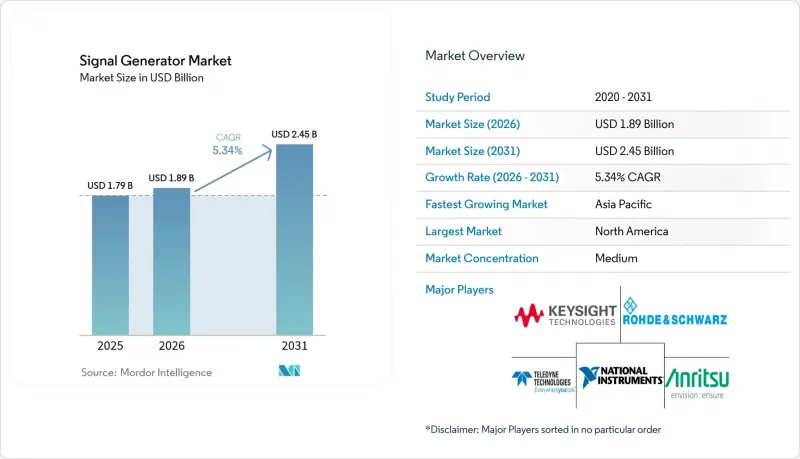
This report is Segmented by Product (General-Purpose Signal Generator, and More), Frequency Range (Less Than 3 GHz, 3-6 GHz, 6-12 GHz, and Above 12 GHz), Form Factor (Benchtop, and More), Technology (2G, 3G, 4G, and 5G NR), Application (Designing, Testing, and More), End-User Industry (Telecommunications, Automotive, and More), and Geography. The Market Forecasts are Provided in Terms of Value (USD).
Global Signal Generator Market Trends and Insights
Accelerated 5G Base-Station Roll-outs in Asia Requiring High-Frequency Vector Signal Generators
China expects more than 4.5 million live 5G base stations in 2025, up from 4.19 million in 2024, obligating operators to purchase multi-channel vector units that validate sub-6 GHz and mmWave waveforms with tight phase coherence. Each site needs several generators for RF conformance, and the domino effect now extends to India and Southeast Asia, which are fast-tracking open-RAN trials. MIMO and beamforming checks call for wider modulation bandwidths, propelling premium models that cover 3.5-28 GHz. Microwave backhaul, used by 60% of cell sites, pushes additional procurement of high-frequency sources. Consequently, Asia-Pacific is shaping the demand curve for the signal generator market well into the medium term.
Radar Upgrade Programs in North-American A&D Boosting Demand for Above 18 GHz Generators
The U.S. Department of Defense funds GaN-based AESA retrofits, prompting contractors to secure generators capable of 8-54 GHz threat-scenario emulation. Keysight's VXG series, which streams coherent multichannel waveforms up to 54 GHz, typifies the new benchmark. Compounded by electronic-warfare red-team exercises and domestic sourcing mandates, demand for ultra-low phase-noise sources will persist into the next decade, incrementally lifting the signal generator market growth.
Entry-Level Chinese Benchtop Units Eroding Prices in LATAM
Chinese vendors leverage post-COVID supply normalization to ship 6 GHz generators at prices 30-40% under Western brands, especially in price-sensitive South America. Component availability gives them cost levers, pressuring incumbents to defend margins or migrate upmarket. The resulting discounting pulls average selling prices down, trimming near-term revenue growth for the signal generator market.
Other drivers and restraints analyzed in the detailed report include:
- mmWave Automotive Radar Prototyping by European Tier-1s Fuels Multi-Channel AWG Sales
- Semiconductor Test Capacity Expansions in Taiwan and South Korea Driving PXI Modular Units
- GaAs/MMIC Shortages Delaying European Deliveries
For complete list of drivers and restraints, kindly check the Table Of Contents.
Segment Analysis
General-purpose instruments accounted for 46.10% of 2025 revenue, underscoring their versatility across RF education, troubleshooting, and legacy wireless protocols. However, vector and arbitrary-waveform units, buoyed by 5G NR's complex numerologies, will post a 6.85% CAGR and steadily shrink the gap. The signal generator market size for vector products is set to outpace conventional gear as two-box architectures give way to integrated I/Q modulators. Segment leaders now embed digital up-conversion and wide-bandwidth RF chains to span sub-GHz through 40 GHz, allowing one chassis to replace several legacy models.
Software-defined moves, such as Rohde & Schwarz's SMW200A, which adds mmWave amplifiers via plug-in heads, grant path-to-terahertz upgrades without full capital refresh. Function generators keep a niche in academia, though shrinking price gaps encourage labs to purchase entry-level AWGs instead. Across OEM R&D, twin drivers - time-to-market and reduced rack footprints - sustain demand for hybrid generation-and-analysis benches, reaffirming a premium for accuracy and spectral purity in the signal generator market.
The 3-6 GHz block delivered 33.70% of 2025 turnover through sub-6 GHz 5G, Wi-Fi 6E, and industrial IoT use cases. Yet, automotive radar, 5G mmWave backhaul, and satellite uplinks propel frequencies above 12 GHz at a 9.12% CAGR. Dual-path architectures covering DC-to-44 GHz compress multiple instruments into one, simplifying calibration chains.
Photonic techniques - demonstrated by Rohde & Schwarz's ultra-stable tunable THz sources - extend internal references well past 100 GHz, a prerequisite for 6G trials. GaN front-ends mitigate output-power roll-off, though gallium constraints loom. As instruments flex wider instantaneous bandwidths, traditional band-based segmentation fades, yet procurement budgets still reference historic cutoff points, preserving clarity when allocating spend across the signal generator market.
Complete Report Scope:
- By Product
- General-Purpose Signal Generator
- RF Signal Generator
- Microwave Signal Generator
- Arbitrary Waveform Generator
- Special-Purpose Signal Generator
- Video Signal Generator
- Audio Signal Generator
- Pitch Generator
- Function Generator
- Analog Function Generator
- Digital Function Generator
- Sweep Function Generator
- General-Purpose Signal Generator
- By Frequency Range
- Less than 3 GHz
- 3-6 GHz
- 6-12 GHz
- Above 12 GHz (mmWave)
- By Form Factor
- Benchtop
- Portable/Handheld
- Modular/PXI
- By Technology
- 2G (GSM, CDMA)
- 3G (W-CDMA, CDMA2000)
- 4G (LTE, WiMAX)
- 5G NR
- By Application
- Designing
- Testing
- Manufacturing
- Certification
- Troubleshooting
- Repairing
- By End-User Industry
- Telecommunications
- Aerospace and Defense
- Automotive
- Electronics Manufacturing and Semiconductors
- Healthcare/Medical Devices
- Education and Research
- By Geography
- North America
- United States
- Canada
- Mexico
- Europe
- Germany
- United Kingdom
- France
- Italy
- Spain
- Nordics (Denmark, Sweden, Norway, Finland)
- Rest of Europe
- Asia-Pacific
- China
- Japan
- South Korea
- India
- Southeast Asia
- Australia
- Rest of Asia-Pacific
- South America
- Brazil
- Argentina
- Rest of South America
- Middle East and Africa
- Middle East
- United Arab Emirates
- Saudi Arabia
- Rest of Middle East
- Africa
- South Africa
- Nigeria
- Rest of Africa
- Middle East
- North America
Geography Analysis
North America held 32.10% of 2025 revenue, buoyed by persistent A&D funding and early 5G roll-outs. U.S. federal budgets back radar upgrades, while Canadian quantum clusters purchase ultra-low-phase-noise gear for superconducting-qubit experiments. Domestic sourcing preferences following tariff regimes favor local vendors, preserving premium pricing.
Asia-Pacific is the fastest-growing region at 6.18% CAGR through 2031. China's announcement of 4.5 million live 5G macro sites in 2025 guarantees sustained sub-6 GHz vector-generator volume. Taiwan and South Korea will collectively pour more than USD 54 billion into 300 mm fabs by 2027, which will continuously expand PXI slot installations. Government tax credits catalyze local supply-chain clusters, reinforcing a virtuous cycle for the signal generator market.
Europe records steady but slower growth. Automotive radar R&D around Stuttgart, Munich, and Gothenburg anchors high-frequency demand, whereas stricter electromagnetic-emission norms raise test complexity for >20 dBm outputs. Gallium shortages, however, risk delivery delays for 40+ GHz models until on-shore wafer lines come online, marginally damping the regional signal generator market size. The Middle East and Africa, though currently small, invest in sovereign small-sat factories; portable RF sources accompany assembly and launch-site testing, offering upside once launch cadence accelerates.
- Keysight Technologies Inc.
- Rohde and Schwarz GmbH and Co KG
- Tektronix Inc. (Keithley Instruments)
- Anritsu Corporation
- National Instruments Corp.
- Teledyne Technologies Inc.
- BandK Precision Corp.
- Fluke Corporation
- Yokogawa Electric Corporation
- Good Will Instrument Co. Ltd.
- AnaPico AG
- Spirent Communications plc
- Mini-Circuits
- Tabor Electronics Ltd.
- Aim-TTi (Thurlby than dar)
- Siglent Technologies Co. Ltd.
- Rigol Technologies Co. Ltd.
- Stanford Research Systems
- Fortive Corp. (Fluke/Tektronix)
- Pico Technology
Additional Benefits:
- The market estimate (ME) sheet in Excel format
- 3 months of analyst support
TABLE OF CONTENTS
1 INTRODUCTION
- 1.1 Study Assumptions and Market Definition
- 1.2 Scope of the Study
2 RESEARCH METHODOLOGY
3 EXECUTIVE SUMMARY
4 MARKET LANDSCAPE
- 4.1 Market Overview
- 4.2 Market Drivers
- 4.2.1 Accelerated 5G Base-Station Roll-outs in Asia Requiring High-Frequency Vector Signal Generators
- 4.2.2 Radar Upgrade Programs in North-American AandD Boosting Demand for Above 18 GHz Generators
- 4.2.3 mmWave Automotive Radar Prototyping by European Tier-1s Fuels Multi-Channel AWG Sales
- 4.2.4 Semiconductor Test capacity Expansions in Taiwan and South Korea Driving PXI Modular Units
- 4.2.5 Quantum-Computing Research Hubs (Canada, NL) Needing Ultra-Low-Phase-Noise Sources
- 4.2.6 Middle-East Small-Sat Manufacturing Spurs Portable RF Generator Adoption
- 4.3 Market Restraints
- 4.3.1 Entry-Level Chinese Benchtop Units Eroding Prices in LATAM
- 4.3.2 GaAs/MMIC Shortages Delaying European Deliveries
- 4.3.3 EU Electromagnetic Emission Norms Raising Compliance Cost for Above 20 dBm Models
- 4.3.4 RF-Test Talent Shortage in Africa and Oceania Curbing Uptake
- 4.4 Industry Ecosystem Analysis
- 4.5 Technological Outlook
- 4.6 Porter's Five Forces Analysis
- 4.6.1 Bargaining Power of Suppliers
- 4.6.2 Bargaining Power of Buyers
- 4.6.3 Threat of New Entrants
- 4.6.4 Threat of Substitutes
- 4.6.5 Intensity of Competitive Rivalry
5 MARKET SIZE AND GROWTH FORECASTS (VALUES)
- 5.1 By Product
- 5.1.1 General-Purpose Signal Generator
- 5.1.1.1 RF Signal Generator
- 5.1.1.2 Microwave Signal Generator
- 5.1.1.3 Arbitrary Waveform Generator
- 5.1.2 Special-Purpose Signal Generator
- 5.1.2.1 Video Signal Generator
- 5.1.2.2 Audio Signal Generator
- 5.1.2.3 Pitch Generator
- 5.1.3 Function Generator
- 5.1.3.1 Analog Function Generator
- 5.1.3.2 Digital Function Generator
- 5.1.3.3 Sweep Function Generator
- 5.1.1 General-Purpose Signal Generator
- 5.2 By Frequency Range
- 5.2.1 Less than 3 GHz
- 5.2.2 3-6 GHz
- 5.2.3 6-12 GHz
- 5.2.4 Above 12 GHz (mmWave)
- 5.3 By Form Factor
- 5.3.1 Benchtop
- 5.3.2 Portable/Handheld
- 5.3.3 Modular/PXI
- 5.4 By Technology
- 5.4.1 2G (GSM, CDMA)
- 5.4.2 3G (W-CDMA, CDMA2000)
- 5.4.3 4G (LTE, WiMAX)
- 5.4.4 5G NR
- 5.5 By Application
- 5.5.1 Designing
- 5.5.2 Testing
- 5.5.3 Manufacturing
- 5.5.4 Certification
- 5.5.5 Troubleshooting
- 5.5.6 Repairing
- 5.6 By End-User Industry
- 5.6.1 Telecommunications
- 5.6.2 Aerospace and Defense
- 5.6.3 Automotive
- 5.6.4 Electronics Manufacturing and Semiconductors
- 5.6.5 Healthcare/Medical Devices
- 5.6.6 Education and Research
- 5.7 By Geography
- 5.7.1 North America
- 5.7.1.1 United States
- 5.7.1.2 Canada
- 5.7.1.3 Mexico
- 5.7.2 Europe
- 5.7.2.1 Germany
- 5.7.2.2 United Kingdom
- 5.7.2.3 France
- 5.7.2.4 Italy
- 5.7.2.5 Spain
- 5.7.2.6 Nordics (Denmark, Sweden, Norway, Finland)
- 5.7.2.7 Rest of Europe
- 5.7.3 Asia-Pacific
- 5.7.3.1 China
- 5.7.3.2 Japan
- 5.7.3.3 South Korea
- 5.7.3.4 India
- 5.7.3.5 Southeast Asia
- 5.7.3.6 Australia
- 5.7.3.7 Rest of Asia-Pacific
- 5.7.4 South America
- 5.7.4.1 Brazil
- 5.7.4.2 Argentina
- 5.7.4.3 Rest of South America
- 5.7.5 Middle East and Africa
- 5.7.5.1 Middle East
- 5.7.5.1.1 United Arab Emirates
- 5.7.5.1.2 Saudi Arabia
- 5.7.5.1.3 Rest of Middle East
- 5.7.5.2 Africa
- 5.7.5.2.1 South Africa
- 5.7.5.2.2 Nigeria
- 5.7.5.2.3 Rest of Africa
- 5.7.5.1 Middle East
- 5.7.1 North America
6 COMPETITIVE LANDSCAPE
- 6.1 Market Concentration
- 6.2 Strategic Moves (MandA, Partnerships, Product Launches)
- 6.3 Market Share Analysis
- 6.4 Company Profiles (includes Global-Level Overview, Market-Level Overview, Core Segments, Financials as available, Strategic Information, Market Rank/Share, Products and Services, Recent Developments)
- 6.4.1 Keysight Technologies Inc.
- 6.4.2 Rohde and Schwarz GmbH and Co KG
- 6.4.3 Tektronix Inc. (Keithley Instruments)
- 6.4.4 Anritsu Corporation
- 6.4.5 National Instruments Corp.
- 6.4.6 Teledyne Technologies Inc.
- 6.4.7 BandK Precision Corp.
- 6.4.8 Fluke Corporation
- 6.4.9 Yokogawa Electric Corporation
- 6.4.10 Good Will Instrument Co. Ltd.
- 6.4.11 AnaPico AG
- 6.4.12 Spirent Communications plc
- 6.4.13 Mini-Circuits
- 6.4.14 Tabor Electronics Ltd.
- 6.4.15 Aim-TTi (Thurlby than dar)
- 6.4.16 Siglent Technologies Co. Ltd.
- 6.4.17 Rigol Technologies Co. Ltd.
- 6.4.18 Stanford Research Systems
- 6.4.19 Fortive Corp. (Fluke/Tektronix)
- 6.4.20 Pico Technology
7 MARKET OPPORTUNITIES AND FUTURE OUTLOOK
- 7.1 White-Space and Unmet-Need Assessment

