PUBLISHER: Mordor Intelligence | PRODUCT CODE: 2124130

PUBLISHER: Mordor Intelligence | PRODUCT CODE: 2124130
IoT Gateway - Market Share Analysis, Industry Trends & Statistics, Growth Forecasts (2026 - 2031)
According to Mordor Intelligence, the IoT gateway market size reached USD 2.49 billion in 2026 and is projected to climb to USD 4.51 billion by 2031, advancing at a 12.61% CAGR during the forecast span.
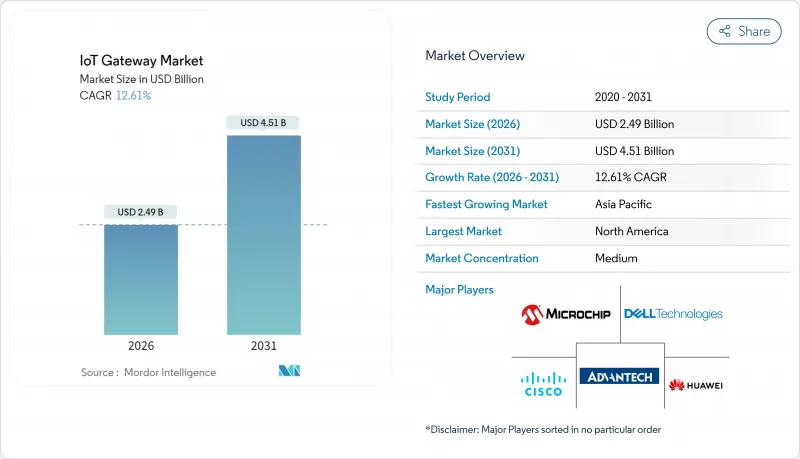
This report is Segmented by Component (Processor, Sensor, and More), End-User Industry (Industrial/Manufacturing, Healthcare and Life Sciences, and More), Deployment Environment (DIN-rail/Guide-rail, and More), Application (Edge AI and Analytics, Remote Monitoring and Telemetry, and More), and Geography. The Market Forecasts are Provided in Terms of Value (USD).
Global IoT Gateway Market Trends and Insights
5G-Enabled Low-Latency Edge Connectivity Roll-Outs
Enterprises are adopting 5G standalone cores that guarantee sub-20 millisecond latency, enabling gateways to control collaborative robots and augmented-reality service tools in real time. Qualcomm's QCS8550 processor combines a 5G RedCap modem with a 12 TOPS AI engine, letting factory operators keep high-throughput vision inference on-premises while sending model retraining jobs to the cloud. Private 5G sites increased by 140% year over year, with gateway shipments into automotive plants accounting for 38% of that volume. RedCap became commercially available in mid-2025, however, most battery-powered sensors still rely on LTE-M, resulting in a two-tier architecture with high-bandwidth and low-power links. Early adopters report that deterministic latency cuts unplanned production stoppages by enabling microsecond-level machine coordination.
Industry 4.0 Adoption and Factory Edge Analytics
Manufacturers embed IoT gateways in CNC machines and conveyors to run predictive maintenance models that flag bearing failures 72 hours in advance, cutting downtime by nearly one-third. Siemens delivered more than 50,000 Industrial Edge gateways in 2024, each shipping with a marketplace for containerized analytics apps. ABB's Ability Edgenius platform, launched in March 2025, enables maintenance teams to deploy TensorFlow Lite models via a drag-and-drop interface, eliminating the need for data science staff. While the return on investment is proven, air-gapped operational networks hinder over-the-air patching; many facilities still use USB keys for firmware updates, thereby extending the mean time to remediation for critical patches.
Fragmented Protocol Standards and Legacy Integration Cost
Gateways juggle Modbus RTU, OPC UA, MQTT, CoAP, and vendor-specific fieldbus, forcing separate software stacks that bloat firmware images and complicate quality assurance. IEEE research shows conversion bugs trigger nearly half of gateway downtime, with data-type mismatches between Modbus and MQTT topping the list. While the Matter protocol gained momentum in smart homes, only a minority of industrial gateways shipped in 2025 support it, leaving factories to maintain parallel stacks indefinitely. Retrofitting a decade-old PLC with Ethernet/IP can cost more than replacing the controller, stalling upgrade projects in cash-constrained plants. OEMs respond by shipping modular gateway mezzanine cards, but these add BOM cost and lengthen certification cycles.
Other drivers and restraints analyzed in the detailed report include:
- Rapid Smart-City LPWAN Gateway Deployments
- AI/ML Inference Moving From Cloud to Gateway Silicon
- Escalating Cyber-Attack Surface at Distributed Gateways
For complete list of drivers and restraints, kindly check the Table Of Contents.
Segment Analysis
Connectivity IC revenue is forecast to expand at 13.11% CAGR during 2026-2031 as multi-radio boards demand discrete RF front-ends for Wi-Fi 7, Bluetooth LE, and 5G RedCap. Qualcomm's tri-band Wi-Fi 7 chipset generates 5.8 Gbps peak throughput, meeting vision inspection workloads that stream 4K video from production lines. Processors remain the largest line item because they anchor compute and security; yet, their growth lags as OEMs extend life cycles to recoup R&D investments. The IoT gateway market size for connectivity ICs is expected to surpass USD 1 billion by 2031, if unit forecasts hold.
Edge AI inflection reshapes processor criteria. Intel and NXP bundle 1-8 TOPS accelerators plus deterministic clocks, commanding a 23% price premium that OEMs gladly pay to differentiate on inference latency. Memory and storage commoditize, though NOR flash with Execute-in-Place (XiP) retains margin because secure boot demands it. Power-management ICs are designed to accommodate wider input voltage ranges, aligning with global certification standards.
Industrial manufacturing claimed 29.84% of IoT gateway market size in 2025, supported by predictive maintenance and collaborative robots that need real-time failsafe signals. Siemens, ABB, and Schneider Electric integrate gateways into PLC cabinets to simplify procurement. Healthcare grows at 12.98% CAGR as reimbursement frameworks cover remote patient monitoring devices that aggregate vital signs, infusion pump data, and ventilator metrics. A JAMA study reported hospital gateways cut sepsis detection times by six hours, saving critical care beds.
Automotive and transportation sectors leverage V2X gateways for fleet telemetry; however, spectrum allocation delays in the EU are pushing large-scale deployment to 2026. Energy and utilities adopt IP67 gateways in substations for grid balancing, while retail chains install camera-enabled gateways to track footfall, although only one-third realize payback within two years.
Complete Report Scope:
- By Component
- Processor
- Sensor
- Memory and Storage Device
- Connectivity IC
- Logic / ASIC
- Power Management and Other Components
- By End-User Industry
- Industrial / Manufacturing
- Automotive and Transportation
- Healthcare and Life Sciences
- Consumer Electronics and Smart Home
- Energy and Utilities
- BFSI
- Oil and Gas
- Retail and Hospitality
- Aerospace and Defense
- Agriculture and Smart Farming
- By Application
- Edge AI and Analytics
- Remote Monitoring and Telemetry
- Predictive Maintenance
- Secure Connectivity Management
- Protocol Translation Gateway
- By Deployment Environment (Form Factor)
- DIN-rail / Guide-rail
- Wall-mounted / Cabinet
- Embedded / Board-level
- Rugged Outdoor
- Portable / Mobile
- By Geography
- North America
- United States
- Canada
- Mexico
- South America
- Brazil
- Argentina
- Rest of South America
- Europe
- United Kingdom
- Germany
- France
- Italy
- Spain
- Rest of Europe
- Asia-Pacific
- China
- Japan
- India
- South Korea
- Australia and New Zealand
- Rest of Asia Pacific
- Middle East and Africa
- Middle East
- Saudi Arabia
- United Arab Emirates
- Turkey
- Rest of Middle East
- Africa
- South Africa
- Nigeria
- Rest of Africa
- Middle East
- North America
Geography Analysis
North America captured 38.74% IoT gateway market share in 2025, bolstered by early 5G standalone deployments and logistics hubs that rely on private LTE for asset tracking. Cisco shipped 180,000 industrial gateways in fiscal 2025, bundling Splunk analytics to differentiate. Canada concentrates on mining and forestry with rugged units that endure sub-zero winters, while Mexico's nearshoring wave installs greenfield IIoT lines for automotive suppliers.
Asia-Pacific grows at 13.66% CAGR, the swiftest worldwide. China deploys NB-IoT gateways for smart meters at massive scale, and India rolls out LoRaWAN hubs in agricultural logistics corridors. Japan and South Korea are pioneers in 5G private networks for autonomous mobile robots, whereas Australia utilizes LPWAN for crop and cattle oversight across vast ranches. Regulatory fragmentation, such as India's pending device security certification, can postpone launches by up to a year.
Europe held 22% share in 2025. Germany invests heavily under the Industry 4.0 program, France pushes smart-city pilots, and the UK channels post-Brexit policy toward 5G campus networks. The NIS2 Directive mandates IEC 62443 compliance, adding 15-20% to the cost of gateway bills while enhancing baseline security. Southern European adoption trails due to lower automation intensity, and Eastern Europe grows as auto suppliers modernize.
The Middle East and Africa hold a combined 7% share. The UAE and Saudi Arabia fund mega-projects where thousands of gateways support autonomous mobility and energy management. South America adopts LoRaWAN for irrigation and smart metering, though economic headwinds impede broad rollouts.
- Cisco Systems, Inc.
- Advantech Co., Ltd.
- Dell Technologies Inc.
- Microchip Technology Inc.
- Huawei Technologies Co., Ltd.
- Hewlett Packard Enterprise Development LP
- Samsara Inc.
- Eurotech S.p.A.
- ADLINK Technology Inc.
- Kontron AG
- Intel Corporation
- Siemens AG
- NXP Semiconductors N.V.
- Texas Instruments Incorporated
- Sierra Wireless, Inc.
- AAEON Technology Inc.
- Moxa Inc.
- Digi International Inc.
- Schneider Electric SE
- ABB Ltd.
- Qualcomm Incorporated
- Thales Group
- Telit Cinterion Ltd.
- Red Hat, Inc.
- Nokia Corporation
- Ericsson AB
- Cradlepoint, Inc.
Additional Benefits:
- The market estimate (ME) sheet in Excel format
- 3 months of analyst support
TABLE OF CONTENTS
1 INTRODUCTION
- 1.1 Study Assumptions and Market Definition
- 1.2 Scope of the Study
2 RESEARCH METHODOLOGY
3 EXECUTIVE SUMMARY
4 MARKET LANDSCAPE
- 4.1 Market Overview
- 4.2 Market Drivers
- 4.2.1 5G-enabled Low-latency Edge Connectivity Roll-outs
- 4.2.2 Industry 4.0 Adoption and Factory Edge Analytics
- 4.2.3 Rapid Smart-city LPWAN Gateway Deployments
- 4.2.4 AI/ML Inference Moving from Cloud to Gateway Silicon
- 4.2.5 Telco Private-network Slicing for Secure IoT Backhaul
- 4.2.6 Growing OEM Demand for eSIM-based Secure Lifecycle Management
- 4.3 Market Restraints
- 4.3.1 Fragmented Protocol Standards and Legacy Integration Cost
- 4.3.2 Escalating Cyber-attack Surface at Distributed Gateways
- 4.3.3 Short Refresh Cycles Driving CAPEX and e-waste Concerns
- 4.3.4 Uneven Global 5G Coverage Limiting Advanced Use-cases
- 4.4 Industry Value Chain Analysis
- 4.5 Regulatory Landscape
- 4.6 Technological Outlook
- 4.7 Porter's Five Forces Analysis
- 4.7.1 Bargaining Power of Suppliers
- 4.7.2 Bargaining Power of Consumers
- 4.7.3 Threat of New Entrants
- 4.7.4 Threat of Substitutes
- 4.7.5 Intensity of Competitive Rivalry
- 4.8 Assessment of Impact of Macroeconomic Factors
- 4.9 Technology Snapshot
- 4.9.1 Bluetooth / BLE
- 4.9.2 Wi-Fi (incl. Wi-Fi 6/7)
- 4.9.3 ZigBee / Z-Wave / Thread
- 4.9.4 Ethernet
- 4.9.5 Cellular (2G-5G/RedCap)
- 4.9.6 LPWAN (LoRaWAN, NB-IoT, Sigfox, LTE-M)
- 4.9.7 Other Connectivity Types
5 MARKET SIZE AND GROWTH FORECASTS (VALUE)
- 5.1 By Component
- 5.1.1 Processor
- 5.1.2 Sensor
- 5.1.3 Memory and Storage Device
- 5.1.4 Connectivity IC
- 5.1.5 Logic / ASIC
- 5.1.6 Power Management and Other Components
- 5.2 By End-User Industry
- 5.2.1 Industrial / Manufacturing
- 5.2.2 Automotive and Transportation
- 5.2.3 Healthcare and Life Sciences
- 5.2.4 Consumer Electronics and Smart Home
- 5.2.5 Energy and Utilities
- 5.2.6 BFSI
- 5.2.7 Oil and Gas
- 5.2.8 Retail and Hospitality
- 5.2.9 Aerospace and Defense
- 5.2.10 Agriculture and Smart Farming
- 5.3 By Application
- 5.3.1 Edge AI and Analytics
- 5.3.2 Remote Monitoring and Telemetry
- 5.3.3 Predictive Maintenance
- 5.3.4 Secure Connectivity Management
- 5.3.5 Protocol Translation Gateway
- 5.4 By Deployment Environment (Form Factor)
- 5.4.1 DIN-rail / Guide-rail
- 5.4.2 Wall-mounted / Cabinet
- 5.4.3 Embedded / Board-level
- 5.4.4 Rugged Outdoor
- 5.4.5 Portable / Mobile
- 5.5 By Geography
- 5.5.1 North America
- 5.5.1.1 United States
- 5.5.1.2 Canada
- 5.5.1.3 Mexico
- 5.5.2 South America
- 5.5.2.1 Brazil
- 5.5.2.2 Argentina
- 5.5.2.3 Rest of South America
- 5.5.3 Europe
- 5.5.3.1 United Kingdom
- 5.5.3.2 Germany
- 5.5.3.3 France
- 5.5.3.4 Italy
- 5.5.3.5 Spain
- 5.5.3.6 Rest of Europe
- 5.5.4 Asia-Pacific
- 5.5.4.1 China
- 5.5.4.2 Japan
- 5.5.4.3 India
- 5.5.4.4 South Korea
- 5.5.4.5 Australia and New Zealand
- 5.5.4.6 Rest of Asia Pacific
- 5.5.5 Middle East and Africa
- 5.5.5.1 Middle East
- 5.5.5.1.1 Saudi Arabia
- 5.5.5.1.2 United Arab Emirates
- 5.5.5.1.3 Turkey
- 5.5.5.1.4 Rest of Middle East
- 5.5.5.2 Africa
- 5.5.5.2.1 South Africa
- 5.5.5.2.2 Nigeria
- 5.5.5.2.3 Rest of Africa
- 5.5.5.1 Middle East
- 5.5.1 North America
6 COMPETITIVE LANDSCAPE
- 6.1 Market Concentration
- 6.2 Strategic Moves
- 6.3 Market Share Analysis
- 6.4 Company Profiles (includes Global level Overview, Market level overview, Core Segments, Financials as available, Strategic Information, Market Rank/Share for key companies, Products and Services, and Recent Developments)
- 6.4.1 Cisco Systems, Inc.
- 6.4.2 Advantech Co., Ltd.
- 6.4.3 Dell Technologies Inc.
- 6.4.4 Microchip Technology Inc.
- 6.4.5 Huawei Technologies Co., Ltd.
- 6.4.6 Hewlett Packard Enterprise Development LP
- 6.4.7 Samsara Inc.
- 6.4.8 Eurotech S.p.A.
- 6.4.9 ADLINK Technology Inc.
- 6.4.10 Kontron AG
- 6.4.11 Intel Corporation
- 6.4.12 Siemens AG
- 6.4.13 NXP Semiconductors N.V.
- 6.4.14 Texas Instruments Incorporated
- 6.4.15 Sierra Wireless, Inc.
- 6.4.16 AAEON Technology Inc.
- 6.4.17 Moxa Inc.
- 6.4.18 Digi International Inc.
- 6.4.19 Schneider Electric SE
- 6.4.20 ABB Ltd.
- 6.4.21 Qualcomm Incorporated
- 6.4.22 Thales Group
- 6.4.23 Telit Cinterion Ltd.
- 6.4.24 Red Hat, Inc.
- 6.4.25 Nokia Corporation
- 6.4.26 Ericsson AB
- 6.4.27 Cradlepoint, Inc.
7 MARKET OPPORTUNITIES AND FUTURE OUTLOOK
- 7.1 White-space and Unmet-Need Assessment

