PUBLISHER: Mordor Intelligence | PRODUCT CODE: 2124132

PUBLISHER: Mordor Intelligence | PRODUCT CODE: 2124132
Digital Signage Media Player - Market Share Analysis, Industry Trends & Statistics, Growth Forecasts (2026 - 2031)
According to Mordor Intelligence, digital signage media player market size in 2026 is estimated at USD 2.32 billion, growing from 2025 value of USD 2.13 billion with 2031 projections showing USD 3.56 billion, growing at 8.94% CAGR over 2026-2031.
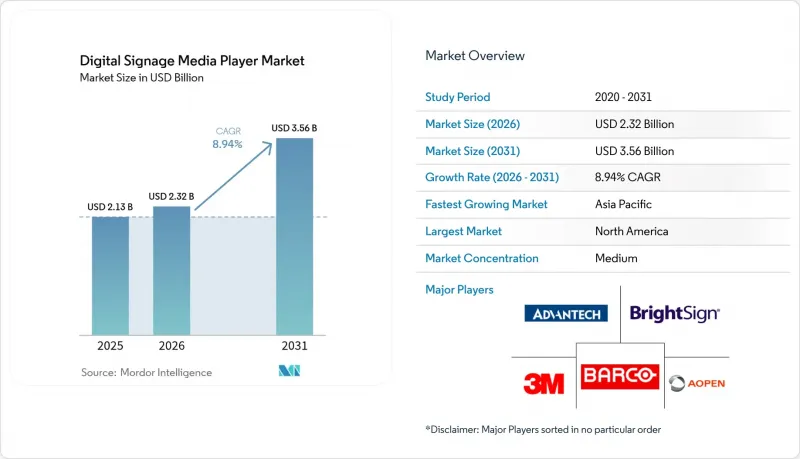
This report is Segmented by Component (Hardware and Software), Product (Entry-Level, Advanced-Level, and Enterprise-Level), Connectivity (Wired and Wireless), Application (Retail, Hospitality, Corporate, Transportation, Education, and Government), and Geography. The Market Forecasts are Provided in Terms of Value (USD).
Global Digital Signage Media Player Market Trends and Insights
Proliferation of 4K/8K SoC-based media players
Media-grade chipsets such as MediaTek MT9679 integrate native 8K decoding while consuming 40% less power than discrete GPU boards, cutting rack-space needs and service calls in transit hubs and corporate campuses. BrightSign's XT1145 line illustrates how single-board designs eliminate external servers, shrinking the total cost of ownership. The compact architecture also resists dust ingress and vibration, unlocking outdoor and industrial niches. As more displays ship with built-in computing, the Digital Signage Media Player market gains fresh demand for software-centric orchestration rather than replacement hardware.
Falling SSD and DRAM prices are lowering BOM cost
NAND flash prices surged 77% in 2024, yet per-gigabyte economics still improved as higher-density dies reached volume scale. Vendors responded by doubling onboard storage on mid-tier players, enabling richer video and AI models without external drives. Although DRAM pricing climbed on AI server demand, controller advances allowed tighter memory footprints that offset cost spikes. The net result keeps entry-level price points stable, sustaining deployments among small retailers and QSR chains across Southeast Asia.
Fragmented signage OS and CMS standards
Samsung's retirement of MagicINFO Cloud requires customers to migrate to VXT or rebuild on another stack by May 2026, illustrating the cost of proprietary lock-in. Hospitality groups operating mixed fleets from multiple vendors often juggle three or more dashboards, inflating training and maintenance hours. Although open-source suites like Xibo promote RESTful APIs, certification gaps keep large system integrators cautious. The absence of a neutral standards body delays mass adoption of plug-and-play peripherals, slowing rollouts in price-sensitive public-sector tenders inside the Digital Signage Media Player market.
Other drivers and restraints analyzed in the detailed report include:
- Retail analytics demand for real-time content triggers
- Edge-AI inference enabling hyper-local ads
- Cyber-security vulnerabilities in SoC firmware
For complete list of drivers and restraints, kindly check the Table Of Contents.
Segment Analysis
Hardware accounted for 62.10% of the Digital Signage Media Player market in 2025 thanks to ongoing demand for commercial-grade displays, solid-state drives, and mounting brackets. System-on-Chip integration is lowering the bill-of-materials, yet the sheer volume of panels shipping with embedded processors keeps revenue tilted toward physical assets. Conversely, software is charting a 10.12% CAGR to 2031 as subscription-based content management, AI analytics, and fleet orchestration unlock recurring revenue. The blended model lets vendors transition from one-time hardware sales to annuity streams, a shift welcomed by investors seeking margin resilience. Samsung's VXT suite bundles creative tools, device telemetry, and AI text-to-image generation in a single license that pairs neatly with its displays. Smaller integrators white-label open-source back-ends, competing on vertical templates for education and hospitality. As enterprises recalibrate total cost of ownership, buyers emphasize lifetime software roadmap and security patch cadence over CPU clock speeds, nudging procurement matrices toward SaaS metrics.
The evolution is steering the Digital Signage Media Player market toward holistic offerings where hardware reliability and software agility co-define value propositions. Manufacturers respond by pre-installing operating systems, secure boot loaders, and zero-touch enrollment keys that compress deployment timelines from weeks to hours. On the user side, marketing teams favor cloud dashboards that support campaign A/B tests and remote proof of play, reducing truck rolls. As data becomes the primary monetization lever, analytics plug-ins that quantify dwell time, gender mix, and traffic patterns are fast becoming standard SKUs. The result is a virtuous loop: richer insights drive bigger ad budgets, spurring upgrades to higher-capacity players with on-device GPUs, which in turn feed more data back to software layers.
Advanced-level units held 46.30% revenue in 2025 by striking balance between cost and performance, yet enterprise-grade models are projected to rise at 10.22% CAGR, the quickest among product tiers. Enterprise buyers demand high-availability features such as redundant power inputs, secure element chips, and IT-friendly APIs, elevating average selling price. The segment also mandates 24/7 duty cycles, extended temperature tolerance, and five-year firmware support, attributes seldom found in entry-level hardware. Partnerships such as LG-BrightSign integrate BrightSignOS within panel firmware, blending enterprise-class control with streamlined installation. These collaborations collapse procurement complexity, allowing corporate real-estate teams to specify an all-in-one SKU that marries display and player.
Market perception is shifting as CIOs equate signage endpoints with IoT nodes that must comply with zero-trust frameworks. Enterprise models now embed TPM 2.0 chips, VPN clients, and PKI-based authentication, helping organizations pass internal security audits. Multinational retailers run multi-zone networks across continents; here, unified device analytics and over-the-air firmware upgrades are non-negotiable. This uptick in functional depth supports higher gross margins and reduces churn, cementing enterprise models as the financial engine of the Digital Signage Media Player market.
Complete Report Scope:
- By Component
- Hardware
- Software
- By Product
- Entry-Level
- Advanced-Level
- Enterprise-Level
- By Connectivity
- Wired
- Wireless
- By Application
- Retail
- Hospitality
- Corporate
- Transportation
- Education
- Government
- By Geography
- North America
- United States
- Canada
- Mexico
- South America
- Brazil
- Argentina
- Rest of South America
- Europe
- Germany
- United Kingdom
- France
- Italy
- Spain
- Russia
- Rest of Europe
- Asia-Pacific
- China
- Japan
- India
- South Korea
- South-East Asia
- Rest of Asia-Pacific
- Middle East and Africa
- Middle East
- Saudi Arabia
- United Arab Emirates
- Turkey
- Rest of Middle East
- Africa
- South Africa
- Nigeria
- Rest of Africa
- Middle East
- North America
Geography Analysis
North America led the Digital Signage Media Player market in 2025 with 32.85% revenue, buoyed by early adoption of 4K and 8K displays, mature retail ecosystems, and aggressive customer-experience budgets. U.S. quick-service restaurants standardized menu-board rollouts across thousands of outlets, generating multi-year refresh cycles. Canadian airports launched smart-gate programs using AI-ready players to merge advertising with touchless boarding guidance, underscoring the region's appetite for security-certified hardware. Vendors benefit from strong service revenues because enterprises outsource content creation and network management, further enlarging lifetime contract value.
Asia-Pacific is the pace-setter with a 11.95% CAGR to 2031, powered by urban rail expansions, new mall openings, and government-backed smart-city grants. Chinese city clusters approve integrated street-furniture tenders that bundle 5G small cells with LED displays, stimulating bulk orders from local ODMs. Southeast Asian airports push bilingual passenger-information systems ahead of regional travel booms, while Japanese retailers pilot computer-vision loyalty kiosks in convenience stores. Falling panel prices combined with low labor costs make large-format video walls economical, helping the region challenge North America's dominance in the Digital Signage Media Player market.
Europe remains an influential center owing to stringent data-protection rules that shape player firmware and CMS design. General Data Protection Regulation drives demand for on-premises content hosting, elevating security-enabled appliances over cloud-only rivals. Energy-efficiency targets encourage adoption of mini-LED backlights and power-saving SoCs, creating a green-signage premium segment. Public-private partnerships fund digital bus stops and city-wide wayfinding in Scandinavian capitals, and cultural institutions retrofit museums with interactive guides. Meanwhile, Latin America accelerates through retail modernization and stadium upgrades tied to global sporting events, and the Middle East prioritizes hospitality and government information projects linked to economic diversification.
- Advantech Co., Ltd.
- AOPEN, Inc.
- BrightSign, LLC
- IAdea Corporation
- ONELAN Limited (Uniguest)
- Cisco Systems, Inc.
- Dell Technologies Inc.
- Hewlett-Packard Enterprise Company
- Barco NV
- Christie Digital Systems USA, Inc.
- 3M Company
- LG Electronics Inc.
- Samsung Electronics Co., Ltd.
- NEC Corporation (Sharp NEC Display Solutions Ltd.)
- Stratacache, Inc.
- Broadsign International, LLC
- Disguise Technologies Limited
- Dataton AB
- AV Stumpfl GmbH
- Green-Hippo Ltd. (tvONE)
- 7thSense Design Ltd.
Additional Benefits:
- The market estimate (ME) sheet in Excel format
- 3 months of analyst support
TABLE OF CONTENTS
1 INTRODUCTION
- 1.1 Study Assumptions and Market Definition
- 1.2 Scope of the Study
2 RESEARCH METHODOLOGY
3 EXECUTIVE SUMMARY
4 MARKET LANDSCAPE
- 4.1 Market Overview
- 4.2 Market Drivers
- 4.2.1 Proliferation of 4K/8K SoC-based media players
- 4.2.2 Falling SSD and DRAM prices lowering BOM cost
- 4.2.3 Declining LCD/LED signage hardware prices
- 4.2.4 Retail analytics demand for real-time content triggers
- 4.2.5 Edge-AI inference enabling hyper-local ads
- 4.2.6 Open-source CMS ecosystems shortening refresh cycles
- 4.3 Market Restraints
- 4.3.1 Fragmented signage OS and CMS standards
- 4.3.2 Cyber-security vulnerabilities in SoC firmware
- 4.3.3 Supply-chain volatility of industrial-grade GPUs
- 4.3.4 Rising e-paper alternatives for low-power signage
- 4.4 Industry Supply-Chain Analysis
- 4.5 Regulatory Landscape
- 4.6 Impact of Macroeconomic Factors
- 4.7 Technological Outlook
- 4.8 Porter's Five Forces Analysis
- 4.8.1 Bargaining Power of Suppliers
- 4.8.2 Bargaining Power of Consumers
- 4.8.3 Threat of New Entrants
- 4.8.4 Threat of Substitutes
- 4.8.5 Intensity of Competitive Rivalry
5 MARKET SIZE AND GROWTH FORECASTS (VALUE)
- 5.1 By Component
- 5.1.1 Hardware
- 5.1.2 Software
- 5.2 By Product
- 5.2.1 Entry-Level
- 5.2.2 Advanced-Level
- 5.2.3 Enterprise-Level
- 5.3 By Connectivity
- 5.3.1 Wired
- 5.3.2 Wireless
- 5.4 By Application
- 5.4.1 Retail
- 5.4.2 Hospitality
- 5.4.3 Corporate
- 5.4.4 Transportation
- 5.4.5 Education
- 5.4.6 Government
- 5.5 By Geography
- 5.5.1 North America
- 5.5.1.1 United States
- 5.5.1.2 Canada
- 5.5.1.3 Mexico
- 5.5.2 South America
- 5.5.2.1 Brazil
- 5.5.2.2 Argentina
- 5.5.2.3 Rest of South America
- 5.5.3 Europe
- 5.5.3.1 Germany
- 5.5.3.2 United Kingdom
- 5.5.3.3 France
- 5.5.3.4 Italy
- 5.5.3.5 Spain
- 5.5.3.6 Russia
- 5.5.3.7 Rest of Europe
- 5.5.4 Asia-Pacific
- 5.5.4.1 China
- 5.5.4.2 Japan
- 5.5.4.3 India
- 5.5.4.4 South Korea
- 5.5.4.5 South-East Asia
- 5.5.4.6 Rest of Asia-Pacific
- 5.5.5 Middle East and Africa
- 5.5.5.1 Middle East
- 5.5.5.1.1 Saudi Arabia
- 5.5.5.1.2 United Arab Emirates
- 5.5.5.1.3 Turkey
- 5.5.5.1.4 Rest of Middle East
- 5.5.5.2 Africa
- 5.5.5.2.1 South Africa
- 5.5.5.2.2 Nigeria
- 5.5.5.2.3 Rest of Africa
- 5.5.5.1 Middle East
- 5.5.1 North America
6 COMPETITIVE LANDSCAPE
- 6.1 Market Concentration
- 6.2 Strategic Moves
- 6.3 Market Share Analysis
- 6.4 Company Profiles (includes Global-level Overview, Market-level Overview, Core Segments, Financials as available, Strategic Information, Market Rank/Share, Products and Services, Recent Developments)
- 6.4.1 Advantech Co., Ltd.
- 6.4.2 AOPEN, Inc.
- 6.4.3 BrightSign, LLC
- 6.4.4 IAdea Corporation
- 6.4.5 ONELAN Limited (Uniguest)
- 6.4.6 Cisco Systems, Inc.
- 6.4.7 Dell Technologies Inc.
- 6.4.8 Hewlett-Packard Enterprise Company
- 6.4.9 Barco NV
- 6.4.10 Christie Digital Systems USA, Inc.
- 6.4.11 3M Company
- 6.4.12 LG Electronics Inc.
- 6.4.13 Samsung Electronics Co., Ltd.
- 6.4.14 NEC Corporation (Sharp NEC Display Solutions Ltd.)
- 6.4.15 Stratacache, Inc.
- 6.4.16 Broadsign International, LLC
- 6.4.17 Disguise Technologies Limited
- 6.4.18 Dataton AB
- 6.4.19 AV Stumpfl GmbH
- 6.4.20 Green-Hippo Ltd. (tvONE)
- 6.4.21 7thSense Design Ltd.
7 MARKET OPPORTUNITIES AND FUTURE OUTLOOK
- 7.1 White-space and Unmet-need Assessment

