PUBLISHER: Mordor Intelligence | PRODUCT CODE: 2124137

PUBLISHER: Mordor Intelligence | PRODUCT CODE: 2124137
DLP Projector - Market Share Analysis, Industry Trends & Statistics, Growth Forecasts (2026 - 2031)
According to Mordor Intelligence, the DLP projector market or Digital Light Processing Projector Market size is estimated at USD 6.69 billion in 2026 and is projected to reach USD 9.49 billion by 2031, representing a 7.24% CAGR over the forecast period.
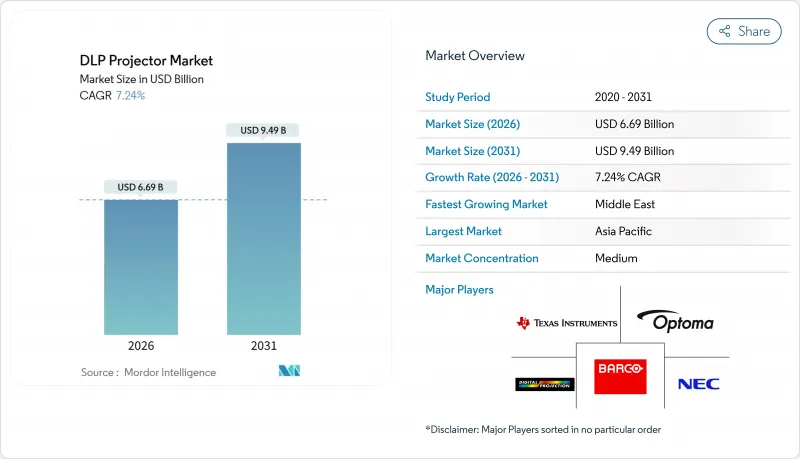
This report is Segmented by Light Source (Lamp, LED, Laser), Chip Model (One Chip, and Three Chip), Throw Distance (Normal Throw, and More), Brightness Class (Below 2, 500 Lumens, 2, 500-4, 999 Lumens, and More), Resolution (WXGA, Full HD, and More), Application (Business, Education, and More), and Geography. The Market Forecasts are Provided in Terms of Value (USD).
Global DLP Projector Market Trends and Insights
Rapid Digitalization in the Education Sector
Government stimulus for digital classrooms is accelerating projector tenders, exemplified by India's plan to surpass USD 2.1 billion in education-sector projector spend by 2029. Laser models now run 20,000 hours before service, tenfold the lamp interval, which cuts downtime for districts with limited technicians. Epson's February 2025 PowerLite L-Series, which includes twelve laser SKUs spanning 4,000-7,000 lumens, was released expressly for K-12 and higher-ed rollouts.
Surge in Home Cinema Adoption with Affordable 4K
Texas Instruments' DLP473TE 0.47-inch chipset, launched in July 2025, enables brands to ship native 4K projectors at a price point near USD 1,500. Hisense soon followed with the PX3-Pro triple-laser ultra-short-throw projector at 3,000 ANSI lumens and a sub-0.25 throw ratio, marketed as an alternative to OLED TVs. Optoma, BenQ, and XGIMI unveiled similarly priced models in the same quarter, creating a consumer price war.
High Cost of Laser-Based DLP Projectors
Laser units are still priced 40%-80% above their lamp counterparts, restricting uptake in developing markets, including non-metro India, where lamp projectors remain dominant. Vendors offer hybrid laser-phosphor models to trim bill-of-materials costs, but such compromises reduce color-gamut coverage and brightness uniformity.
Other drivers and restraints analyzed in the detailed report include:
- Replacement Cycle for Lamp to Laser Upgrades in Corporations
- Increment in Demand in the Entertainment Industry
- Growing Adoption of Large Flat-Panel Displays as Alternatives
For complete list of drivers and restraints, kindly check the Table Of Contents.
Segment Analysis
Laser systems are on track for a 7.67% CAGR, outstripping the overall DLP Projector Market or Digital Light Processing Projector Market as buyers prioritize maintenance savings. Lamp units, which accounted for 44.83% of revenue in 2025, remain prevalent in price-sensitive rental markets and emerging economies where short-term capital constraints outweigh lifecycle economics. Energy-efficiency standards favor instant-on laser engines that draw less power in standby, while advances in gallium-nitride diodes push wall-plug efficiency to higher levels. The DLP projector market size for laser units is forecast to surpass lamp revenue by 2029, driven by cinema, simulation, and projection-mapping projects that require stable brightness exceeding 10,000 lumens. Lamp demand persists in South America and Africa, where utilization rates are low and existing inventories of spare lamps extend the usable life at a minimal incremental cost.
Manufacturers exploit laser momentum by bundling five-year warranties and by integrating eco-modes that dim output during static content. Corporate buyers cite reduced downtime and lamp logistics as primary reasons for standardizing on laser, while venue operators see higher color saturation and uniformity as ways to justify premium ticket pricing. Sequential Segmented Transfer DMD technology solidifies the laser's edge by enabling 4K120 Hz performance, positioning DLP for gaming and virtual reality arenas that cannot tolerate the ramp-up delays of lamp illumination.
The one-chip design controlled 62.14% of the 2025 revenue base, reflecting its cost advantage in education, small business, and entry-level home cinema. Texas Instruments supplies a broad SKU line with pixel-shift options that deliver pseudo-4K images on budget hardware, keeping price pressure on three-chip rivals. The three-chip category, however, is charting a 7.51% CAGR as large venues, simulation suites, and high-end cinemas demand color uniformity across red, green, and blue channels. The DLP Projector Market or Digital Light Processing Projector Market share of three-chip models, therefore, expands more quickly than unit volumes, because ASPs above USD 30,000 inflate revenue weightings.
Component roadmaps indicate rising cross-over points where one-chip platforms add RGB lasers and high-refresh DMDs, narrowing the visual gap without reaching three-chip price levels. Nevertheless, stadium operators, planetariums, and flagship cinemas still allocate budgets to three-chip rigs to avoid rainbow artifacts and to maintain greater than 95% DCI-P3 coverage. Regional uptake is skewed toward North America, Europe, and the Middle East, where five-year service contracts often bundle calibration and spares.
Complete Report Scope:
- By Light Source
- Lamp
- LED
- Laser
- By Chip Model
- One Chip
- Three Chip
- By Throw Distance
- Normal Throw
- Short Throw
- Ultra-Short Throw
- By Brightness Class
- Below 2,500 Lumens
- 2,500-4,999 Lumens
- 5,000-9,999 Lumens
- Above 10,000 Lumens
- By Resolution
- XGA and Below
- WXGA
- Full HD
- 4K and Above
- By Application
- Home Entertainment and Cinema
- Business
- Education
- Large Venues
- Simulation and Training
- Projection Mapping Advertising
- Other Applications
- By Geography
- North America
- United States
- Canada
- Mexico
- Europe
- Germany
- United Kingdom
- France
- Russia
- Rest of Europe
- Asia-Pacific
- China
- Japan
- India
- South Korea
- Australia
- Rest of Asia-Pacific
- Middle East and Africa
- Middle East
- Saudi Arabia
- United Arab Emirates
- Rest of Middle East
- Africa
- South Africa
- Egypt
- Rest of Africa
- Middle East
- South America
- Brazil
- Argentina
- Rest of South America
- North America
Geography Analysis
Asia-Pacific assembled 36.77% of 2025 revenue, lifted by China's consumer projector enthusiasm and by India's public-school digitization grants. Several provinces subsidize the local assembly of 4K DLP models, keeping channel prices low enough to expand beyond tier-one cities. Japanese corporations are refreshing their meeting room fleets with laser units that help satisfy internal sustainability goals, thereby reinforcing replacement demand even as new-build office space plateaus.
The Middle East registers the fastest 8.29% CAGR, driven by mega-projects in Saudi Arabia and the United Arab Emirates that require projectors with 20,000-plus lumens for stadiums, cultural centers, and expo venues. Vision 2030 tourism targets in Saudi Arabia include projection mapping spectacles at heritage sites, while Dubai's event calendar sustains rental-staging inventories. Regional integrators often bundle long-term service contracts, which inflates revenue relative to the number of units.
North America and Europe experience steady but slower growth, shaped by corporate lamp-to-laser replacement cycles, cinema retrofits, and premium home-theater buyers who favor ultra-short-throw designs. The substitution risk from large flat panels is highest in small conference rooms, although projector makers defend their share in spaces above 100 inches. South America and Africa lag due to financing constraints, yet intermittent education grants and donor-funded ICT initiatives create pockets of demand. Currency volatility and import duties temper ASPs, prompting vendors to release lamp models that stretch service intervals to 4,000 hours.
- Texas Instruments Inc.
- Barco NV
- Optoma Corporation
- Digital Projection Ltd.
- NEC Corporation
- Acer Inc.
- ViewSonic Corporation
- Delta Electronics Inc.
- BenQ Corporation
- Panasonic Holdings Corporation
- Seiko Epson Corporation
- Christie Digital Systems Inc.
- Sony Group Corporation
- LG Electronics Inc.
- Canon Inc.
- Maxell Ltd.
- Xiaomi Corporation
- Hisense Visual Technology Co., Ltd.
- InFocus Corporation
Additional Benefits:
- The market estimate (ME) sheet in Excel format
- 3 months of analyst support
TABLE OF CONTENTS
1 INTRODUCTION
- 1.1 Study Assumptions and Market Definition
- 1.2 Scope of the Study
2 RESEARCH METHODOLOGY
3 EXECUTIVE SUMMARY
4 MARKET LANDSCAPE
- 4.1 Market Overview
- 4.2 Market Drivers
- 4.2.1 Increment in Demand in the Entertainment Industry
- 4.2.2 Rapid Digitalization in the Education Sector
- 4.2.3 Surge in Home Cinema Adoption with Affordable 4K
- 4.2.4 Replacement Cycle for Lamp to Laser Upgrades in Corporates
- 4.2.5 Increasing Deployment in Simulation and Training for Defense
- 4.2.6 Growth in Immersive Retail Experiences via Projection Mapping
- 4.3 Market Restraints
- 4.3.1 High Cost of Laser-Based DLP Projectors
- 4.3.2 Stiff Competition from LCD and LCOS Technologies
- 4.3.3 Growing Adoption of Large Flat-Panel Displays as Alternatives
- 4.3.4 Supply Chain Constraints for High-Power Laser Diodes
- 4.4 Industry Value Chain Analysis
- 4.5 Regulatory Landscape
- 4.6 Technological Outlook
- 4.7 Impact of Macroeconomic Factors on the Market
- 4.8 Impact of COVID-19
- 4.9 Porter's Five Forces Analysis
- 4.9.1 Bargaining Power of Suppliers
- 4.9.2 Bargaining Power of Buyers
- 4.9.3 Threat of New Entrants
- 4.9.4 Threat of Substitutes
- 4.9.5 Degree of Competition
5 MARKET SIZE AND GROWTH FORECASTS (VALUE)
- 5.1 By Light Source
- 5.1.1 Lamp
- 5.1.2 LED
- 5.1.3 Laser
- 5.2 By Chip Model
- 5.2.1 One Chip
- 5.2.2 Three Chip
- 5.3 By Throw Distance
- 5.3.1 Normal Throw
- 5.3.2 Short Throw
- 5.3.3 Ultra-Short Throw
- 5.4 By Brightness Class
- 5.4.1 Below 2,500 Lumens
- 5.4.2 2,500-4,999 Lumens
- 5.4.3 5,000-9,999 Lumens
- 5.4.4 Above 10,000 Lumens
- 5.5 By Resolution
- 5.5.1 XGA and Below
- 5.5.2 WXGA
- 5.5.3 Full HD
- 5.5.4 4K and Above
- 5.6 By Application
- 5.6.1 Home Entertainment and Cinema
- 5.6.2 Business
- 5.6.3 Education
- 5.6.4 Large Venues
- 5.6.5 Simulation and Training
- 5.6.6 Projection Mapping Advertising
- 5.6.7 Other Applications
- 5.7 By Geography
- 5.7.1 North America
- 5.7.1.1 United States
- 5.7.1.2 Canada
- 5.7.1.3 Mexico
- 5.7.2 Europe
- 5.7.2.1 Germany
- 5.7.2.2 United Kingdom
- 5.7.2.3 France
- 5.7.2.4 Russia
- 5.7.2.5 Rest of Europe
- 5.7.3 Asia-Pacific
- 5.7.3.1 China
- 5.7.3.2 Japan
- 5.7.3.3 India
- 5.7.3.4 South Korea
- 5.7.3.5 Australia
- 5.7.3.6 Rest of Asia-Pacific
- 5.7.4 Middle East and Africa
- 5.7.4.1 Middle East
- 5.7.4.1.1 Saudi Arabia
- 5.7.4.1.2 United Arab Emirates
- 5.7.4.1.3 Rest of Middle East
- 5.7.4.2 Africa
- 5.7.4.2.1 South Africa
- 5.7.4.2.2 Egypt
- 5.7.4.2.3 Rest of Africa
- 5.7.4.1 Middle East
- 5.7.5 South America
- 5.7.5.1 Brazil
- 5.7.5.2 Argentina
- 5.7.5.3 Rest of South America
- 5.7.1 North America
6 COMPETITIVE LANDSCAPE
- 6.1 Market Concentration
- 6.2 Strategic Moves
- 6.3 Market Share Analysis
- 6.4 Company Profiles (includes Global Level Overview, Market Level Overview, Core Segments, Financials as available, Strategic Information, Market Rank/Share for Key Companies, Products and Services, and Recent Developments)
- 6.4.1 Texas Instruments Inc.
- 6.4.2 Barco NV
- 6.4.3 Optoma Corporation
- 6.4.4 Digital Projection Ltd.
- 6.4.5 NEC Corporation
- 6.4.6 Acer Inc.
- 6.4.7 ViewSonic Corporation
- 6.4.8 Delta Electronics Inc.
- 6.4.9 BenQ Corporation
- 6.4.10 Panasonic Holdings Corporation
- 6.4.11 Seiko Epson Corporation
- 6.4.12 Christie Digital Systems Inc.
- 6.4.13 Sony Group Corporation
- 6.4.14 LG Electronics Inc.
- 6.4.15 Canon Inc.
- 6.4.16 Maxell Ltd.
- 6.4.17 Xiaomi Corporation
- 6.4.18 Hisense Visual Technology Co., Ltd.
- 6.4.19 InFocus Corporation
7 MARKET OPPORTUNITIES AND FUTURE OUTLOOK
- 7.1 White-Space and Unmet-Need Assessment

