PUBLISHER: Mordor Intelligence | PRODUCT CODE: 2124141

PUBLISHER: Mordor Intelligence | PRODUCT CODE: 2124141
Personal Robots - Market Share Analysis, Industry Trends & Statistics, Growth Forecasts (2026 - 2031)
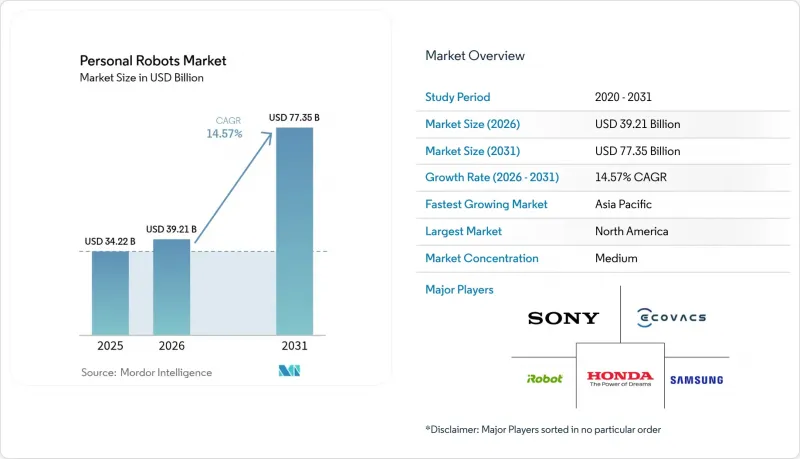
According to Mordor Intelligence, the personal robots market size was valued at USD 34.22 billion in 2025 and estimated to grow from USD 39.21 billion in 2026 to reach USD 77.35 billion by 2031, at a CAGR of 14.57% during the forecast period (2026-2031).
This report is Segmented by Application (Household Work, Entertainment, and More), Mobility (Stationary, Mobile Wheeled, and More), Component (Hardware, Software, and More), Control Interface (App-Controlled, Voice-Controlled, and More), and by Geography. The Market Sizes and Forecasts are Provided in Terms of Value (USD).
Global Personal Robots Market Trends and Insights
Boom in Household Robotic Vacuum Adoption
Robotic vacuums normalized the very idea of letting an autonomous device roam inside private spaces, lowering psychological and technical barriers for more complex helpers. Chinese vendors scaled production and undercut prices, pushing iRobot into a 45% revenue slide in Q4 2024 while Ecovacs logged RMB 16.54 billion in sales and Roborock RMB 11.95 billion in the same year. Premium players kept margins by touting performance; Dyson's 360 Vis Nav model ships with six-times competitor suction at a USD 799.99 price, proving that high-spec niches can coexist with mass adoption.
Increased Availability of Low-Cost AI Processors
Specialized chips from Qualcomm and NVIDIA are halving core component costs, trimming a humanoid bill-of-materials from USD 35,000 in 2025 to as low as USD 13,000 by 2030-35. The new economics let startups like Figure AI move domestic pilots up by two years, while China's UBTech readies mass production for Walker S2 units in late 2025.
Data-Privacy Concerns Around Home Mapping
Strict regimes such as GDPR require explicit consent for the maps and behavioral data robots collect. A January 2025 YouGov poll found privacy ranked as the top barrier for 48% of Americans considering a household robot, just ahead of reliability worries at 49%. Firms now spend heavily on on-device processing, data localization and user-controlled sharing to satisfy regulators.
Other drivers and restraints analyzed in the detailed report include:
- Integration with Smart-Home Ecosystems
- Ageing-in-Place Initiatives in OECD Countries
- High Replacement Cost of Batteries and Sensors
For complete list of drivers and restraints, kindly check the Table Of Contents.
Segment Analysis
Household work robots generated the largest slice of 57.35% in the personal robots market in 2025. Vacuum cleaners deliver clear time savings and predictable outcomes, sustaining user trust and high repeat-buy intent. Entertainment robots such as Mixi's CES-winning Romi have broadened category visibility. Meanwhile, elderly & handicap assistance is scaling fastest at a 23.2% CAGR as hospitals pilot in-room delivery and families seek reliable toileting, medication and fall-alert support.
The revenue shift illustrates a maturing category moving from convenience to necessity. As unit tasks diversify, subscription software for mapping, AI upgrades and diagnostics further expands the personal robots market size for service providers.
In 2025, mobile wheeled designs captured 66.20% of total value thanks to efficient power draw and affordable parts. Stationary models remain niche, focused on security or local telepresence.
Humanoid bipedal forms are the growth story, climbing at 28.4% CAGR through 2031. Figure AI's USD 2.6 billion valuation and Genesis AI's USD 105 million seed round highlight investor belief that bipedal machines will navigate human-built spaces with minimal modification, ultimately lifting the personal robots market share for bipedal systems as balance control and AI reasoning mature.
Complete Report Scope:
- By Application
- Household Work
- Entertainment and Social Companion
- Elderly and Handicap Assistance
- Home Security and Surveillance
- Education and Research
- By Mobility
- Stationary
- Mobile Wheeled
- Humanoid Bipedal
- By Component
- Hardware
- Software
- Services and Subscriptions
- By Control Interface
- App-Controlled
- Voice-Controlled
- Gesture / Vision-Controlled
- Fully Autonomous
- By Geography
- North America
- United States
- Canada
- Mexico
- Europe
- United Kingdom
- Germany
- France
- Italy
- Rest of Europe
- Asia-Pacific
- China
- Japan
- India
- South Korea
- Rest of Asia-Pacific
- Middle East
- Israel
- Saudi Arabia
- United Arab Emirates
- Turkey
- Rest of Middle East
- Africa
- South Africa
- Egypt
- Rest of Africa
- South America
- Brazil
- Argentina
- Rest of South America
- North America
Geography Analysis
Asia-Pacific held 34.60% of 2025 revenue, buoyed by China's component scale and Japan's elderly-care pilots. China's humanoid robot market hit USD 2.9 billion in 2024 and is projected to soar past USD 46 billion by 2031 at a 48.6% CAGR, dwarfing global growth rates. Government subsidies, mature supply chains and cultural comfort with robotics sustain leadership. South Korea's 5G infrastructure supports vision-heavy applications, while India's urban middle class presents long-run volume upside once price points fall.
North America remains influential in AI research, venture funding and premium tiers. The United States recorded USD 0.56 billion in humanoid robot sales in 2024, and the region holds 47.5% of global humanoid revenue today. Interest levels are healthy-38% of Americans like the idea of a household robot-but 32% still cap their budget below USD 500, evidence of elasticity challenges that vendors must address through feature bundling or financing plans.
The Middle East is the fastest-growing region at 19.1% CAGR through 2031. Oil-funded diversification programs, retail expansion to USD 386.9 billion by 2028 and young tech-forward populations underpin demand. UAE and Saudi Arabia have carved out robotics test zones, while Israel's startup ecosystem supplies AI talent. Turkey's USD 20 billion home robotics spend in 2024 confirms appetite across non-Gulf economies, reinforcing the region's role as an early target for premium and service-rich offerings.
- iRobot Corporation
- Ecovacs Robotics Co., Ltd.
- Roborock Technology Co., Ltd.
- Samsung Electronics Co., Ltd.
- Dyson Technology Limited
- Honda Motor Co., Ltd.
- Sony Group Corporation
- Amazon.com, Inc. (Astro)
- Neato Robotics Inc. (Vorwerk)
- UBTECH Robotics Corp.
- Temi USA Inc.
- Segway Inc. (Ninebot)
- FandP Robotics AG
- Gecko Systems International Corp.
Additional Benefits:
- The market estimate (ME) sheet in Excel format
- 3 months of analyst support
TABLE OF CONTENTS
1 INTRODUCTION
- 1.1 Study Assumptions and Market Definition
- 1.2 Scope of the Study
2 RESEARCH METHODOLOGY
3 EXECUTIVE SUMMARY
4 MARKET LANDSCAPE
- 4.1 Market Overview
- 4.2 Market Drivers
- 4.2.1 Boom in household robotic vacuum adoption
- 4.2.2 Increased availability of low-cost AI processors
- 4.2.3 Integration with smart-home ecosystems
- 4.2.4 Ageing-in-place initiatives in OECD countries
- 4.2.5 Hospital pilot programs for in-room delivery (under-the-radar)
- 4.2.6 Open-source ROS-based platforms lowering entry barriers (under-the-radar)
- 4.3 Market Restraints
- 4.3.1 Data-privacy concerns around home mapping
- 4.3.2 High replacement cost of batteries and sensors
- 4.3.3 Fragmented global safety standards
- 4.3.4 Limited SLAM accuracy in cluttered Asian apartments (under-the-radar)
- 4.4 Value / Supply-Chain Analysis
- 4.5 Regulatory Landscape
- 4.6 Technological Outlook
- 4.7 Porter's Five Forces Analysis
- 4.7.1 Threat of New Entrants
- 4.7.2 Bargaining Power of Buyers
- 4.7.3 Bargaining Power of Suppliers
- 4.7.4 Threat of Substitutes
- 4.7.5 Competitive Rivalry
5 MARKET SIZE AND GROWTH FORECASTS (VALUE)
- 5.1 By Application
- 5.1.1 Household Work
- 5.1.2 Entertainment and Social Companion
- 5.1.3 Elderly and Handicap Assistance
- 5.1.4 Home Security and Surveillance
- 5.1.5 Education and Research
- 5.2 By Mobility
- 5.2.1 Stationary
- 5.2.2 Mobile Wheeled
- 5.2.3 Humanoid Bipedal
- 5.3 By Component
- 5.3.1 Hardware
- 5.3.2 Software
- 5.3.3 Services and Subscriptions
- 5.4 By Control Interface
- 5.4.1 App-Controlled
- 5.4.2 Voice-Controlled
- 5.4.3 Gesture / Vision-Controlled
- 5.4.4 Fully Autonomous
- 5.5 By Geography
- 5.5.1 North America
- 5.5.1.1 United States
- 5.5.1.2 Canada
- 5.5.1.3 Mexico
- 5.5.2 Europe
- 5.5.2.1 United Kingdom
- 5.5.2.2 Germany
- 5.5.2.3 France
- 5.5.2.4 Italy
- 5.5.2.5 Rest of Europe
- 5.5.3 Asia-Pacific
- 5.5.3.1 China
- 5.5.3.2 Japan
- 5.5.3.3 India
- 5.5.3.4 South Korea
- 5.5.3.5 Rest of Asia-Pacific
- 5.5.4 Middle East
- 5.5.4.1 Israel
- 5.5.4.2 Saudi Arabia
- 5.5.4.3 United Arab Emirates
- 5.5.4.4 Turkey
- 5.5.4.5 Rest of Middle East
- 5.5.5 Africa
- 5.5.5.1 South Africa
- 5.5.5.2 Egypt
- 5.5.5.3 Rest of Africa
- 5.5.6 South America
- 5.5.6.1 Brazil
- 5.5.6.2 Argentina
- 5.5.6.3 Rest of South America
- 5.5.1 North America
6 COMPETITIVE LANDSCAPE
- 6.1 Market Concentration
- 6.2 Strategic Moves
- 6.3 Market Share Analysis
- 6.4 Company Profiles (includes Global level Overview, Market level overview, Core Segments, Financials as available, Strategic Information, Market Rank/Share for key companies, Products and Services, and Recent Developments)
- 6.4.1 iRobot Corporation
- 6.4.2 Ecovacs Robotics Co., Ltd.
- 6.4.3 Roborock Technology Co., Ltd.
- 6.4.4 Samsung Electronics Co., Ltd.
- 6.4.5 Dyson Technology Limited
- 6.4.6 Honda Motor Co., Ltd.
- 6.4.7 Sony Group Corporation
- 6.4.8 Amazon.com, Inc. (Astro)
- 6.4.9 Neato Robotics Inc. (Vorwerk)
- 6.4.10 UBTECH Robotics Corp.
- 6.4.11 Temi USA Inc.
- 6.4.12 Segway Inc. (Ninebot)
- 6.4.13 FandP Robotics AG
- 6.4.14 Gecko Systems International Corp.
7 MARKET OPPORTUNITIES AND FUTURE OUTLOOK
- 7.1 White-space and Unmet-Need Assessment

