PUBLISHER: Mordor Intelligence | PRODUCT CODE: 2124142

PUBLISHER: Mordor Intelligence | PRODUCT CODE: 2124142
Disposable Face Mask - Market Share Analysis, Industry Trends & Statistics, Growth Forecasts (2026 - 2031)
According to Mordor Intelligence, the disposable face mask market size is expected to increase from USD 2.65 billion in 2025 to USD 2.69 billion in 2026 and reach USD 2.97 billion by 2031, growing at a CAGR of 1.98% over 2026-2031.
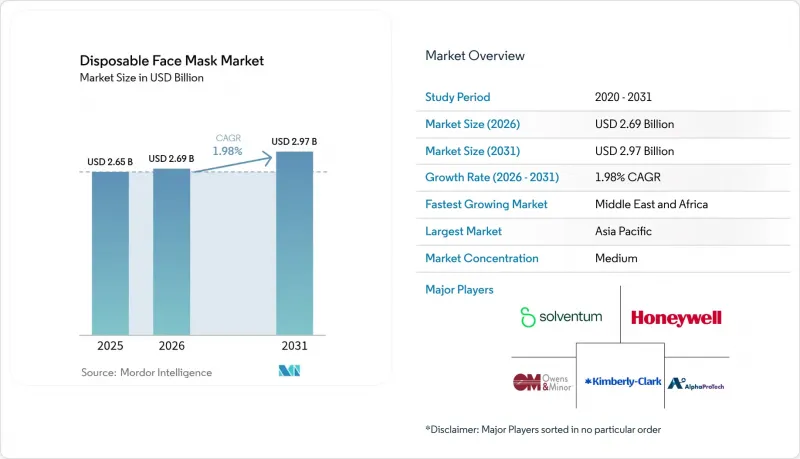
This report is Segmented by Product Type (Surgical Masks, Respirators, Procedure Masks), Material (Melt-Blown Polypropylene, and More), Distribution Channel (Hospitals & Pharmacies, and More), User Demographics (Adult, Pediatric/Child, Geriatric), End-User (Healthcare Professionals, and More), and Geography (North America, and More). The Market Forecasts are Provided in Terms of Value (USD).
Global Disposable Face Mask Market Trends and Insights
Post-COVID Stockpiling by National Strategic Reserves
Federal agencies converted emergency buys into permanent rotation programs that guarantee multi-year respirator volumes. The United States Strategic National Stockpile held 350 million N95s in 2024, 26 times pre-2020 levels, while Canada's vendor-managed model forces suppliers to backfill expiring lots. Similar six-month supply buffers in Germany and France institutionalize base-line demand, particularly for certified respirators, and motivate manufacturers to maintain NIOSH-compliant production lines.
Re-Institutionalized Infection-Prevention in Non-Acute Healthcare Settings
CMS embedded documented mask policies into Medicare reimbursement rules for nursing homes in 2024, turning episodic mask use into a compliance requirement. Outpatient dialysis centers and home-health agencies now purchase year-round stock, decoupling demand from public sentiment. Occupational health frameworks such as ISO 45001 further normalize respiratory protection across ancillary healthcare services.
Raw-Material Cost Spikes for Melt-Blown Polypropylene
Polypropylene prices averaged USD 1,378 per metric ton in Q4 2025, and smaller suppliers could not hedge feedstock exposure. Fixed-price government contracts squeeze margins during cost surges, discouraging long-term capacity investments outside vertically integrated firms.
Other drivers and restraints analyzed in the detailed report include:
- Mandated Mask Use During Severe Seasonal Flu in Asia
- Corporate "Air-Quality First" ESG Programs
- Saturation of Low-End SKUs Drives ASP Erosion
For complete list of drivers and restraints, kindly check the Table Of Contents.
Segment Analysis
Surgical masks captured 61.24% of Disposable face mask market share in 2025, while respirators are advancing at a 4.42% CAGR through 2031. Certified N95 and FFP2 devices command ASPs of USD 1.50-3.00, offering superior margin profiles that coax manufacturers to retool. OSHA fit-testing mandates reinforce the Disposable face mask market trend toward certified options, and ASTM F3502 provides an intermediate "Workplace Performance" tier for buyers who want better protection without full respirator protocols. Procedure masks retreat to cost-sensitive niches such as food service. Manufacturers capable of offering the entire certified-to-value continuum remain best positioned to capture shifting procurement patterns.
Second-order effects include the widening gap between brand-anchored respirators and commodity procedure masks. Companies with in-house melt-blown lines integrate vertically to control filtration media quality, while others outsource but differentiate through packaging or ear-loop comfort. Replacement cycles driven by standard updates ensure periodic demand spikes that benefit respirator portfolios, further tilting revenue mix toward certified SKUs.
Melt-blown polypropylene held 86.32% of the Disposable face mask market size in 2025, owing to high filtration efficiency per cost unit. Yet bamboo fiber and PLA bioplastics are projected to scale at a 5.53% CAGR as EU recycling mandates steer R&D budgets into compostable substrates. Producers juggle the economics of premium-priced bioplastics against uncertain willingness-to-pay, targeting European tenders that value sustainability metrics. For now, polypropylene remains unmatched in electrostatic charge retention and breathability, but pilot electro-spinning lines for nanocellulose composites point to a measured diversification of raw-material risk.
Cost volatility further motivates diversification. Vertically integrated suppliers hedge feedstock swings by controlling refinery off-takes, whereas mid-tier firms pursue long-term resin contracts or lightweight mask designs that use less polypropylene per unit. In parallel, consumer brands tap into eco-conscious niches by blending PLA outer layers with conventional melt-blown cores, a hybrid approach that meets filtration thresholds while signaling environmental progress.
Complete Report Scope:
- By Product Type
- Surgical Masks
- Respirators (N95/KN95/FFP2)
- Procedure Masks
- By Material
- Melt-blown Polypropylene
- Cotton & Cellulose
- Others (Bamboo, Silk, Bioplastics)
- By Distribution Channel
- Hospitals & Pharmacies (Offline)
- General Retail & Supermarkets
- Online & Direct-to-Consumer
- By User Demographics
- Adult
- Pediatric / Child
- Geraitric
- By End-User
- Healthcare Professionals
- Industrial/Construction Workers
- General Consumers
- By Geography
- North America
- United States
- Canada
- Mexico
- Europe
- Germany
- France
- United Kingdom
- Italy
- Spain
- Rest of Europe
- Asia-Pacific
- China
- Japan
- India
- South Korea
- Australia
- Rest of Asia-Pacific
- Middle East & Africa
- GCC
- South Africa
- Rest of Middle East & Africa
- South America
- Brazil
- Argentina
- Rest of South America
- North America
Geography Analysis
Asia-Pacific retained 39.62% of Disposable face mask market share in 2025, buoyed by domestic consumption in China, Japan, South Korea, and India and by the region's export leadership. WHO flu advisories sustain periodic consumer spikes, while industrial demand climbs with large-scale infrastructure projects. Domestic manufacturers scale melt-blown capacity quickly, allowing rapid response to regional outbreaks and price changes.
North America stands as the second-largest market. The U.S. and Canada continue to fund strategic stockpiles that impose rolling replenishment schedules under vendor-managed inventory contracts. Mexico leverages nearshoring to supply polypropylene masks to U.S. buyers seeking diversification away from Asia. Yet emerging single-use-plastic rules in Canada foreshadow tighter scrutiny on non-medical disposables.
Europe's demand is driven by EN 149 FFP2 adoption and sustainability legislation. Regulation 2025/40 requires high recycled content in consumer packaging, nudging R&D toward compostable masks. Fragmented national procurement encourages localized production, often supported by government grants aimed at strategic autonomy.
Middle East and Africa, the fastest-growing cluster at 4.89% CAGR, benefits from expanded GCC hospital networks and South African centralized tenders that stipulate ISO and ASTM compliance. Price sensitivity slows certified respirator adoption in sub-Saharan economies, but multilateral financing for pandemic preparedness is bridging the affordability gap.
South America experiences strong e-commerce penetration. Brazilian and Argentine online retailers push private-label masks that undercut pharmacy prices by up to 40%, fragmenting the Disposable face mask market landscape. Currency volatility and import duties complicate supply planning, yet favorable demographics keep baseline volumes resilient.
- Alpha Pro Tech Ltd.
- Ansell
- BYD Co. Ltd. (Electronics)
- Cardinal Health
- Drager
- Honeywell International
- Kimberly-Clark Worldwide
- Lakeland Industries
- Makrite Industries
- Medicom
- Moldex-Metric
- Owens & Minor Inc.
- Prestige Ameritech
- Shanghai Dasheng
- Solventum
- UVEX Group
- Winner Medical
- Zhende Medical
Additional Benefits:
- The market estimate (ME) sheet in Excel format
- 3 months of analyst support
TABLE OF CONTENTS
1 Introduction
- 1.1 Study Assumptions & Market Definition
- 1.2 Scope of the Study
2 Research Methodology
3 Executive Summary
4 Market Landscape
- 4.1 Market Overview
- 4.2 Market Drivers
- 4.2.1 Post-COVID Pandemic Stockpiling by National Strategic Reserves
- 4.2.2 Re-Institutionalization of Infection-Prevention Standards in Non-Acute Healthcare Settings
- 4.2.3 Mandated Use in Severe Seasonal Flu Outbreaks Across Asia
- 4.2.4 Corporate "Air-Quality First" ESG Commitments
- 4.2.5 Rapid E-Commerce Private-Label Penetration in LATAM
- 4.2.6 WHO-Led Filtration-Test Standardization (ISO 16890, ASTM F3502) Triggers Mask-Replacement Cycles
- 4.3 Market Restraints
- 4.3.1 Raw-Material Cost Spikes for Melt-Blown Polypropylene
- 4.3.2 Saturation of Low-End SKUs Driving ASP Erosion
- 4.3.3 Legislative Clampdown on Single-Use Plastics in the EU & Canada
- 4.3.4 Rise of Reusable Respirators & Biodegradable Mask Substitutes
- 4.4 Value / Supply-Chain Analysis
- 4.5 Regulatory Landscape
- 4.6 Technological Outlook
- 4.7 Porter's Five Forces Analysis
- 4.7.1 Bargaining Power of Suppliers
- 4.7.2 Bargaining Power of Buyers
- 4.7.3 Threat of New Entrants
- 4.7.4 Threat of Substitutes
- 4.7.5 Intensity of Competitive Rivalry
5 Market Size & Growth Forecasts ( Value in USD)
- 5.1 By Product Type
- 5.1.1 Surgical Masks
- 5.1.2 Respirators (N95/KN95/FFP2)
- 5.1.3 Procedure Masks
- 5.2 By Material
- 5.2.1 Melt-blown Polypropylene
- 5.2.2 Cotton & Cellulose
- 5.2.3 Others (Bamboo, Silk, Bioplastics)
- 5.3 By Distribution Channel
- 5.3.1 Hospitals & Pharmacies (Offline)
- 5.3.2 General Retail & Supermarkets
- 5.3.3 Online & Direct-to-Consumer
- 5.4 By User Demographics
- 5.4.1 Adult
- 5.4.2 Pediatric / Child
- 5.4.3 Geraitric
- 5.5 By End-User
- 5.5.1 Healthcare Professionals
- 5.5.2 Industrial/Construction Workers
- 5.5.3 General Consumers
- 5.6 By Geography
- 5.6.1 North America
- 5.6.1.1 United States
- 5.6.1.2 Canada
- 5.6.1.3 Mexico
- 5.6.2 Europe
- 5.6.2.1 Germany
- 5.6.2.2 France
- 5.6.2.3 United Kingdom
- 5.6.2.4 Italy
- 5.6.2.5 Spain
- 5.6.2.6 Rest of Europe
- 5.6.3 Asia-Pacific
- 5.6.3.1 China
- 5.6.3.2 Japan
- 5.6.3.3 India
- 5.6.3.4 South Korea
- 5.6.3.5 Australia
- 5.6.3.6 Rest of Asia-Pacific
- 5.6.4 Middle East & Africa
- 5.6.4.1 GCC
- 5.6.4.2 South Africa
- 5.6.4.3 Rest of Middle East & Africa
- 5.6.5 South America
- 5.6.5.1 Brazil
- 5.6.5.2 Argentina
- 5.6.5.3 Rest of South America
- 5.6.1 North America
6 Competitive Landscape
- 6.1 Market Concentration
- 6.2 Market Share Analysis
- 6.3 Company Profiles (includes Global level Overview, Market level overview, Core Segments, Financials as available, Strategic Information, Market Rank/Share for key companies, Products and Services, and Recent Developments)
- 6.3.1 Alpha Pro Tech Ltd.
- 6.3.2 Ansell Ltd.
- 6.3.3 BYD Co. Ltd. (Electronics)
- 6.3.4 Cardinal Health
- 6.3.5 Drager
- 6.3.6 Honeywell International Inc.
- 6.3.7 Kimberly-Clark Corporation
- 6.3.8 Lakeland Industries
- 6.3.9 Makrite Industries
- 6.3.10 Medicom
- 6.3.11 Moldex-Metric Inc.
- 6.3.12 Owens & Minor Inc.
- 6.3.13 Prestige Ameritech
- 6.3.14 Shanghai Dasheng
- 6.3.15 Solventum
- 6.3.16 UVEX Group
- 6.3.17 Winner Medical
- 6.3.18 Zhende Medical
7 Market Opportunities & Future Outlook
- 7.1 White-space & Unmet-need Assessment

