PUBLISHER: Mordor Intelligence | PRODUCT CODE: 2124143

PUBLISHER: Mordor Intelligence | PRODUCT CODE: 2124143
Depth Filtration - Market Share Analysis, Industry Trends & Statistics, Growth Forecasts (2026 - 2031)
According to Mordor Intelligence, the depth filtration market size is projected to expand from USD 3.07 billion in 2025 and USD 3.34 billion in 2026 to USD 5.23 billion by 2031, registering a CAGR of 9.38% between 2026 to 2031.
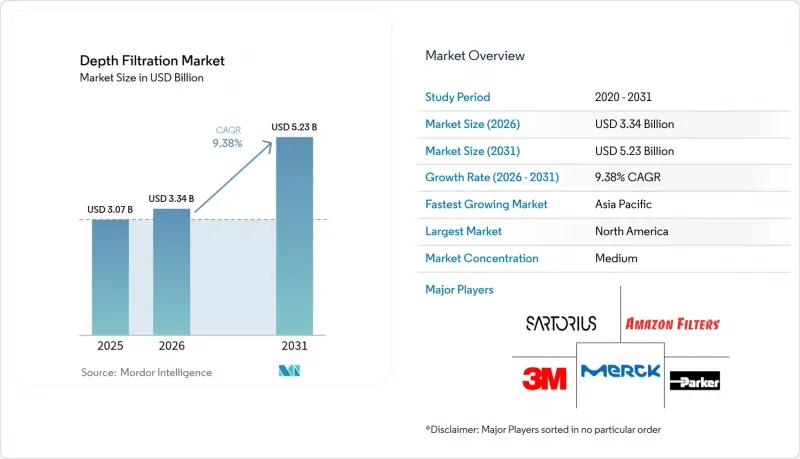
This report is Segmented by Media (Cellulose Fiber, Diatomaceous Earth, Activated Carbon Blends, Perlite & Others), Product (Cartridge, Capsule, Sheets & Pads, Modules & Lenticular, Other Products), Application (Biopharmaceutical, and More), End-User (Pharma & Biotech, and More), and Geography (North America, Europe, Asia-Pacific, MEA, South America). Market Forecasts are Provided in Terms of Value (USD).
Global Depth Filtration Market Trends and Insights
Rising Biologics & Cell-Gene Therapy Volumes
Single-use bioreactor capacity additions totaled 4.2 million L in 2024, and 31% of those vessels support cell- and gene-therapy programs that require multiple depth-filtration steps. Each 2,000 L CAR-T perfusion run yields up to 80 L of harvest, which must be clarified without damaging viral vectors. BARDA earmarked USD 500 million in 2024 for vaccine fill-finish expansions that mandate the use of disposable depth filters, institutionalizing this workflow in federally funded plants. Filters now incorporate co-layers of activated carbon or charged diatomaceous earth to capture sub-200 bp DNA fragments while preserving 20 nm virus particles, locking suppliers into long-term deals with therapy sponsors.
Single-Use Depth Filter Adoption in Modular Bioprocessing
Prefabricated cleanroom pods can be commissioned in 18 months versus 36 months for traditional builds, a schedule advantage CDMOs exploit to win late-phase projects. Lonza's Visp site came online in October 2024 with fully disposable clarification trains that cut water-for-injection use by 40% compared with stainless-steel clarifiers. The latest ISPE Baseline Guides classify single-use depth filters as low-risk, exempting them from site-to-site revalidation and accelerating multi-facility rollouts. Supply-chain fragility surfaced when a Finnish pulp mill fire in March 2025 added six-week lead times, reminding CDMOs to dual-source critical filters.
Membrane & Tangential-Flow Filtration Price Competition
TFF cassette prices slid 22% between 2022 and 2025, narrowing the historic cost gap with depth filters. Hybrid trains now pair one disposable depth filter with a 0.45 µm TFF step, trimming clarification spends 15-20% per batch. Pall's Depth-TFF module, launched in September 2024, targets this workflow consolidation and intensifies price pressure, especially in cost-sensitive biosimilar plants.
Other drivers and restraints analyzed in the detailed report include:
- Stringent Food & Beverage Clarity Standards
- Growth of Craft Breweries & Micro-Wineries
- Raw Material (Cellulose/ Diatomite) Supply Volatility
For complete list of drivers and restraints, kindly check the Table Of Contents.
Segment Analysis
Cellulose fiber accounted for the largest share of the depth filtration market in 2025, at USD 1.41 billion, or 46.02% of revenue. Activated-carbon blends will outpace all rivals with a 10.06% CAGR, fueled by craft breweries that demand simultaneous aroma polishing and microbial reduction. Diatomaceous earth remains preferred for high-solids wine lees and municipal water pre-treatment, but disposal fees under the EU Waste Framework Directive are tilting wineries toward low-waste cellulose sheets. Synthetic nanocellulose, although nascent, unlocks electrostatic capture of host-cell DNA, trimming nuclease steps in gene-therapy lines and protecting depth filtration market share in premium bioprocess applications.
Media innovation is shifting the depth filtration industry toward multifunctional filters that marry mechanical sieving with adsorptive chemistry. Activated carbon's capacity to strip polyphenols aligns with consumer "clean label" trends and boosts shelf stability. Charged nanocellulose reduces DNA loads by 99.5%, meeting stringent regulatory requirements without adding unit operations. Suppliers that qualify these blends gain first-mover lock-in because therapy sponsors resist media switches mid-trial.
Cartridge filters accounted for 38.27% of the depth filtration market in 2025, yet capsule formats will post an 11.63% CAGR through 2031. Capsules arrive gamma-sterilized, eliminating 4-6 h steam-in-place cycles and cutting per-batch validation labor by USD 1,800 in clinical runs. RFID-enabled cartridges still dominate legacy stainless lines because they integrate with existing housings, but fill-finish suites built since 2024 default to capsules to shave changeover time.
Modules and lenticular systems are concentrating flow capacity into smaller footprints, a decisive factor when cleanroom rent exceeds USD 3,000/m2/y. Sheets and pads, long used in wine cellars, are ceding ground to lenticular stacks that reduce operator exposure to diatomaceous earth dust. Specialty in-line capsules serve point-of-use lead removal in U.S. municipal upgrades, adding a steady but low-margin revenue tail.
Complete Report Scope:
- By Media
- Cellulose Fiber
- Diatomaceous Earth
- Activated Carbon Blends
- Perlite & Others
- By Product
- Cartridge Filters
- Capsule Filters
- Filter Sheets & Pads
- Modules & Lenticular Systems
- Other Products
- By Application
- Biopharmaceutical Processing
- Food & Beverage Clarification
- Water & Waste-water Treatment
- Other Applications
- By End-user
- Pharmaceutical & Biotechnology Companies
- Contract Development & Manufacturing Organizations (CDMOs)
- Academic & Research Institutes
- Other End Users
- By Geography
- North America
- United States
- Canada
- Mexico
- Europe
- Germany
- United Kingdom
- France
- Italy
- Spain
- Rest of Europe
- Asia-Pacific
- China
- Japan
- India
- Australia
- South Korea
- Rest of Asia-Pacific
- Middle East & Africa
- GCC
- South Africa
- Rest of Middle East & Africa
- South America
- Brazil
- Argentina
- Rest of South America
- North America
Geography Analysis
North America generated 34.08% of 2025 revenue, underwritten by FDA fast-track pathways that speed single-use devices through 510(k) clearance. Boston, San Francisco, and RTP anchor cell-therapy clusters that mandate disposable clarification to mitigate cross-contamination, bolstered by BARDA's USD 500 million fill-finish expansion that codified depth filtration as standard equipment. Canada and Mexico contribute biosimilar output, with Pfizer's Sanford site expanding single-use trains in 2024 for EU and LATAM supply.
Asia-Pacific is poised for an 11.07% CAGR, the fastest worldwide. China's NMPA cleared seven domestic CAR-T therapies in 2024, each produced in facilities that reject stainless-steel clarifiers to sidestep cross-program carryover risks. India's biosimilar plants retrofit depth-filter cartridges to satisfy EMA data-integrity rules mandating real-time pressure-drop logs. Japan shortened regenerative-medicine approval timelines to 12 months for processes featuring validated single-use depth filtration, spurring CDMO investment.
Europe, MEA, and South America supply the balance. EU sustainability directives are pushing suppliers toward recyclable cartridges; Sartorius is piloting take-back loops to recover cellulose for non-pharma reuse. Brazil's ethanol and Argentina's wine sectors maintain steady diatomaceous earth demand, while GCC desalination plants add depth pre-filters to extend RO life. South American uptake remains commodity-price sensitive but benefits from beverage exports that require haze-free clarification.
- 3M
- Amazon Filters Ltd.
- Cobetter Filtration
- Critical Process Filtration
- Danaher Corp. (Pall)
- Eaton Filtration
- FILTROX
- Gemu Group
- Graver Technologies
- GS-Filt
- Hangzhou Darlly Filtration
- Meissner Filtration Products
- Merck
- Microclar
- Microdyn-Nadir
- Parker Hannifin
- Pentair
- Porvair Filtration
- Saint-Gobain Life Sciences
- Sartorius
Additional Benefits:
- The market estimate (ME) sheet in Excel format
- 3 months of analyst support
TABLE OF CONTENTS
1 Introduction
- 1.1 Study Assumptions & Market Definition
- 1.2 Scope of the Study
2 Research Methodology
3 Executive Summary
4 Market Landscape
- 4.1 Market Overview
- 4.2 Market Drivers
- 4.2.1 Rising Biologics & Cell-Gene Therapy Volumes
- 4.2.2 Single-Use Depth Filter Adoption in Modular Bioprocessing
- 4.2.3 Stringent Food & Beverage Clarity Standards
- 4.2.4 Growth of Craft Breweries & Micro-Wineries
- 4.2.5 Emerging Demand for Exosome & Viral-Vector Purification
- 4.2.6 Micro-Algae Protein Extraction Scale-Up
- 4.3 Market Restraints
- 4.3.1 Membrane & Tangential-Flow Filtration Price Competition
- 4.3.2 Raw Material (Cellulose/Diatomite) Supply Volatility
- 4.3.3 High Disposal Cost for Single-Use Filter Waste
- 4.3.4 Regulatory Push Toward Plastic-Free Consumables
- 4.4 Regulatory Landscape
- 4.5 Technological Outlook
- 4.6 Porter's Five Forces Analysis
- 4.6.1 Threat of New Entrants
- 4.6.2 Bargaining Power of Buyers
- 4.6.3 Bargaining Power of Suppliers
- 4.6.4 Threat of Substitute Products
- 4.6.5 Intensity of Competitive Rivalry
5 Market Size & Growth Forecasts
- 5.1 By Media
- 5.1.1 Cellulose Fiber
- 5.1.2 Diatomaceous Earth
- 5.1.3 Activated Carbon Blends
- 5.1.4 Perlite & Others
- 5.2 By Product
- 5.2.1 Cartridge Filters
- 5.2.2 Capsule Filters
- 5.2.3 Filter Sheets & Pads
- 5.2.4 Modules & Lenticular Systems
- 5.2.5 Other Products
- 5.3 By Application
- 5.3.1 Biopharmaceutical Processing
- 5.3.2 Food & Beverage Clarification
- 5.3.3 Water & Waste-water Treatment
- 5.3.4 Other Applications
- 5.4 By End-user
- 5.4.1 Pharmaceutical & Biotechnology Companies
- 5.4.2 Contract Development & Manufacturing Organizations (CDMOs)
- 5.4.3 Academic & Research Institutes
- 5.4.4 Other End Users
- 5.5 By Geography
- 5.5.1 North America
- 5.5.1.1 United States
- 5.5.1.2 Canada
- 5.5.1.3 Mexico
- 5.5.2 Europe
- 5.5.2.1 Germany
- 5.5.2.2 United Kingdom
- 5.5.2.3 France
- 5.5.2.4 Italy
- 5.5.2.5 Spain
- 5.5.2.6 Rest of Europe
- 5.5.3 Asia-Pacific
- 5.5.3.1 China
- 5.5.3.2 Japan
- 5.5.3.3 India
- 5.5.3.4 Australia
- 5.5.3.5 South Korea
- 5.5.3.6 Rest of Asia-Pacific
- 5.5.4 Middle East & Africa
- 5.5.4.1 GCC
- 5.5.4.2 South Africa
- 5.5.4.3 Rest of Middle East & Africa
- 5.5.5 South America
- 5.5.5.1 Brazil
- 5.5.5.2 Argentina
- 5.5.5.3 Rest of South America
- 5.5.1 North America
6 Competitive Landscape
- 6.1 Market Concentration
- 6.2 Market Share Analysis
- 6.3 Company Profiles (includes Global Level Overview, Market Level Overview, Core Segments, Financials as Available, Strategic Information, Market Rank/Share for Key Companies, Products & Services, and Recent Developments)
- 6.3.1 3M
- 6.3.2 Amazon Filters Ltd.
- 6.3.3 Cobetter Filtration
- 6.3.4 Critical Process Filtration
- 6.3.5 Danaher Corp. (Pall)
- 6.3.6 Eaton Filtration
- 6.3.7 FILTROX AG
- 6.3.8 Gemu Group
- 6.3.9 Graver Technologies
- 6.3.10 GS-Filt
- 6.3.11 Hangzhou Darlly Filtration
- 6.3.12 Meissner Filtration Products
- 6.3.13 Merck KGaA
- 6.3.14 Microclar
- 6.3.15 Microdyn-Nadir
- 6.3.16 Parker Hannifin Corp.
- 6.3.17 Pentair
- 6.3.18 Porvair Filtration
- 6.3.19 Saint-Gobain Life Sciences
- 6.3.20 Sartorius Stedim Biotech
7 Market Opportunities & Future Outlook
- 7.1 White-space & Unmet-Need Assessment

