PUBLISHER: Mordor Intelligence | PRODUCT CODE: 2124147

PUBLISHER: Mordor Intelligence | PRODUCT CODE: 2124147
HR Analytics - Market Share Analysis, Industry Trends & Statistics, Growth Forecasts (2026 - 2031)
According to Mordor Intelligence, the HR analytics market size is projected to be USD 4.89 billion in 2025, USD 5.71 billion in 2026, and reach USD 10.82 billion by 2031, growing at a CAGR of 13.64% from 2026 to 2031.
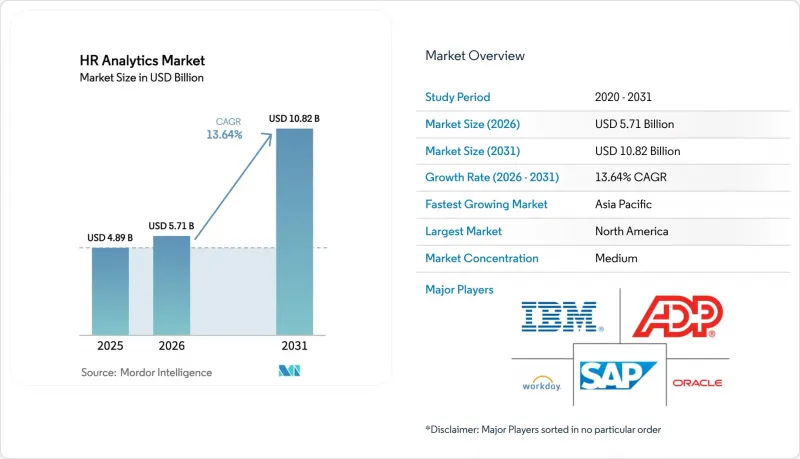
This report is Segmented by Component (Solutions, and Services), Deployment Mode (On-Premise, and Cloud), Organization Size (Large Enterprises, and Small and Medium Enterprises), Application (Talent Acquisition and Onboarding, Workforce Planning and Optimization, and More), End-User Industry (IT and Telecom, Retail and Consumer Goods, Manufacturing, and More), and Geography. Market Forecasts are in Value (USD).
Global HR Analytics Market Trends and Insights
Cloud-Based HR Analytics Adoption Surge
Moving HR analytics to the cloud has eliminated the upfront hardware and licensing costs that once limited adoption to very large companies. An ISG poll of 1,200 organizations showed that 69% were already running at least one HR module in software-as-a-service form by the close of 2025, a steep jump from 52% in 2023. Oracle added 1,400 Fusion Cloud HCM clients during fiscal 2025 as modular, per-employee pricing appealed to budget-sensitive buyers. Workday shipped three major releases in 2025, versus the single annual update common in legacy on-premises deployments, underscoring the feature-velocity advantage of a multi-tenant design. The same architecture, however, channels data through hyperscale centers that can clash with EU cross-border rules, a tension highlighted by Amazon's EUR 746 million (USD 843 million) GDPR fine for employee data processing.
Need to Cut Attrition and Optimize Workforce Cost
Voluntary turnover costs U.S. employers USD 1 trillion in 2025, prompting firms to lean on predictive models that flag flight risk months before a resignation. IBM's Watson Analytics reached 95% accuracy in predicting which workers would exit within a year by blending tenure, promotion history, and external labor-market signals. Hospitals that paired these insights with targeted retention bonuses and shift-pattern tweaks trimmed registered-nurse attrition by 22%, saving an average of USD 52,100 per avoided departure. Pay-compression dashboards also reveal cases where new hires out-earn long-serving colleagues, a trigger for "quiet quitting" that companies address through mid-cycle salary corrections. As CHROs quantify such savings, finance teams increasingly treat people analytics as a cost-containment lever rather than a discretionary tool.
Shortage of HR Data-Science Talent
People analytics roles blend SQL, Python, statistics, and HR policy knowledge, a skill cocktail still rare in labor markets worldwide. LinkedIn's 2025 Emerging Jobs Report ranked people analytics specialist seventh by growth rate, yet the median position sat unfilled for more than 90 days and carried salary premiums of 25-35% over standard HR analyst positions. Deloitte observes that many mid-market firms stall at descriptive dashboards because they lack the staff to build predictive models. Drag-and-drop tools from vendors such as Visier reduce entry barriers, but interpreting model output and steering interventions still call for seasoned analysts. Until universities and in-house academies expand pipelines, talent scarcity will cap analytics ROI for small to midsize employers.
Other drivers and restraints analyzed in the detailed report include:
- Hybrid and Remote Work Accelerating Data-Driven HR
- Generative-AI Copilots Embedded in HR Suites
- Data-Privacy and Compliance Complexity
For complete list of drivers and restraints, kindly check the Table Of Contents.
Segment Analysis
Solutions captured 69.73% of 2025 revenue, underscoring enterprises' preference for packaged dashboards, prebuilt connectors, and embedded predictive models that can be activated with minimal configuration. Services such as implementation consulting, custom model development, and managed analytics are advancing at a 13.89% CAGR, as firms without in-house data talent rely on partners for data migration, change management, and bias-testing. The HR analytics market share advantage enjoyed by software vendors is likely to narrow as regulatory requirements for explainability and privacy drive demand for specialized advisory projects.
Subscription pricing lets buyers add modules over time, compressing deployment cycles from months to weeks. Oracle recorded a 23% jump in cloud-services fees in fiscal-2025 because clients needed mapping of complex org structures to standardized metric libraries. Accenture and IBM both expanded workforce analytics practices by double digits, pairing data scientists with industrial-organizational psychologists to turn raw insights into retention or reskilling programs. This advisory uptick signals that services will continue to gain ground, even though software remains the spine of the HR analytics market.
Cloud installations accounted for 75.67% of 2025 spending and are growing at a 13.96% CAGR, outpacing all other deployment options. Multi-tenant design accelerates feature releases, evidenced by Workday's three major updates in 2025 versus annual patches on legacy stacks. Consumption-based pricing also aligns vendor revenue with customer headcount, easing CFO concerns about shelf-ware during hiring freezes.
On-premises platforms persist in government and highly regulated banking, where data residency or mainframe entanglements slow migration. SAP reported that SuccessFactors added 2,100 cloud customers in 2025, while on-premises ECC licenses fell 9%. Hybrid architectures, a cloud analytics layer combined with in-country mirrors for sensitive records, are an interim fix in Russia, Indonesia, and Vietnam, but overhead costs may eventually push holdouts toward full SaaS adoption.
Complete Report Scope:
- By Component
- Solutions
- Services
- By Deployment Mode
- On-Premise
- Cloud
- By Organization Size
- Large Enterprises
- Small and Medium Enterprises
- By Application
- Talent Acquisition and Onboarding
- Workforce Planning and Optimization
- Compensation and Payroll Analytics
- Learning and Development Analytics
- Employee Engagement and Wellbeing Analytics
- Diversity, Equity and Inclusion Analytics
- By End-User Industry
- IT and Telecom
- Banking, financial services and insurance (BFSI)
- Retail and Consumer Goods
- Healthcare and Life Sciences
- Manufacturing
- Government and Public Sector
- Other End-User Industries
- By Geography
- North America
- United States
- Canada
- Mexico
- Europe
- Germany
- United Kingdom
- France
- Russia
- Rest of Europe
- Asia-Pacific
- China
- Japan
- India
- South Korea
- Australia
- Rest of Asia-Pacific
- Middle East and Africa
- Middle East
- Saudi Arabia
- United Arab Emirates
- Rest of Middle East
- Africa
- South Africa
- Egypt
- Rest of Africa
- Middle East
- South America
- Brazil
- Argentina
- Rest of South America
- North America
Geography Analysis
North America accounted for 39.48% of 2025 revenue, supported by SEC rules mandating human-capital disclosures for listed companies and robust venture investment in HR tech startups. U.S. enterprises spent an average of USD 1.6 million each on AI-powered HR tooling during 2025. Canada's Pay Equity Act further boosts demand for compensation analytics, while Mexico's manufacturing nearshoring boom drives the need for headcount-planning dashboards that keep pace with plant expansions.
Asia-Pacific is the fastest-growing region, with a 14.69% CAGR. India's IT majors adopted skills graphs to redeploy staff as generative-AI automation reshapes delivery models. China's state-owned enterprises digitize HR processes under government modernization mandates, and Japan's shrinking labor pool forces manufacturers to maximize productivity per worker. Australia's 2024 Fair Work amendments extend leave entitlements to gig-economy workers, opening new analytics use cases in contingent labor management.
Europe's Corporate Sustainability Reporting Directive embeds diversity and training metrics into audited statements, pushing HR analytics into CFO territory. Germany's works council co-determination rules require consent layers for employee monitoring, thereby influencing product roadmaps. In the Middle East, Saudi Arabia's Saudization quotas create a compliance-driven need for dashboards that track citizen-to-expat ratios. South America lags in spending, yet Brazil's labor-law modernization is nudging employers toward cloud analytics for hybrid scheduling compliance.
- SAP SE
- Oracle Corporation
- Workday Inc.
- IBM Corporation
- ADP Inc.
- UKG Inc.
- Tableau Software, LLC
- Visier Inc.
- Crunchr BV
- Culture Amp Pty Ltd
- ChartHop Inc.
- PeopleInsight Analytics Corp.
- Lattice HQ Inc.
- Gloat Ltd.
- Eightfold AI Inc.
- HiBob Ltd.
- Syndio Solutions Inc.
- Nakisa Inc.
- Zoho Corporation Pvt Ltd.
- GainInsights Solutions Pvt Ltd.
- Cornerstone OnDemand Inc.
- Ceridian HCM Holding Inc.
- BambooHR LLC
- Paycor Inc.
- Personio GmbH
Additional Benefits:
- The market estimate (ME) sheet in Excel format
- 3 months of analyst support
TABLE OF CONTENTS
1 INTRODUCTION
- 1.1 Study Assumptions and Market Definition
- 1.2 Scope of the Study
2 RESEARCH METHODOLOGY
3 EXECUTIVE SUMMARY
4 MARKET LANDSCAPE
- 4.1 Market Overview
- 4.2 Market Drivers
- 4.2.1 Cloud-Based HR Analytics Adoption Surge
- 4.2.2 Need to Cut Attrition and Optimise Workforce Cost
- 4.2.3 Hybrid and Remote Work Accelerating Data-Driven HR
- 4.2.4 Generative-AI Copilots Embedded in HR Suites
- 4.2.5 ESG-Linked Human-Capital Disclosure Mandates
- 4.2.6 Wearable and Biometric Data for Wellbeing Analytics
- 4.3 Market Restraints
- 4.3.1 Shortage of HR Data-Science Talent
- 4.3.2 Data-Privacy and Compliance Complexity
- 4.3.3 Algorithmic-Bias Litigation Risk
- 4.3.4 Legacy Siloed HR Data Architectures
- 4.4 Industry Value Chain Analysis
- 4.5 Regulatory Landscape
- 4.6 Technological Outlook
- 4.7 Porter's Five Forces Analysis
- 4.7.1 Bargaining Power of Suppliers
- 4.7.2 Bargaining Power of Buyers
- 4.7.3 Threat of New Entrants
- 4.7.4 Threat of Substitutes
- 4.7.5 Intensity of Competitive Rivalry
- 4.8 Impact of Macroeconomic Factors on the Market
5 MARKET SIZE AND GROWTH FORECASTS (VALUE)
- 5.1 By Component
- 5.1.1 Solutions
- 5.1.2 Services
- 5.2 By Deployment Mode
- 5.2.1 On-Premise
- 5.2.2 Cloud
- 5.3 By Organization Size
- 5.3.1 Large Enterprises
- 5.3.2 Small and Medium Enterprises
- 5.4 By Application
- 5.4.1 Talent Acquisition and Onboarding
- 5.4.2 Workforce Planning and Optimization
- 5.4.3 Compensation and Payroll Analytics
- 5.4.4 Learning and Development Analytics
- 5.4.5 Employee Engagement and Wellbeing Analytics
- 5.4.6 Diversity, Equity and Inclusion Analytics
- 5.5 By End-User Industry
- 5.5.1 IT and Telecom
- 5.5.2 Banking, financial services and insurance (BFSI)
- 5.5.3 Retail and Consumer Goods
- 5.5.4 Healthcare and Life Sciences
- 5.5.5 Manufacturing
- 5.5.6 Government and Public Sector
- 5.5.7 Other End-User Industries
- 5.6 By Geography
- 5.6.1 North America
- 5.6.1.1 United States
- 5.6.1.2 Canada
- 5.6.1.3 Mexico
- 5.6.2 Europe
- 5.6.2.1 Germany
- 5.6.2.2 United Kingdom
- 5.6.2.3 France
- 5.6.2.4 Russia
- 5.6.2.5 Rest of Europe
- 5.6.3 Asia-Pacific
- 5.6.3.1 China
- 5.6.3.2 Japan
- 5.6.3.3 India
- 5.6.3.4 South Korea
- 5.6.3.5 Australia
- 5.6.3.6 Rest of Asia-Pacific
- 5.6.4 Middle East and Africa
- 5.6.4.1 Middle East
- 5.6.4.1.1 Saudi Arabia
- 5.6.4.1.2 United Arab Emirates
- 5.6.4.1.3 Rest of Middle East
- 5.6.4.2 Africa
- 5.6.4.2.1 South Africa
- 5.6.4.2.2 Egypt
- 5.6.4.2.3 Rest of Africa
- 5.6.4.1 Middle East
- 5.6.5 South America
- 5.6.5.1 Brazil
- 5.6.5.2 Argentina
- 5.6.5.3 Rest of South America
- 5.6.1 North America
6 COMPETITIVE LANDSCAPE
- 6.1 Market Concentration
- 6.2 Strategic Moves
- 6.3 Market Share Analysis
- 6.4 Company Profiles (includes Global Level Overview, Market Level Overview, Core Segments, Financials as Available, Strategic Information, Market Rank/Share for Key Companies, Products and Services, and Recent Developments)
- 6.4.1 SAP SE
- 6.4.2 Oracle Corporation
- 6.4.3 Workday Inc.
- 6.4.4 IBM Corporation
- 6.4.5 ADP Inc.
- 6.4.6 UKG Inc.
- 6.4.7 Tableau Software, LLC
- 6.4.8 Visier Inc.
- 6.4.9 Crunchr BV
- 6.4.10 Culture Amp Pty Ltd
- 6.4.11 ChartHop Inc.
- 6.4.12 PeopleInsight Analytics Corp.
- 6.4.13 Lattice HQ Inc.
- 6.4.14 Gloat Ltd.
- 6.4.15 Eightfold AI Inc.
- 6.4.16 HiBob Ltd.
- 6.4.17 Syndio Solutions Inc.
- 6.4.18 Nakisa Inc.
- 6.4.19 Zoho Corporation Pvt Ltd.
- 6.4.20 GainInsights Solutions Pvt Ltd.
- 6.4.21 Cornerstone OnDemand Inc.
- 6.4.22 Ceridian HCM Holding Inc.
- 6.4.23 BambooHR LLC
- 6.4.24 Paycor Inc.
- 6.4.25 Personio GmbH
7 MARKET OPPORTUNITIES AND FUTURE OUTLOOK
- 7.1 White-Space and Unmet-Need Assessment

