PUBLISHER: Mordor Intelligence | PRODUCT CODE: 2124149

PUBLISHER: Mordor Intelligence | PRODUCT CODE: 2124149
United Kingdom 3D Printing - Market Share Analysis, Industry Trends & Statistics, Growth Forecasts (2026 - 2031)
According to Mordor Intelligence, the United Kingdom 3D printing market size was valued at USD 1.01 billion in 2025 and estimated to grow from USD 1.14 billion in 2026 to reach USD 2.13 billion by 2031, at a CAGR of 13.22% during the forecast period (2026-2031).
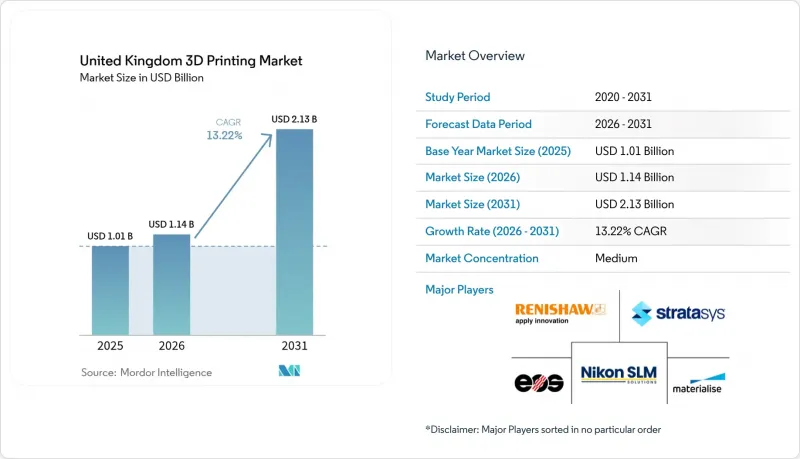
This report is Segmented by Printer Type (Industrial and Desktop/Professional), Material Type (Metal, Polymer, and More), Technology (Powder Bed Fusion, Material Extrusion, and More), Application (Aerospace and Defence, Automotive and Motorsport, and More), and Country (England, Scotland, Wales, and Northern Ireland). The Market Forecasts are Provided in Terms of Value (USD).
United Kingdom 3D Printing Market Trends and Insights
Government grants accelerate industrial adoption
Made Smarter Innovation and Innovate UK programs make capital equipment grants contingent on commercial deployment within 18 months, compressing payback horizons and de-risking first-time purchases. By 2024, Innovate UK committed GBP 78 million (USD 98.5 million) to additive manufacturing projects that span automotive tooling, certified flight parts, and hospital devices. The Aerospace Technology Institute's matching funds reduce certification costs for powder bed fusion components, encouraging prime contractors to qualify full assemblies rather than single parts. Grant conditions also require detailed skills transfer plans, pushing equipment vendors to bundle training with every sale. As a result, small and medium enterprises secure industrial-grade printers that were previously out of reach, widening the supplier base for Tier-1 manufacturers.
Surging demand for large-format industrial printers
Automotive toolmakers and architecture studios increasingly request cubic-meter build volumes to consolidate multicomponent jigs into single prints. Large-format systems such as the BigRep ONE enable production of bumper molds, HVAC ducts, and casting patterns in a single overnight run, reducing fixture lead time by up to 70% and slashing transport-related emissions. English and Scottish clusters are adopting these platforms first because of co-located composite shops and foundries that can immediately consume the printed tooling. Equipment leasing models, aided by accelerated tax allowances, support rapid fleet expansion for service bureaus.
High cap-ex and OPEX of metal systems
Production-class metal printers cost GBP 500,000-2 million (USD 631,000-2.5 million) and demand parallel investment in heat treatment, machining, and non-destructive testing. Metal powder, often 30-40% of total part cost, escalated 25-30% in 2024 amid supply shocks. SMEs struggle to pencil profitability without batch volumes that aerospace programs rarely offer. Leasing pools and shared hubs ease entry but introduce scheduling friction and IP leakage fears. Equipment makers now bundle closed-loop powder handling and in-chamber monitoring to shrink operating expense, yet breakeven horizons remain two to four years for most adopters.
Other drivers and restraints analyzed in the detailed report include:
- NHS framework for hospital-based medical printing
- Ministry of Defence offset clauses for on-site metal AM
- Skills shortage in design-for-additive and QC
For complete list of drivers and restraints, kindly check the Table Of Contents.
Segment Analysis
Industrial machines captured 72.05% United Kingdom 3D printing market share in 2025 as government subsidies favor production-grade hardware and as Tier-1 aerospace OEMs expanded certified lines. Desktop and professional platforms, though smaller, are climbing at a 14.21% CAGR because colleges and micro-businesses now justify in-house validation prints that compress design cycles. The United Kingdom 3D printing market size for desktop systems is projected to almost double by 2031, helped by sub-USD 10,000 resin machines that approach medical-grade accuracy.
Hybrid offerings blur categories: mid-sized gantry printers bundle industrial motion control with desktop-style UI, offering line changeover in minutes rather than hours. Vendors court education customers with subscription models that combine hardware, slicer updates, and curriculum content, ensuring sticky annual revenue. In parallel, industrial fleet operators add robot-assisted depowdering to scale throughput, minimizing labor dependencies that previously capped utilization.
Metal powders delivered 50.35% of 2025 revenue, anchored in titanium and aluminum alloys for defense airframes and civil engine components. The United Kingdom 3D printing market size for metals benefits from multi-year framework agreements that shelter end users from spot price spikes. Ceramics, however, post the fastest 14.56% CAGR as dental crowns, semiconductor packages, and thermal-shock-resistant tooling shift from subtractive routes to binder-jet and stereolithography options.
Polymer filaments and resins sustain prototyping demand and enter functional roles through carbon-fiber-filled grades that replace machined aluminum fixtures. Composite pellets for large-format printers gain share in automotive jigs as OEMs target five-day concept-to-fit timelines. Powder suppliers invest in local atomization lines to derisk import reliance, while ceramic feedstock players exploit readily available raw minerals, smoothing price curves relative to metals.
Complete Report Scope:
- By Printer Type
- Industrial
- Desktop/Professional
- By Material Type
- Metal
- Polymer
- Ceramic
- Composite/Other
- By Technology
- Powder Bed Fusion
- Material Extrusion (FDM / FFF)
- Vat Photopolymerisation
- Binder Jetting
- Directed Energy Deposition
- By Application
- Aerospace and Defence
- Automotive and Motorsport
- Healthcare and Medical Devices
- Construction and Architecture
- Consumer Products and Electronics
- Other Industrial Applications
- By Region
- England
- Scotland
- Wales
- Northern Ireland
List of Companies Covered in this Report:
- Renishaw plc
- Stratasys Ltd.
- EOS GmbH
- Materialise NV
- Nikon SLM Solutions AG
- 3D Systems Corporation
- Wayland Additive Ltd.
- Photocentric Ltd.
- Desktop Metal Inc.
- Formlabs Inc.
- Velo3D Inc.
- Ultimaker BV
- Roboze SpA
- Additive Industries BV
- Axial3D Ltd.
- AMFG Ltd.
- AI Build Ltd.
- GE Additive (General Electric Company)
- HP Development Company LP
- Impress Dental Manufacturing Ltd.
- GEOMIQ Ltd.
- Protolabs Inc.
Additional Benefits:
- The market estimate (ME) sheet in Excel format
- 3 months of analyst support
TABLE OF CONTENTS
1 INTRODUCTION
- 1.1 Study Assumptions and Market Definition
- 1.2 Scope of the Study
2 RESEARCH METHODOLOGY
3 EXECUTIVE SUMMARY
4 MARKET LANDSCAPE
- 4.1 Market Overview
- 4.2 Market Drivers
- 4.2.1 Government grants accelerate industrial adoption
- 4.2.2 Surging demand for large-format industrial printers
- 4.2.3 NHS framework for hospital-based medical printing
- 4.2.4 Ministry of Defence offset clauses for on-site metal AM
- 4.2.5 Net-Zero regulations drive lightweight lattice parts
- 4.2.6 Rise of digital spares marketplaces in rail and defence
- 4.3 Market Restraints
- 4.3.1 High cap-ex and OPEX of metal systems
- 4.3.2 Skills shortage in design-for-additive and QC
- 4.3.3 Metal-powder price volatility post-Ukraine conflict
- 4.3.4 IP liability uncertainty for on-demand parts
- 4.4 Industry Value Chain Analysis
- 4.5 Regulatory Landscape
- 4.6 Technological Outlook
- 4.7 Impact of Macroeconomic Factors
- 4.8 Porter's Five Forces Analysis
- 4.8.1 Threat of New Entrants
- 4.8.2 Bargaining Power of Buyers
- 4.8.3 Bargaining Power of Suppliers
- 4.8.4 Threat of Substitutes
- 4.8.5 Intensity of Competitive Rivalry
5 MARKET SIZE AND GROWTH FORECASTS (VALUES)
- 5.1 By Printer Type
- 5.1.1 Industrial
- 5.1.2 Desktop/Professional
- 5.2 By Material Type
- 5.2.1 Metal
- 5.2.2 Polymer
- 5.2.3 Ceramic
- 5.2.4 Composite/Other
- 5.3 By Technology
- 5.3.1 Powder Bed Fusion
- 5.3.2 Material Extrusion (FDM / FFF)
- 5.3.3 Vat Photopolymerisation
- 5.3.4 Binder Jetting
- 5.3.5 Directed Energy Deposition
- 5.4 By Application
- 5.4.1 Aerospace and Defence
- 5.4.2 Automotive and Motorsport
- 5.4.3 Healthcare and Medical Devices
- 5.4.4 Construction and Architecture
- 5.4.5 Consumer Products and Electronics
- 5.4.6 Other Industrial Applications
- 5.5 By Region
- 5.5.1 England
- 5.5.2 Scotland
- 5.5.3 Wales
- 5.5.4 Northern Ireland
6 COMPETITIVE LANDSCAPE
- 6.1 Market Concentration
- 6.2 Strategic Moves
- 6.3 Market Share Analysis
- 6.4 Company Profiles (includes Global level Overview, Market level overview, Core Segments, Financials as available, Strategic Information, Market Rank/Share for key companies, Products and Services, and Recent Developments)
- 6.4.1 Renishaw plc
- 6.4.2 Stratasys Ltd.
- 6.4.3 EOS GmbH
- 6.4.4 Materialise NV
- 6.4.5 Nikon SLM Solutions AG
- 6.4.6 3D Systems Corporation
- 6.4.7 Wayland Additive Ltd.
- 6.4.8 Photocentric Ltd.
- 6.4.9 Desktop Metal Inc.
- 6.4.10 Formlabs Inc.
- 6.4.11 Velo3D Inc.
- 6.4.12 Ultimaker BV
- 6.4.13 Roboze SpA
- 6.4.14 Additive Industries BV
- 6.4.15 Axial3D Ltd.
- 6.4.16 AMFG Ltd.
- 6.4.17 AI Build Ltd.
- 6.4.18 GE Additive (General Electric Company)
- 6.4.19 HP Development Company LP
- 6.4.20 Impress Dental Manufacturing Ltd.
- 6.4.21 GEOMIQ Ltd.
- 6.4.22 Protolabs Inc.
7 MARKET OPPORTUNITIES AND FUTURE OUTLOOK
- 7.1 White-space and Unmet-need Assessment

