PUBLISHER: Mordor Intelligence | PRODUCT CODE: 2124156

PUBLISHER: Mordor Intelligence | PRODUCT CODE: 2124156
Voice Analytics - Market Share Analysis, Industry Trends & Statistics, Growth Forecasts (2026 - 2031)
According to Mordor Intelligence, the voice analytics market size was valued at USD 1.68 billion in 2025 and estimated to grow from USD 1.93 billion in 2026 to reach USD 4.08 billion by 2031, at a CAGR of 16.15% during the forecast period (2026-2031).
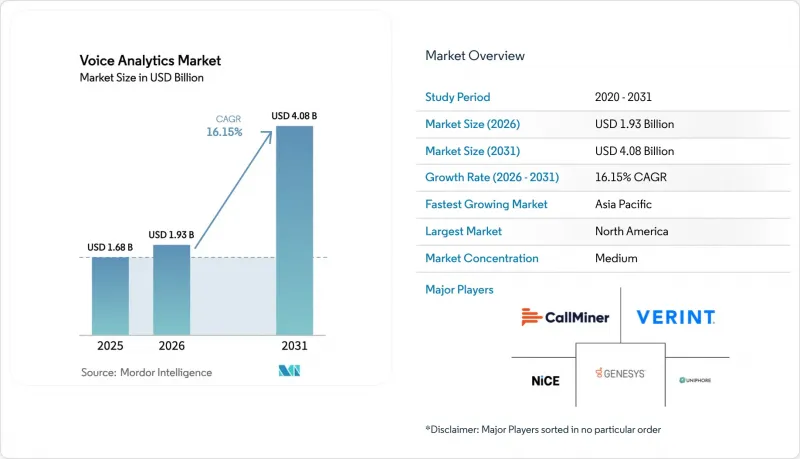
This report is Segmented by Component (Solution and Services), Deployment Mode (Cloud and On-Premise), Organization Size (Small and Medium-Sized Enterprises and Large Enterprises), Application (Health Monitoring, Sentiment Analysis, and More), End-User Vertical (Retail and E-Commerce, Telecom and IT, BFSI, Healthcare, and More) and by Geography. The Market Forecasts are Provided in Terms of Value (USD).
Global Voice Analytics Market Trends and Insights
Cloud-Native Contact-Center Adoption
Contact-center-as-a-service revenue exceeded USD 7 billion in 2024, and vendors have folded low-latency transcription into their core stacks. Enterprises now spin up compliant voice workflows within weeks instead of months, cutting total cost of ownership by up to 40% over five years. Hyperscalers compete on sub-200-millisecond transcription, and edge-optimized inference endpoints keep the voice analytics market moving toward real-time intervention. The economic case is compelling, ISG Research estimated that cloud-native deployments cut total cost of ownership by 30 to 40 percent over 5 years by eliminating hardware refresh cycles and enabling elastic scaling during peak call volumes.
Regulatory Mandates for Voice Recording Compliance
Fines topping USD 1.1 billion in 2024 underscored that electronic-communication retention is non-negotiable for broker-dealers. In healthcare, the U.S. Centers for Medicare and Medicaid Services introduced reimbursement codes in 2025 for remote patient monitoring that includes voice-based symptom tracking, provided the platform meets Health Insurance Portability and Accountability Act encryption standards. Similar obligations in Europe and Asia ensure a stable base of mandated demand. As data-sovereignty rules tighten, hybrid architectures that keep raw audio on domestic servers while syncing model updates from the cloud are becoming standard within the voice analytics market.
Data-Privacy and Surveillance Concerns
Voice recordings qualify as biometric data under the General Data Protection Regulation, requiring explicit opt-in consent and short retention windows. The U.S. Telephone Consumer Protection Act prohibits recording calls without prior consent in 11 two-party-consent states, complicating multi-state deployments and exposing enterprises to class-action litigation if consent workflows fail. Privacy-advocacy reports have highlighted cases in which emotion detection influenced employee evaluations without transparent review, prompting companies to roll out dashboards that explain why a given alert was triggered.
Other drivers and restraints analyzed in the detailed report include:
- Real-Time CX Analytics to Reduce Churn and Upsell
- Self-Supervised Learning Minimizing Labeling Needs
- High Integration and License Costs for SMEs
For complete list of drivers and restraints, kindly check the Table Of Contents.
Segment Analysis
Solutions generated 61.73% of 2025 revenue, but professional and managed services are forecast to grow at a 16.42% CAGR through 2031 as enterprises outsource dialect tuning, model monitoring, and compliance workflows. The voice analytics market size for managed services is projected to widen as vendors bundle quarterly retraining, assuring minimum word-error-rate thresholds.
Commoditization pressure is mounting on stand-alone speech engines because hyperscalers now offer transcription for USD 0.015 per minute.Voice biometrics modules are gaining traction in banking; the module authenticates callers by analysing 100-plus vocal characteristics-pitch, cadence, formant frequencies-eliminating the need for security questions and cutting average handle time by 30 to 45 seconds per call. Consequently, vendors pivot toward outcome-based contracts that guarantee accuracy, driving a higher share of value toward services. Verint's professional-services backlog surpassed USD 200 million in 2024, a signal that services revenue is becoming critical inside the voice analytics market.
Cloud held 70.53% of revenue in 2025 and is projected to rise at a 16.76% CAGR to 2031. Automatic scaling, GPU-optimized inference, and weekly model updates make cloud the default for most buyers, while edge appliances handle low-latency preprocessing. Hybrid offerings such as AWS Outposts preserve on-premise data residency but sync model weights from the cloud, satisfying regulatory demands without ceding elasticity.
On-premise remains relevant for defense and highly regulated finance, yet its voice analytics market share declines yearly as capital-expenditure budgets tighten. China's data-localisation laws favour on-premise or domestic-cloud deployments; the Cyberspace Administration of China mandates that voice data collected within the country remain on servers physically located in China, benefiting local vendors such as iFlytek over multinational platforms. Studies of European telecom carriers found cloud contact centers delivered 22 fewer hours of downtime per 1,000 agents, reinforcing the reliability argument.
Complete Report Scope:
- By Component
- Solution
- Speech Analytics Engine
- Voice Biometrics Module
- Dashboards and Reporting
- Services
- Professional Services
- Managed Services
- By Deployment Mode
- On-Cloud
- Premise
- By Organization Size
- Small and Medium-sized Enterprises
- Large Enterprises
- By Application
- Health Monitoring
- Sentiment Analysis
- Sales and Marketing
- Risk and Fraud Detection
- Call Monitoring
- Compliance Audit
- By End-User Vertical
- Retail and E-commerce
- Telecom and IT
- BFSI
- Healthcare
- Government and Defense
- Other End-User Verticals
- Geography
- North America
- United States
- Canada
- Mexico
- South America
- Brazil
- Argentina
- Rest of South America
- Europe
- Germany
- United Kingdom
- France
- Italy
- Spain
- Rest of Europe
- Asia Pacific
- China
- Japan
- India
- South Korea
- Southeast Asia
- Rest of Asia Pacific
- Middle East
- Saudi Arabia
- United Arab Emirates
- Turkey
- Rest of Middle East
- Africa
- South Africa
- Nigeria
- Egypt
- Rest of Africa
- North America
Geography Analysis
North America held 40.72% of 2025 revenue. Two-party-consent laws in 11 U.S. states drive granular consent workflows, and Financial Industry Regulatory Authority rules require six-year call retention, locking in demand. Hyperscaler innovation pipelines are headquartered in the United States, and new telehealth reimbursement codes turn clinics into early adopters. Mexico's bilingual near-shoring boom is also lifting Spanish-English analytics demand.
Asia Pacific records the fastest growth at a 17.93% CAGR to 2031. India's Bhashini project is seeding open-source speech models for 22 languages, while Japan's policy paper on aging prioritizes speech interfaces for elder care. Provincial subsidies in China favor domestic speech engines due to strict data-localization rules, and Southeast Asia's mobile-first economies pilot low-bandwidth deployments for micro-finance and agricultural advisory.
Europe benefits from a clear compliance framework under the General Data Protection Regulation and the pending AI Act. Emotion-detection systems fall under high-risk classification, prompting on-premise or private-cloud rollouts with explainability layers. Middle East sovereign-wealth funds co-invest in Arabic dialect models, and emerging African contact centers favor on-premise appliances because of connectivity limits, yet market-entry barriers are falling as bandwidth improves.
- NICE Ltd.
- Verint Systems
- Genesys Cloud Services, Inc.
- Avaya LLC
- Talkdesk, Inc.
- Uniphore Technologies Inc.
- Amazon Web Services
- Google Cloud
- Microsoft Corporation
- IBM
- Callminer Inc.
- Calabrio, Inc.
- SESTEK
- Invoca, Inc.
- VoiceBase
- audEERING
- VoiceSense
- RankMiner Inc.
- Beyond Verbal
- Nuance Communications
Additional Benefits:
- The market estimate (ME) sheet in Excel format
- 3 months of analyst support
TABLE OF CONTENTS
1 INTRODUCTION
- 1.1 Study Assumptions and Market Definition
- 1.2 Scope of the Study
2 RESEARCH METHODOLOGY
3 EXECUTIVE SUMMARY
4 MARKET LANDSCAPE
- 4.1 Market Overview
- 4.2 Market Drivers
- 4.2.1 Cloud-native Contact-Centre Adoption
- 4.2.2 Regulatory Mandates for Voice Recording Compliance
- 4.2.3 Real-time CX Analytics to Reduce Churn and Upsell
- 4.2.4 Self-supervised Learning Minimising Labelled Data Needs
- 4.2.5 Speech Emotion AI for Clinically Reimbursed Mental-Health Screening
- 4.2.6 On-device Federated Learning Safeguarding Voice Privacy
- 4.3 Market Restraints
- 4.3.1 Data-privacy and Surveillance Concerns
- 4.3.2 High Integration and Licence Costs for SMEs
- 4.3.3 Dialectal and Acoustic Variability Hindering Model Generalisability
- 4.3.4 Carbon Footprint of Training Large Speech Models
- 4.4 Industry Value Chain Analysis
- 4.5 Regulatory Landscape
- 4.6 Porter's Five Forces Analysis
- 4.6.1 Threat of New Entrants
- 4.6.2 Bargaining Power of Buyers
- 4.6.3 Bargaining Power of Suppliers
- 4.6.4 Threat of Substitutes
- 4.6.5 Intensity of Competitive Rivalry
- 4.7 Impact of Macroeconomic Factors on the Market
5 MARKET SIZE AND GROWTH FORECASTS (VALUE)
- 5.1 By Component
- 5.1.1 Solution
- 5.1.2 Speech Analytics Engine
- 5.1.3 Voice Biometrics Module
- 5.1.4 Dashboards and Reporting
- 5.1.5 Services
- 5.1.6 Professional Services
- 5.1.7 Managed Services
- 5.2 By Deployment Mode
- 5.2.1 On-Cloud
- 5.2.2 Premise
- 5.3 By Organization Size
- 5.3.1 Small and Medium-sized Enterprises
- 5.3.2 Large Enterprises
- 5.4 By Application
- 5.4.1 Health Monitoring
- 5.4.2 Sentiment Analysis
- 5.4.3 Sales and Marketing
- 5.4.4 Risk and Fraud Detection
- 5.4.5 Call Monitoring
- 5.4.6 Compliance Audit
- 5.5 By End-User Vertical
- 5.5.1 Retail and E-commerce
- 5.5.2 Telecom and IT
- 5.5.3 BFSI
- 5.5.4 Healthcare
- 5.5.5 Government and Defense
- 5.5.6 Other End-User Verticals
- 5.6 Geography
- 5.6.1 North America
- 5.6.1.1 United States
- 5.6.1.2 Canada
- 5.6.1.3 Mexico
- 5.6.2 South America
- 5.6.2.1 Brazil
- 5.6.2.2 Argentina
- 5.6.2.3 Rest of South America
- 5.6.3 Europe
- 5.6.3.1 Germany
- 5.6.3.2 United Kingdom
- 5.6.3.3 France
- 5.6.3.4 Italy
- 5.6.3.5 Spain
- 5.6.3.6 Rest of Europe
- 5.6.4 Asia Pacific
- 5.6.4.1 China
- 5.6.4.2 Japan
- 5.6.4.3 India
- 5.6.4.4 South Korea
- 5.6.4.5 Southeast Asia
- 5.6.4.6 Rest of Asia Pacific
- 5.6.5 Middle East
- 5.6.5.1 Saudi Arabia
- 5.6.5.2 United Arab Emirates
- 5.6.5.3 Turkey
- 5.6.5.4 Rest of Middle East
- 5.6.6 Africa
- 5.6.6.1 South Africa
- 5.6.6.2 Nigeria
- 5.6.6.3 Egypt
- 5.6.6.4 Rest of Africa
- 5.6.1 North America
6 COMPETITIVE LANDSCAPE
- 6.1 Market Concentration
- 6.2 Strategic Moves
- 6.3 Market Share Analysis
- 6.4 Company Profiles {(includes Global Level Overview, Market Level Overview, Core Segments, Financials as Available, Strategic Information, Market Rank/Share for Key Companies, Products and Services, and Recent Developments)}
- 6.4.1 NICE Ltd.
- 6.4.2 Verint Systems
- 6.4.3 Genesys Cloud Services, Inc.
- 6.4.4 Avaya LLC
- 6.4.5 Talkdesk, Inc.
- 6.4.6 Uniphore Technologies Inc.
- 6.4.7 Amazon Web Services
- 6.4.8 Google Cloud
- 6.4.9 Microsoft Corporation
- 6.4.10 IBM
- 6.4.11 Callminer Inc.
- 6.4.12 Calabrio, Inc.
- 6.4.13 SESTEK
- 6.4.14 Invoca, Inc.
- 6.4.15 VoiceBase
- 6.4.16 audEERING
- 6.4.17 VoiceSense
- 6.4.18 RankMiner Inc.
- 6.4.19 Beyond Verbal
- 6.4.20 Nuance Communications
7 MARKET OPPORTUNITIES AND FUTURE OUTLOOK
- 7.1 White-Space and Unmet-Need Assessment

