PUBLISHER: Mordor Intelligence | PRODUCT CODE: 2124158

PUBLISHER: Mordor Intelligence | PRODUCT CODE: 2124158
Embedded Security - Market Share Analysis, Industry Trends & Statistics, Growth Forecasts (2026 - 2031)
According to Mordor Intelligence, the embedded security market size is projected to expand from USD 9.23 billion in 2025 and USD 10.11 billion in 2026 to USD 15.95 billion by 2031, registering a CAGR of 9.54% between 2026 to 2031.
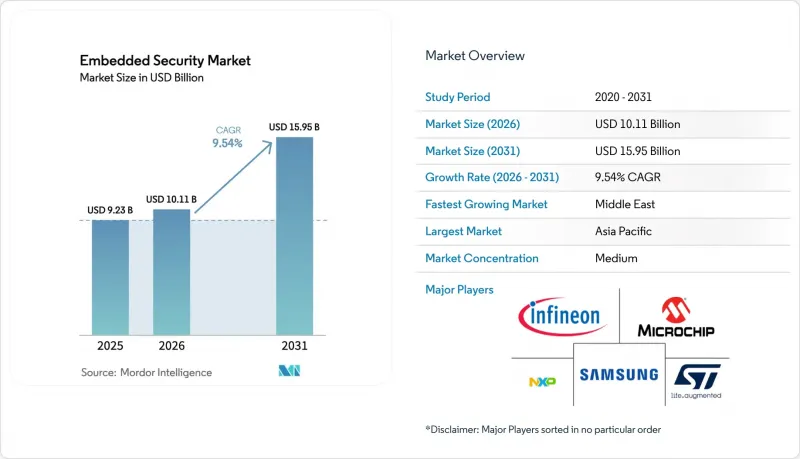
This report is Segmented by Component Type (Hardware, Software, and Services), Application (Payment, Authentication, Content Protection, and More), End-User Industry (Automotive, Healthcare, Consumer Electronics, Telecommunications, Aerospace and Defense, and More), Deployment (On-Premises, and Cloud), and Geography (North America, Europe, and More). The Market Forecasts are Provided in Terms of Value (USD).
Global Embedded Security Market Trends and Insights
Rapid Electrification And ADAS Adoption In Automotive ECUs
Battery-electric platforms integrate up to 100 electronic control units, each obligated to support secure boot, encrypted firmware updates, and authenticated over-the-air patches. Infineon confirmed 18% annual growth in automotive security-controller revenue as Tier-1 suppliers embed AURIX TC4x devices in battery-management and zonal architectures. Centralized compute designs such as Tesla's Hardware 4 concentrate cryptographic workloads, lifting per-vehicle silicon value. Advanced driver-assistance sensors exchange safety-critical data over Ethernet backbones, so OEMs insert secure gateways with intrusion-detection firmware. Stellantis and STMicroelectronics are co-developing vehicle-to-grid modules that embed dedicated secure elements, signaling how bidirectional charging extends security beyond the cabin.
EMVCo Contactless Payment Mandates For Cards And POS Terminals
EMVCo's Contactless Kernel 3.0 forces new payment terminals shipped after January 2025 to implement relay-attack mitigation and biometric verification, compelling dual-interface secure elements with NFC controllers. Mastercard reported 78% contactless penetration in Europe and 65% in Asia Pacific, leaving North America at 42% and primed for hardware refresh. PCI PTS 7.0 simultaneously tightens physical-tamper rules, pushing terminal vendors from generic processors toward certified secure chips. NXP saw a 12% sequential lift in secure-payment IC revenue on India's RuPay card roll-out and Brazil's Pix expansion. Embedded secure elements also power tokenized wallets in eSIM-enabled smartphones, a segment that shipped 1.2 billion units in 2024.
High ASP Gap Versus Commodity Microcontrollers In Cost-Sensitive IoT
Secure MCUs cost USD 1.50-3.00 compared with USD 0.30-0.50 generic parts, a premium that squeezes consumer-IoT gross margins. Attach rates stay below 25% in smart-home accessories despite available STM32L5 and STM32U5 devices that integrate Arm TrustZone. Higher quiescent current also shortens battery life by up to 30%. Microchip's PIC32CM LS00, priced at USD 0.85, narrows the gap but still forces product re-certification.
Other drivers and restraints analyzed in the detailed report include:
- Expanding IoT Edge Nodes In Smart-Home And Industrial Settings
- Post-Quantum-Crypto Migration Roadmaps For Long-Life Controllers
- Fragmented Standards Across Verticals
For complete list of drivers and restraints, kindly check the Table Of Contents.
Segment Analysis
The embedded security market size for hardware reached nearly half of total revenue in 2025, yet services are rising faster as organizations confront 12- to 18-month Common Criteria evaluations. Hardware margins compress in mature payment and SIM segments, while post-quantum-ready secure elements and TPMs keep absolute revenue solid. Software tools, such as static analyzers and key-management middleware, close gaps that once favored turnkey firmware and empower OEMs to retain intellectual property.
Services growth reflects a scarcity of side-channel experts and certified evaluators, driving consulting day rates above USD 2,000. Thales, Rambus, and Synopsys now wrap lifecycle management, certification artifacts, and security audits into recurring packages, blurring the line between silicon sale and subscription. As platform-as-a-service offerings mature, the embedded security market welcomes more hybrid revenue models that bundle chips, firmware, and cloud dashboards in a single contract.
Payment still leads the embedded security market with a 36.64% slice of revenue in 2025, but authentication posts a double-digit growth trajectory supported by phishing-resistant passkey mandates. Governments and cyber-insurers increasingly penalize single-factor logins, prompting enterprises to adopt FIDO2 hardware tokens and device-bound keys. Content-protection hardware stabilizes as studios pivot to software-based multi-DRM inside trusted execution environments, trimming demand for legacy set-top boxes.
Authentication's ascent is amplified by cloud providers that require passkeys for administrative consoles and by healthcare reforms that call for multi-factor access to electronic health records. The shift aligns with hardware that can store both classical and lattice-based keys, future-proofing investment. As a result, the embedded security market size tied to authentication is set to narrow the gap with payment by the end of the decade, particularly in regions that lag in contactless penetration.
Complete Report Scope:
- By Component Type
- Hardware
- Software
- Services
- By Application
- Payment
- Authentication
- Content Protection
- Other Applications
- By End-User Industry
- Automotive
- Healthcare
- Consumer Electronics
- Telecommunications
- Aerospace and Defense
- Other End-User Industries
- By Deployment
- On-Premise
- Cloud
- By Geography
- North America
- United States
- Canada
- Mexico
- South America
- Brazil
- Argentina
- Rest of South America
- Europe
- Germany
- United Kingdom
- France
- Italy
- Spain
- Russia
- Rest of Europe
- Asia Pacific
- China
- Japan
- India
- South Korea
- Australia
- Rest of Asia Pacific
- Middle East
- Saudi Arabia
- United Arab Emirates
- Turkey
- Rest of Middle East
- Africa
- Nigeria
- Egypt
- Rest of Africa
- North America
Geography Analysis
Asia Pacific controlled 40.42% of embedded security market revenue in 2025. Taiwan and South Korea supply leading-edge secure-element wafers, while China's Multi-Level Protection Scheme forces domestic cryptographic IP, lifting local demand. Despite its size, the region's growth moderates as mature smartphone and payment-card penetration reduces incremental volume.
The Middle East is the fastest-growing geography at 11.52% CAGR, fueled by Saudi Arabia's NEOM smart-city contracts exceeding USD 500 million and the UAE Cybersecurity Decree that mandates hardware encryption for critical infrastructure. Projects span smart grids, autonomous transit, and national identity layers, creating a pipeline for secure elements across industrial, consumer, and civic devices.
North America and Europe jointly contribute roughly 45% of revenue. Both regions face slower growth due to mature automotive and payment ecosystems, but they lead post-quantum pilots and industrial-IoT retrofits. Europe's Cyber Resilience Act forces secure-element integration yet depends on Asian fabs for supply, exposing geopolitical risk. In the United States, defense restrictions confine sourcing to DMEA-trusted foundries, tightening supply but ensuring provenance. South America and Africa remain early-stage markets; Brazil's Pix payment and Nigeria's eNaira CBDC offer pockets of opportunity yet lack scale to shift global rankings.
- Infineon Technologies AG
- NXP Semiconductors NV
- STMicroelectronics NV
- Microchip Technology Inc.
- Samsung Electronics Co.
- Texas Instruments Inc.
- Renesas Electronics Corp.
- Qualcomm Inc.
- Broadcom Inc.
- Lattice Semiconductor Corp.
- Synopsys Inc.
- Arm Ltd.
- Rambus Inc.
- Verimatrix SA
- Thales Group
- G+D Mobile Security GmbH
- Idemia Group
- Karamba Security Ltd.
- Trillium Secure Inc.
- ESCRYPT GmbH
- Sectigo Ltd.
- Mocana Corp.
- Intellias Ltd.
- Winbond Electronics Corp.
- Nuvoton Technology Corp.
- IAR Systems AB
- Secure-IC SA
- PQShield Ltd.
Additional Benefits:
- The market estimate (ME) sheet in Excel format
- 3 months of analyst support
TABLE OF CONTENTS
1 INTRODUCTION
- 1.1 Study Assumptions and Market Definition
- 1.2 Scope of the Study
2 RESEARCH METHODOLOGY
3 EXECUTIVE SUMMARY
4 MARKET LANDSCAPE
- 4.1 Market Overview
- 4.2 Market Drivers
- 4.2.1 Rapid Electrification and ADAS Adoption in Automotive ECUs
- 4.2.2 EMVCo Contactless Payment Mandates for Cards and POS Terminals
- 4.2.3 Expanding IoT Edge Nodes in Smart-Home and Industrial Settings
- 4.2.4 Post-Quantum-Crypto Migration Roadmaps for Long-Life Controllers
- 4.2.5 EU Cyber-Resilience Act Requiring Hardware Roots of Trust
- 4.2.6 Digital Battery Passports Creating Secure-Element Demand
- 4.3 Market Restraints
- 4.3.1 High ASP Gap Versus Commodity Microcontrollers in Cost-Sensitive IoT
- 4.3.2 Fragmented Standards Across Verticals (GlobalPlatform vs. TCG)
- 4.3.3 Supply-Chain "Ghost-Foundry" Risk Limiting Qualified Sources
- 4.3.4 Shortage of Secure-Element Firmware Verification Skill Sets
- 4.4 Industry Value Chain Analysis
- 4.5 Regulatory Landscape
- 4.6 Technological Outlook
- 4.7 Porter's Five Forces Analysis
- 4.7.1 Threat of New Entrants
- 4.7.2 Bargaining Power of Buyers
- 4.7.3 Bargaining Power of Suppliers
- 4.7.4 Threat of Substitutes
- 4.7.5 Intensity of Competitive Rivalry
- 4.8 Impact of Macroeconomic Factors on the Market
- 4.9 Key Performance Indicators
5 MARKET SIZE AND GROWTH FORECASTS (VALUE)
- 5.1 By Component Type
- 5.1.1 Hardware
- 5.1.2 Software
- 5.1.3 Services
- 5.2 By Application
- 5.2.1 Payment
- 5.2.2 Authentication
- 5.2.3 Content Protection
- 5.2.4 Other Applications
- 5.3 By End-User Industry
- 5.3.1 Automotive
- 5.3.2 Healthcare
- 5.3.3 Consumer Electronics
- 5.3.4 Telecommunications
- 5.3.5 Aerospace and Defense
- 5.3.6 Other End-User Industries
- 5.4 By Deployment
- 5.4.1 On-Premise
- 5.4.2 Cloud
- 5.5 By Geography
- 5.5.1 North America
- 5.5.1.1 United States
- 5.5.1.2 Canada
- 5.5.1.3 Mexico
- 5.5.2 South America
- 5.5.2.1 Brazil
- 5.5.2.2 Argentina
- 5.5.2.3 Rest of South America
- 5.5.3 Europe
- 5.5.3.1 Germany
- 5.5.3.2 United Kingdom
- 5.5.3.3 France
- 5.5.3.4 Italy
- 5.5.3.5 Spain
- 5.5.3.6 Russia
- 5.5.3.7 Rest of Europe
- 5.5.4 Asia Pacific
- 5.5.4.1 China
- 5.5.4.2 Japan
- 5.5.4.3 India
- 5.5.4.4 South Korea
- 5.5.4.5 Australia
- 5.5.4.6 Rest of Asia Pacific
- 5.5.5 Middle East
- 5.5.5.1 Saudi Arabia
- 5.5.5.2 United Arab Emirates
- 5.5.5.3 Turkey
- 5.5.5.4 Rest of Middle East
- 5.5.6 Africa
- 5.5.6.1 Nigeria
- 5.5.6.2 Egypt
- 5.5.6.3 Rest of Africa
- 5.5.1 North America
6 COMPETITIVE LANDSCAPE
- 6.1 Market Concentration
- 6.2 Strategic Moves
- 6.3 Market Share Analysis
- 6.4 Company Profiles (includes Global Level Overview, Market Level Overview, Core Segments, Financials as Available, Strategic Information, Market Rank/Share for Key Companies, Products and Services, and Recent Developments)
- 6.4.1 Infineon Technologies AG
- 6.4.2 NXP Semiconductors NV
- 6.4.3 STMicroelectronics NV
- 6.4.4 Microchip Technology Inc.
- 6.4.5 Samsung Electronics Co.
- 6.4.6 Texas Instruments Inc.
- 6.4.7 Renesas Electronics Corp.
- 6.4.8 Qualcomm Inc.
- 6.4.9 Broadcom Inc.
- 6.4.10 Lattice Semiconductor Corp.
- 6.4.11 Synopsys Inc.
- 6.4.12 Arm Ltd.
- 6.4.13 Rambus Inc.
- 6.4.14 Verimatrix SA
- 6.4.15 Thales Group
- 6.4.16 G+D Mobile Security GmbH
- 6.4.17 Idemia Group
- 6.4.18 Karamba Security Ltd.
- 6.4.19 Trillium Secure Inc.
- 6.4.20 ESCRYPT GmbH
- 6.4.21 Sectigo Ltd.
- 6.4.22 Mocana Corp.
- 6.4.23 Intellias Ltd.
- 6.4.24 Winbond Electronics Corp.
- 6.4.25 Nuvoton Technology Corp.
- 6.4.26 IAR Systems AB
- 6.4.27 Secure-IC SA
- 6.4.28 PQShield Ltd.
7 MARKET OPPORTUNITIES AND FUTURE OUTLOOK
- 7.1 White-Space and Unmet-Need Assessment

