PUBLISHER: Mordor Intelligence | PRODUCT CODE: 2124160

PUBLISHER: Mordor Intelligence | PRODUCT CODE: 2124160
Content Intelligence - Market Share Analysis, Industry Trends & Statistics, Growth Forecasts (2026 - 2031)
According to Mordor Intelligence, the content intelligence market size is expected to grow from USD 2.01 billion in 2025 to USD 2.59 billion in 2026 and is forecast to reach USD 9.15 billion by 2031 at 28.74% CAGR over 2026-2031.
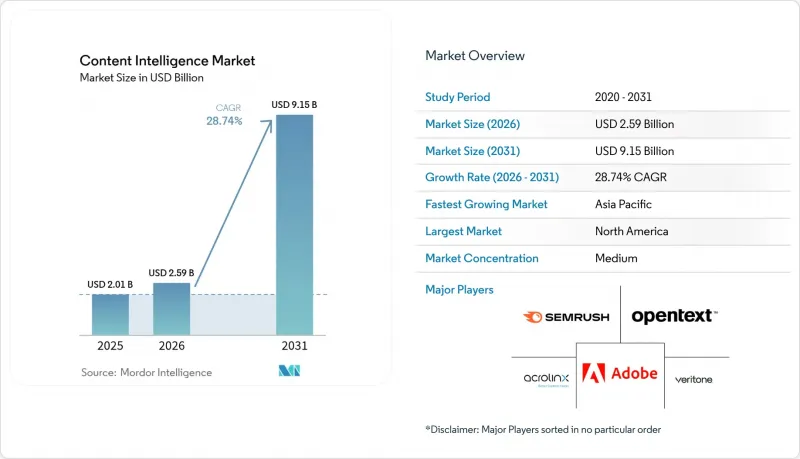
This report is Segmented by Component (Solution, Service), Deployment (Cloud, On-Premise, Hybrid), Organization Size (SMEs, Large Enterprises), End-User Vertical (Media and Entertainment, Government and Public Sector, and More), and Geography. The Market Size and Forecasts are Provided in Terms of Value (USD).
Global Content Intelligence Market Trends and Insights
Demand for personalised, data-driven content at scale
Enterprises now recognize that generic messaging struggles to cut through sophisticated consumer filters. Adobe's Customer Experience Orchestration platform demonstrated engagement gains of up to 30% for banner variants in 2024. The move toward first-party data strategies gives firms proprietary fuel for ever-more-accurate personalization models. Organizations using content intelligence market platforms report 40-70% faster creation cycles and higher relevance scores, confirming that scale and quality are no longer trade-offs. Financial services, healthcare, and retail all cite similar benefits as AI tailors content to regulatory or customer nuances. The emphasis on performance measurement accelerates spending on analytics modules that quantify engagement lifts. These dynamics strengthen the content intelligence market outlook for mid-term growth.
AI/ML integration across martech stacks
Generative AI has shifted from bolt-on feature to core infrastructure. Adobe's GenStudio unifies creation, brand governance, and analytics in one workflow, showing how AI removes hand-offs that slowed production. OpenText's Titanium X combines 15 AI aviators and more than 100 agents, promising USD 1 billion in savings over a decade for process-heavy clients. Consolidation pressures legacy vendors to upgrade or risk displacement by AI-native entrants. Firms now budget for continuous model tuning, agent orchestration, and data-ops rather than one-time licenses. Early adopters of integrated stacks credit AI orchestration for real-time A/B testing and fully automated campaign iteration. This integration drives a sustained uplift across the content intelligence market through 2030.
Data-privacy and GDPR / DMA compliance costs
OpenAI's EUR 15 million fine in 2025 illustrates the financial exposure tied to data misuse. New European Data Protection Board guidance obliges firms to justify every personal-data use in training, monitoring, and inference. Enterprises adopting the content intelligence market must therefore invest in privacy-preserving architectures, on-premise deployments, and synthetic data pipelines. Compliance audits add 25-40% to total cost of ownership, slowing buying cycles in heavily regulated sectors. Despite the drag, firms accept higher costs to retain EU market access.
Other drivers and restraints analyzed in the detailed report include:
- Omnichannel content explosion on video and social platforms
- Accessibility regulations (WCAG 3.0) accelerating adoption
- Shortage of content-AI talent and change-management gaps
For complete list of drivers and restraints, kindly check the Table Of Contents.
Segment Analysis
Services captured rapid growth with a 33.02% CAGR through 2031 even though Solutions retained 63.10% of 2025 revenue. The Content intelligence market size for services is projected to climb sharply as companies need consulting, workflow redesign, and change management alongside tooling. Larger regulated enterprises turn to specialized integrators that align AI output with compliance obligations. Case in point, Adobe's collaboration with PwC targets heavily regulated verticals to bundle platform, data governance, and domain expertise. Solutions revenue remains sizable, yet commoditization of basic AI features tempers its pace. Vendors differentiate by embedding industry-specific models and low-code orchestration, yet buyers still lean on service partners to translate capability into business value. That dependence underpins sustained Services acceleration across the content intelligence market.
Implementation success metrics underscore the shift: organizations pairing software and managed services report 20-30% higher adoption rates and quicker time-to-value than tool-only deployments. Subscription-based services now account for 76% of Veritone's customer contracts, signaling a pivot toward outcome-centric engagements. Over the forecast horizon, mature enterprises will rebalance budgets toward advisory, model fine-tuning, and continuous optimization as AI moves from pilot to production.
Cloud remained dominant at a 76.20% share in 2025, but hybrid configurations now post the fastest trajectory at 35.95% CAGR. The Content intelligence market share for hybrid setups rises as firms split sensitive data onto local clusters while keeping burst workloads in public clouds. Hybrid rollouts lower latency for real-time personalization and meet jurisdictional data mandates without forgoing elastic scaling. Early adopters have measured 30-50% operating-expense savings compared with all-cloud when processing heavy multimedia assets. Vendors respond with containerized micro-services that slide easily between environments, shielding users from infrastructure complexity.
On-premise instances hold niche value for defense and highly regulated healthcare customers. The release of small, domain-tuned language models that perform well on CPU cores further reduces reliance on GPU-rich data centers, making local inference practical. Over time, multi-cloud control planes that abstract policy, model versioning, and usage metering will become standard. This flexibility cements hybrid as a mainstream choice across the content intelligence market.
Complete Report Scope:
- By Component
- Solution
- Service
- By Deployment
- Cloud
- On-premise
- Hybrid
- By Organisation Size
- Small and Medium-sized Enterprises (SMEs)
- Large Enterprises
- By End-user Vertical
- Media and Entertainment
- Government and Public Sector
- Banking, Financial Services and Insurance (BFSI)
- IT and Telecommunications
- Manufacturing
- Healthcare and Life-sciences
- Retail and e-Commerce
- Others
- By Geography
- North America
- United States
- Canada
- Europe
- Germany
- United Kingdom
- France
- Rest of Europe
- Asia-Pacific
- India
- China
- Japan
- Rest of Asia-Pacific
- South America
- Brazil
- Argentina
- Rest of South America
- Middle East and Africa
- Saudi Arabia
- South Africa
- United Arab Emirates
- Rest of Middle East and Africa
- North America
Geography Analysis
North America generated 37.40% of 2025 revenue thanks to early enterprise AI rollouts and deep cloud infrastructure. The region maintains clear leadership, yet growth stabilizes as large enterprises shift from experimentation to optimization. The Content intelligence market size in North America climbs steadily, supported by regulatory pushes for accessibility and rising zero-party data strategies. Vendor ecosystems cluster around established tech hubs, securing venture funding and fostering partnerships with system integrators.
Asia-Pacific exhibits the fastest pace at 33.84% CAGR, driven by national AI programs and a flourishing creator economy that fuels demand for multilingual, multi-platform content. Local start-ups launch lightweight models fine-tuned for regional languages, helping brands localize at scale. Hybrid cloud adoption also rises where data-residency rules coexist with cost pressures. These forces gradually chip away at North American dominance, although the two regions together still command most of the content intelligence market.
Europe shows resilient expansion as GDPR and the forthcoming EU AI Act compel enterprises to adopt content governance and explainability tooling. Many firms choose hybrid or on-premise deployments to align with stringent data-sovereignty mandates. South America and the Middle East and Africa remain nascent but attractive; improved broadband and government digitization plans create green-field opportunities for SaaS providers. Global penetration confirms that AI-enabled content intelligence is trending from early adopter privilege toward mainstream necessity.
- Adobe Inc.
- OpenText Corporation
- Semrush Holdings Inc.
- Acrolinx GmbH
- Veritone Inc.
- M-Files Corporation
- Smartlogic Holdings Ltd.
- Curata Inc.
- Scoop.it SAS
- Socialbakers a.s. (now Emplifi)
- Concured Ltd.
- Atomic Reach Inc.
- OneSpot Inc.
- Vennli Inc.
- Sitecore Holding II A/S
- BrightEdge Technologies Inc.
- StoryChief NV
- Sprinklr Inc.
- Vyond Inc.
- ChapsVision Group
- Degreed Inc.
Additional Benefits:
- The market estimate (ME) sheet in Excel format
- 3 months of analyst support
TABLE OF CONTENTS
1 INTRODUCTION
- 1.1 Study Assumptions and Market Definition
- 1.2 Scope of the Study
2 RESEARCH METHODOLOGY
3 EXECUTIVE SUMMARY
4 MARKET LANDSCAPE
- 4.1 Market Overview
- 4.2 Market Drivers
- 4.2.1 Demand for personalised, data-driven content at scale
- 4.2.2 AI/ML integration across martech stacks
- 4.2.3 Omnichannel content explosion on video and social platforms
- 4.2.4 Accessibility regulations (WCAG 3.0) accelerating adoption
- 4.2.5 Deployment of in-house small language models lowering TCO
- 4.2.6 Synthetic audience data unlocking zero-party targeting
- 4.3 Market Restraints
- 4.3.1 Data-privacy and GDPR / DMA compliance costs
- 4.3.2 Shortage of content-AI talent and change-management gaps
- 4.3.3 GPU/ASIC supply-chain bottlenecks inflating inference costs
- 4.3.4 Hallucination-driven brand-liability risks
- 4.4 Value / Supply-Chain Analysis
- 4.5 Regulatory Landscape
- 4.6 Technological Outlook
- 4.7 Porter's Five Forces Analysis
- 4.7.1 Bargaining Power of Buyers/Consumers
- 4.7.2 Bargaining Power of Suppliers
- 4.7.3 Threat of New Entrants
- 4.7.4 Threat of Substitutes
- 4.7.5 Intensity of Competitive Rivalry
5 MARKET SIZE AND GROWTH FORECASTS (VALUE)
- 5.1 By Component
- 5.1.1 Solution
- 5.1.2 Service
- 5.2 By Deployment
- 5.2.1 Cloud
- 5.2.2 On-premise
- 5.2.3 Hybrid
- 5.3 By Organisation Size
- 5.3.1 Small and Medium-sized Enterprises (SMEs)
- 5.3.2 Large Enterprises
- 5.4 By End-user Vertical
- 5.4.1 Media and Entertainment
- 5.4.2 Government and Public Sector
- 5.4.3 Banking, Financial Services and Insurance (BFSI)
- 5.4.4 IT and Telecommunications
- 5.4.5 Manufacturing
- 5.4.6 Healthcare and Life-sciences
- 5.4.7 Retail and e-Commerce
- 5.4.8 Others
- 5.5 By Geography
- 5.5.1 North America
- 5.5.1.1 United States
- 5.5.1.2 Canada
- 5.5.2 Europe
- 5.5.2.1 Germany
- 5.5.2.2 United Kingdom
- 5.5.2.3 France
- 5.5.2.4 Rest of Europe
- 5.5.3 Asia-Pacific
- 5.5.3.1 India
- 5.5.3.2 China
- 5.5.3.3 Japan
- 5.5.3.4 Rest of Asia-Pacific
- 5.5.4 South America
- 5.5.4.1 Brazil
- 5.5.4.2 Argentina
- 5.5.4.3 Rest of South America
- 5.5.5 Middle East and Africa
- 5.5.5.1 Saudi Arabia
- 5.5.5.2 South Africa
- 5.5.5.3 United Arab Emirates
- 5.5.5.4 Rest of Middle East and Africa
- 5.5.1 North America
6 COMPETITIVE LANDSCAPE
- 6.1 Market Concentration
- 6.2 Strategic Moves
- 6.3 Market Share Analysis
- 6.4 Company Profiles (includes Global-level Overview, Market-level Overview, Core Segments, Financials as available, Strategic Information, Market Rank/Share, Products and Services, Recent Developments)
- 6.4.1 Adobe Inc.
- 6.4.2 OpenText Corporation
- 6.4.3 Semrush Holdings Inc.
- 6.4.4 Acrolinx GmbH
- 6.4.5 Veritone Inc.
- 6.4.6 M-Files Corporation
- 6.4.7 Smartlogic Holdings Ltd.
- 6.4.8 Curata Inc.
- 6.4.9 Scoop.it SAS
- 6.4.10 Socialbakers a.s. (now Emplifi)
- 6.4.11 Concured Ltd.
- 6.4.12 Atomic Reach Inc.
- 6.4.13 OneSpot Inc.
- 6.4.14 Vennli Inc.
- 6.4.15 Sitecore Holding II A/S
- 6.4.16 BrightEdge Technologies Inc.
- 6.4.17 StoryChief NV
- 6.4.18 Sprinklr Inc.
- 6.4.19 Vyond Inc.
- 6.4.20 ChapsVision Group
- 6.4.21 Degreed Inc.
7 MARKET OPPORTUNITIES AND FUTURE OUTLOOK
- 7.1 White-space and Unmet-need Assessment

