PUBLISHER: Mordor Intelligence | PRODUCT CODE: 2124174

PUBLISHER: Mordor Intelligence | PRODUCT CODE: 2124174
United States Small Home Appliances - Market Share Analysis, Industry Trends & Statistics, Growth Forecasts (2026 - 2031)
According to Mordor Intelligence, the United States small home appliances market size is expected to grow from USD 27.42 billion in 2025 to USD 28.44 billion in 2026 and is forecast to reach USD 34.14 billion by 2031 at 3.72% CAGR over 2026-2031.
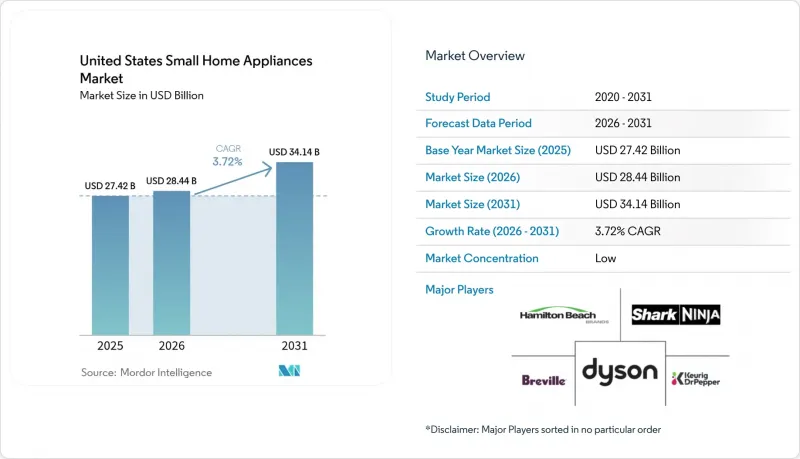
This report is Segmented by Product (Coffee Makers, Food Processors, Grills and Roasters, Electric Kettles, Juicers and Blenders, and More ), and by Distribution Channel (Multi-Branded Stores, Exclusive Brand Outlets, Online, and Other Distribution Channels), and by Geography (Northeast, Southeast, Midwest, Southwest, and West). The Market Forecasts are Provided in Terms of Value (USD).
United States Small Home Appliances Market Trends and Insights
Energy-Efficiency Regulations and Utility-Cost Awareness
Federal appliance standards are shortening innovation cycles as vendors redesign platforms to meet lower kilowatt-hour ceilings while maintaining price points that satisfy value-oriented shoppers. The Department of Energy projects its latest water-heater rules will trim US energy use by 17.6 quadrillion Btu over 30 years, underscoring the payoff for high-efficiency compressors and heat-pump integrations. Dishwasher caps of 223 kWh per year from April 2027 further accelerate the adoption of brushless motors and proprietary heat-recovery modules, prompting system-level design around kitchen ecosystems rather than single units. California's above-average electricity tariffs heighten consumer payback scrutiny, letting brands with credible Energy Star labels lift average selling prices without eroding demand. Parallel rules for commercial walk-in coolers spill upstream to residential suppliers that share evaporator and insulation sourcing, reinforcing scale advantages for vertically integrated producers.
Rapid Adoption of Smart and Connected Appliances
According to Houzz's "2024 U.S. Kitchen Trends Study," connected appliances penetration reached 30% of US kitchen renovations in 2024, and Wi-Fi is now table stakes, not an upsell. Samsung's 2025 Bespoke AI range, equipped with 9-inch screens and food-recognition vision, illustrates how embedded intelligence commands premium shelf placement and lifts attachment rates for companion apps. GE Appliances' SmartHQ platform provisions predictive-maintenance alerts that reduce warranty claims and stimulate aftermarket part sales. Interoperability progress under Matter 1.4 reduces consumer risk of ecosystem lock-in, while on-device AI sidesteps privacy pushback linked to cloud-based data retention. Yet advanced mapping in robotic vacuums has drawn scrutiny from privacy advocates, signaling that feature depth must remain balanced against data-security assurances to preserve adoption momentum.
Volatile raw materials and semiconductor pricing
Copper trading above USD 10,000 per metric ton inflates refrigeration-circuit costs by up to 4.2%, forcing OEMs to pursue hedging or redesign evaporator geometries to reduce metal load factors. Global chip shortfalls continue to delay launch calendars for feature-laden models, prolonging SKUs based on legacy microcontrollers and throttling innovation cadence. Steel-based appliance tariffs of 50% effective June 2025, close former import-arbitrage windows and amplify cost inflation that outpaces household wage growth, risking price-driven demand pullbacks.
Other drivers and restraints analyzed in the detailed report include:
- Expansion of E-Commerce and Direct-to-Consumer Models
- Growing Disposable Income, Changing Lifestyles, and Urbanization
- Supply-chain disruptions and freight-cost pressures
For complete list of drivers and restraints, kindly check the Table Of Contents.
Segment Analysis
Vacuum cleaners preserve the largest 21.85% share, yet robotic entrants backed by aggressive Chinese pricing pressure are squeezing margins, prompting incumbents to layer navigation AI and subscription consumables to stabilize revenues. Air fryers generated the fastest 7.35% CAGR through 2031 as consumers pursued healthier cooking that mimics deep-fried textures without submerging food in oil. The US small home appliances market size for air fryers is projected to grow significantly by 2030, illustrating how a formerly niche tool became central to weeknight meal prep. Food companies now co-develop SKUs engineered for air-fryer performance, while appliance makers incorporate dual-basket designs and app-based recipe platforms to extend usage occasions.
Coffee makers and electric kettles benefit from premiumization as consumers chase cafe-quality extraction at home. Specialty espresso units with PID-controlled boilers and smartphone telemetry lift attachment sales of branded beans and descaling kits. Food processors and blenders see brand consolidation. Countertop ovens now bundle air-fry and dehydration modes, dissolving historical product silos and encouraging modular component sourcing. The residual "other" segment-waffle irons, mini-rice cookers, niche sous-vide sticks-leverages social-media micro-trends, yielding burst demand cycles that savvy suppliers satisfy via limited-run drops through DTC storefronts.
Complete Report Scope:
- By Product
- Coffee Makers
- Food Processors
- Grills and Roasters
- Electric Kettles
- Juicers and Blenders
- Air Fryers
- Vacuum Cleaners
- Toasters
- Countertop Ovens
- Other Small Home Appliances (Waffle Makers, Deep Fryers, Egg Cookers, Tea Makers, Rice Cookers, Etc.)
- By Distribution Channel
- Multi-Brand Stores
- Exclusive Brand Outlets
- Online
- Other Distribution Channels
- By Geography
- Northeast
- Southeast
- Midwest
- Southwest
- West
List of Companies Covered in this Report:
- SharkNinja Operating LLC
- Dyson Ltd.
- Hamilton Beach Brands Holding Co.
- Keurig Dr Pepper Inc. (Keurig)
- Breville Group Ltd.
- Instant Brands Inc.
- Conair Corporation (Cuisinart)
- iRobot Corporation
- Panasonic Corporation
- Versuni (Philips Domestic Appliances)
- Ninja (Brand Of SharkNinja)
- Bissell Inc.
- Spectrum Brands Holdings (Black+Decker Appliances)
- Gourmia Inc.
- Smeg S.p.A.
- De'Longhi Group
- Midea Group
- TTI Floor Care (Hoover, Dirt Devil, Oreck)
- Electrolux AB
- KitchenAid (Whirlpool SDA Division)
Additional Benefits:
- The market estimate (ME) sheet in Excel format
- 3 months of analyst support
TABLE OF CONTENTS
1 Introduction
- 1.1 Study Assumptions & Market Definition
- 1.2 Scope of the Study
2 Research Methodology
3 Executive Summary
4 Market Landscape
- 4.1 Market Overview
- 4.2 Market Drivers
- 4.2.1 Energy-Efficiency Regulations And Utility-Cost Awareness
- 4.2.2 Rapid Adoption Of Smart And Connected Appliances
- 4.2.3 Expansion Of E-Commerce And Direct-To-Consumer Models
- 4.2.4 Housing Starts, Renovation Boom, And Replacement Cycles
- 4.2.5 Growing Disposable Income, Changing Lifestyles, and Urbanization
- 4.3 Market Restraints
- 4.3.1 Volatile Raw-Material And Semiconductor Pricing
- 4.3.2 Supply-Chain Disruptions And Freight Cost Pressures
- 4.3.3 Intensifying Price Competition And Private-Label Expansion
- 4.3.4 Right-To-Repair Legislation Extending Product Lifecycles
- 4.4 Industry Value Chain Analysis
- 4.5 Porter's Five Forces Analysis
- 4.5.1 Threat Of New Entrants
- 4.5.2 Bargaining Power Of Suppliers
- 4.5.3 Bargaining Power Of Buyers
- 4.5.4 Threat Of Substitutes
- 4.5.5 Competitive Rivalry
- 4.6 Insights Into The Latest Trends And Innovations In The Market
- 4.7 Insights On Recent Developments (New Product Launches, Strategic Initiatives, Investments, Partnerships, JVs, Expansion, M&As, Etc.) In The Market
5 Market Size & Growth Forecasts (Value)
- 5.1 By Product
- 5.1.1 Coffee Makers
- 5.1.2 Food Processors
- 5.1.3 Grills and Roasters
- 5.1.4 Electric Kettles
- 5.1.5 Juicers and Blenders
- 5.1.6 Air Fryers
- 5.1.7 Vacuum Cleaners
- 5.1.8 Toasters
- 5.1.9 Countertop Ovens
- 5.1.10 Other Small Home Appliances (Waffle Makers, Deep Fryers, Egg Cookers, Tea Makers, Rice Cookers, Etc.)
- 5.2 By Distribution Channel
- 5.2.1 Multi-Brand Stores
- 5.2.2 Exclusive Brand Outlets
- 5.2.3 Online
- 5.2.4 Other Distribution Channels
- 5.3 By Geography
- 5.3.1 Northeast
- 5.3.2 Southeast
- 5.3.3 Midwest
- 5.3.4 Southwest
- 5.3.5 West
6 Competitive Landscape
- 6.1 Market Concentration
- 6.2 Strategic Moves
- 6.3 Market Share Analysis
- 6.4 Company Profiles (Includes Global Level Overview, Market Level Overview, Core Segments, Financials As Available, Strategic Information, Market Rank/Share For Key Companies, Products & Services, And Recent Developments)
- 6.4.1 SharkNinja Operating LLC
- 6.4.2 Dyson Ltd.
- 6.4.3 Hamilton Beach Brands Holding Co.
- 6.4.4 Keurig Dr Pepper Inc. (Keurig)
- 6.4.5 Breville Group Ltd.
- 6.4.6 Instant Brands Inc.
- 6.4.7 Conair Corporation (Cuisinart)
- 6.4.8 iRobot Corporation
- 6.4.9 Panasonic Corporation
- 6.4.10 Versuni (Philips Domestic Appliances)
- 6.4.11 Ninja (Brand Of SharkNinja)
- 6.4.12 Bissell Inc.
- 6.4.13 Spectrum Brands Holdings (Black+Decker Appliances)
- 6.4.14 Gourmia Inc.
- 6.4.15 Smeg S.p.A.
- 6.4.16 De'Longhi Group
- 6.4.17 Midea Group
- 6.4.18 TTI Floor Care (Hoover, Dirt Devil, Oreck)
- 6.4.19 Electrolux AB
- 6.4.20 KitchenAid (Whirlpool SDA Division)
7 Market Opportunities & Future Outlook
- 7.1 Smart Home Integration & IoT Adoption

