PUBLISHER: Mordor Intelligence | PRODUCT CODE: 2124176

PUBLISHER: Mordor Intelligence | PRODUCT CODE: 2124176
Pressure Infusion Bags - Market Share Analysis, Industry Trends & Statistics, Growth Forecasts (2026 - 2031)
According to Mordor Intelligence, pressure infusion bags market size in 2026 is estimated at USD 371.21 million, growing from 2025 value of USD 352.10 million with 2031 projections showing USD 483.69 million, growing at 5.43% CAGR over 2026-2031.
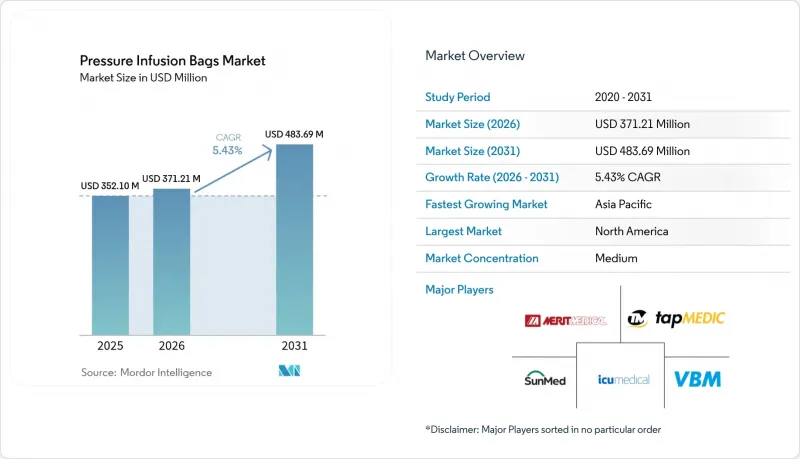
This report is Segmented by Product Type (Reusable, Disposable), Material (Nylon, Polyurethane, Other Materials), Pressure Range (250-300 MmHg, and More), Application (Blood and Drug Infusion, Invasive Pressure Monitoring, and More), End User (Hospitals and Clinics, and More), and Geography (North America, Europe, Asia-Pacific, and More). The Market Forecasts are Provided in Terms of Value (USD).
Global Pressure Infusion Bags Market Trends and Insights
Rising Prevalence of Chronic Diseases & Trauma Cases
Trauma centers increasingly report complex polytrauma presentations requiring rapid, high-volume infusions that favor reliable pressurized delivery systems. Combat casualty care underscores this need: the U.S. Department of Defense's Golden Hour initiatives highlight pressure-assisted devices capable of continuous operation for two days in austere environments. Tactical Combat Casualty Care Guidelines 2024 recommend early intravenous or intraosseous access supported by portable pressure systems for hemorrhagic shock. Parallel demographic shifts, aging populations, and urban mobility-related injuries are boosting unit consumption in civilian emergency departments worldwide.
Rapid Adoption of Disposable Pressure Bags in OR & ED
Hospital infection-control committees widely favor single-use bags after outbreaks linked to inadequately reprocessed reusable cuffs. B. Braun's DUPLEX platform demonstrated a 54% reduction in medication-error incidence and shaved nearly four minutes off each dose preparation cycle, a benefit amplified during mass-casualty events. As labor shortages inflate reprocessing costs, disposables offer an attractive total-cost profile, turning once-marginal price premiums into operational savings.
Shortage of Skilled Infusion Therapists in Low-Income Regions
Nepal's nursing schools report diminished supervision, leaving graduates unprepared for complex infusion protocols, a pattern repeated across several low-resource health systems. Only 31.1% of global practitioners receive formal training on contrast-media allergy management, underscoring a skills gap that limits sophisticated device use.
Other drivers and restraints analyzed in the detailed report include:
- Expansion of Ambulatory/Field-Care & Military Medicine
- Technological Shift to Integrated Pressure-Monitoring Valves
- Stringent ISO 8536-8 Particulate / Pressure Compliance Costs
For complete list of drivers and restraints, kindly check the Table Of Contents.
Segment Analysis
Disposable bags captured 69.22% of 2025 revenue, anchoring the pressure infusion bags market's infection-control priority. This share reflects rising legal liability from hospital-acquired infections alongside payor penalties. Under these dynamics, the pressure infusion bags market size for disposables is projected to grow at 6.08% CAGR through 2031, replacing reusable cuffs even in cost-sensitive regions.
Hospitals now measure the hidden costs of sterilization staff time, autoclave maintenance, and litigation against the straightforward economics of one-time-use bags. During multi-casualty drills, emergency departments reported 20% faster turnover when disposables were pre-assembled on trauma carts. Manufacturers are consequently automating production to narrow unit-cost differentials while maintaining quality assurance.
Nylon held 43.85% revenue in 2025 due to its established biocompatibility and favorable price-performance ratio. Yet PVC-free biopolymers post a 6.97% CAGR, powered by EU directives phasing out DEHP-containing PVC in clinical environments. This momentum positions PVC-free variants as the fastest-growing slice of the pressure infusion bags market.
Sustainability teams at university hospitals increasingly specify bio-polyurethane bags in tenders, citing lifecycle-carbon savings and lower incineration emissions. Suppliers are diversifying feedstocks away from volatile nylon streams, hedging geopolitical risk and stabilizing cost structures while promoting green-label credentials.
Complete Report Scope:
- By Product Type
- Reusable
- Disposable
- By Material
- Nylon
- Polyurethane
- Silicone-coated Composites
- PVC-free Biopolymers
- By Pressure Range
- 250-300 mmHg
- 301-400 mmHg
- More than 400 mmHg
- By Application
- Blood & Drug Infusion
- Invasive Pressure Monitoring
- Rapid Fluid Resuscitation
- Contrast-Media Injection
- By End User
- Hospitals & Clinics
- Ambulatory Surgical & Outpatient Centers
- Home Care & Long Term Care
- Other End Users
- By Geography
- North America
- United States
- Canada
- Mexico
- Europe
- Germany
- United Kingdom
- France
- Italy
- Spain
- Rest of Europe
- Asia-Pacific
- China
- Japan
- India
- Australia
- South Korea
- Rest of Asia-Pacific
- Middle East & Africa
- GCC
- South Africa
- Rest of Middle East & Africa
- South America
- Brazil
- Argentina
- Rest of South America
- North America
Geography Analysis
North America held 37.10% of 2025 revenue, underpinned by premium reimbursement structures, strong military medical budgets, and rapid adoption of smart infusion technologies. U.S. buyers benefit from bundled payment incentives that reward shorter ICU stays, encouraging investment in devices that reduce infusion-related complications. Canada's national procurement initiatives are likewise pivoting toward disposable, PVC-free alternatives, aligning with federal environmental targets.
Asia-Pacific logs the fastest regional CAGR at 5.89% through 2031, propelled by hospital-build programs in China and India and by rising surgical volumes in Indonesia, Vietnam, and the Philippines. Multiple Chinese manufacturers have advanced to Class III device certification, enhancing domestic competition and driving export ambitions despite R&D constraints. Regional regulators coordinate under ASEAN Medical Device Directives to ease market entry, although varied reimbursement models still require localized go-to-market strategies.
Europe commands a substantial slice of the pressure infusion bags market, with sustainability and quality directives shaping procurement standards. Germany's DRG-based hospital financing supports premium purchases that shorten postoperative recovery. France's eco-design decree accelerates adoption of bio-polymeric bags, while UK hospitals continue to align with EU technical files post-Brexit. The Middle East funds state-of-the-art trauma centers, notably in the UAE and Saudi Arabia, whereas South Africa consolidates regional distribution, supplying neighboring states with pressure infusion kits through existing pharmaceutical channels.
- Merit Medical Systems
- ICU Medical
- VBM Medizintechnik
- Biegler
- SunMed
- Tapmedic
- Armstrong Medical (Eakin Healthcare)
- Sarstedt
- Fairmont Medical
- Spengler
- Ecomed
- Baxter
- B. Braun
- Fresenius
- Smiths Group
- Terumo Corp.
- Medline Industries
- 3M Health Care
- Codan US Corp.
- Vogt Medical Vertrieb
Additional Benefits:
- The market estimate (ME) sheet in Excel format
- 3 months of analyst support
TABLE OF CONTENTS
1 Introduction
- 1.1 Study Assumptions & Market Definition
- 1.2 Scope of the Study
2 Research Methodology
3 Executive Summary
4 Market Landscape
- 4.1 Market Overview
- 4.2 Market Drivers
- 4.2.1 Rising Prevalence of Chronic Diseases & Trauma Cases
- 4.2.2 Rapid Adoption of Disposable Pressure Bags in OR & ED
- 4.2.3 Expansion of Ambulatory/Field-Care & Military Medicine
- 4.2.4 Technological Shift to Integrated Pressure-Monitoring Valves
- 4.2.5 Sustainability Push for PVC-Free, Recyclable Bag Materials
- 4.2.6 AI-Assisted Closed-Loop Infusion Systems Enable Higher Bag Throughput
- 4.3 Market Restraints
- 4.3.1 Shortage of Skilled Infusion Therapists in Low-Income Regions
- 4.3.2 Stringent Iso 8536-8 Particulate/Pressure Compliance Costs
- 4.3.3 Volatility in Medical-Grade Nylon & PU Resin Supply Chains
- 4.3.4 Competition from Elastomeric & Needle-Free Pressure Devices
- 4.4 Porter's Five Forces Analysis
- 4.4.1 Threat of New Entrants
- 4.4.2 Bargaining Power of Buyers
- 4.4.3 Bargaining Power of Suppliers
- 4.4.4 Threat of Substitutes
- 4.4.5 Intensity of Competitive Rivalry
5 Market Size & Growth Forecasts (Value in USD)
- 5.1 By Product Type
- 5.1.1 Reusable
- 5.1.2 Disposable
- 5.2 By Material
- 5.2.1 Nylon
- 5.2.2 Polyurethane
- 5.2.3 Silicone-coated Composites
- 5.2.4 PVC-free Biopolymers
- 5.3 By Pressure Range
- 5.3.1 250-300 mmHg
- 5.3.2 301-400 mmHg
- 5.3.3 More than 400 mmHg
- 5.4 By Application
- 5.4.1 Blood & Drug Infusion
- 5.4.2 Invasive Pressure Monitoring
- 5.4.3 Rapid Fluid Resuscitation
- 5.4.4 Contrast-Media Injection
- 5.5 By End User
- 5.5.1 Hospitals & Clinics
- 5.5.2 Ambulatory Surgical & Outpatient Centers
- 5.5.3 Home Care & Long Term Care
- 5.5.4 Other End Users
- 5.6 By Geography
- 5.6.1 North America
- 5.6.1.1 United States
- 5.6.1.2 Canada
- 5.6.1.3 Mexico
- 5.6.2 Europe
- 5.6.2.1 Germany
- 5.6.2.2 United Kingdom
- 5.6.2.3 France
- 5.6.2.4 Italy
- 5.6.2.5 Spain
- 5.6.2.6 Rest of Europe
- 5.6.3 Asia-Pacific
- 5.6.3.1 China
- 5.6.3.2 Japan
- 5.6.3.3 India
- 5.6.3.4 Australia
- 5.6.3.5 South Korea
- 5.6.3.6 Rest of Asia-Pacific
- 5.6.4 Middle East & Africa
- 5.6.4.1 GCC
- 5.6.4.2 South Africa
- 5.6.4.3 Rest of Middle East & Africa
- 5.6.5 South America
- 5.6.5.1 Brazil
- 5.6.5.2 Argentina
- 5.6.5.3 Rest of South America
- 5.6.1 North America
6 Competitive Landscape
- 6.1 Market Concentration
- 6.2 Market Share Analysis
- 6.3 Company Profiles (includes Global level Overview, Market level overview, Core Segments, Financials as available, Strategic Information, Market Rank/Share for key companies, Products & Services, and Recent Developments)
- 6.3.1 Merit Medical Systems
- 6.3.2 ICU Medical Inc.
- 6.3.3 VBM Medizintechnik GmbH
- 6.3.4 Biegler GmbH
- 6.3.5 SunMed
- 6.3.6 Tapmedic LLC
- 6.3.7 Armstrong Medical (Eakin Healthcare)
- 6.3.8 Sarstedt AG & Co. KG
- 6.3.9 Fairmont Medical
- 6.3.10 Spengler SAS
- 6.3.11 Ecomed
- 6.3.12 Baxter International
- 6.3.13 B. Braun Melsungen AG
- 6.3.14 Fresenius Kabi
- 6.3.15 Smiths Medical
- 6.3.16 Terumo Corp.
- 6.3.17 Medline Industries
- 6.3.18 3M Health Care
- 6.3.19 Codan US Corp.
- 6.3.20 Vogt Medical Vertrieb
7 Market Opportunities & Future Outlook
- 7.1 White-space & Unmet-need Assessment

