PUBLISHER: Mordor Intelligence | PRODUCT CODE: 2124177

PUBLISHER: Mordor Intelligence | PRODUCT CODE: 2124177
Automotive Inside Rearview Mirrors - Market Share Analysis, Industry Trends & Statistics, Growth Forecasts (2026 - 2031)
According to Mordor Intelligence, the automotive inside rearview mirrors market size is expected to grow from USD 3.26 billion in 2025 to USD 3.45 billion in 2026 and is forecast to reach USD 4.56 billion by 2031 at 5.74% CAGR over 2026-2031.
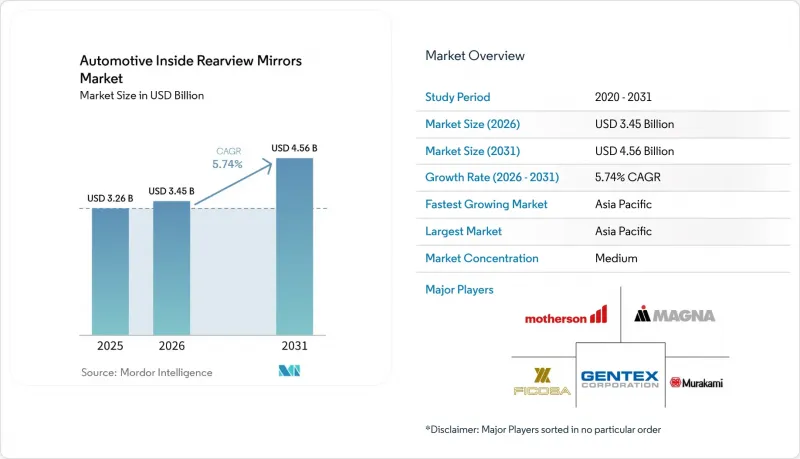
This report is Segmented by Vehicle Type (Passenger Car and Commercial Vehicle), Powertrain Type (ICE and Electric), Feature Type (Prismatic, Auto-Dimming, Blind Spot Indicator, and Other Smart Features), Sales Channel (OEM and Aftermarket), and Geography (North America, Europe, Asia-Pacific, and Rest of the World). Market Sizes and Forecasts are Provided in Terms of Value (USD).
Global Automotive Inside Rearview Mirrors Market Trends and Insights
Stricter Safety & Rear-Visibility Regulations
Regulators worldwide continue to tighten rear visibility, blind-spot, and crash-avoidance requirements, which directly lifts demand for better-performing rearview mirrors. New car assessment programs and road-safety agencies increasingly link star ratings or compliance labels to visibility performance, glare reduction, and driver awareness systems. This pushes OEMs to upgrade mirrors from basic prismatic designs to units with wider fields of view, improved anti-glare functionality, and integrated warning indicators.
In parallel, commercial-vehicle rules for buses, coaches, and trucks mandate defined mirror coverage zones and, in some regions, supplementary camera systems. Even when cameras are added, a certified interior mirror or digital mirror display is usually still required, reinforcing the mirror module as a non-negotiable safety component. Because these regulations evolve slowly but ratchet upward, they create a long-term structural pull on mirror content and quality across all major automotive regions.
Adoption of ADAS & Smart Mirror Modules
Advanced driver-assistance systems (ADAS) are increasingly being routed through or displayed in the inside rear-view mirror module. Auto-dimming, blind-spot indicators, lane-departure alerts, and camera streaming from rear or surround-view systems are now frequently anchored in the mirror housing. This design choice centralizes critical information in the driver's natural line of sight, without increasing dashboard clutter.
As more mass-market vehicles add ADAS bundles, the mirror becomes a logical integration node for sensors, cameras, and displays. Suppliers respond by offering smart mirror platforms with modular add-ons: electrochromic glass, embedded LEDs, microphones for voice assistants, and even driver-monitoring cameras. This trend turns the mirror from a low-margin commodity into a higher-value electronics hub, lifting average selling prices and deepening supplier-OEM partnerships.
High Cost of Advanced Mirrors in Price-Sensitive Segments
Auto-dimming, camera-integrated, and sensor-rich mirrors significantly increase bill-of-materials cost versus traditional prismatic units. In mature markets, this is absorbed into higher trim prices, but in emerging economies, where entry-level cars and basic commercial vehicles dominate, OEMs face strong resistance to passing these costs to consumers. As a result, many models in India, Southeast Asia, Africa, and Latin America still ship with basic mirrors, and smart features are limited to premium variants or optional packs with low take-rates.
This cost barrier is especially acute when combined with rising electronics prices and currency volatility. Smaller OEMs and regional brands may delay upgrading mirror specifications to avoid margin erosion, even when regulations permit more advanced solutions. Consequently, the adoption curve for smart mirrors flattens in low- and mid-income markets, muting global growth that would otherwise be supported by safety and technology trends.
Other drivers and restraints analyzed in the detailed report include:
- Premium Vehicle Mix & Feature Upgrades in Mass Segments
- Electrification & EV Interior Re-Architecture
- Semiconductor & Electronics Supply Volatility
For complete list of drivers and restraints, kindly check the Table Of Contents.
Segment Analysis
Passenger cars dominate the automotive inside rearview mirrors market, with around 81.94% share in 2025. High global production volumes of hatchbacks, sedans, SUVs, and crossovers underpin this dominance, alongside increasingly stringent occupant-safety norms that make advanced interior mirrors standard or near-standard on many trims. Auto-dimming, integrated displays, and embedded sensors are now frequently specified in mid-range and premium passenger vehicles, lifting mirror content per vehicle. The rise of compact SUVs and crossovers with higher beltlines and rear head restraints has also increased reliance on optimized mirror designs and digital mirrors for rearward visibility.
Commercial vehicles form a smaller but strategically important segment, particularly for safety-critical applications. Trucks and buses require specialized inside mirrors, often paired with complex exterior mirror sets and camera systems to manage extended blind spots. Fleet operators and regulators push for enhanced rear visibility in school buses, coaches, and long-haul trucks, incentivizing OEMs to integrate digital rearview modules and driver monitoring into fleet-spec cabs. Over the forecast period, commercial vehicles are expected to grow steadily as governments tighten safety rules for professional drivers and as logistics and passenger transport fleets upgrade to more advanced mirror systems.
Vehicles with internal combustion engines (ICE) continue to represent roughly 84.92% of inside rearview mirror demand in 2025, reflecting the large global in-use fleet and ongoing ICE vehicle sales in emerging markets. Inside rearview mirror specifications for ICE vehicles are being upgraded as OEMs respond to new safety regulations and competitive benchmarks, adding auto-dimming, compass/temperature displays, and basic ADAS alerts into the mirror housing. This keeps the ICE segment structurally important for mirror suppliers even as EV growth accelerates.
The electric vehicle (EV) segment, though smaller today, is forecast to grow at an impressive 20.95% CAGR through 2031 in the inside rearview mirrors market. EV architectures often incorporate camera-based mirror systems and integrated driver monitoring as standard features, increasing the electronics and software content per mirror. As OEMs redesign cabins around large central displays and digital cockpits, the inside rearview mirror becomes a logical location for ADAS sensors, driver monitoring cameras, and streaming-video displays. This makes EVs an outsized driver of advanced mirror technology adoption, with premium electric models frequently debuting new digital mirror configurations that later trickle down into higher-volume ICE platforms.
Complete Report Scope:
- By Vehicle Type
- Passenger Car
- Commercial Vehicle
- By Powertrain Type
- ICE
- Electric
- By Feature Type
- Auto-Dimming
- Prismatic
- Blind spot indicator
- Other Smart / Digital Mirrors
- By Sales Channel Type
- OEM
- Aftermarket
- By Geography
- North America
- United States
- Canada
- Rest of North America
- Europe
- Germany
- United Kingdom
- France
- Rest of Europe
- Asia Pacific
- India
- China
- Japan
- South Korea
- Rest of Asia-Pacific
- Rest of the World
- Brazil
- United Arab Emirates
- Other Countries
- North America
Geography Analysis
Asia-Pacific is the clear demand hub for automotive inside rearview mirrors, accounting for an estimated 41.05% of global market value in 2025 and growing at about 6.63% CAGR over 2026-2031. This reflects the region's dominance in vehicle production, with China, Japan, India, and South Korea together contributing the largest share of global light-vehicle output and new registrations. High volumes of passenger cars, rising SUV and crossover sales, and accelerating EV adoption all translate into strong OEM fitment of both conventional and smart IRVMs. As local brands move up the value ladder, mid-range and premium trims increasingly adopt auto-dimming and feature-rich mirrors, further lifting content per vehicle in Asia-Pacific.
North America and Europe remain substantial but comparatively slower-growing markets, driven by stringent safety regulations and high ADAS penetration, while the Rest of the World (Latin America, Middle East & Africa) offers smaller but steadily expanding pockets of demand tied to vehicle parc growth and gradual safety upgrades. However, neither region matches Asia-Pacific's combination of scale and growth: OEM programs in China and India alone can shift global demand for advanced mirrors when they migrate a feature from optional to standard. Over the forecast period, this dynamic keeps Asia-Pacific both the largest regional market and the fastest-growing geography, making it the strategic focal point for mirror suppliers' capacity expansion, localization, and co-development programs with global and regional automakers.
- Gentex Corporation
- Samvardhana Motherson Reflectec
- Magna International, Inc.
- Ficosa International SA
- Continental AG
- Murakami Corporation
- Tokai Rika Co., Ltd.
- Mitsuba Corporation
- SL Corporation
- Flabeg Automotive Holding GmbH
Additional Benefits:
- The market estimate (ME) sheet in Excel format
- 3 months of analyst support
TABLE OF CONTENTS
1 Introduction
- 1.1 Study Assumptions and Market Definition
- 1.2 Scope of the Study
2 Research Methodology
3 Executive Summary
4 Market Landscape
- 4.1 Market Overview
- 4.2 Market Drivers
- 4.2.1 Stricter Safety and Rear-Visibility Regulations
- 4.2.2 Adoption of ADAS and Smart Mirror Modules
- 4.2.3 Premium Vehicle Mix and Feature Upgrades in Mass Segments
- 4.2.4 Electrification and EV Interior Re-architecture
- 4.2.5 Fleet and Commercial-Vehicle Safety Programs
- 4.2.6 Vehicle Production Growth in Emerging Markets
- 4.3 Market Restraints
- 4.3.1 High Cost of Advanced Mirrors in Price-Sensitive Segments
- 4.3.2 Semiconductor and Electronics Supply Volatility
- 4.3.3 OEM Cost-Down Pressure and Mirror Commoditization
- 4.3.4 Regulatory and Design Uncertainty Around Pure Camera-Mirror Systems
- 4.4 Value / Supply-Chain Analysis
- 4.5 Regulatory Landscape
- 4.6 Technological Outlook
- 4.7 Porter's Five Forces
- 4.7.1 Threat of New Entrants
- 4.7.2 Bargaining Power of Buyers/Consumers
- 4.7.3 Bargaining Power of Suppliers
- 4.7.4 Threat of Substitute Products
- 4.7.5 Intensity of Competitive Rivalry
5 Market Size and Growth Forecasts (Value)
- 5.1 By Vehicle Type
- 5.1.1 Passenger Car
- 5.1.2 Commercial Vehicle
- 5.2 By Powertrain Type
- 5.2.1 ICE
- 5.2.2 Electric
- 5.3 By Feature Type
- 5.3.1 Auto-Dimming
- 5.3.2 Prismatic
- 5.3.3 Blind spot indicator
- 5.3.4 Other Smart / Digital Mirrors
- 5.4 By Sales Channel Type
- 5.4.1 OEM
- 5.4.2 Aftermarket
- 5.5 By Geography
- 5.5.1 North America
- 5.5.1.1 United States
- 5.5.1.2 Canada
- 5.5.1.3 Rest of North America
- 5.5.2 Europe
- 5.5.2.1 Germany
- 5.5.2.2 United Kingdom
- 5.5.2.3 France
- 5.5.2.4 Rest of Europe
- 5.5.3 Asia Pacific
- 5.5.3.1 India
- 5.5.3.2 China
- 5.5.3.3 Japan
- 5.5.3.4 South Korea
- 5.5.3.5 Rest of Asia-Pacific
- 5.5.4 Rest of the World
- 5.5.4.1 Brazil
- 5.5.4.2 United Arab Emirates
- 5.5.4.3 Other Countries
- 5.5.1 North America
6 Competitive Landscape
- 6.1 Vendor Market Share
- 6.2 Company Profiles
- 6.2.1 Gentex Corporation
- 6.2.2 Samvardhana Motherson Reflectec
- 6.2.3 Magna International, Inc.
- 6.2.4 Ficosa International SA
- 6.2.5 Continental AG
- 6.2.6 Murakami Corporation
- 6.2.7 Tokai Rika Co., Ltd.
- 6.2.8 Mitsuba Corporation
- 6.2.9 SL Corporation
- 6.2.10 Flabeg Automotive Holding GmbH
7 Market Opportunities and Future Outlook

