PUBLISHER: Mordor Intelligence | PRODUCT CODE: 2124182

PUBLISHER: Mordor Intelligence | PRODUCT CODE: 2124182
Time-of-Flight (TOF) Sensor - Market Share Analysis, Industry Trends & Statistics, Growth Forecasts (2026 - 2031)
According to Mordor Intelligence, the global Time-of-Flight sensor market size was valued at USD 6.68 billion in 2025 and estimated to grow from USD 8.06 billion in 2026 to reach USD 20.52 billion by 2031, at a CAGR of 20.56% during the forecast period (2026-2031).
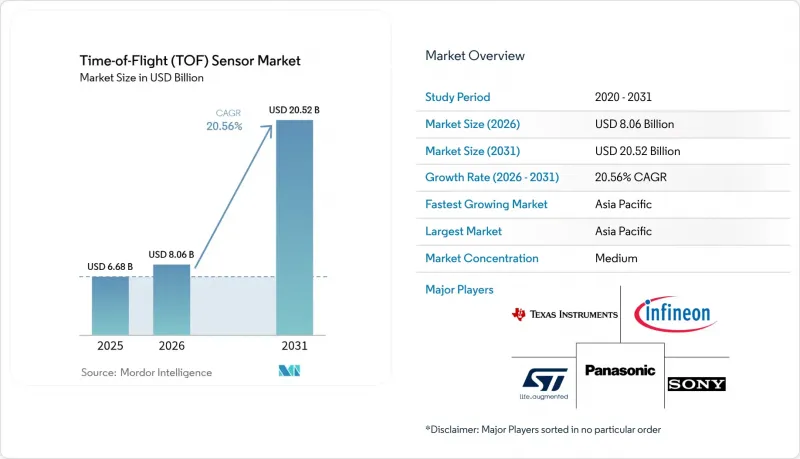
This report is Segmented by Sensor Type (Indirect, Direct, Range-Gated Imagers), Resolution (QVGA and Below, VGA, HD and Above), Range (Short, Medium, Long), Application (Augmented and Virtual Reality, Lidar, and More), End-User Vertical (Consumer Electronics, Automotive, and More), and Geography. The Market Forecasts are Provided in Terms of Value (USD).
Global Time-of-Flight (TOF) Sensor Market Trends and Insights
Growing adoption of machine-vision systems in Europe and Japan
Industrial clusters in Germany, Italy, and Japan are equipping robots with Time-of-Flight imagers to improve bin-picking and random-order depalletizing. Nikon's robot-vision package, shipping since late 2024, streams 250 fps depth frames, cutting cycle time for automotive stamping lines. Japanese integrators now couple these sensors with private 5 G to stop machines instantly when intrusion is detected, an approach validated by Tokyo Boeki and Net One Systems in 2025. As labor shortages worsen and EU factories upgrade to Industry 4.0 standards, the Time-of-Flight sensor market expects steady purchase orders for mid-range iToF arrays.
Rising demand for dToF 3-D smartphone cameras in China and South Korea
Samsung's Galaxy S24 Ultra debuted a refined dToF module that improves bokeh accuracy and AR anchoring, reinforcing the shift from structured-light to direct ToF in flagships. Chinese OEMs mirror this move to differentiate imaging, and analysts see smartphone 3-D camera revenues climbing to USD 44.01 billion by 2030. Because handset refresh cycles are short, every design win lifts annual unit volumes, magnifying the contribution of mobile shipments to the Time-of-Flight sensor market.
Multipath Interference and Ambient-Light Noise at Greater than30 m Range
Laboratory trials at MIT show that photons bouncing off multiple surfaces distort raw phase data, misplacing objects in depth maps. Microsoft's SPUMIC algorithm corrects this in software, yet its compute footprint discourages budget deployments. Sensor vendors respond with larger pixels and global-shutter arrays, but performance still drops outdoors at noon, restraining some smart-city and long-haul industrial use cases inside the Time-of-Flight sensor market.
Other drivers and restraints analyzed in the detailed report include:
- dToF LiDAR integration for Level-3+ ADAS roll-outs in EU and US
- Miniaturization of SPAD-based modules enabling sub-6 mm camera islands
- Volatile VCSEL supply concentration in the Taiwan-US corridor
For complete list of drivers and restraints, kindly check the Table Of Contents.
Segment Analysis
Indirect ToF technology accounted for 62.40% of the Time-of-Flight sensor market in 2025, reflecting its cost advantage and maturity in smartphones, webcams, and pick-and-place robots. Direct ToF units, though pricier, are surging at a 22.6% CAGR because range-gated SPAD arrays guarantee centimeter-grade accuracy beyond 200 m. The Time-of-Flight sensor market size for direct ToF modules is projected to swell rapidly as automakers fixate on LiDAR-centric ADAS stacks. Tier-1 suppliers value the latency-free depth output that dToF delivers, enabling redundancy with radar tracks during sensor-fusion. Indirect ToF chipsets continue to gain new features-global-shutter, HDR, and embedded DSP-positioning them as the default for AR handsets and factory cobots.
Advanced foundry nodes now pack on-chip histogramming that reduces external DRAM needs, cutting bill-of-materials in half for VR controllers. The Time-of-Flight sensor market benefits when handset OEMs can reuse a single iToF die across front-facing portrait cameras and rear-facing autofocus assist. Automobile LiDAR, however, mandates avalanche diodes, galvanically isolated from logic, which keeps the direct ToF bill higher through 2031. Both architectures coexist, filling discrete performance slots and stabilizing revenue diversity within the Time-of-Flight sensor market.
Smartphone portraiture and AR mapping drove 48.10% of 2025 demand, cementing 3-D imaging as the largest revenue bucket. The Time-of-Flight sensor market size for LiDAR is climbing at a 23.1% CAGR because Level-3 ADAS roll-outs require multiple roof-line lasers per vehicle. Machine-vision retrofits in electronics assembly lines adopt iToF cameras to identify solder misalignment at real-time takt speed, and e-commerce distribution centers fit depth arrays on aisle-roaming robots for dynamic obstacle avoidance.
Robotics and drones, while smaller today, represent high-growth greenfields: oxygen-starved mines use dToF scanners to map voids, and crop-spraying UAVs leverage low-weight ToF altimeters to maintain canopy distance. Gesture-recognition in smart TVs, gaming consoles, and XR headsets shifts toward multizone iToF, avoiding the privacy pitfalls of RGB capture. In-cabin driver monitoring-mandated in Europe from 2026-advances ultrawide near-infrared ToF optics that track gaze and microsleep behavior without emitting visible light, broadening safety-related revenues for the Time-of-Flight sensor market.
Complete Report Scope:
- By Sensor Type
- Indirect (iToF / RF-Modulated)
- Direct (dToF)
- Range-Gated Imagers
- By Component
- Illumination (VCSEL/LED)
- Sensor/Receiver Array
- Depth Processor
- By Resolution
- QVGA and Below
- VGA
- HD and Above
- By Range
- Short
- Medium
- Long
- By Application
- Augmented and Virtual Reality
- LiDAR
- Machine Vision
- 3-D Imaging and Scanning (incl. Smartphone Cameras)
- Robotics and Drones
- Gesture Recognition and Biometrics
- In-Cabin Driver-Monitoring Systems
- Security and Surveillance
- By End-User Vertical
- Consumer Electronics
- Automotive
- Entertainment and Gaming
- Industrial and Manufacturing
- Healthcare and Medical Imaging
- Logistics and Warehouse Automation
- Security and Smart Buildings
- By Geography
- North America
- United States
- Canada
- Mexico
- South America
- Brazil
- Argentina
- Rest of South America
- Europe
- Germany
- United Kingdom
- France
- Italy
- Rest of Europe
- Asia-Pacific
- China
- Japan
- South Korea
- India
- Rest of Asia-Pacific
- Middle East
- Israel
- Saudi Arabia
- Turkey
- Rest of Middle East
- Africa
- South Africa
- Rest of Africa
- Oceania
- Australia
- New Zealand
- North America
Geography Analysis
Asia-Pacific remains the epicenter of the Time-of-Flight sensor market, supplying and consuming over half of global output. China's smartphone assembly clusters in Guangdong absorb millions of iToF dies each quarter, while Jiangsu-based back-end houses attach meta-optics lenses at scale. Japanese fabs refine SPAD wafers for high-margin automotive contracts, leveraging domestic robotics ecosystems to pilot new process nodes. South Korea's vertically integrated conglomerates anchor both emitter and image-sensor production, providing internal demand and export revenue that stabilizes fab utilization. The Time-of-Flight sensor market size in this region grows in lockstep with handset ASP gains and regional EV roll-outs that specify multi-beam LiDAR.
North America drives technological specification. Silicon Valley lidar start-ups push range and eye-safety envelopes, and Seattle-area e-commerce warehouses prove out high-density robot-to-robot coordination. Federal highway regulators studying hands-free pilot deployments indirectly promote adoption of redundant cabin cameras, enlarging local demand for the Time-of-Flight sensor market. Canada's agritech scene pilots drone-based biomass estimation using NIR ToF altimeters, marking niche rural growth.
Europe blends regulatory pull and industrial automation. The EU General Safety Regulation 2026 mandates advanced driver-monitoring, guaranteeing baseline shipments. German Tier-1s, Italian packaging-line specialists, and Nordic robotics makers integrate iToF in quality-driven workflows. Tax incentives for energy-efficient factory retrofits help finance sensor refresh cycles. Although economic headwinds temper consumer electronics demand, industrial capital expenditure stabilizes the regional Time-of-Flight sensor market.
- Sony Corporation (Sony Semiconductor Solutions)
- STMicroelectronics N.V.
- Infineon Technologies AG
- Texas Instruments Incorporated
- onsemi (ON Semiconductor Corp.)
- Panasonic Holdings Corp.
- Sharp Corp.
- Keyence Corp.
- Teledyne Technologies Inc.
- Omron Corp.
- ams-OSRAM AG
- Melexis N.V.
- PMD Technologies AG
- Analog Devices Inc.
- Cognex Corp.
- LMI Technologies Inc.
- Samsung Electronics Co. Ltd.
- LG Innotek Co. Ltd.
- Hamamatsu Photonics K.K.
- Renesas Electronics Corp.
- Himax Technologies Inc.
- Tower Semiconductor Ltd.
Additional Benefits:
- The market estimate (ME) sheet in Excel format
- 3 months of analyst support
TABLE OF CONTENTS
1 INTRODUCTION
- 1.1 Study Assumptions and Market Definition
- 1.2 Scope of the Study
2 RESEARCH METHODOLOGY
3 EXECUTIVE SUMMARY
4 MARKET LANDSCAPE
- 4.1 Market Overview
- 4.2 Macroeconomic Impact Analysis
- 4.3 Market Drivers
- 4.3.1 Growing Adoption of Machine Vision Systems Across Manufacturing Hubs in Europe and Japan
- 4.3.2 Rising Demand for Smartphones Integrating dToF 3-D Cameras in China and South Korea
- 4.3.3 Integration of dToF LiDAR for Level-3+ ADAS Roll-outs in EU and U.S.
- 4.3.4 Miniaturization of SPAD-Based ToF Modules Enabling Sub-6 mm Camera Islands
- 4.3.5 Warehouse Automation Push Elevating iToF Depth Cameras in North-American Logistics
- 4.3.6 Government-Mandated Driver-Monitoring Systems under EU GSR-2026
- 4.4 Market Restraints
- 4.4.1 Multipath Interference and Ambient-Light Noise at >30 m Range
- 4.4.2 Volatile VCSEL Supply Concentration in Taiwan-U.S. Corridor
- 4.4.3 Strict EU GDPR Rules on In-Store People-Counting Cameras
- 4.4.4 Price Erosion from Competing Structured-Light Depth Solutions in Entry Smartphones
- 4.5 Value / Supply-Chain Analysis
- 4.6 Regulatory and Technological Outlook
- 4.7 Porter's Five Forces Analysis
- 4.7.1 Bargaining Power of Suppliers
- 4.7.2 Bargaining Power of Buyers
- 4.7.3 Threat of New Entrants
- 4.7.4 Threat of Substitute Products
- 4.7.5 Degree of Competition
5 MARKET SIZE AND GROWTH FORECASTS (VALUE)
- 5.1 By Sensor Type
- 5.1.1 Indirect (iToF / RF-Modulated)
- 5.1.2 Direct (dToF)
- 5.1.3 Range-Gated Imagers
- 5.2 By Component
- 5.2.1 Illumination (VCSEL/LED)
- 5.2.2 Sensor/Receiver Array
- 5.2.3 Depth Processor
- 5.3 By Resolution
- 5.3.1 QVGA and Below
- 5.3.2 VGA
- 5.3.3 HD and Above
- 5.4 By Range
- 5.4.1 Short
- 5.4.2 Medium
- 5.4.3 Long
- 5.5 By Application
- 5.5.1 Augmented and Virtual Reality
- 5.5.2 LiDAR
- 5.5.3 Machine Vision
- 5.5.4 3-D Imaging and Scanning (incl. Smartphone Cameras)
- 5.5.5 Robotics and Drones
- 5.5.6 Gesture Recognition and Biometrics
- 5.5.7 In-Cabin Driver-Monitoring Systems
- 5.5.8 Security and Surveillance
- 5.6 By End-User Vertical
- 5.6.1 Consumer Electronics
- 5.6.2 Automotive
- 5.6.3 Entertainment and Gaming
- 5.6.4 Industrial and Manufacturing
- 5.6.5 Healthcare and Medical Imaging
- 5.6.6 Logistics and Warehouse Automation
- 5.6.7 Security and Smart Buildings
- 5.7 By Geography
- 5.7.1 North America
- 5.7.1.1 United States
- 5.7.1.2 Canada
- 5.7.1.3 Mexico
- 5.7.2 South America
- 5.7.2.1 Brazil
- 5.7.2.2 Argentina
- 5.7.2.3 Rest of South America
- 5.7.3 Europe
- 5.7.3.1 Germany
- 5.7.3.2 United Kingdom
- 5.7.3.3 France
- 5.7.3.4 Italy
- 5.7.3.5 Rest of Europe
- 5.7.4 Asia-Pacific
- 5.7.4.1 China
- 5.7.4.2 Japan
- 5.7.4.3 South Korea
- 5.7.4.4 India
- 5.7.4.5 Rest of Asia-Pacific
- 5.7.5 Middle East
- 5.7.5.1 Israel
- 5.7.5.2 Saudi Arabia
- 5.7.5.3 Turkey
- 5.7.5.4 Rest of Middle East
- 5.7.6 Africa
- 5.7.6.1 South Africa
- 5.7.6.2 Rest of Africa
- 5.7.7 Oceania
- 5.7.7.1 Australia
- 5.7.7.2 New Zealand
- 5.7.1 North America
6 COMPETITIVE LANDSCAPE
- 6.1 Market Concentration
- 6.2 Strategic Moves
- 6.3 Market Share Analysis
- 6.4 Company Profiles (includes Global and Market Overview, Core Segments, Financials, Strategy, Market Rank/Share, Products and Services, Recent Developments)
- 6.4.1 Sony Corporation (Sony Semiconductor Solutions)
- 6.4.2 STMicroelectronics N.V.
- 6.4.3 Infineon Technologies AG
- 6.4.4 Texas Instruments Incorporated
- 6.4.5 onsemi (ON Semiconductor Corp.)
- 6.4.6 Panasonic Holdings Corp.
- 6.4.7 Sharp Corp.
- 6.4.8 Keyence Corp.
- 6.4.9 Teledyne Technologies Inc.
- 6.4.10 Omron Corp.
- 6.4.11 ams-OSRAM AG
- 6.4.12 Melexis N.V.
- 6.4.13 PMD Technologies AG
- 6.4.14 Analog Devices Inc.
- 6.4.15 Cognex Corp.
- 6.4.16 LMI Technologies Inc.
- 6.4.17 Samsung Electronics Co. Ltd.
- 6.4.18 LG Innotek Co. Ltd.
- 6.4.19 Hamamatsu Photonics K.K.
- 6.4.20 Renesas Electronics Corp.
- 6.4.21 Himax Technologies Inc.
- 6.4.22 Tower Semiconductor Ltd.
7 MARKET OPPORTUNITIES AND FUTURE OUTLOOK
- 7.1 White-Space and Unmet-Need Assessment

