PUBLISHER: Mordor Intelligence | PRODUCT CODE: 2124191

PUBLISHER: Mordor Intelligence | PRODUCT CODE: 2124191
Smart Diaper - Market Share Analysis, Industry Trends & Statistics, Growth Forecasts (2026 - 2031)
According to Mordor Intelligence, the smart diaper market size is estimated at USD 1.68 billion in 2026, and is expected to reach USD 2.54 billion by 2031, at a CAGR of 8.62% during the forecast period (2026-2031).
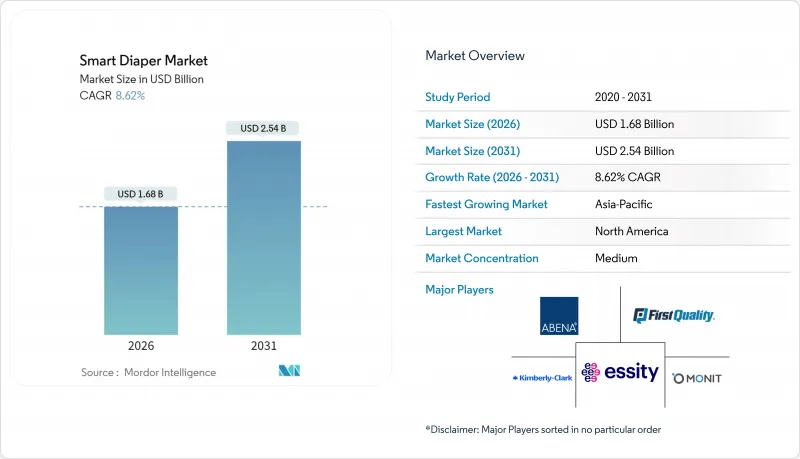
This report is Segmented by End-User (Baby, Adult, and Veterinary/Pet), Product Type (Disposable, and Reusable and Sensor Patches), Sensor Connectivity Technology (RFID, Bluetooth Low Energy, NB-IoT/LTE-M, and More), Distribution Channel (Institutional, Retail, and E-Commerce), and Geography (North America, Europe, Asia-Pacific, South America, and More). The Market Forecasts are Provided in Terms of Value (USD).
Global Smart Diaper Market Trends and Insights
Large Geriatric Population in Developed Countries
Population aging is shifting diaper demand from infants to seniors. Japan surpassed a 30% share of the 65-plus market in 2024, and adult briefs now outsell baby equivalents domestically. The United States expects more than 80 million seniors by 2040, magnifying labor pressure inside skilled-nursing facilities where turnover already exceeds 60%. Smart diapers reduce manual checks, cutting 15-20 minutes of staff time per resident each shift. National subsidy programs such as Japan's Care Robot Support Office reimburse as much as 50% of device expenditure, further accelerating the smart diaper market.
Digital-Health Push by Long-Term-Care Insurers
CMS expanded Remote Patient Monitoring codes in 2024 to include continuous moisture sensing, opening a USD 50-100 monthly reimbursement stream for nursing-home operators. German and U.S. insurers have since piloted value-based contracts that bundle ulcer prevention, incentivizing facilities to deploy connected briefs. Early trials indicate a 40% decline in stage-1-2 pressure ulcers after implementing predictive change protocols. These financial incentives are reshaping capital budgets, allowing administrators to justify the premium smart diaper market price relative to conventional products.
High Unit Cost Versus Conventional Diapers
Sensor-equipped briefs cost USD 1-3 each, three to five times more than basic disposables, and reusable patches run USD 50-150. While institutions can amortize these expenses over labor savings, out-of-pocket payers in emerging economies view the premium as prohibitive. Subscription bundles that spread hardware charges across monthly deliveries have entered the smart diaper market, but uptake remains limited.
Other drivers and restraints analyzed in the detailed report include:
- IoT-Enabled Elderly-Home Platforms Seeking Integrated Continence Sensors
- AI-Driven Predictive Analytics for Urinary Incontinence Events
- Infection and Dermatitis Risk From Prolonged Wear
For complete list of drivers and restraints, kindly check the Table Of Contents.
Segment Analysis
The baby category controlled 59.91% of the smart diaper market in 2025, buoyed by real-time sleep analytics embraced by affluent parents. Neonatal intensive-care units adopted preemie versions to track hydration, extending clinical credibility. Meanwhile, the adult segment is projected to register a 9.34% CAGR, the highest among all groups, as skilled-nursing operators combat projected caregiver shortages and rising ulcer-related litigation. The smart diaper market size for geriatric applications is therefore on a steeper expansion path than its pediatric counterpart.
Adult adoption is strongest in Japan, where adult briefs surpassed infant volume in 2024. Facilities there pair sensor alerts with staffing algorithms, freeing nurses for higher-acuity tasks. In the United States, CMS reimbursement is spurring trial programs across multistate chains. Special-needs adults and a nascent pet-care niche add incremental volume, hinting at diversification possibilities for the smart diapers industry.
Disposable formats held 74.22% of the smart diaper market share in 2025 as brands embedded low-cost printed circuitry directly into high-speed lines. Sensor integration costs fell after Toray's 2024 polymer breakthrough, preserving incumbents' scale advantages. Convenience and simple waste handling sustain household demand despite higher per-use cost.
Reusable patches, however, are expanding at a 10.57% CAGR. A USD 200 starter kit that survives 50 wash cycles lowers lifetime costs to USD 4 per use, undercutting disposables in high-volume institutional settings. Sustainability mandates in Europe elevate the appeal of reusables, aligning with circular-economy targets and reshaping procurement criteria in the smart diaper market.
Complete Report Scope:
- By End-User
- Baby
- Adult (Geriatric and Special-needs)
- Veterinary / Pet
- BY Product Type
- Disposable Smart Diapers
- Reusable Smart Diapers and Sensor Patches
- By Sensor Connectivity Technology
- RFID-based
- Bluetooth Low Energy (BLE)
- NB-IoT / LTE-M
- Others (Wi-Fi, Ultra-Wideband)
- By Distribution Channel
- Institutional (B2B Hospitals, Nursing Homes)
- Retail (B&M Pharmacies, Supermarkets)
- E-commerce / Direct-to-Consumer
- By Geography
- North America
- United States
- Canada
- Mexico
- South America
- Brazil
- Argentina
- Rest of South America
- Europe
- Germany
- United Kingdom
- France
- Italy
- Spain
- Rest of Europe
- Asia-Pacific
- China
- Japan
- India
- South Korea
- ASEAN
- Rest of Asia-Pacific
- Middle East
- Saudi Arabia
- United Arab Emirates
- Rest of Middle East
- Africa
- South Africa
- Nigeria
- Rest of Africa
- North America
Geography Analysis
North America accounted for the largest regional share, at 35.83% of the smart diaper market in 2025. CMS reimbursement, high caregiver wages, and a 25 million adult-incontinence population underpin demand. Pilot studies showing 40% ulcer-reduction cement administrative confidence, and multistate operators are standardizing connected briefs across portfolios. Canada progresses cautiously under budget constraints, while Mexico's uptake remains confined to private urban facilities.
Asia-Pacific is the fastest-growing territory with an 11.07% CAGR forecast through 2031. Japan's demographic inversion and 50% government subsidy catalyze institutional rollouts. China's CNY 73,000 crore (USD 10 billion) elderly-care allocation finances pilot deployments in Tier-1 cities, even as broad market penetration lags due to price sensitivity. India's looming 230 million elder cohort offers strategic upside, but family-centric caregiving and limited insurance coverage curb near-term volumes. South Korea and select ASEAN nations show niche growth tied to middle-class expansion.
Europe, at 20% of the 2025 value, benefits from CE-certified products and long-term-care insurance schemes that reimburse assistive devices. Scandinavian facilities pioneered Essity's integrated SmartCare platform, aligning with stringent GDPR data safeguards. German insurers now test outcome-based payments, while the United Kingdom's budget pressures slow National Health Service adoption. Southern Europe and emerging Middle East and Africa markets remain nascent because of lower institutional capacity and high out-of-pocket costs.
- Abena Holding A/S
- Alphabet Inc. (Verily Life Sciences LLC)
- Aureate AI Pte Ltd.
- Domtar Corporation
- Essity Aktiebolag (publ)
- First Quality Enterprises, Inc.
- Hunan Cosom Care Products Co., Ltd.
- Kimberly-Clark Corporation
- Koninklijke Philips N.V.
- Monit Corp.
- Nobel Hygiene Pvt Ltd.
- Ontex Group NV
- Pixie Scientific Inc.
- Procter & Gamble Company
- Simavita Ltd.
- Sinopulsar Technology Inc.
- Smardii Inc.
- Stryker Corporation
- Triple W Japan KK
- Unicharm Corporation
Additional Benefits:
- The market estimate (ME) sheet in Excel format
- 3 months of analyst support
TABLE OF CONTENTS
1 INTRODUCTION
- 1.1 Study Assumptions and Market Definition
- 1.2 Scope of the Study
2 RESEARCH METHODOLOGY
3 EXECUTIVE SUMMARY
4 MARKET LANDSCAPE
- 4.1 Market Overview
- 4.2 Market Drivers
- 4.2.1 Large Geriatric Population In Developed Countries
- 4.2.2 Rising Birth Rates and Higher Disposable Income In Emerging Markets
- 4.2.3 Digital-Health Push By Long-Term-Care Insurers
- 4.2.4 Iot-Enabled Elderly-Home Platforms Seeking Integrated Continence Sensors
- 4.2.5 Ai-Driven Predictive Analytics For Urinary Incontinence Events
- 4.2.6 Post-Pandemic Tele-Nursing Adoption Accelerating Smart Diaper Usage
- 4.3 Market Restraints
- 4.3.1 High Unit Cost Versus Conventional Diapers
- 4.3.2 Infection and Dermatitis Risk From Prolonged Wear
- 4.3.3 Data-Privacy and Cybersecurity Concerns In Connected Devices
- 4.3.4 Short Battery/Adhesive Sensor Life Limiting Reuse Cycles
- 4.4 Industry Value Chain Analysis
- 4.5 Regulatory Landscape
- 4.6 Technological Outlook
- 4.7 Porter's Five Forces Analysis
- 4.7.1 Bargaining Power of Suppliers
- 4.7.2 Bargaining Power of Buyers
- 4.7.3 Threat of New Entrants
- 4.7.4 Threat of Substitutes
- 4.7.5 Intensity of Competitive Rivalry
5 MARKET SIZE AND GROWTH FORECASTS (VALUE)
- 5.1 By End-User
- 5.1.1 Baby
- 5.1.2 Adult (Geriatric and Special-needs)
- 5.1.3 Veterinary / Pet
- 5.2 BY Product Type
- 5.2.1 Disposable Smart Diapers
- 5.2.2 Reusable Smart Diapers and Sensor Patches
- 5.3 By Sensor Connectivity Technology
- 5.3.1 RFID-based
- 5.3.2 Bluetooth Low Energy (BLE)
- 5.3.3 NB-IoT / LTE-M
- 5.3.4 Others (Wi-Fi, Ultra-Wideband)
- 5.4 By Distribution Channel
- 5.4.1 Institutional (B2B Hospitals, Nursing Homes)
- 5.4.2 Retail (B&M Pharmacies, Supermarkets)
- 5.4.3 E-commerce / Direct-to-Consumer
- 5.5 By Geography
- 5.5.1 North America
- 5.5.1.1 United States
- 5.5.1.2 Canada
- 5.5.1.3 Mexico
- 5.5.2 South America
- 5.5.2.1 Brazil
- 5.5.2.2 Argentina
- 5.5.2.3 Rest of South America
- 5.5.3 Europe
- 5.5.3.1 Germany
- 5.5.3.2 United Kingdom
- 5.5.3.3 France
- 5.5.3.4 Italy
- 5.5.3.5 Spain
- 5.5.3.6 Rest of Europe
- 5.5.4 Asia-Pacific
- 5.5.4.1 China
- 5.5.4.2 Japan
- 5.5.4.3 India
- 5.5.4.4 South Korea
- 5.5.4.5 ASEAN
- 5.5.4.6 Rest of Asia-Pacific
- 5.5.5 Middle East
- 5.5.5.1 Saudi Arabia
- 5.5.5.2 United Arab Emirates
- 5.5.5.3 Rest of Middle East
- 5.5.6 Africa
- 5.5.6.1 South Africa
- 5.5.6.2 Nigeria
- 5.5.6.3 Rest of Africa
- 5.5.1 North America
6 COMPETITIVE LANDSCAPE
- 6.1 Market Concentration
- 6.2 Strategic Moves
- 6.3 Market Share Analysis
- 6.4 Company Profiles (includes Global level Overview, Market Level Overview, Core Segments, Financials as Available, Strategic Information, Market Rank/Share for Key Companies, Products and Services, and Recent Developments)
- 6.4.1 Abena Holding A/S
- 6.4.2 Alphabet Inc. (Verily Life Sciences LLC)
- 6.4.3 Aureate AI Pte Ltd.
- 6.4.4 Domtar Corporation
- 6.4.5 Essity Aktiebolag (publ)
- 6.4.6 First Quality Enterprises, Inc.
- 6.4.7 Hunan Cosom Care Products Co., Ltd.
- 6.4.8 Kimberly-Clark Corporation
- 6.4.9 Koninklijke Philips N.V.
- 6.4.10 Monit Corp.
- 6.4.11 Nobel Hygiene Pvt Ltd.
- 6.4.12 Ontex Group NV
- 6.4.13 Pixie Scientific Inc.
- 6.4.14 Procter & Gamble Company
- 6.4.15 Simavita Ltd.
- 6.4.16 Sinopulsar Technology Inc.
- 6.4.17 Smardii Inc.
- 6.4.18 Stryker Corporation
- 6.4.19 Triple W Japan KK
- 6.4.20 Unicharm Corporation
7 MARKET OPPORTUNITIES AND FUTURE OUTLOOK
- 7.1 White-space and Unmet-Need Assessment

