PUBLISHER: Mordor Intelligence | PRODUCT CODE: 2124204

PUBLISHER: Mordor Intelligence | PRODUCT CODE: 2124204
China Processed Meat - Market Share Analysis, Industry Trends & Statistics, Growth Forecasts (2026 - 2031)
According to Mordor Intelligence, the China processed meat market size is projected to be USD 31.26 billion in 2025, USD 32.84 billion in 2026, and reach USD 42.04 billion by 2031, growing at a CAGR of 5.06% from 2026 to 2031.
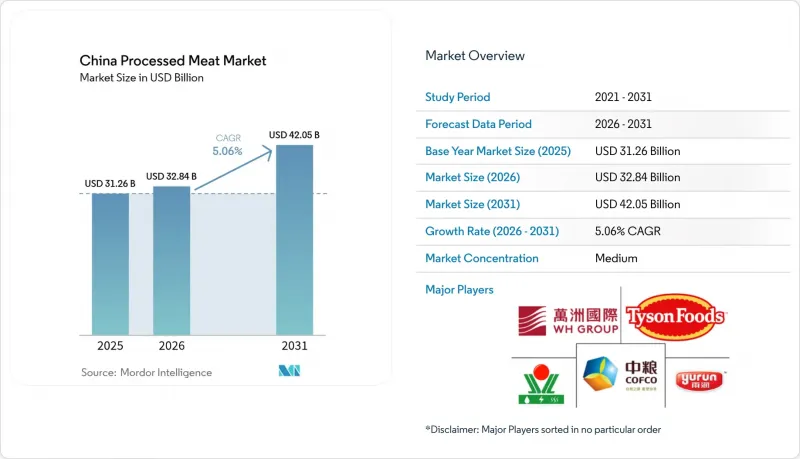
This report is Segmented by Product Type (Poultry, Pork, Beef, Mutton & Goat, Other Meats), End-User (Food Processing Industry, HoReCa/Food Service, Retail/Household), and Geography (China). The Market Forecasts are Provided in Terms of Value (USD) and Volume (Units).
China Processed Meat Market Trends and Insights
Rising Demand for Ready-to-Eat Protein Snacks Among Urban Millennials
Urban millennials in China are reshaping protein consumption by prioritizing convenience and portion control, driving meat snacks to approximately 14% of the broader snack-food category in 2024. Single-serve jerky, chicken tenders, and luncheon-meat cups align with on-the-go lifestyles and smaller household sizes in tier-1 and tier-2 cities, where per-capita disposable income exceeded CNY 80,000 (USD 11,200) in 2025. E-commerce platforms report that ready-to-eat protein SKUs grew unit sales by 23% year-over-year in the first half of 2025, outpacing traditional refrigerated sausages by a factor of three, according to the USDA Foreign Agricultural Service. This channel shift is compressing the advantage of legacy cold-chain networks, as ambient-stable formats bypass the need for end-to-end refrigeration. Brands that invest in retort-pouch technology and nitrogen-flush packaging are capturing incremental share among consumers who previously relied on fresh wet-market purchases.
Government Push for Cold-Chain Infrastructure Expansion
The State Council's 14th Five-Year Plan for a Modern Logistics System earmarked CNY 100 billion (USD 14 billion) in preferential credit to construct 100 national cold-chain logistics bases by 2025, targeting provinces with underdeveloped refrigerated capacity such as Guizhou, Gansu, and Ningxia, according to the National Development and Reform Commission. These hubs integrate pre-cooling, blast-freezing, and temperature-monitored distribution, reducing spoilage rates from 15-18% to below 5% and extending the viable sales radius for processed meat by 300-500 kilometers. The Ministry of Transport mandated GPS-enabled cold-chain vehicles for inter-provincial meat shipments starting January 2025, closing a compliance gap that previously allowed unrefrigerated transport in rural corridors. This infrastructure build-out is democratizing access to branded processed meat in lower-tier cities, where modern retail penetration historically lagged coastal regions by a decade.
ASF Recurrence Disrupting Pork Supply
The World Organisation for Animal Health recorded 3 African Swine Fever outbreaks in China during 2024, concentrated in Jilin and Heilongjiang provinces, triggering localized culling of approximately 18,000 hogs and temporary transport bans that disrupted regional pork flows. Although national herd recovery reached 95% of pre-2018 levels by mid-2025, recurring ASF cases continue to sustain biosecurity costs and raise insurance premiums for integrated producers. Spot pork prices spiked 12-15% in affected provinces during the third quarter of 2024, compressing margins for processors locked into fixed-price contracts with retail chains. The Ministry of Agriculture and Rural Affairs expanded mandatory vaccination trials to 8 provinces in 2025, yet efficacy data remain inconclusive, leaving supply-chain planners hedging with higher poultry and beef inventories. This persistent tail risk is steering long-term capital allocation toward poultry processing capacity.
Other drivers and restraints analyzed in the detailed report include:
- E-commerce Fresh-Food Logistics Innovations Lowering Delivery Cost
- Automation & AI in Slaughtering Boosting Yield, Lowering Cost
- Stricter Sodium & Nitrate Regulations
For complete list of drivers and restraints, kindly check the Table Of Contents.
Segment Analysis
Poultry processed products are expanding at a 7.56% CAGR through 2031, the fastest rate among all meat types, while pork-based items held 56.42% of the market share in 2025. This divergence reflects poultry's lower input-cost volatility and rising acceptance of chicken nuggets, tenders, and deli meats in quick-service restaurant chains, which added 12,000 outlets across China in 2024, according to the Chain Store & Franchise Association. China consumed 14.5 million metric tons of poultry in 2024, with processed products accounting for an estimated 22% of total volume, up from 18% in 2020, according to the USDA Foreign Agricultural Service. Beef processed products, corned beef, jerky, sausages, and deli meats are gaining traction in tier-1 cities where per-capita income supports premium positioning, yet import dependency and tariff exposure limit volume growth. Mutton and goat segments remain niche, concentrated in northwestern provinces, with cultural preferences for smoked and cured lamb, while other meats, such as duck, rabbit, and turkey, serve specialty channels with minimal scale. The General Administration of Customs reported that frozen poultry imports rose 8% in 2024, driven by foodservice demand for standardized portioned cuts that reduce kitchen labor.
Pork's dominant share is underpinned by deep cultural affinity and the ubiquity of sausages, bacon, luncheon meat, and jerky across retail and HoReCa channels, yet African Swine Fever recurrence and regulatory pressure on sodium content are moderating growth. WH Group's Shuanghui brand commands an estimated 18-20% share of the pork processed segment, leveraging vertical integration and nationwide cold-chain reach. Automation in slaughtering and deboning is raising carcass yield by 2-3 percentage points, enabling processors to absorb input-cost inflation without proportional price increases. Beef and mutton processors face higher raw-material costs and fragmented supply chains, limiting their ability to compete on price with poultry and pork alternatives. The Ministry of Agriculture and Rural Affairs' livestock census indicated that beef cattle inventory grew 4% in 2024, yet domestic production remains insufficient to meet processed-meat demand, sustaining reliance on imports from Australia, Brazil, and Argentina.
Complete Report Scope:
- By Meat Type
- Poultry
- Chicken Nuggets and patties
- Deli Meats
- Tenders
- Sausages
- Others
- Pork
- Sausages
- Bacon
- Nuggets
- Luncheon Meat
- Jerkey
- Others
- Beef
- Corned Meat
- Jerkey
- Corned beef
- Sausages
- Deli Meats
- Luncheon Meat
- Cooked and Smoked Beef Cuts
- Others
- Mutton and Goat
- Smoked and cured lamb
- Jerkey
- Sausages
- Salami
- Luncheon Meats
- Others
- Other Meats (Duck, Pigeon, Rabbit, Turkey)
- Poultry
- By End-User
- Food Processing Industry
- HoReCa/ Food Service
- Hotels
- Restaurants
- Catering
- Retail/ House Hold
- Supermarkets & Hypermarkets
- Convenience & Neighborhood Stores
- Online Retail
- Specialty stores
- Others
List of Companies Covered in this Report:
- WH Group Limited
- Tyson Foods, Inc.
- Shuanghui Development
- China Yurun Food Group Ltd.
- Jinluo Group
- COFCO Meat Holdings Ltd.
- Hormel Foods Corporation
- NH Foods Ltd.
- Doyoo Group
- Liuhe Group
- Henan Zhongpin Food Share Co.
- BEKS (Beijing Ershang)
- Shandong Delisi Group Co., Ltd.
- Foshan Huanan Poultry Co.
- Wen's Food Group
- Muyuan Foods Co., Ltd.
- Sichuan Giant Food
- Guangdong Evergreen
- Sunner Development
- Rui Xiang Food
Additional Benefits:
- The market estimate (ME) sheet in Excel format
- 3 months of analyst support
TABLE OF CONTENTS
1 INTRODUCTION
- 1.1 Study Assumptions and Market Definition
- 1.2 Scope of the Study
2 RESEARCH METHODOLOGY
3 EXECUTIVE SUMMARY
4 MARKET DYNAMICS
- 4.1 Market Overview
- 4.2 Market Drivers
- 4.2.1 Rising Demand for Ready-to-Eat Protein Snacks Among Urban Millennials
- 4.2.2 Government Push for Cold-Chain Infrastructure Expansion
- 4.2.3 Domestic Brand Premiumisation Targeting Lower-Tier Cities
- 4.2.4 E-commerce Fresh-Food Logistics Innovations Lowering Delivery Cost
- 4.2.5 Food-Safety Scandals Driving Shift to Packaged Branded Meat
- 4.2.6 Automation & AI in Slaughtering Boosting Yield, Lowering Cost
- 4.3 Market Restraints
- 4.3.1 ASF Recurrence Disrupting Pork Supply
- 4.3.2 Stricter Sodium & Nitrate Regulations
- 4.3.3 Consumer Health Shift Toward Plant-Based Proteins
- 4.3.4 Carbon-Neutral Targets Increasing Compliance Costs
- 4.4 Supply Chain Analysis
- 4.5 Regulatory Outlook
- 4.6 Technological Outlook
- 4.7 Porter's Five Forces
- 4.7.1 Threat of New Entrants
- 4.7.2 Bargaining Power of Buyers
- 4.7.3 Bargaining Power of Suppliers
- 4.7.4 Threat of Substitute Products
- 4.7.5 Intensity of Competitive Rivalry
5 MARKET SIZE AND GROWTH FORECASTS (VALUE AND VOLUME)
- 5.1 By Meat Type
- 5.1.1 Poultry
- 5.1.1.1 Chicken Nuggets and patties
- 5.1.1.2 Deli Meats
- 5.1.1.3 Tenders
- 5.1.1.4 Sausages
- 5.1.1.5 Others
- 5.1.2 Pork
- 5.1.2.1 Sausages
- 5.1.2.2 Bacon
- 5.1.2.3 Nuggets
- 5.1.2.4 Luncheon Meat
- 5.1.2.5 Jerkey
- 5.1.2.6 Others
- 5.1.3 Beef
- 5.1.3.1 Corned Meat
- 5.1.3.2 Jerkey
- 5.1.3.3 Corned beef
- 5.1.3.4 Sausages
- 5.1.3.5 Deli Meats
- 5.1.3.6 Luncheon Meat
- 5.1.3.7 Cooked and Smoked Beef Cuts
- 5.1.3.8 Others
- 5.1.4 Mutton and Goat
- 5.1.4.1 Smoked and cured lamb
- 5.1.4.2 Jerkey
- 5.1.4.3 Sausages
- 5.1.4.4 Salami
- 5.1.4.5 Luncheon Meats
- 5.1.4.6 Others
- 5.1.5 Other Meats (Duck, Pigeon, Rabbit, Turkey)
- 5.1.1 Poultry
- 5.2 By End-User
- 5.2.1 Food Processing Industry
- 5.2.2 HoReCa/ Food Service
- 5.2.2.1 Hotels
- 5.2.2.2 Restaurants
- 5.2.2.3 Catering
- 5.2.3 Retail/ House Hold
- 5.2.3.1 Supermarkets & Hypermarkets
- 5.2.3.2 Convenience & Neighborhood Stores
- 5.2.3.3 Online Retail
- 5.2.3.4 Specialty stores
- 5.2.3.5 Others
6 COMPETITIVE LANDSCAPE
- 6.1 Market Concentration
- 6.2 Strategic Moves
- 6.3 Market Share Analysis
- 6.4 Company Profiles (includes Global level Overview, Market level overview, Core Segments, Financials, Strategic Information, Market Rank/Share, Products and Services, Recent Developments)
- 6.4.1 WH Group Limited
- 6.4.2 Tyson Foods, Inc.
- 6.4.3 Shuanghui Development
- 6.4.4 China Yurun Food Group Ltd.
- 6.4.5 Jinluo Group
- 6.4.6 COFCO Meat Holdings Ltd.
- 6.4.7 Hormel Foods Corporation
- 6.4.8 NH Foods Ltd.
- 6.4.9 Doyoo Group
- 6.4.10 Liuhe Group
- 6.4.11 Henan Zhongpin Food Share Co.
- 6.4.12 BEKS (Beijing Ershang)
- 6.4.13 Shandong Delisi Group Co., Ltd.
- 6.4.14 Foshan Huanan Poultry Co.
- 6.4.15 Wen's Food Group
- 6.4.16 Muyuan Foods Co., Ltd.
- 6.4.17 Sichuan Giant Food
- 6.4.18 Guangdong Evergreen
- 6.4.19 Sunner Development
- 6.4.20 Rui Xiang Food
7 MARKET OPPORTUNITIES AND FUTURE TRENDS

