PUBLISHER: Mordor Intelligence | PRODUCT CODE: 2124208

PUBLISHER: Mordor Intelligence | PRODUCT CODE: 2124208
Chlorinated Polyethylene - Market Share Analysis, Industry Trends & Statistics, Growth Forecasts (2026 - 2031)
According to Mordor Intelligence, the chlorinated polyethylene market size is expected to increase from USD 0.76 billion in 2025 to USD 0.8 billion in 2026 and reach USD 1.04 billion by 2031, growing at a CAGR of 5.41% over 2026-2031.
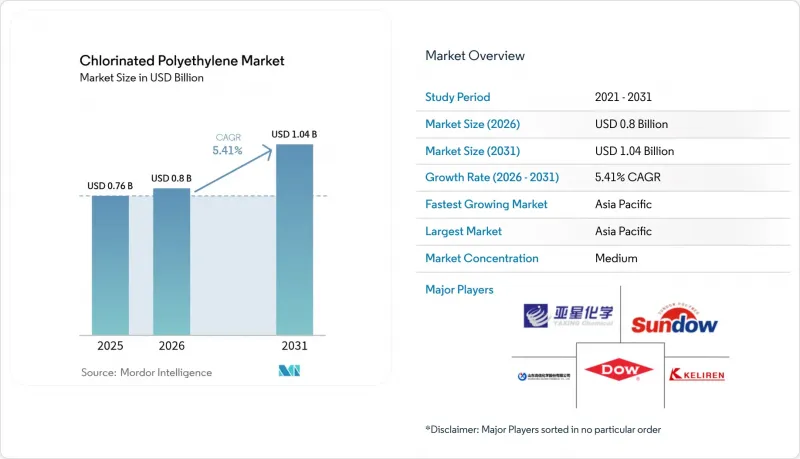
This report is Segmented by Product (CPE 135A, CPE 135B, and Other Products), Application (Impact Modifiers, Wire and Cable Jacketing, Hose and Tubing, Adhesives, and Other Applications), and Geography (Asia-Pacific, North America, Europe, South America, and Middle East and Africa). The Market Forecasts are Provided in Terms of Value (USD).
Global Chlorinated Polyethylene Market Trends and Insights
Shift Toward Halogen-Free Flame-Retardant CPE Hybrids
Formulators are lowering total halogen content by blending CPE with phosphorus-nitrogen intumescent systems, reaching UL-94 V-0 ratings while meeting IEC 60754-2 thresholds. A 2025 study showed that adding micro-encapsulated red phosphorus and melamine cyanurate delivers limiting oxygen index values above 34% and smoke density below 80 Ds, allowing 40% less mineral hydroxide filler. North American and EU cable plants serving data centers and rail transit are early adopters because local codes mandate low-smoke performance without banning all halogens. Such "reduced-halogen" compounds lengthen the product life cycle for the chlorinated polyethylene market, though precise dispersion and moisture-resistant packaging raise formulation complexity and cost.
Chinese Supply-Side Expansion Enhancing Price Competitiveness
Integrated ethylene and chlor-alkali assets in Shandong province drove average CPE cash costs below USD 1,200 per tonne in 2025, undercutting Western producers by 20-30%. Weifang Yaxing alone lifted capacity to 80,000 tpa yet saw margins narrow when export demand cooled, prompting a pivot toward greenhouse-film and specialty hose grades. Price softness benefits compounders across India, Vietnam, and Indonesia that feed cost-sensitive PVC and cable segments, although quality variability among smaller Shandong facilities stokes anti-dumping inquiries and undermines brand confidence.
EU Public-Procurement Bans on Chlorinated Plastics
Germany, France, and the Netherlands now prioritize LSZH materials in publicly funded projects. Although REACH and CPR stop short of an outright ban, procurement guidelines cap halogen acid gas at <= 0.5% under IEC 60754-1. Cable and roofing suppliers must keep dual inventories, diverting CPE toward industrial markets while downtown fire codes tighten. The chlorinated polyethylene market therefore faces near-term European volume erosion and margin compression.
Other drivers and restraints analyzed in the detailed report include:
- Oil-Resistant Hoses for Hydrogen Refueling Infrastructure
- Growth of 3-Layer Smart Roofing Membranes
- TPV and SEBS Elastomer Performance Advances
For complete list of drivers and restraints, kindly check the Table Of Contents.
Segment Analysis
The chlorinated polyethylene market size for CPE 135A accounted for 52.94% of revenue share in 2025. This semi-crystalline grade balances 35+-2% chlorine with Mooney viscosity around 50, generating Shore A 60 hardness and elongation above 600%, metrics prized for rigid PVC impact modification and wire jackets. Higher-viscosity CPE 135B offers extra melt strength, unlocking blown-film and flame-retardant filler loading that underpins a forecast 5.51% CAGR through 2031. Specialty variants. high-chlorine (>40% Cl) for UL-94 V-0 cable compounds, modified molecular-weight grades for rubber magnets, and heat-stable versions for under-hood hoses, collectively broaden value pools beyond commodity resin.
Competition intensifies as producers migrate upstream: Dow, Resonac, and leading Shandong firms supply co-processed CPE-phosphorus masterbatches, enabling compounders to offer turnkey low-smoke solutions. This vertical move shields margin amid flat commodity pricing and embeds long-term customers within integrated supply contracts, reinforcing stickiness across the chlorinated polyethylene market.
Complete Report Scope:
- By Product
- CPE 135A
- CPE 135B
- Other Products
- By Application
- Impact Modifiers
- Wire and Cable Jacketing
- Hose and Tubing
- Adhesives
- Other Applications
- By Geography
- Asia-Pacific
- China
- India
- Japan
- South Korea
- ASEAN
- Rest of Asia-Pacific
- North America
- United States
- Canada
- Mexico
- Europe
- Germany
- United Kingdom
- France
- Italy
- Russia
- Rest of Europe
- South America
- Brazil
- Argentina
- Rest of South America
- Middle-East and Africa
- Saudi Arabia
- South Africa
- Rest of Middle-East and Africa
- Asia-Pacific
Geography Analysis
Asia-Pacific anchored 72.15% of 2025 global demand for the chlorinated polyethylene market and is projected to grow at a 5.78% CAGR through 2031. China harbors integrated ethylene (62 Mt y) and polyethylene (45 Mt y) assets that flow chlorine feedstock cheaply into CPE reactors. Shandong clusters deliver ex-works prices under USD 1,200 t, spurring compounders in India and Vietnam to capture share versus XLPE and TPO. Overcapacity, however, trims producer margins and invites periodic anti-dumping probes from Turkey and Brazil.
North American market growth is buoyed by EV charging cables, data-center power cords, and oil-patch hoses. Federal codes allow CPE in industrial wiring; state procurements in California increasingly request LSZH for high-occupancy transit. Southwire's 2025 EV charge-station spec (SPEC 45005) calls for thermoset CPE jackets to assure 90 °C continuous rating and FT4 flame compliance. Such documents validate CPE's staying power despite halogen scrutiny.
European market faces dual headwinds: national procurement bans shrink building-wire tonnage, and CBAM may raise landed costs for high-carbon imports. Local producers, led by Nobian in the Netherlands, retrofit membrane electrolysers paired with renewable electricity to cut embedded carbon and sustain domestic CPE competitiveness.
South America, the Middle East, and Africa are witnessing rising demand for chlorinated polyethylene. Brazil and Mexico deploy CPE-based three-layer roofing in tropical industrial zones; Saudi Arabia and the UAE specify CPE jackets in offshore drilling cables where 90°C oil immersion is routine. Lower regulatory pressure on halogens and heavy sunlight drive incremental uptake, supporting diversified growth across the chlorinated polyethylene market.
- Aurora Material Solutions
- Bontecn Group China Co. Ltd
- Dow
- Dycon Chemicals
- Epigral Limited
- Hangzhou Keli Chemical Co. Ltd
- Jiangsu Tianteng Chemical Industry Co. Ltd
- Resonac Holdings Corporation
- Shandong Gaoxin Chemical Co. Ltd
- Shandong Ketian Chemical Co. Ltd
- Shandong Novista Chemical Ltd (Novista Group)
- Shandong Rike Chemical Co.,Ltd
- Shandong Xiangsheng New Materials Technology Co. Ltd
- Shandong Xuye New Materials Co. Ltd
- Sundow Polymers Co. Ltd
- Weifang Yaxing Chemical Co. Ltd
Additional Benefits:
- The market estimate (ME) sheet in Excel format
- 3 months of analyst support
TABLE OF CONTENTS
1 Introduction
- 1.1 Study Assumptions and Market Definition
- 1.2 Scope of the Study
2 Research Methodology
3 Executive Summary
4 Market Landscape
- 4.1 Market Overview
- 4.2 Market Drivers
- 4.2.1 Shift Toward Halogen-Free Flame-Retardant CPE Hybrids
- 4.2.2 Chinese Supply-Side Expansion Enhancing Price Competitiveness
- 4.2.3 Oil-Resistant Hoses for Hydrogen Refuelling Infrastructure
- 4.2.4 Growth of 3-Layer Smart Roofing Membranes in Tropical Regions
- 4.2.5 On-site Chlorination Tech Cutting Scope-3 Emissions in Europe
- 4.3 Market Restraints
- 4.3.1 EU Public-Procurement Bans on Chlorinated Plastics
- 4.3.2 TPV and SEBS Elastomer Performance Advances
- 4.3.3 Emerging Carbon-Border Tariffs on Halogenated Polymers
- 4.4 Value Chain Analysis
- 4.5 Porter's Five Forces
- 4.5.1 Bargaining Power of Suppliers
- 4.5.2 Bargaining Power of Buyers
- 4.5.3 Threat of New Entrants
- 4.5.4 Threat of Substitutes
- 4.5.5 Competitive Rivalry
5 Market Size and Growth Forecasts (Value)
- 5.1 By Product
- 5.1.1 CPE 135A
- 5.1.2 CPE 135B
- 5.1.3 Other Products
- 5.2 By Application
- 5.2.1 Impact Modifiers
- 5.2.2 Wire and Cable Jacketing
- 5.2.3 Hose and Tubing
- 5.2.4 Adhesives
- 5.2.5 Other Applications
- 5.3 By Geography
- 5.3.1 Asia-Pacific
- 5.3.1.1 China
- 5.3.1.2 India
- 5.3.1.3 Japan
- 5.3.1.4 South Korea
- 5.3.1.5 ASEAN
- 5.3.1.6 Rest of Asia-Pacific
- 5.3.2 North America
- 5.3.2.1 United States
- 5.3.2.2 Canada
- 5.3.2.3 Mexico
- 5.3.3 Europe
- 5.3.3.1 Germany
- 5.3.3.2 United Kingdom
- 5.3.3.3 France
- 5.3.3.4 Italy
- 5.3.3.5 Russia
- 5.3.3.6 Rest of Europe
- 5.3.4 South America
- 5.3.4.1 Brazil
- 5.3.4.2 Argentina
- 5.3.4.3 Rest of South America
- 5.3.5 Middle-East and Africa
- 5.3.5.1 Saudi Arabia
- 5.3.5.2 South Africa
- 5.3.5.3 Rest of Middle-East and Africa
- 5.3.1 Asia-Pacific
6 Competitive Landscape
- 6.1 Market Concentration
- 6.2 Strategic Moves
- 6.3 Market Share(%)/Ranking Analysis
- 6.4 Company Profiles (includes Global Overview, Market Overview, Core Segments, Financials, Strategic Information, Products and Services, Recent Developments)
- 6.4.1 Aurora Material Solutions
- 6.4.2 Bontecn Group China Co. Ltd
- 6.4.3 Dow
- 6.4.4 Dycon Chemicals
- 6.4.5 Epigral Limited
- 6.4.6 Hangzhou Keli Chemical Co. Ltd
- 6.4.7 Jiangsu Tianteng Chemical Industry Co. Ltd
- 6.4.8 Resonac Holdings Corporation
- 6.4.9 Shandong Gaoxin Chemical Co. Ltd
- 6.4.10 Shandong Ketian Chemical Co. Ltd
- 6.4.11 Shandong Novista Chemical Ltd (Novista Group)
- 6.4.12 Shandong Rike Chemical Co.,Ltd
- 6.4.13 Shandong Xiangsheng New Materials Technology Co. Ltd
- 6.4.14 Shandong Xuye New Materials Co. Ltd
- 6.4.15 Sundow Polymers Co. Ltd
- 6.4.16 Weifang Yaxing Chemical Co. Ltd
7 Market Opportunities and Future Outlook
- 7.1 White-space and Unmet-Need Assessment

