PUBLISHER: Mordor Intelligence | PRODUCT CODE: 2124216

PUBLISHER: Mordor Intelligence | PRODUCT CODE: 2124216
Software-Defined Perimeter - Market Share Analysis, Industry Trends & Statistics, Growth Forecasts (2026 - 2031)
According to Mordor Intelligence, software-Defined perimeter market size in 2026 is estimated at USD 14.62 billion, growing from 2025 value of USD 11.54 billion with 2031 projections showing USD 47.64 billion, growing at 26.64% CAGR over 2026-2031.
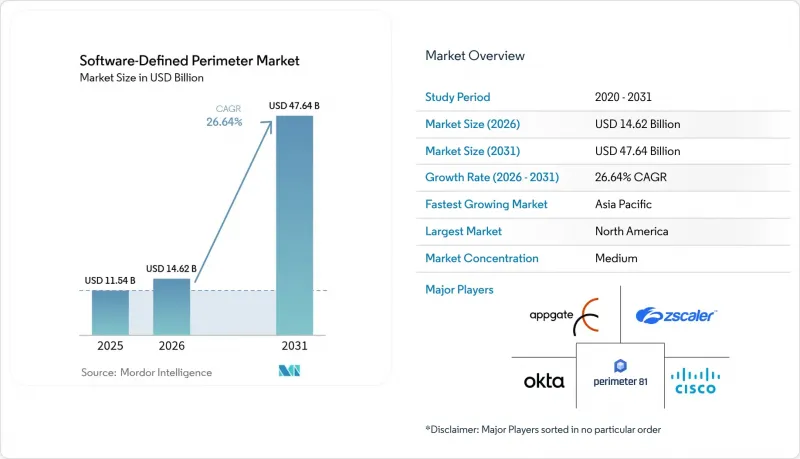
This report is Segmented by Offering (Solutions, Services), Connectivity Model (Cloud Edge, Data-Centre Gateway, and More), Deployment Mode, Organization Size, End-User Industry (BFSI, IT and Telecom, and More), and Geography. The Market Forecasts are Provided in Terms of Value (USD).
Global Software-Defined Perimeter Market Trends and Insights
Rapid multi-cloud adoption & expanding attack-surface
Organizations now run an average of 2.6 public clouds, fragmenting control planes and eroding legacy perimeter defenses. Software-Defined Perimeter solutions mitigate this sprawl by establishing application-specific micro-tunnels that follow workloads wherever they reside. Financial-services spending illustrates the stakes: USD 623 billion in IT outlays during 2024 drove parallel investments in zero-trust overlays. Agencies such as the UK Ministry for Levelling Up trimmed connection times by 80% after moving to an SDP fabric that blocked 81 million policy violations.
Surge in remote and hybrid workforce post-2024
VPN weaknesses surfaced when remote traffic ballooned; 56% of firms reported incidents tied to over-permissive tunnels. Manufacturers like Flex secured 20,000 staff with Prisma Access, isolating sessions and halting lateral malware spread. Identity-aware segmentation proved decisive for maintaining uptime during crisis-level ventilator output.
Integration Complexity with Legacy NAC/VPN Estates
Enterprises often run overlapping NAC, VPN, and SD-WAN tools. Policy migration thus becomes labor-intensive, as shown by a Fortune 500 bank that only realized a 25X bandwidth boost and 50% opex cut after aligning disparate rule sets. SMEs are hit harder, with up to 70% adopting digital tools during COVID-19 yet lacking security budgets, according to the OECD.
Other drivers and restraints analyzed in the detailed report include:
- Escalating zero-trust mandates from regulators
- Convergence of SDP with SASE edge nodes
- Telco rollout of 5G network-slice security APIs
- Shortage of zero-trust skills inflates deployment cost
For complete list of drivers and restraints, kindly check the Table Of Contents.
Segment Analysis
Solutions accounted for 77.10% of 2025 revenue, anchoring the Software-Defined Perimeter market with policy engines and control planes. Services, however, are on pace for a 30.05% CAGR through 2031 as firms lean on design, migration, and managed detection expertise. BT's global managed service based on the Zero Trust Exchange underscores the pivot to as-a-service consumption models. This mix suggests the Software-Defined Perimeter market will remain solution-led but service-dependent for execution.
Managed engagements cover architecture blueprints, pilot staging, and 24X7 incident response-tasks that internal teams cannot absorb amid talent shortfalls. As organizations unify identity, device, and application postures, specialist partners fine-tune conditional-access logic and continuous verification loops.
Cloud-edge connectivity secured 51.90% of 2025 spend, but endpoint-centric models are set to outpace at a 33.62% CAGR. Rising edge workloads and IoT adoption pull enforcement closer to the device, aligning with Zero Trust SASE nodes that collapse inspection into single-pass exchanges. Supermicro's cloud-managed gateways showcase how lightweight agents and over-the-air policy pushes deliver context-aware shields at the network's extreme.
Latency-sensitive industries such as manufacturing and healthcare value this proximity, especially when device operating systems cannot host full agents. As multi-access edge computing matures, endpoint-centric frameworks will anchor new micro-perimeters around every sensor and actuator, reinforcing Software-Defined Perimeter market resilience.
Complete Report Scope:
- By Offering
- Solutions
- Services
- By Connectivity Model
- Cloud Edge
- Data-centre Gateway
- Endpoint-centric (Client/Agent)
- By Deployment Mode
- Cloud
- On-Premise
- Hybrid
- By Organisation Size
- Large Enterprises
- Small and Medium Enterprises (SMEs)
- By End-User Industry
- BFSI
- IT and Telecom
- Healthcare and Life-Sciences
- Retail and E-commerce
- Government and Defence
- Manufacturing, Energy and Others
- By Geography
- North America
- United States
- Canada
- Mexico
- South America
- Brazil
- Argentina
- Rest of South America
- Europe
- United Kingdom
- Germany
- France
- Spain
- Italy
- Rest of Europe
- Asia-Pacific
- China
- Japan
- India
- South Korea
- ASEAN
- Rest of Asia-Pacific
- Middle East and Africa
- Middle East
- GCC
- Turkey
- Rest of Middle East
- Africa
- South Africa
- Nigeria
- Rest of Africa
- Middle East
- North America
Geography Analysis
North America generated 39.05% of 2025 revenue, underpinned by federal zero-trust edicts and mature cloud infrastructure. Executive Order 14144 mandates secure-by-design software for agencies, sustaining funnel growth among contractors. Enterprises across critical infrastructure adopt Software-Defined Perimeter market controls to pass audit checkpoints and win public-sector bids.
Asia-Pacific is the fastest-growing territory at a 27.90% CAGR. Accelerated digitization, elevated breach costs of USD 30 million per incident, and government-led cyber programs spur spending. Telcos supply network-slice APIs that embed identity, making SDP adoption viable even where skills are scarce. Despite acute talent gaps, cloud-hosted policy brokers offset operational hurdles, broadening the Software-Defined Perimeter market footprint in Japan, Australia, India, and Singapore.
Europe follows with GDPR-driven demand for granular access and data sovereignty. Cloud brokers that geofence workloads-while authenticating users via EU-hosted IdPs-help firms satisfy cross-border transfer rules. Middle East and Africa remain nascent but gain traction through smart-city builds and oil-and-gas digitization. Government grants and regional SOC hubs foster early pilots, paving the way for wider Software-Defined Perimeter market penetration.
- Akamai Technologies Inc.
- AON PLC (Perimeter 81)
- Broadcom Inc. (Symantec Enterprise Cloud)
- Cato Networks Ltd.
- Check Point Software Technologies Ltd.
- Cisco Systems Inc.
- Fortinet Inc.
- Google LLC (BeyondCorp Enterprise)
- IBM Corporation (Security Verify Trust)
- Ivanti Inc.
- Microsoft Corporation (Azure AD ZTNA)
- Netskope Inc.
- Okta Inc.
- OpenVPN Inc.
- Palo Alto Networks Inc.
- Proofpoint Inc.
- Safe-T Group Ltd.
- Unisys Corporation
- Verizon Communications Inc. (Vidder SDP)
- Zscaler Inc.
Additional Benefits:
- The market estimate (ME) sheet in Excel format
- 3 months of analyst support
TABLE OF CONTENTS
1 INTRODUCTION
- 1.1 Study Assumptions and Market Definition
- 1.2 Scope of the Study
2 RESEARCH METHODOLOGY
3 EXECUTIVE SUMMARY
4 MARKET LANDSCAPE
- 4.1 Market Overview
- 4.2 Market Drivers
- 4.2.1 Rapid multi-cloud adoption and expanding attack-surface
- 4.2.2 Surge in remote and hybrid workforce post-2024
- 4.2.3 Escalating zero-trust mandates from regulators (e.g., U.S. EO 14028)
- 4.2.4 Convergence of SDP with SASE edge nodes
- 4.2.5 Telco rollout of 5G network-slice security APIs
- 4.3 Market Restraints
- 4.3.1 Integration complexity with legacy NAC/VPN estates
- 4.3.2 Shortage of zero-trust skills inflates deployment cost
- 4.3.3 Vendor lock-in fears due to proprietary overlay protocols
- 4.4 Value / Supply-Chain Analysis
- 4.5 Regulatory Landscape
- 4.6 Technological Outlook
- 4.7 Porter's Five Forces Analysis
- 4.7.1 Threat of New Entrants
- 4.7.2 Bargaining Power of Buyers
- 4.7.3 Bargaining Power of Suppliers
- 4.7.4 Threat of Substitutes
- 4.7.5 Intensity of Competitive Rivalry
5 MARKET SIZE AND GROWTH FORECASTS (VALUE)
- 5.1 By Offering
- 5.1.1 Solutions
- 5.1.2 Services
- 5.2 By Connectivity Model
- 5.2.1 Cloud Edge
- 5.2.2 Data-centre Gateway
- 5.2.3 Endpoint-centric (Client/Agent)
- 5.3 By Deployment Mode
- 5.3.1 Cloud
- 5.3.2 On-Premise
- 5.3.3 Hybrid
- 5.4 By Organisation Size
- 5.4.1 Large Enterprises
- 5.4.2 Small and Medium Enterprises (SMEs)
- 5.5 By End-User Industry
- 5.5.1 BFSI
- 5.5.2 IT and Telecom
- 5.5.3 Healthcare and Life-Sciences
- 5.5.4 Retail and E-commerce
- 5.5.5 Government and Defence
- 5.5.6 Manufacturing, Energy and Others
- 5.6 By Geography
- 5.6.1 North America
- 5.6.1.1 United States
- 5.6.1.2 Canada
- 5.6.1.3 Mexico
- 5.6.2 South America
- 5.6.2.1 Brazil
- 5.6.2.2 Argentina
- 5.6.2.3 Rest of South America
- 5.6.3 Europe
- 5.6.3.1 United Kingdom
- 5.6.3.2 Germany
- 5.6.3.3 France
- 5.6.3.4 Spain
- 5.6.3.5 Italy
- 5.6.3.6 Rest of Europe
- 5.6.4 Asia-Pacific
- 5.6.4.1 China
- 5.6.4.2 Japan
- 5.6.4.3 India
- 5.6.4.4 South Korea
- 5.6.4.5 ASEAN
- 5.6.4.6 Rest of Asia-Pacific
- 5.6.5 Middle East and Africa
- 5.6.5.1 Middle East
- 5.6.5.1.1 GCC
- 5.6.5.1.2 Turkey
- 5.6.5.1.3 Rest of Middle East
- 5.6.5.2 Africa
- 5.6.5.2.1 South Africa
- 5.6.5.2.2 Nigeria
- 5.6.5.2.3 Rest of Africa
- 5.6.5.1 Middle East
- 5.6.1 North America
6 COMPETITIVE LANDSCAPE
- 6.1 Market Concentration
- 6.2 Strategic Moves
- 6.3 Market Share Analysis
- 6.4 Company Profiles (includes Global level Overview, Market level overview, Core Segments, Financials as available, Strategic Information, Market Rank/Share, Products and Services, Recent Developments)
- 6.4.1 Akamai Technologies Inc.
- 6.4.2 AON PLC (Perimeter 81)
- 6.4.3 Broadcom Inc. (Symantec Enterprise Cloud)
- 6.4.4 Cato Networks Ltd.
- 6.4.5 Check Point Software Technologies Ltd.
- 6.4.6 Cisco Systems Inc.
- 6.4.7 Fortinet Inc.
- 6.4.8 Google LLC (BeyondCorp Enterprise)
- 6.4.9 IBM Corporation (Security Verify Trust)
- 6.4.10 Ivanti Inc.
- 6.4.11 Microsoft Corporation (Azure AD ZTNA)
- 6.4.12 Netskope Inc.
- 6.4.13 Okta Inc.
- 6.4.14 OpenVPN Inc.
- 6.4.15 Palo Alto Networks Inc.
- 6.4.16 Proofpoint Inc.
- 6.4.17 Safe-T Group Ltd.
- 6.4.18 Unisys Corporation
- 6.4.19 Verizon Communications Inc. (Vidder SDP)
- 6.4.20 Zscaler Inc.
7 MARKET OPPORTUNITIES AND FUTURE OUTLOOK
- 7.1 White-space and Unmet-Need Assessment

