PUBLISHER: Mordor Intelligence | PRODUCT CODE: 2124233

PUBLISHER: Mordor Intelligence | PRODUCT CODE: 2124233
UHT Milk - Market Share Analysis, Industry Trends & Statistics, Growth Forecasts (2026 - 2031)
According to Mordor Intelligence, the UHT milk market size is expected to increase from USD 93.06 billion in 2025 to USD 99.89 billion in 2026 and reach USD 141.09 billion by 2031, growing at a CAGR of 7.15% over 2026-2031.
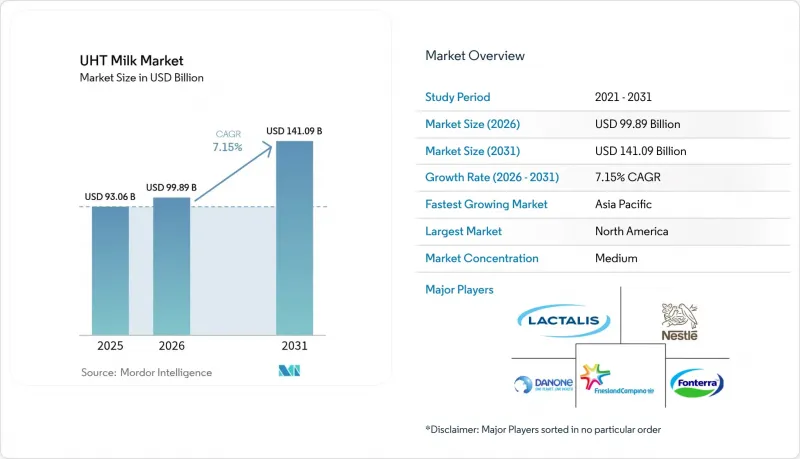
This report is Segmented by Fat Content (Whole/Full-cream, Semi-Skimmed, Skimmed), Flavor (Unflavoured, Flavoured), Packaging Format (Cartons, Bottles, Pouches, Others), Distribution Channel (Food Service/HoReCa, Retail), and Geography (North America, Europe, Asia-Pacific, South America, Middle East and Africa). The Market Forecasts are Provided in Terms of Value (USD) and Volume (Liters).
Global UHT Milk Market Trends and Insights
Improvements in aseptic packaging extending shelf life
Aseptic carton technology offers extended ambient shelf stability without requiring refrigeration, enabling dairy processors to expand into regions with limited or cost-prohibitive cold-chain infrastructure. Tetra Pak has introduced fiber-based barrier coatings that reduce the thickness of aluminum foil while maintaining oxygen impermeability. This innovation lowers material costs and improves the recyclability of packaging. Dairy Farmers of America has invested significantly in upgrading several facilities with aseptic filling lines capable of processing large volumes of dairy products annually. This initiative targets export markets in regions such as Southeast Asia and West Africa, where high ambient temperatures challenge traditional dairy distribution methods. In India, this packaging advancement is particularly significant as the Food Safety and Standards Authority of India (FSSAI) requires ultra-high temperature milk to display production and best-before dates in regional languages. This regulation necessitates localized labeling by both multinational and cooperative dairy brands while maintaining product sterility. The combination of reduced packaging costs and improved distribution capabilities is enabling dairy companies to expand into tier-2 cities. These areas, where per-capita dairy consumption is lower than in metropolitan regions, are witnessing faster growth in consumption compared to the national average.
Shift to organized retail boosting ultra-high temperature availability
Modern trade channels, such as supermarkets and hypermarkets, have increased the shelf space dedicated to ultra-high temperature (UHT) milk across Asia-Pacific markets. This shift highlights retailers' recognition that ambient products, which do not require refrigeration, achieve higher inventory turnover compared to chilled alternatives. In 2024, Walmart added ultra-high temperature private-label milk to its Great Value portfolio, utilizing vertical integration with dairy cooperatives to offer lower prices than branded competitors while maintaining strong gross margins. In Brazil, the penetration of organized retail has grown significantly, benefiting ultra-high temperature milk as chains like Carrefour and Pao de Acucar focus on shelf-stable assortments to reduce spoilage losses. A similar trend is observed in Middle Eastern markets, where Almarai leads Saudi Arabian supermarket dairy aisles with ultra-high temperature formats that cater to consumer preferences for bulk purchasing and extended storage. The focus of organized retail on traceability and quality assurance is raising standards for unbranded and loose milk vendors. This development is driving the shift toward packaged ultra-high temperature products, which include batch codes and nutritional labeling, addressing consumer demand for quality and safety.
Consumer preference for fresh, pasteurized milk's flavor
Taste perception remains a notable challenge in North America and Western Europe, where blind taste tests consistently reveal that consumers detect subtle caramelized notes in ultra-high temperature (UHT) milk. These notes are a result of Maillard reactions occurring during thermal processing. A sensory study by Cornell University found that most participants in the United States preferred the flavor profile of pasteurized milk over UHT milk, citing a "cooked" aftertaste as the primary drawback. This preference is particularly pronounced in regions with advanced cold-chain infrastructure, where fresh milk is delivered promptly after processing and often sold at premium prices, signaling higher quality to consumers. In contrast, markets such as Germany and Spain show higher acceptance of UHT milk, with penetration rates exceeding 80%. This indicates that taste aversion to UHT milk is influenced by cultural factors rather than being universal. Dairy processors are working to address this issue by optimizing thermal processing methods to minimize flavor deviations. For example, FrieslandCampina has implemented direct steam injection systems, which reduce heating time to just a few seconds. This method helps preserve the organoleptic properties of fresh milk while ensuring sterility. The challenge is further intensified by premium fresh milk brands that promote cold-pressed or minimally processed variants, often priced significantly higher. These products reinforce the perception that ultra-high temperature processing compromises milk quality.
Other drivers and restraints analyzed in the detailed report include:
- E-commerce and online retail expansions aiding distribution
- Demand from working parents for ready-to-use nutritious products
- Lactose intolerance driving shifts away from dairy ultra-high temperature
For complete list of drivers and restraints, kindly check the Table Of Contents.
Segment Analysis
Skimmed ultra-high temperature (UHT) milk is projected to grow at a compound annual growth rate (CAGR) of 9.54% between 2026 and 2031, surpassing the growth of whole or full-cream variants, which accounted for a 42.12% market share in 2025. This trend is driven by consumers increasingly prioritizing protein intake while reducing saturated fat consumption. Semi-skimmed formulations, offering moderate fat content without compromising creaminess, appeal to households seeking a balanced option. These formulations are particularly popular in European markets, where regulatory definitions classify milk as skimmed (less than 0.5% fat), semi-skimmed (1.5% to 1.8% fat), or whole milk (minimum 3.5% fat).
Whole or full-cream ultra-high temperature milk continues to dominate in South Asia and Middle Eastern markets, where cultural preferences favor richer dairy products, and higher fat content is often associated with quality and nutritional value. The growing preference for skimmed variants is influenced by rising obesity rates and the prevalence of cardiovascular diseases. According to the World Health Organization, 39% of adults globally were overweight in 2025, prompting dietary shifts toward lower-calorie options . Additionally, fitness and wellness influencers are driving demand for high-protein, low-fat dairy products. Skimmed ultra-high temperature milk is increasingly positioned as a post-workout recovery beverage, offering 8 grams of protein per 250-milliliter serving with minimal fat content.
Flavored ultra-high temperature milk is projected to grow at a compound annual growth rate (CAGR) of 9.32% between 2026 and 2031. In contrast, unflavored variants accounted for 59.43% of revenue in 2025, highlighting a division between commodity dairy products and value-added functional beverages. Chocolate and strawberry remain the most popular flavors, while coffee-infused and matcha-blended ultra-high temperature milk are emerging as premium subcategories. These products are particularly gaining traction in Asia-Pacific and North America, where ready-to-drink coffee culture is well-established. For instance, Nestle launched a cold-brew coffee ultra-high temperature milk in 2025, containing 120 milligrams of caffeine per 330-milliliter serving, positioning it as a breakfast alternative to traditional coffee beverages.
Flavored ultra-high temperature milk is also being utilized as a medium for functional fortification, with brands incorporating probiotics, omega-3 fatty acids, and plant sterols to address health concerns such as digestive health, cardiovascular wellness, and immune support. Meanwhile, unflavored ultra-high temperature milk continues to dominate household consumption due to its versatility in cooking, baking, and beverage preparation. It is also widely used in institutional channels, including food service and hotel, restaurant, and catering (HoReCa) segments, where neutral flavor profiles are essential for culinary applications.
Complete Report Scope:
- By Fat Content
- Whole/Full-cream
- Semi-skimmed
- Skimmed
- By Flavor
- Unflavoured
- Flavoured
- By Packaging Format
- Cartons
- Bottles
- Pouches
- Others
- By Distribution Channel
- Food Service/HoReCa
- Retail
- Supermarkets/Hypermarkets
- Convenience Stores
- Online Retail
- Others
- By Geography
- North America
- United States
- Canada
- Mexico
- Rest of North America
- Europe
- Germany
- United Kingdom
- Italy
- France
- Spain
- Netherlands
- Poland
- Belgium
- Sweden
- Rest of Europe
- Asia-Pacific
- China
- India
- Japan
- Australia
- Indonesia
- Rest of Asia-Pacific
- South America
- Brazil
- Argentina
- Colombia
- Chile
- Peru
- Rest of South America
- Middle East and Africa
- South Africa
- Saudi Arabia
- United Arab Emirates
- Nigeria
- Egypt
- Morocco
- Turkey
- Rest of Middle East and Africa
- North America
Geography Analysis
In 2025, North America accounted for 37.32% of the global ultra-high temperature (UHT) milk revenue, making it the leading segment. This dominance was driven by consumer preferences for shelf-stable products in the United States and Canada. Despite the widespread availability of refrigeration infrastructure in these countries, ambient products are valued for emergency preparedness and extended pantry storage. The Food and Drug Administration regulates UHT milk under the same nutritional labeling and safety standards as pasteurized milk, simplifying market entry for both domestic and imported brands . Mexico is emerging as a growth area within the region, supported by increasing organized retail penetration and rising per-capita dairy consumption, which aligns with the expansion of the middle class.
The Asia-Pacific region is projected to grow at a compound annual growth rate (CAGR) of 9.82% between 2026 and 2031, making it the fastest-growing segment globally. This growth is primarily driven by gaps in cold-chain infrastructure in countries such as India, Indonesia, and rural China, making UHT milk a practical alternative to chilled dairy products. In India, the Food Safety and Standards Authority enforces stringent quality controls for UHT milk, including microbial testing and shelf-life validation, which has bolstered consumer trust in packaged dairy . In China, dairy modernization efforts are leading to capacity expansions by companies like Mengniu and Yili, which collectively invested USD 2.3 billion in 2024 and 2025 to establish aseptic processing facilities aimed at meeting domestic demand without relying on imported milk powder. Meanwhile, Japan and Australia represent mature markets in the region, where UHT milk is positioned as a premium convenience product rather than a necessity, resulting in stable rather than growing consumption levels.
Europe leads in per-capita UHT milk consumption globally, with Germany, France, Spain, Belgium, and the Netherlands collectively accounting for the majority of the region's volume in 2025. This reflects decades of consumer familiarity with ambient dairy products. The European Food Safety Authority's harmonized standards for UHT processing and labeling facilitate cross-border trade, enabling companies like Arla and Lactalis to operate pan-European supply chains. Sustainability is a key focus in the region, with European consumers prioritizing recyclable packaging and carbon-neutral production. This has prompted dairy processors to invest in renewable energy and circular economy initiatives.
- Nestle S.A.
- Groupe Lactalis SA
- Royal FrieslandCampina N.V.
- Danone SA
- Fonterra Co-operative Group Ltd.
- China Mengniu Dairy Co. Ltd.
- Yili Group
- Arla Foods amba
- Gujarat Co-operative Milk Marketing Federation (Amul)
- Saputo Inc.
- Almarai Company
- Parmalat
- Hochwald Foods GmbH
- Dana Dairy Group
- Savencia Fromage & Dairy
- Meiji Holdings Co. Ltd.
- Bright Dairy & Food Co.
- Terra Vita SpA
- Parag Milk Foods Ltd.
- Devondale Murray Goulburn
Additional Benefits:
- The market estimate (ME) sheet in Excel format
- 3 months of analyst support
TABLE OF CONTENTS
1 INTRODUCTION
- 1.1 Study Assumptions and Market Definition
- 1.2 Scope of the Study
2 RESEARCH METHODOLOGY
3 EXECUTIVE SUMMARY
4 MARKET LANDSCAPE
- 4.1 Market Overview
- 4.2 Market Drivers
- 4.2.1 Improvements in aseptic packaging extending shelf life
- 4.2.2 Shift to organized retail boosting UHT availability
- 4.2.3 E-commerce and online retail expansions aiding distribution
- 4.2.4 Demand from working parents for ready-to-use nutritious products
- 4.2.5 Nutritional retention during high-temperature processing
- 4.2.6 Investments in dairy innovation for flavored UHT variants
- 4.3 Market Restraints
- 4.3.1 Consumer preference for fresh, pasteurized milk's flavor
- 4.3.2 Lactose intolerance driving shifts away from dairy UHT
- 4.3.3 High initial costs for sterilization equipment and aseptic tech
- 4.3.4 Perceptions of nutrient degradation from ultra-high heat
- 4.4 Value Chain Analysis
- 4.5 Regulatory Outlook
- 4.6 Porter's Five Forces
- 4.6.1 Threat of New Entrants
- 4.6.2 Bargaining Power of Buyers
- 4.6.3 Bargaining Power of Suppliers
- 4.6.4 Threat of Substitute Products
- 4.6.5 Intensity of Competitive Rivalry
5 MARKET SIZE AND GROWTH FORECASTS (VALUE AND VOLUME)
- 5.1 By Fat Content
- 5.1.1 Whole/Full-cream
- 5.1.2 Semi-skimmed
- 5.1.3 Skimmed
- 5.2 By Flavor
- 5.2.1 Unflavoured
- 5.2.2 Flavoured
- 5.3 By Packaging Format
- 5.3.1 Cartons
- 5.3.2 Bottles
- 5.3.3 Pouches
- 5.3.4 Others
- 5.4 By Distribution Channel
- 5.4.1 Food Service/HoReCa
- 5.4.2 Retail
- 5.4.2.1 Supermarkets/Hypermarkets
- 5.4.2.2 Convenience Stores
- 5.4.2.3 Online Retail
- 5.4.2.4 Others
- 5.5 By Geography
- 5.5.1 North America
- 5.5.1.1 United States
- 5.5.1.2 Canada
- 5.5.1.3 Mexico
- 5.5.1.4 Rest of North America
- 5.5.2 Europe
- 5.5.2.1 Germany
- 5.5.2.2 United Kingdom
- 5.5.2.3 Italy
- 5.5.2.4 France
- 5.5.2.5 Spain
- 5.5.2.6 Netherlands
- 5.5.2.7 Poland
- 5.5.2.8 Belgium
- 5.5.2.9 Sweden
- 5.5.2.10 Rest of Europe
- 5.5.3 Asia-Pacific
- 5.5.3.1 China
- 5.5.3.2 India
- 5.5.3.3 Japan
- 5.5.3.4 Australia
- 5.5.3.5 Indonesia
- 5.5.3.6 Rest of Asia-Pacific
- 5.5.4 South America
- 5.5.4.1 Brazil
- 5.5.4.2 Argentina
- 5.5.4.3 Colombia
- 5.5.4.4 Chile
- 5.5.4.5 Peru
- 5.5.4.6 Rest of South America
- 5.5.5 Middle East and Africa
- 5.5.5.1 South Africa
- 5.5.5.2 Saudi Arabia
- 5.5.5.3 United Arab Emirates
- 5.5.5.4 Nigeria
- 5.5.5.5 Egypt
- 5.5.5.6 Morocco
- 5.5.5.7 Turkey
- 5.5.5.8 Rest of Middle East and Africa
- 5.5.1 North America
6 COMPETITIVE LANDSCAPE
- 6.1 Market Concentration
- 6.2 Strategic Moves
- 6.3 Market Ranking Analysis
- 6.4 Company Profiles (includes Global-level Overview, Market-level Overview, Core Segments, Financials (if available), Strategic Information, Market Rank/Share, Products and Services, Recent Developments)
- 6.4.1 Nestle S.A.
- 6.4.2 Groupe Lactalis SA
- 6.4.3 Royal FrieslandCampina N.V.
- 6.4.4 Danone SA
- 6.4.5 Fonterra Co-operative Group Ltd.
- 6.4.6 China Mengniu Dairy Co. Ltd.
- 6.4.7 Yili Group
- 6.4.8 Arla Foods amba
- 6.4.9 Gujarat Co-operative Milk Marketing Federation (Amul)
- 6.4.10 Saputo Inc.
- 6.4.11 Almarai Company
- 6.4.12 Parmalat
- 6.4.13 Hochwald Foods GmbH
- 6.4.14 Dana Dairy Group
- 6.4.15 Savencia Fromage & Dairy
- 6.4.16 Meiji Holdings Co. Ltd.
- 6.4.17 Bright Dairy & Food Co.
- 6.4.18 Terra Vita SpA
- 6.4.19 Parag Milk Foods Ltd.
- 6.4.20 Devondale Murray Goulburn
7 MARKET OPPORTUNITIES AND FUTURE OUTLOOK

