PUBLISHER: Mordor Intelligence | PRODUCT CODE: 2124265

PUBLISHER: Mordor Intelligence | PRODUCT CODE: 2124265
Japan Home Furniture - Market Share Analysis, Industry Trends & Statistics, Growth Forecasts (2026 - 2031)
According to Mordor Intelligence, the Japan home furniture market size is estimated at USD 17.71 billion in 2026, and is expected to reach USD 20.95 billion by 2031, at a CAGR of 3.42% during the forecast period (2026-2031).
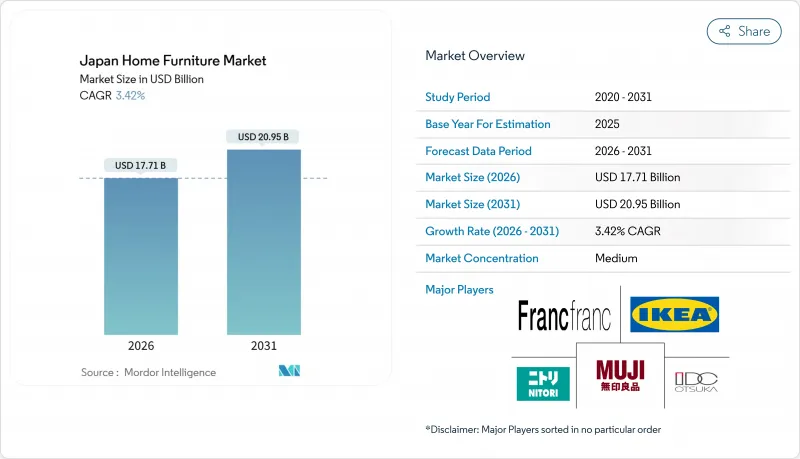
This report is Segmented by Product Type (Living Room and Dining Room Furniture, Bedroom Furniture, Kitchen Furniture, Home Office Furniture, Bathroom Furniture, and More), Material (Wood, Metal, and More), Price Range (Economy, Mid-Range, Premium), Distribution Channel (Home Centers, Specialty Furniture Stores, and More), and Geography. The Market Forecasts are Provided in Terms of Value (USD).
Japan Home Furniture Market Trends and Insights
Aging Population Demanding Ergonomic & Assistive Furniture
Households with at least one member aged 65 or above already comprise a large share of the base, and the demographic tilt will shape product development and replacement patterns across the Japan home furniture market. Manufacturers are folding assistive features into mainstream ranges so that grab rails, anti-slip fabrics, and powered recline options are available without channeling buyers into specialized catalogs. The long-term expansion of the 75-plus cohort, concentrated in Kanto and western Honshu, establishes a stable renewal cycle as seating and beds are upgraded to models that lower caregiver strain and allow easier transfers. Pilot programs that embed posture sensors and environmental monitoring into chairs and desks remain at pre-commercial maturity, with the bulk of smart-furniture concepts clustered at Technology Readiness Levels 4 to 6 . The policy environment is supportive through barrier-free housing standards and guidance on care devices, which signals continued alignment between public health objectives and adaptive furniture features. As these dynamics extend, the Japan home furniture market will see a wider set of residential SKUs designed for mobility, safe access, and age-friendly ergonomics that fit into compact urban spaces.
Urban Apartment Downsizing Boosting Multifunctional Furniture Demand
High new-home prices in the major wards have pushed buyers toward smaller units, which prioritize utility and shift-in-place flexibility in furniture selection. Compact apartments without dedicated rooms are driving the uptake of expandable tables, fold-down desks, and storage-integrated sofas that can pivot between work, dining, and rest within a constrained footprint. Retailers are responding through room-set demonstrations scaled to actual city floor plans and by calibrating assortments for multi-function use, which keeps conversion high even as display areas shrink. Hybrid work preferences also influence home-office accessories, since many employees toggle between office and compact homes and prefer portable seating and collapsible stands to maintain ergonomic standards. Closed-loop manufacturing at domestic sites is maturing, with major integrated players reporting very high recycling rates that support polymer substitution and cost containment in e-commerce shipping. These forces together will continue to channel demand to multi-purpose formats in the Japan home furniture market, as developers and retailers co-optimize for space efficiency and practical comfort in daily use.
Declining Housing Starts Limiting New Furniture Purchases
Housing starts dropped below long-term averages in 2024, reducing the volume of first-time furnishing demand and shifting market momentum toward replacement and upgrade cycles. Central bank commentary points to structural pressures from demographic decline and price dynamics, which continue to concentrate housing demand in central urban wards while suburban areas experience population outflows. Fewer residential completions have lowered demand for coordinated, full-home furniture purchases, resulting in smaller basket sizes compared with new-build outfitting. As a result, retailers with strong renewal-focused assortments, installation capabilities, and after-sales services are better positioned to stabilize revenues, while operators heavily exposed to new construction cycles face sharper volume declines. In response, the Japan home furniture market is increasingly prioritizing durability, repairability, and modular upgrades, making contractor partnerships and small-space customization essential strategies for sustaining demand amid lower housing completions.
Other drivers and restraints analyzed in the detailed report include:
- E-commerce Penetration Increasing Furniture Accessibility
- Government Incentives for Sustainably-Sourced Wood Products
- Rising Raw-material & Logistics Costs Squeezing Margins
For complete list of drivers and restraints, kindly check the Table Of Contents.
Segment Analysis
Living room and dining room furniture holds 36.12% in 2025 and remains the anchor for coordinated purchases, while home office furniture is set to grow at a 4.97% CAGR during 2026 to 2031 as hybrid work stabilizes. Living zones skew toward modular sofas and extendable tables that host multi-generational use without increasing footprint, which aligns with urban layouts where traffic flow and storage are equally important. The Japan home furniture market is also seeing a steady rotation into compact entertainment and display units that free wall space while hiding cables and peripherals. The home-office category is diverging into permanent setups for larger units and portable add-ons for small apartments where dedicated workrooms are not feasible, both of which support sustained growth in seating and ergonomic accessories. Overall, product mix decisions are influenced by space constraints, demographic needs, and workplace patterns, which together reinforce multifunctional, easy-to-move, and easy-to-clean designs across rooms.
Bedroom and kitchen categories track replacement cycles triggered by life events, retrofits, and safety upgrades for seniors, while bathroom and outdoor pieces remain niche within the residential share. The Japan home furniture market favors quiet aesthetics with neutral tones, which supports platform designs that can be reconfigured as needs change without replacing core frames. Consumers are more willing to mix home-office and living-room items when furniture can fold, stack, or telescope, which expands use cases without increasing clutter in small homes. Retailers with strong room visualization and pick-up networks are capturing share, as they can demonstrate function within realistic floor plans and keep delivery fees modest for bulky items. Given these conditions, the Japan home furniture market will continue to see Home Office Furniture outpace the broader category as the hybrid model persists and employers standardize support for at-home ergonomics.
Wood holds a 56.12% share and remains the mainstay for frames, cabinetry, and premium finishes, supported by policies that encourage domestic species and by widespread certification that sustains trust and pricing power. Plastic and Polymer will advance the fastest at a 4.56% CAGR through 2031 due to lighter weight that lowers shipping costs and due to increased use of recycled inputs that match sustainability targets. The Japan home furniture market is also adopting metal selectively for ergonomic frames and minimalist accents where strength-to-weight ratios are decisive. Industry programs that improve traceability and raise the share of certified wood in total supply are stabilizing costs and ensuring steady access to inputs even when exchange rates move. As material science evolves, the balance of wood, polymer, and metal reflects trade-offs between cost, durability, weight, and environmental claims within the Japan home furniture market.
Circularity is now a competitive differentiator, particularly for high-volume retailers that can specify recycled plastics and bio-composites across hundreds of SKUs with reliable sourcing and quality control. Innovations in low-carbon steel are entering office-adjacent residential items, which signals a broader decarbonization of material choices beyond polymers and wood. In parallel, certified domestic timber helps reduce exposure to foreign supply shocks and aligns with legality requirements that regulators enforce in upstream wood trades. These shifts favor integrated players that can maintain consistent inputs at scale and reinforce the Japan home furniture industry's push toward documented sustainability attributes. As end buyers place more weight on environmental information, materials strategy will remain central to product design and merchandising.
Complete Report Scope:
- By Product
- Living Room & Dining Room Furniture
- Bedroom Furniture
- Kitchen Furniture
- Home Office Furniture
- Bathroom Furniture
- Outdoor Furniture
- Other Furniture
- By Material
- Wood
- Metal
- Plastic & Polymer
- Others
- By Price Range
- Economy
- Mid-Range
- Premium
- By Distribution Channel
- Home Centers
- Specialty Furniture Stores
- Online
- Other Distribution Channels
- By Geography
- Kanto Region
- Kansai Region
- Chubu Region
- Rest of Japan
List of Companies Covered in this Report:
- Nitori Holdings Co., Ltd.
- Ryohin Keikaku Co., Ltd. (MUJI)
- IKEA Japan K.K.
- IDC Otsuka Furniture Co., Ltd.
- Francfranc Corporation
- Actus Co., Ltd.
- Karimoku Furniture Inc.
- Maruni Wood Industry Inc.
- Hida Sangyo Co., Ltd.
- Okamura Corporation
- Shimachu Co., Ltd.
- La-Z-Boy Japan Co., Ltd.
- BALS Corporation
- Lowya (VELTRA Corporation)
- Inaba International Co., Ltd.
- Seki Furniture Co., Ltd.
- LIXIL VIVA Corporation
- Niimaru Co., Ltd.
- Isetan Mitsukoshi Holdings Ltd. (Furniture Division)
- Takumi Kohgei Co., Ltd.
Additional Benefits:
- The market estimate (ME) sheet in Excel format
- 3 months of analyst support
TABLE OF CONTENTS
1 Introduction
- 1.1 Study Assumptions & Market Definition
- 1.2 Scope of the Study
2 Research Methodology
3 Executive Summary
4 Market Landscape
- 4.1 Market Overview
- 4.2 Market Drivers
- 4.2.1 Aging population demanding ergonomic & assistive furniture
- 4.2.2 Urban apartment downsizing boosting multifunctional furniture demand
- 4.2.3 E-commerce penetration increasing furniture accessibility
- 4.2.4 Government incentives for sustainably-sourced wood products
- 4.2.5 Tatami-inspired hybrid minimalist designs gaining popularity
- 4.2.6 Corporate flex-office conversions prompting bulk home-office purchases
- 4.3 Market Restraints
- 4.3.1 Declining housing starts limiting new furniture purchases
- 4.3.2 Rising raw-material & logistics costs squeezing margins
- 4.3.3 Import disruptions from stricter maritime emissions rules
- 4.3.4 Shrinking skilled carpentry workforce constraining premium supply
- 4.4 Industry Value Chain Analysis
- 4.5 Regulatory Landscape
- 4.6 Porter's Five Forces
- 4.6.1 Bargaining Power of Suppliers
- 4.6.2 Bargaining Power of Buyers
- 4.6.3 Threat of New Entrants
- 4.6.4 Threat of Substitutes
- 4.6.5 Industry Rivalry
- 4.7 Insights into the Latest Trends and Innovations in the Market
- 4.8 Insights on Recent Developments (New Product Launches, Strategic Initiatives, Investments, Partnerships, JVs, Expansion, M&As, etc.) in the Market
5 Market Size & Growth Forecasts
- 5.1 By Product
- 5.1.1 Living Room & Dining Room Furniture
- 5.1.2 Bedroom Furniture
- 5.1.3 Kitchen Furniture
- 5.1.4 Home Office Furniture
- 5.1.5 Bathroom Furniture
- 5.1.6 Outdoor Furniture
- 5.1.7 Other Furniture
- 5.2 By Material
- 5.2.1 Wood
- 5.2.2 Metal
- 5.2.3 Plastic & Polymer
- 5.2.4 Others
- 5.3 By Price Range
- 5.3.1 Economy
- 5.3.2 Mid-Range
- 5.3.3 Premium
- 5.4 By Distribution Channel
- 5.4.1 Home Centers
- 5.4.2 Specialty Furniture Stores
- 5.4.3 Online
- 5.4.4 Other Distribution Channels
- 5.5 By Geography
- 5.5.1 Kanto Region
- 5.5.2 Kansai Region
- 5.5.3 Chubu Region
- 5.5.4 Rest of Japan
6 Competitive Landscape
- 6.1 Market Concentration
- 6.2 Strategic Moves
- 6.3 Market Share Analysis
- 6.4 Company Profiles {(includes Global level Overview, Market level overview, Core Segments, Financials as available, Strategic Information, Market Rank/Share for key companies, Products & Services, and Recent Developments)}
- 6.4.1 Nitori Holdings Co., Ltd.
- 6.4.2 Ryohin Keikaku Co., Ltd. (MUJI)
- 6.4.3 IKEA Japan K.K.
- 6.4.4 IDC Otsuka Furniture Co., Ltd.
- 6.4.5 Francfranc Corporation
- 6.4.6 Actus Co., Ltd.
- 6.4.7 Karimoku Furniture Inc.
- 6.4.8 Maruni Wood Industry Inc.
- 6.4.9 Hida Sangyo Co., Ltd.
- 6.4.10 Okamura Corporation
- 6.4.11 Shimachu Co., Ltd.
- 6.4.12 La-Z-Boy Japan Co., Ltd.
- 6.4.13 BALS Corporation
- 6.4.14 Lowya (VELTRA Corporation)
- 6.4.15 Inaba International Co., Ltd.
- 6.4.16 Seki Furniture Co., Ltd.
- 6.4.17 LIXIL VIVA Corporation
- 6.4.18 Niimaru Co., Ltd.
- 6.4.19 Isetan Mitsukoshi Holdings Ltd. (Furniture Division)
- 6.4.20 Takumi Kohgei Co., Ltd.
7 Market Opportunities & Future Outlook
- 7.1 Subscription-based furniture rental models
- 7.2 Smart IoT-integrated furniture for senior care

