PUBLISHER: Mordor Intelligence | PRODUCT CODE: 2124269

PUBLISHER: Mordor Intelligence | PRODUCT CODE: 2124269
Zero Trust Security - Market Share Analysis, Industry Trends & Statistics, Growth Forecasts (2026 - 2031)
According to Mordor Intelligence, the zero trust security market size is expected to grow from USD 41.72 billion in 2025 to USD 48.43 billion in 2026 and is forecast to reach USD 102.01 billion by 2031 at 16.07% CAGR over 2026-2031.
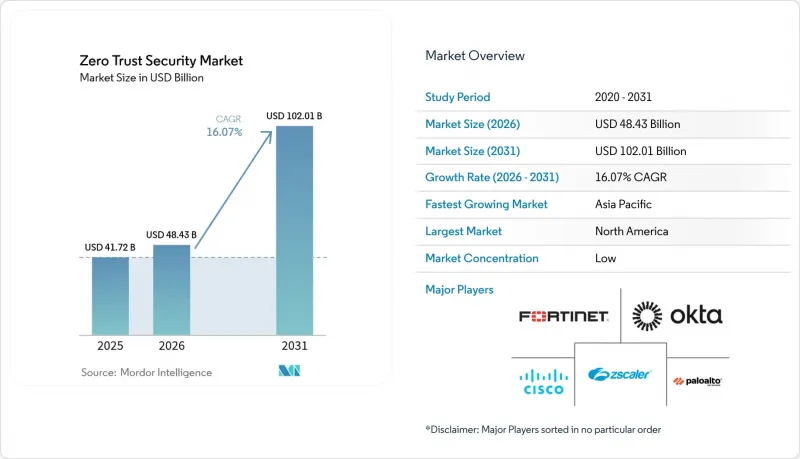
This report is Segmented by Offering (Solutions and Services), Deployment Mode (On-Premise and Cloud), Organization Size (Small and Medium Enterprises and Large Enterprises), Authentication Type (Single-Factor and Multi-Factor), End-User Industry (IT and Telecom, BFSI, Manufacturing, and More), and Geography. The Market Forecasts are Provided in Terms of Value (USD).
Global Zero Trust Security Market Trends and Insights
Increasing number of data breaches
Zero-day vulnerabilities tripled in 2024, and ransomware represented one-third of all breaches across 92% of industries. Human factors contributed to 68% of incidents, pressing enterprises to adopt continuous verification that assumes internal compromise. Third-party weaknesses climbed 68%, forcing organizations to extend zero trust principles to suppliers. Insider threats cost financial institutions USD 16.2 million per event on average. Breach economics, therefore, favor preventative spending on zero trust controls over expensive post-incident remediation.
Expansion of remote/hybrid workforces
Permanent remote work invalidates VPN-centric access. Organizations that adopted zero trust architectures saw an 83% cut in incident-response times and an 80% drop in successful breaches. NTT DATA's rollout connected 50,000 users in 30 days, proving cloud-delivered scalability. Remote Browser Isolation tools further protect distributed staff without hindering productivity, fueling sustained demand for zero-trust network access.
Legacy integration hurdles
Decades-old applications often lack modern authentication hooks, forcing custom connectors that extend deployment schedules. Healthcare facilities struggle to retrofit network-enabled medical devices built without security in mind. Manufacturers face similar constraints with operational technology, where uptime trumps security. Vendors that package pre-configured integrations ease friction and shorten project payback.
Other drivers and restraints analyzed in the detailed report include:
- Rising regulatory mandates
- Explosion of machine and API traffic
- High up-front architecture cost
For complete list of drivers and restraints, kindly check the Table Of Contents.
Segment Analysis
Solutions accounted for 66.55% of 2025 revenue, anchoring the zero trust security market through integrated policy engines and analytics dashboards. However, services are rising at a 19.05% CAGR as enterprises rely on partners to design, deploy, and fine-tune architectures across hybrid landscapes.
Professional services guide strategy, while managed offerings deliver continuous optimization without ballooning headcount. High-profile rollouts-such as Cimpress transforming global access controls-underline the organizational change management needed alongside technology shifts, explaining why the zero trust security market continues to pivot toward service-led value delivery.
On-premise solutions preserved 53.85% of 2025 spending, reflecting regulated workloads that remain inside corporate data centers. Cloud deployments, growing at 19.66% CAGR, attract firms seeking instant scalability and simplified updates.
Hybrid patterns dominate: sensitive data stays on-site while SaaS gateways manage identity and policy logic. As compliance frameworks evolve to recognize cloud residency controls, the zero trust security market size attached to cloud models is expected to expand rapidly, narrowing the on-premise lead over the forecast period.
Complete Report Scope:
- By Offering
- Solutions
- Services
- By Deployment Mode
- On-premise
- Cloud
- By Organisation Size
- Small and Medium Enterprises (SMEs)
- Large Enterprises
- By Authentication Type
- Single-Factor
- Multi-Factor
- By End-user Industry
- IT and Telecom
- BFSI
- Manufacturing
- Healthcare
- Energy and Utilities
- Retail and E-commerce
- Government and Defense
- Other End-user Industries
- By Geography
- North America
- United States
- Canada
- Mexico
- South America
- Brazil
- Argentina
- Chile
- Rest of South America
- Europe
- Germany
- United Kingdom
- France
- Italy
- Spain
- Russia
- Rest of Europe
- Asia-Pacific
- China
- India
- Japan
- South Korea
- Australia
- Singapore
- Malaysia
- Rest of Asia-Pacific
- Middle East and Africa
- Middle East
- United Arab Emirates
- Saudi Arabia
- Turkey
- Rest of Middle East
- Africa
- South Africa
- Nigeria
- Rest of Africa
- Middle East
- North America
Geography Analysis
North America secured 34.72% of 2025 revenue through mature regulations, extensive cloud adoption, and vendor density. Federal mandates push agencies and contractors toward consistent architectures, while financial hubs in New York and Toronto showcase reference deployments that ripple across other verticals. Competitive pressure, however, is intensifying as newer cloud-native entrants challenge incumbents on price and automation.
Asia-Pacific commands the fastest CAGR at 18.63% to 2031. Governments from Singapore to Japan enact cybersecurity roadmaps that embed zero trust principles, letting firms leapfrog legacy firewalls in favor of cloud-delivered controls. Manufacturing clusters rely on micro-segmentation to protect converged IT/OT environments, further expanding the zero-trust security market in the region.
Europe's steady progression stems from GDPR and sector-specific directives that favor privacy-preserving architectures. Vendors that provide granular audit trails and EU-based data centers gain traction. Meanwhile, the Middle East and Africa register emerging potential as digital governments fund modernization, though adoption still lags due to limited local skill sets and infrastructure.
- Palo Alto Networks Inc.
- Cisco Systems Inc.
- Zscaler Inc.
- Okta Inc.
- Fortinet Inc.
- CrowdStrike Holdings Inc.
- Check Point Software Tech.
- IBM Corporation
- Akamai Technologies Inc.
- Illumio Inc.
- Appgate Inc.
- Netskope Inc.
- Cloudflare Inc.
- Duo Security LLC
- BeyondTrust Corp.
- CyberArk Software Ltd.
- Ping Identity Corp.
- SailPoint Technologies
- One Identity LLC
- Banyan Security Inc.
- Zero Networks Ltd.
- Elisity Inc.
- Versa Networks Inc.
- Vectra AI Inc.
- Guardicore Ltd. (Cisco Networks)
Additional Benefits:
- The market estimate (ME) sheet in Excel format
- 3 months of analyst support
TABLE OF CONTENTS
1 INTRODUCTION
- 1.1 Study Assumptions and Market Definition
- 1.2 Scope of the Study
2 RESEARCH METHODOLOGY
3 EXECUTIVE SUMMARY
4 MARKET LANDSCAPE
- 4.1 Market Overview
- 4.2 Market Drivers
- 4.2.1 Increasing number of data breaches
- 4.2.2 Expansion of remote/hybrid workforces
- 4.2.3 Rising regulatory mandates
- 4.2.4 Explosion of machine and API traffic
- 4.2.5 Smart-NIC micro-segmentation
- 4.2.6 Identity-network convergence
- 4.3 Market Restraints
- 4.3.1 Legacy integration hurdles
- 4.3.2 High up-front architecture cost
- 4.3.3 Shadow-IT SaaS bypass
- 4.3.4 Supplier data-sharing clauses
- 4.4 Industry Value Chain Analysis
- 4.5 Regulatory Landscape
- 4.6 Technological Outlook
- 4.7 Industry Attractiveness - Porter's Five Forces Analysis
- 4.7.1 Bargaining Power of Suppliers
- 4.7.2 Bargaining Power of Buyers
- 4.7.3 Threat of New Entrants
- 4.7.4 Threat of Substitutes
- 4.7.5 Intensity of Competitive Rivalry
- 4.8 Impact of Macroeconomic Factors on the Market
5 MARKET SIZE AND GROWTH FORECASTS (VALUES)
- 5.1 By Offering
- 5.1.1 Solutions
- 5.1.2 Services
- 5.2 By Deployment Mode
- 5.2.1 On-premise
- 5.2.2 Cloud
- 5.3 By Organisation Size
- 5.3.1 Small and Medium Enterprises (SMEs)
- 5.3.2 Large Enterprises
- 5.4 By Authentication Type
- 5.4.1 Single-Factor
- 5.4.2 Multi-Factor
- 5.5 By End-user Industry
- 5.5.1 IT and Telecom
- 5.5.2 BFSI
- 5.5.3 Manufacturing
- 5.5.4 Healthcare
- 5.5.5 Energy and Utilities
- 5.5.6 Retail and E-commerce
- 5.5.7 Government and Defense
- 5.5.8 Other End-user Industries
- 5.6 By Geography
- 5.6.1 North America
- 5.6.1.1 United States
- 5.6.1.2 Canada
- 5.6.1.3 Mexico
- 5.6.2 South America
- 5.6.2.1 Brazil
- 5.6.2.2 Argentina
- 5.6.2.3 Chile
- 5.6.2.4 Rest of South America
- 5.6.3 Europe
- 5.6.3.1 Germany
- 5.6.3.2 United Kingdom
- 5.6.3.3 France
- 5.6.3.4 Italy
- 5.6.3.5 Spain
- 5.6.3.6 Russia
- 5.6.3.7 Rest of Europe
- 5.6.4 Asia-Pacific
- 5.6.4.1 China
- 5.6.4.2 India
- 5.6.4.3 Japan
- 5.6.4.4 South Korea
- 5.6.4.5 Australia
- 5.6.4.6 Singapore
- 5.6.4.7 Malaysia
- 5.6.4.8 Rest of Asia-Pacific
- 5.6.5 Middle East and Africa
- 5.6.5.1 Middle East
- 5.6.5.1.1 United Arab Emirates
- 5.6.5.1.2 Saudi Arabia
- 5.6.5.1.3 Turkey
- 5.6.5.1.4 Rest of Middle East
- 5.6.5.2 Africa
- 5.6.5.2.1 South Africa
- 5.6.5.2.2 Nigeria
- 5.6.5.2.3 Rest of Africa
- 5.6.5.1 Middle East
- 5.6.1 North America
6 COMPETITIVE LANDSCAPE
- 6.1 Market Concentration
- 6.2 Strategic Moves
- 6.3 Market Share Analysis
- 6.4 Company Profiles (includes Global level Overview, Market level overview, Core Segments, Financials as available, Strategic Information, Market Rank/Share for key companies, Products and Services, and Recent Developments)
- 6.4.1 Palo Alto Networks Inc.
- 6.4.2 Cisco Systems Inc.
- 6.4.3 Zscaler Inc.
- 6.4.4 Okta Inc.
- 6.4.5 Fortinet Inc.
- 6.4.6 CrowdStrike Holdings Inc.
- 6.4.7 Check Point Software Tech.
- 6.4.8 IBM Corporation
- 6.4.9 Akamai Technologies Inc.
- 6.4.10 Illumio Inc.
- 6.4.11 Appgate Inc.
- 6.4.12 Netskope Inc.
- 6.4.13 Cloudflare Inc.
- 6.4.14 Duo Security LLC
- 6.4.15 BeyondTrust Corp.
- 6.4.16 CyberArk Software Ltd.
- 6.4.17 Ping Identity Corp.
- 6.4.18 SailPoint Technologies
- 6.4.19 One Identity LLC
- 6.4.20 Banyan Security Inc.
- 6.4.21 Zero Networks Ltd.
- 6.4.22 Elisity Inc.
- 6.4.23 Versa Networks Inc.
- 6.4.24 Vectra AI Inc.
- 6.4.25 Guardicore Ltd. (Cisco Networks)
7 MARKET OPPORTUNITIES AND FUTURE TRENDS
- 7.1 White-Space and Unmet-Need Assessment

