PUBLISHER: Mordor Intelligence | PRODUCT CODE: 2124288

PUBLISHER: Mordor Intelligence | PRODUCT CODE: 2124288
Asia Pacific Small Cell Tower - Market Share Analysis, Industry Trends & Statistics, Growth Forecasts (2026 - 2031)
According to Mordor Intelligence, the Asia Pacific small cell tower market size is expected to grow from 2.80 million units in 2025 to 2.97 million units in 2026 and is forecast to reach 4.02 million units by 2031 at 6.22% CAGR over 2026-2031.
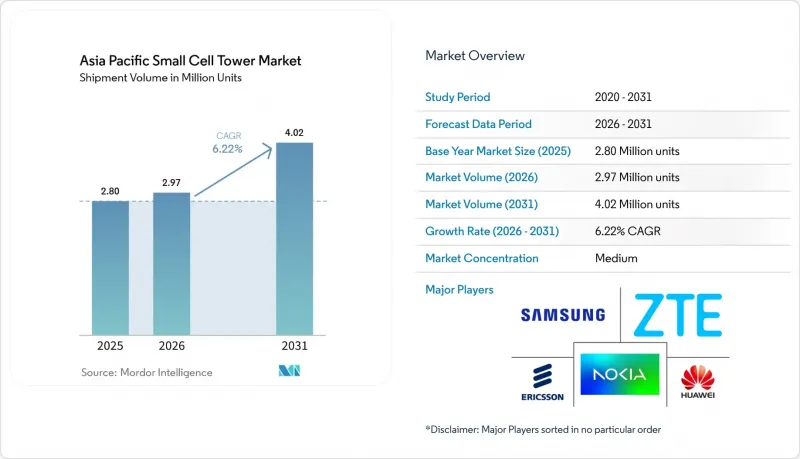
This report is Segmented by Application (Outdoor, and Indoor), Network Technology (3G, 4G/LTE, and 5G), Ownership Model (Operator-Deployed, Neutral-Host, and Private Enterprises), Deployment Location (Urban, Suburban, and Rural), and Country (China, South Korea, Japan, India, South-East Asia, and Rest of Asia Pacific). The Market Forecasts are Provided in Terms of Volume (Units).
Asia Pacific Small Cell Tower Market Trends and Insights
Rapid Surge in Mobile Data Traffic and Densification Requirements
Mobile video streaming, cloud gaming, and workplace collaboration tools have triggered year-over-year traffic spikes of 40-60% in key metropolitan areas, exceeding the capacity of macro sites beyond their engineered limits. Operators now view dense grids of small cells as the most cost-efficient lever to add spectral reuse in real estate-constrained neighborhoods. Street-level poles, bus shelters, and building facades host these radios, minimizing landlord negotiations while shortening installation cycles. The densification imperative extends to airports, malls, and entertainment venues, where per-user throughput demands remain highest during peak hours. Vendors able to supply compact, multi-band radios that integrate 4G anchor carriers with 5G NR are securing preferred-supplier status. As a result, the Asia Pacific small cell tower market continues to mature from pilot deployments toward mass-scale grid planning.
Accelerated 5G Rollout Timelines Across Asia Pacific
Competitive announcements have condensed national 5G roadmaps by as much as 18 months, forcing operators to compress site-acquisition, civil works, and integration activities. Governments in China and South Korea have linked infrastructure development to broader economic growth targets, releasing funds and public properties for accelerated deployment. Because small cells cover limited radii, they enable rapid 5G coverage overlays without waiting for new macro towers. Multi-technology radios that switch between NSA and SA modes help operators satisfy near-term coverage promises while laying groundwork for standalone cores. Integrated antennas, digital front-haul, and zero-touch provisioning tools are shortening time-to-revenue, underpinning robust demand for the Asia Pacific small cell tower market.
Complex Site Acquisition and Permitting Hurdles
Municipal zoning disparities prolong approval cycles and inflate leasing charges, especially across tier-1 Indian cities where building owners demand premium rents. Some jurisdictions require separate no-objection certificates from fire, aviation, and heritage departments, which can extend project timelines. The absence of standardized fee structures complicates network planning, as per-site cost variability challenges return-on-investment calculations. Operators often negotiate rooftop access on an ad-hoc basis, delaying grid densification and capping near-term shipment volumes for the Asia Pacific small cell tower market.
Other drivers and restraints analyzed in the detailed report include:
- Government Initiatives and Spectrum Policies Supporting Small Cell Deployments
- Emergence of Private 5G Networks in Manufacturing Corridors
- High Upfront Capital Expenditure for Dense Deployments
For complete list of drivers and restraints, kindly check the Table Of Contents.
Segment Analysis
Indoor sites captured 30.88% of shipments in 2025, equivalent to approximately 0.86 million units of the Asia Pacific small cell tower market size, and are projected to track a 7.32% CAGR to 2031. Enterprises view robust indoor 5G as non-negotiable for customer engagement tools, cashier-less checkouts, and immersive retail displays. Consequently, shopping malls, airports, and stadiums allocate capital expenditure budgets exclusively for small cell layers rather than Wi-Fi upgrades. Neutral-host operators bundle these systems into long-term service agreements, easing budget approval while ensuring multi-carrier access.
Outdoor deployments continue to anchor the Asia Pacific small cell tower market, accounting for 69.12% of the 2025 volumes. Operators use pole-mount and wall-mount radios in alleyways and transit corridors to alleviate macro-sector congestion during peak commuting hours. Integrated street-furniture designs blend radios, power modules, and backhaul links into aesthetically pleasing housings, thereby satisfying municipal ordinances. Although outdoor grids remain the dominant revenue stream, the rising momentum in indoor grids underscores the market's dual-track growth narrative.
4G/LTE radios comprised 50.32% of 2025 shipments, equivalent to 1.41 million units in the Asia Pacific small cell tower market size, reflecting operators' preference for maximizing existing spectrum allocations. Yet 5G radios are expanding at an 7.98% CAGR as carriers introduce mid-band and mmWave layers that support multi-gigabit peak throughput. Combo radios that deliver dual-standard coverage preserve site rent outlays and accelerate user migration.
Multi-technology platform adoption also addresses the realities of device mix. In late 2025, 5G smartphone penetration sits below 45% in many Southeast Asian markets, compelling operators to retain 4G anchor links for voice services and IoT endpoints. Gradual sunset plans for 3G free additional spectrum, enabling carriers to refarm bandwidth for 5G NR, thus reinforcing demand for software-upgradable radios.
Complete Report Scope:
- By Application
- Outdoor
- Indoor
- By Network Technology
- 3G
- 4G/LTE
- 5G
- By Ownership Model
- Operator-deployed
- Neutral-host
- Private enterprises
- By Deployment Location
- Urban
- Suburban
- Rural
- By Country
- China
- South Korea
- Japan
- India
- South-East Asia
- Rest of Asia Pacific
List of Companies Covered in this Report:
- Huawei Technologies Co., Ltd.
- Telefonaktiebolaget LM Ericsson
- Nokia Corporation
- ZTE Corporation
- Samsung Electronics Co., Ltd.
- Parallel Wireless Inc.
- Airspan Networks Inc.
- Baicells Technologies Co., Ltd.
- NEC Corporation
- Comba Telecom Systems Holdings Limited
- Fujitsu Limited
- JMA Wireless
- CommScope Holding Company, Inc.
- Mavenir Systems, Inc.
- Rakuten Symphony, Inc.
- Qucell Networks Co., Ltd.
- ip.access Ltd.
- Corning Incorporated
- Sercomm Corporation
- Dali Wireless, Inc.
Additional Benefits:
- The market estimate (ME) sheet in Excel format
- 3 months of analyst support
TABLE OF CONTENTS
1 INTRODUCTION
- 1.1 Study Assumptions and Market Definition
- 1.2 Scope of the Study
2 RESEARCH METHODOLOGY
3 EXECUTIVE SUMMARY
4 MARKET LANDSCAPE
- 4.1 Market Overview
- 4.2 Market Drivers
- 4.2.1 Rapid surge in mobile data traffic and densification requirements
- 4.2.2 Accelerated 5G rollout timelines across Asia Pacific
- 4.2.3 Government initiatives and spectrum policies supporting small cell deployments
- 4.2.4 Emergence of private 5G networks in manufacturing corridors
- 4.2.5 AI-powered self-optimizing networks lowering OPEX for densification
- 4.3 Market Restraints
- 4.3.1 Complex site acquisition and permitting hurdles
- 4.3.2 High upfront capital expenditure for dense deployments
- 4.3.3 Interference management in shared and unlicensed spectrum bands
- 4.3.4 Semiconductor supply-chain disruptions delaying roll-outs
- 4.4 Impact of Macroeconomic Factors
- 4.5 Industry Value Chain Analysis
- 4.6 Regulatory Landscape
- 4.7 Technological Outlook
- 4.8 Porter's Five Forces Analysis
- 4.8.1 Bargaining Power of Suppliers
- 4.8.2 Bargaining Power of Consumers
- 4.8.3 Threat of New Entrants
- 4.8.4 Intensity of Competitive Rivalry
- 4.8.5 Threat of Substitutes
- 4.9 Analysis of 5G Roadmap in Asia Pacific
5 MARKET SIZE AND GROWTH FORECASTS (VALUE)
- 5.1 By Application
- 5.1.1 Outdoor
- 5.1.2 Indoor
- 5.2 By Network Technology
- 5.2.1 3G
- 5.2.2 4G/LTE
- 5.2.3 5G
- 5.3 By Ownership Model
- 5.3.1 Operator-deployed
- 5.3.2 Neutral-host
- 5.3.3 Private enterprises
- 5.4 By Deployment Location
- 5.4.1 Urban
- 5.4.2 Suburban
- 5.4.3 Rural
- 5.5 By Country
- 5.5.1 China
- 5.5.2 South Korea
- 5.5.3 Japan
- 5.5.4 India
- 5.5.5 South-East Asia
- 5.5.6 Rest of Asia Pacific
6 COMPETITIVE LANDSCAPE
- 6.1 Market Concentration
- 6.2 Strategic Moves
- 6.3 Market Share Analysis
- 6.4 Company Profiles (includes Global level Overview, Market level overview, Core Segments, Financials as available, Strategic Information, Market Rank/Share for key companies, Products and Services, and Recent Developments)
- 6.4.1 Huawei Technologies Co., Ltd.
- 6.4.2 Telefonaktiebolaget LM Ericsson
- 6.4.3 Nokia Corporation
- 6.4.4 ZTE Corporation
- 6.4.5 Samsung Electronics Co., Ltd.
- 6.4.6 Parallel Wireless Inc.
- 6.4.7 Airspan Networks Inc.
- 6.4.8 Baicells Technologies Co., Ltd.
- 6.4.9 NEC Corporation
- 6.4.10 Comba Telecom Systems Holdings Limited
- 6.4.11 Fujitsu Limited
- 6.4.12 JMA Wireless
- 6.4.13 CommScope Holding Company, Inc.
- 6.4.14 Mavenir Systems, Inc.
- 6.4.15 Rakuten Symphony, Inc.
- 6.4.16 Qucell Networks Co., Ltd.
- 6.4.17 ip.access Ltd.
- 6.4.18 Corning Incorporated
- 6.4.19 Sercomm Corporation
- 6.4.20 Dali Wireless, Inc.
7 MARKET OPPORTUNITIES AND FUTURE OUTLOOK
- 7.1 White-space and Unmet-need assessment

