PUBLISHER: Mordor Intelligence | PRODUCT CODE: 2124299

PUBLISHER: Mordor Intelligence | PRODUCT CODE: 2124299
India Payment Gateway - Market Share Analysis, Industry Trends & Statistics, Growth Forecasts (2026 - 2031)
According to Mordor Intelligence, the India payment gateway market size was valued at USD 2.07 billion in 2025 and estimated to grow from USD 2.31 billion in 2026 to reach USD 4.01 billion by 2031, at a CAGR of 11.66% during the forecast period (2026-2031).
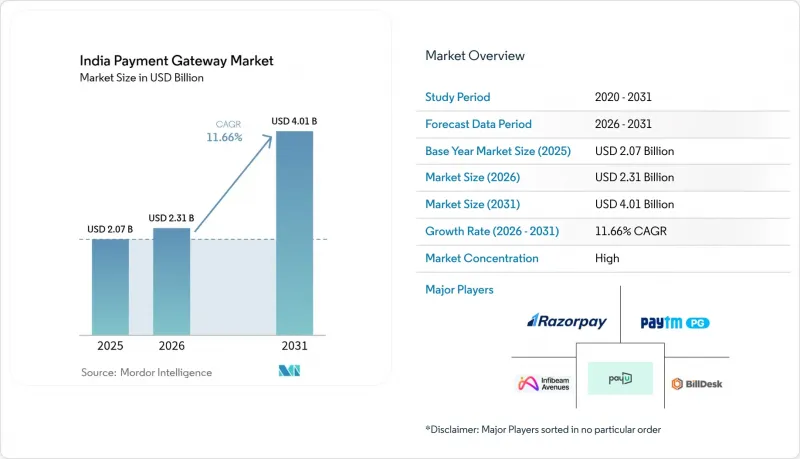
This report is Segmented by Payment Mode (UPI, Cards, Wallets, and More), Organization Size (Small and Medium Enterprises, and Large Enterprises), Deployment Mode (Cloud-Based, On-Premise, and Hybrid), End-User Industry (Retail and FMCG, BFSI and FinTech Platforms, Healthcare and Pharmaceuticals, Education and Ed-Tech, and More), and Geography. The Market Forecasts are Provided in Terms of Value (USD).
India Payment Gateway Market Trends and Insights
Explosive UPI Adoption and International Expansion
UPI processed more than 14 billion transactions in September 2025 alone, equal to roughly 50% of all real-time payments executed worldwide. Bilateral linkages such as UPI-PayNow enable instant cross-border transfers to Singapore at sub-minute settlement windows and materially lower fees, attracting gateway partnerships with major remittance providers. NPCI's "UPI Circle" feature now permits a primary user to delegate payments to up to five secondary profiles, extending real-time rails into underserved demographic cohorts and new merchant categories.
Government-Backed Digital Public Infrastructure
API Setu hosts more than 6,000 live government APIs, while DigiLocker supports 43 crore user wallets, creating standardized KYC layers that compress merchant onboarding cycles for gateways to a few minutes. The Public Financial Management System clears billions of subsidy payments monthly, pushing certified gateways to integrate at scale with direct benefit workflows.
Zero-MDR Economics Pressure on Gateways
The RBI-mandated zero-merchant discount rate for UPI transactions eliminates the traditional ad-valorem revenue line for payment aggregators. Funding to private payment gateway startups contracted sharply in 2024, forcing providers to prioritize subscription-based analytics, cross-border collections, and lending partnerships to remain solvent.
Other drivers and restraints analyzed in the detailed report include:
- MSME Digital Onboarding Incentives (PIDF, ONDC)
- API-First Open Finance and Embedded Payments
- Intensifying RBI Compliance and PA Licensing Costs
For complete list of drivers and restraints, kindly check the Table Of Contents.
Segment Analysis
UPI accounted for 63.85% of India payment gateway market share in 2025, clearing over 240 billion USD-equivalent annually via real-time rails. Cards continue to dominate high-value retail outlays, particularly credit cards linked to RuPay rails that have doubled transaction value year-on-year. Buy-now-pay-later, tightly coupled with credit-on-UPI and Account Aggregator data pipes, is projected to deliver a 11.75% CAGR, the fastest among all modes. Net-banking retains significance for corporate bulk disbursements through NEFT and RTGS, whereas standalone wallet usage is receding as UPI interoperability becomes ubiquitous.
The India payment gateway market size tied to delegated UPI payments is set to grow sharply because "UPI Circle" allows limits of INR 15,000 per linked user each month. Simultaneously, NPCI's plan to spin RuPay and Credit-on-UPI into dedicated subsidiaries signals a strategic focus on specialized rails that can accommodate cross-border flows.
Large organizations made up 57.40% of the India payment gateway market size in 2025 as banks, insurers, and multinationals sought multi-rail orchestration. However, SME adoption is surging at a forecast 12.58% CAGR through 2031, fuelled by ONDC's standardized catalogs, PIDF hardware subsidies, and AA-enabled zero-paper onboarding. BharatPe's merchant base grew 77% month-on-month in early 2024 as Tier-III and beyond cities embraced QR-based acceptance.
Payment gateways serving SMEs now bundle reconciliation dashboards and instant settlement to tackle working-capital pain points. The India payment gateway market share held by hybrid cloud dashboards catering to kirana stores is therefore expected to widen markedly.
Complete Report Scope:
- By Payment Mode
- UPI
- Cards
- Net-Banking
- Wallets
- BNPL
- By Organization Size
- Small and Medium Enterprises
- Large Enterprises
- By Deployment Mode
- Cloud-Based
- On-Premise
- Hybrid
- By End-User Industry
- E-Commerce and Marketplaces
- Retail and FMCG
- BFSI and FinTech Platforms
- Healthcare and Pharmaceuticals
- Education and Ed-Tech
- Travel and Hospitality
- By Region
- North India
- West India
- South India
- East and Northeast India
- Central India
List of Companies Covered in this Report:
- PayU Payments Private Limited
- Razorpay Software Private Limited
- One 97 Communications Limited (Paytm Payments Gateway)
- CCAvenue - Infibeam Avenues Limited
- IndiaIdeas.com Limited (BillDesk)
- PayPal Payments Private Limited
- Instamojo Technologies Private Limited
- One MobiKwik Systems Limited
- Cashfree Payments India Private Limited
- Pine Labs Private Limited (Plural by Pine Labs)
- Stripe India Private Limited
- Worldline ePayments India Private Limited
- Google India Digital Services Private Limited (Google Pay for Merchants)
- Amazon Pay India Private Limited
- BharatPe (Resilient Innovations Private Limited)
- Juspay Technologies Private Limited
- PayG Solutions Private Limited
- Fiserv India Private Limited (IMSL-Fiserv)
- Adyen India Private Limited
- Payoneer India Private Limited
Additional Benefits:
- The market estimate (ME) sheet in Excel format
- 3 months of analyst support
TABLE OF CONTENTS
1 INTRODUCTION
- 1.1 Study Assumptions and Market Definition
- 1.2 Scope of the Study
2 RESEARCH METHODOLOGY
3 EXECUTIVE SUMMARY
4 MARKET LANDSCAPE
- 4.1 Market Overview
- 4.2 Market Drivers
- 4.2.1 Surge in E-Commerce and D2C Transactions
- 4.2.2 Explosive UPI Adoption and International Expansion
- 4.2.3 Government-Backed Digital Public Infrastructure
- 4.2.4 MSME Digital On-Boarding Incentives (PIDF, ONDC)
- 4.2.5 API-First Open Finance and Embedded Payments
- 4.2.6 Rapid Growth of Credit-on-UPI and BNPL
- 4.3 Market Restraints
- 4.3.1 Zero-MDR Economics Pressure on Gateways
- 4.3.2 Intensifying RBI Compliance and PA Licensing Costs
- 4.3.3 Rising Fraud, Cyber-Risk and Outage Incidents
- 4.3.4 Merchant Concentration Among Top UPI Apps
- 4.4 Industry Value Chain Analysis
- 4.5 Regulatory Landscape
- 4.6 Technological Outlook
- 4.7 Impact of Macroeconomic Factors
- 4.8 Porter's Five Forces Analysis
- 4.8.1 Bargaining Power of Suppliers
- 4.8.2 Bargaining Power of Buyers
- 4.8.3 Threat of New Entrants
- 4.8.4 Threat of Substitutes
- 4.8.5 Intensity of Competitive Rivalry
5 MARKET SIZE AND GROWTH FORECASTS (VALUE)
- 5.1 By Payment Mode
- 5.1.1 UPI
- 5.1.2 Cards
- 5.1.3 Net-Banking
- 5.1.4 Wallets
- 5.1.5 BNPL
- 5.2 By Organization Size
- 5.2.1 Small and Medium Enterprises
- 5.2.2 Large Enterprises
- 5.3 By Deployment Mode
- 5.3.1 Cloud-Based
- 5.3.2 On-Premise
- 5.3.3 Hybrid
- 5.4 By End-User Industry
- 5.4.1 E-Commerce and Marketplaces
- 5.4.2 Retail and FMCG
- 5.4.3 BFSI and FinTech Platforms
- 5.4.4 Healthcare and Pharmaceuticals
- 5.4.5 Education and Ed-Tech
- 5.4.6 Travel and Hospitality
- 5.5 By Region
- 5.5.1 North India
- 5.5.2 West India
- 5.5.3 South India
- 5.5.4 East and Northeast India
- 5.5.5 Central India
6 COMPETITIVE LANDSCAPE
- 6.1 Market Concentration
- 6.2 Strategic Moves
- 6.3 Market Share Analysis
- 6.4 Company Profiles (includes Global Level Overview, Market Level Overview, Core Segments, Financials as available, Strategic Information, Market Rank/Share for Key Companies, Products and Services, and Recent Developments)
- 6.4.1 PayU Payments Private Limited
- 6.4.2 Razorpay Software Private Limited
- 6.4.3 One 97 Communications Limited (Paytm Payments Gateway)
- 6.4.4 CCAvenue - Infibeam Avenues Limited
- 6.4.5 IndiaIdeas.com Limited (BillDesk)
- 6.4.6 PayPal Payments Private Limited
- 6.4.7 Instamojo Technologies Private Limited
- 6.4.8 One MobiKwik Systems Limited
- 6.4.9 Cashfree Payments India Private Limited
- 6.4.10 Pine Labs Private Limited (Plural by Pine Labs)
- 6.4.11 Stripe India Private Limited
- 6.4.12 Worldline ePayments India Private Limited
- 6.4.13 Google India Digital Services Private Limited (Google Pay for Merchants)
- 6.4.14 Amazon Pay India Private Limited
- 6.4.15 BharatPe (Resilient Innovations Private Limited)
- 6.4.16 Juspay Technologies Private Limited
- 6.4.17 PayG Solutions Private Limited
- 6.4.18 Fiserv India Private Limited (IMSL-Fiserv)
- 6.4.19 Adyen India Private Limited
- 6.4.20 Payoneer India Private Limited
7 MARKET OPPORTUNITIES AND FUTURE OUTLOOK
- 7.1 White-Space and Unmet-Need Assessment

