PUBLISHER: Mordor Intelligence | PRODUCT CODE: 2124316

PUBLISHER: Mordor Intelligence | PRODUCT CODE: 2124316
Cloud Backup - Market Share Analysis, Industry Trends & Statistics, Growth Forecasts (2026 - 2031)
According to Mordor Intelligence, the cloud backup market size was valued at USD 5.36 billion in 2025 and is estimated to grow from USD 7.13 billion in 2026 to reach USD 21.62 billion by 2031, at a CAGR of 24.84% during the forecast period (2026-2031).
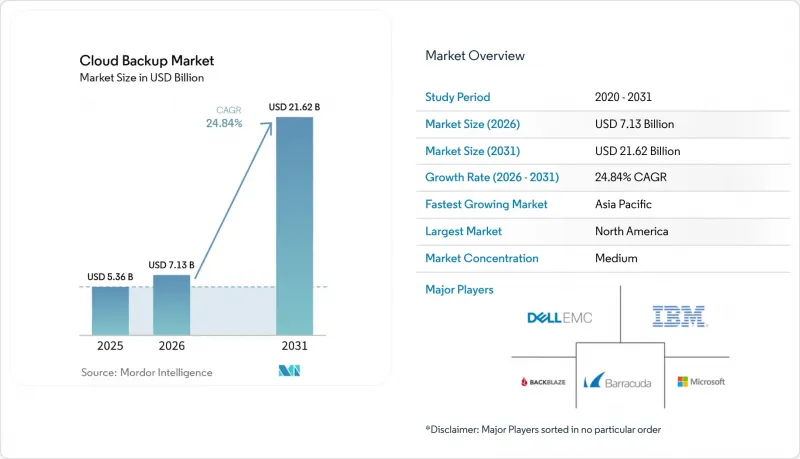
This report is Segmented by Component (Solution, and Services), Deployment Model (Public Cloud, and More), End-User Industry (Banking Financial Services and Insurance, IT and Telecom, and More), Service Provider (Managed Service Provider, and More), Organization Size (Large Enterprises, and Small and Medium-Sized Enterprises), and Geography. The Market Forecasts are Provided in Terms of Value (USD).
Global Cloud Backup Market Trends and Insights
Massive Growth in Data Generation Requiring Affordable, Scalable Storage
Enterprises created 120 zettabytes of data in 2024, straining fixed-capacity arrays. Consumption-based cloud backup aligns cost with active datasets and removes three-year hardware refresh cycles. Hyperscalers' cold object tiers such as Amazon S3 Glacier Instant Retrieval deliver sub-cent-per-gigabyte pricing, enabling decade-long retention without disproportionate spend. Edge caching that transmits only changed blocks mitigates bandwidth limitations, while analytics on backup telemetry support proactive capacity planning. These factors collectively underpin sustained demand for the cloud backup market.
Accelerated Enterprise Adoption of SaaS Platforms Driving Integrated Backup Demand
Microsoft 365 surpassed 400 million paid seats in 2024, yet Microsoft's shared-responsibility model excludes application-layer protection. Enterprises therefore deploy workload-aware tools that snapshot Exchange, SharePoint, and OneDrive data outside the 93-day recycle-bin window. Similar gaps exist for Salesforce and Google Workspace, and the average company now uses 130 SaaS tools. Unified policy engines that orchestrate granular snapshots across disparate APIs have become critical, elevating the cloud backup market as a core pillar of SaaS governance.
Stringent Data-Sovereignty and Cross-Border Transfer Restrictions
China's PIPL forces personal data to remain onshore, while India's DPDP empowers the government to designate restricted categories. European exporters must verify third-country surveillance laws before transfer, inflating due-diligence overhead. These rules drive multinationals to duplicate repositories across jurisdictions, raising infrastructure costs yet stimulating regional spending within the cloud backup market.
Other drivers and restraints analyzed in the detailed report include:
- Rising Enterprise-Wide Cloud Computing Maturity Levels
- Heightened Regulatory Focus on Data-Protection and Resiliency Mandates
- Escalating Hyperscaler Data-Egress Charges Hindering Recovery Economics
For complete list of drivers and restraints, kindly check the Table Of Contents.
Segment Analysis
Solution contracts commanded 63.19% revenue in 2025, yet services are forecast to grow faster at 25.99% CAGR. The cloud backup market size for services reflects rising demand for architecture design, policy scripting, and managed testing. Enterprises that juggle multi-tenant SaaS, container clusters, and legacy mainframes outsource integration to specialists, lifting deal values. Vendors embed AI to classify data and assign retention tiers automatically, tightening compliance posture while lowering storage overhead.
Services growth is reinforced by consumption subscriptions that bundle storage, software, and support. Metallic charges per protected workload, which simplifies procurement for finance teams. Independent validation of backup integrity has become a regulatory staple, boosting third-party audit services. Managed Service Providers with ISO 27001 or SOC 2 certifications capture premium contracts, supporting long-run expansion of the cloud backup market.
Public cloud led 2025 demand at 48.41%, yet hybrid cloud is projected to advance at 25.59% CAGR as firms reconcile in-country mandates with hyperscaler economics. The cloud backup market share for hybrid designs rises when regulators prescribe data localization while boards insist on offsite redundancy. Hybrid topology also supports tiered recovery: mission-critical workloads restore from on-premises copies within minutes, whereas archival data recovers from cloud repositories over hours.
Edge computing widens hybrid relevance. Stores, plants, and towers replicate local snapshots to central clouds during off-peak windows, preserving bandwidth headroom. The EU Data Act, effective in 2024, obliges providers to enable portability, trimming migration risk and further bolstering hybrid adoption. Overall, flexible deployment choice remains a leading purchase criterion in the cloud backup market.
Complete Report Scope:
- By Component
- Solution
- Services
- By Deployment Model
- Public Cloud
- Private Cloud
- Hybrid Cloud
- By End-User Industry
- Banking, Financial Services and Insurance
- IT and Telecom
- Media and Entertainment
- Retail
- Healthcare
- Manufacturing
- Government and Public Sector
- Education
- Other End-User Industries
- By Service Provider
- Managed Service Provider
- Cloud Service Provider
- Telecom and Communication Provider
- Other Service Providers
- By Organization Size
- Large Enterprises
- Small and Medium-Sized Enterprises
- By Geography
- North America
- United States
- Canada
- Mexico
- South America
- Brazil
- Argentina
- Rest of South America
- Europe
- Germany
- United Kingdom
- France
- Italy
- Spain
- Netherlands
- Russia
- Rest of Europe
- Asia Pacific
- China
- Japan
- India
- South Korea
- Australia and New Zealand
- ASEAN
- Rest of Asia Pacific
- Middle East
- Saudi Arabia
- United Arab Emirates
- Turkey
- Rest of Middle East
- Africa
- South Africa
- Nigeria
- Egypt
- Rest of Africa
- North America
Geography Analysis
North America held 35.06% of 2025 revenue thanks to early cloud adoption and mature continuity planning. HIPAA, Sarbanes-Oxley, and state breach laws create compliance urgency, while dense hyperscaler footprints cut latency and enable in-region restores. Asia Pacific is projected to expand at 26.89% CAGR to 2031, the quickest worldwide. China's PIPL and India's DPDP enforce in-country storage, fragmenting architectures yet spurring localized spending that lifts the cloud backup market in both nations.
Europe's landscape is defined by GDPR plus Standard Contractual Clauses that demand granular export controls. Providers hosting data inside EU availability zones enjoy procurement preference, and immutable archives help satisfy Article 17 "right to erasure" requests without compromising record integrity. South America, the Middle East and Africa remain nascent but attractive. Brazil's LGPD mirrors GDPR, driving encryption and reporting requirements; Gulf states are building sovereign clouds to attract foreign direct investment.
Latency-sensitive workloads lead firms to replicate across multiple regions. AWS counts 33 global regions and Azure runs over 60, permitting fine-grained vault placement. Edge micro-data centers in stores, factories, or cell towers add another layer, requiring local snapshots before synchronizing to central repositories. These geographic nuances collectively reinforce robust regional pipelines for the cloud backup market.
- Amazon Web Services, Inc.
- Microsoft Corporation
- IBM Corporation
- Dell Technologies Inc.
- Google LLC
- Veeam Software Group GmbH
- Veritas Technologies LLC
- Commvault Systems, Inc.
- Acronis International GmbH
- Cohesity, Inc.
- Rubrik, Inc.
- Arcserve, LLC
- Barracuda Networks, Inc.
- Backblaze, Inc.
- Carbonite, LLC
- NetApp, Inc.
- Druva Inc.
- Hewlett Packard Enterprise Company
- Oracle Corporation
- Fujitsu Limited
- Cisco Systems, Inc.
- Iron Mountain Incorporated
- Asigra Inc.
Additional Benefits:
- The market estimate (ME) sheet in Excel format
- 3 months of analyst support
TABLE OF CONTENTS
1 INTRODUCTION
- 1.1 Study Assumptions and Market Definition
- 1.2 Scope of the Study
2 RESEARCH METHODOLOGY
3 EXECUTIVE SUMMARY
4 MARKET LANDSCAPE
- 4.1 Market Overview
- 4.2 Market Drivers
- 4.2.1 Massive Growth in Data Generation Requiring Affordable, Scalable Storage
- 4.2.2 Accelerated Enterprise Adoption of SaaS Platforms Driving Integrated Backup Demand
- 4.2.3 Rising Enterprise-wide Cloud Computing Maturity Levels
- 4.2.4 Heightened Regulatory Focus on Data-Protection & Resiliency Mandates
- 4.2.5 Surge in Adoption of Immutable Storage for Ransomware Insurance Compliance
- 4.2.6 Growing Use of AI-Based Data Classification to Optimize Backup Footprints
- 4.3 Market Restraints
- 4.3.1 Stringent Data-Sovereignty and Cross-Border Transfer Restrictions
- 4.3.2 Persistent Privacy and Security Concerns Around Multi-Tenant Clouds
- 4.3.3 Escalating Hyperscaler Data-Egress Charges Hindering Recovery Economics
- 4.3.4 Scarcity of Edge-Grade Backup Solutions for Operational-Technology Workloads
- 4.4 Industry Value-Chain Analysis
- 4.5 Regulatory Landscape
- 4.6 Technological Outlook
- 4.7 Porter's Five Forces Analysis
- 4.7.1 Bargaining Power of Suppliers
- 4.7.2 Bargaining Power of Buyers
- 4.7.3 Threat of New Entrants
- 4.7.4 Threat of Substitute Products
- 4.7.5 Intensity of Competitive Rivalry
- 4.8 Impact of Macroeconomic Factors on the Market
5 MARKET SIZE AND GROWTH FORECASTS (VALUE)
- 5.1 By Component
- 5.1.1 Solution
- 5.1.2 Services
- 5.2 By Deployment Model
- 5.2.1 Public Cloud
- 5.2.2 Private Cloud
- 5.2.3 Hybrid Cloud
- 5.3 By End-User Industry
- 5.3.1 Banking, Financial Services and Insurance
- 5.3.2 IT and Telecom
- 5.3.3 Media and Entertainment
- 5.3.4 Retail
- 5.3.5 Healthcare
- 5.3.6 Manufacturing
- 5.3.7 Government and Public Sector
- 5.3.8 Education
- 5.3.9 Other End-User Industries
- 5.4 By Service Provider
- 5.4.1 Managed Service Provider
- 5.4.2 Cloud Service Provider
- 5.4.3 Telecom and Communication Provider
- 5.4.4 Other Service Providers
- 5.5 By Organization Size
- 5.5.1 Large Enterprises
- 5.5.2 Small and Medium-Sized Enterprises
- 5.6 By Geography
- 5.6.1 North America
- 5.6.1.1 United States
- 5.6.1.2 Canada
- 5.6.1.3 Mexico
- 5.6.2 South America
- 5.6.2.1 Brazil
- 5.6.2.2 Argentina
- 5.6.2.3 Rest of South America
- 5.6.3 Europe
- 5.6.3.1 Germany
- 5.6.3.2 United Kingdom
- 5.6.3.3 France
- 5.6.3.4 Italy
- 5.6.3.5 Spain
- 5.6.3.6 Netherlands
- 5.6.3.7 Russia
- 5.6.3.8 Rest of Europe
- 5.6.4 Asia Pacific
- 5.6.4.1 China
- 5.6.4.2 Japan
- 5.6.4.3 India
- 5.6.4.4 South Korea
- 5.6.4.5 Australia and New Zealand
- 5.6.4.6 ASEAN
- 5.6.4.7 Rest of Asia Pacific
- 5.6.5 Middle East
- 5.6.5.1 Saudi Arabia
- 5.6.5.2 United Arab Emirates
- 5.6.5.3 Turkey
- 5.6.5.4 Rest of Middle East
- 5.6.6 Africa
- 5.6.6.1 South Africa
- 5.6.6.2 Nigeria
- 5.6.6.3 Egypt
- 5.6.6.4 Rest of Africa
- 5.6.1 North America
6 COMPETITIVE LANDSCAPE
- 6.1 Market Concentration
- 6.2 Strategic Moves
- 6.3 Market Share Analysis
- 6.4 Company Profiles (includes Global Level Overview, Market Level Overview, Core Segments, Financials as available, Strategic Information, Market Rank/Share for Key Companies, Products and Services, and Recent Developments)
- 6.4.1 Amazon Web Services, Inc.
- 6.4.2 Microsoft Corporation
- 6.4.3 IBM Corporation
- 6.4.4 Dell Technologies Inc.
- 6.4.5 Google LLC
- 6.4.6 Veeam Software Group GmbH
- 6.4.7 Veritas Technologies LLC
- 6.4.8 Commvault Systems, Inc.
- 6.4.9 Acronis International GmbH
- 6.4.10 Cohesity, Inc.
- 6.4.11 Rubrik, Inc.
- 6.4.12 Arcserve, LLC
- 6.4.13 Barracuda Networks, Inc.
- 6.4.14 Backblaze, Inc.
- 6.4.15 Carbonite, LLC
- 6.4.16 NetApp, Inc.
- 6.4.17 Druva Inc.
- 6.4.18 Hewlett Packard Enterprise Company
- 6.4.19 Oracle Corporation
- 6.4.20 Fujitsu Limited
- 6.4.21 Cisco Systems, Inc.
- 6.4.22 Iron Mountain Incorporated
- 6.4.23 Asigra Inc.
7 MARKET OPPORTUNITIES AND FUTURE OUTLOOK
- 7.1 White-Space and Unmet-Need Assessment

