PUBLISHER: Mordor Intelligence | PRODUCT CODE: 2124318

PUBLISHER: Mordor Intelligence | PRODUCT CODE: 2124318
Microlearning - Market Share Analysis, Industry Trends & Statistics, Growth Forecasts (2026 - 2031)
According to Mordor Intelligence, the microlearning market size reached USD 3.32 billion in 2026 and is forecast to advance at an 11.83% CAGR to USD 5.81 billion by 2031.
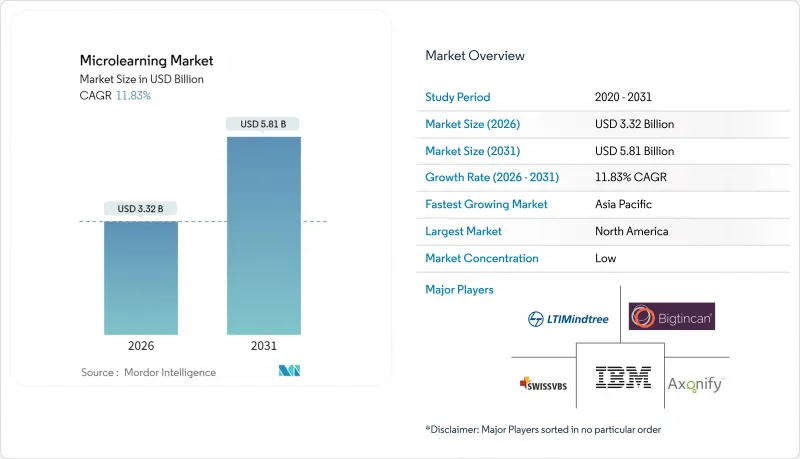
This report is Segmented by Component (Solution, and Services), Organization Size (Large Enterprises, and Small and Medium-Sized Enterprises), Deployment Mode (On-Premise, and Cloud), End User (Retail, Manufacturing, Telecom and IT, and More), Delivery Format (Video-Based Learning, Interactive Simulation, Podcast and Audiobook, and More), and Geography. The Market Forecasts are Provided in Terms of Value (USD).
Global Microlearning Market Trends and Insights
Proliferation of Mobile-First Workforce Learning Platforms
Roughly 2.7 billion frontline and deskless employees now rely on smartphones for daily tasks, and adoption of microlearning market solutions that launch natively on iOS and Android removes the desktop bottleneck. Beverage chain Chatime reached 91% learner uptake with sub-5-minute modules accessed during pre-shift briefings, while Pet Supermarket logged 79% completion rates and cut turnover by 15% using similar tactics. AWS projects Asia Pacific will require 5.7 billion digital training interventions by 2025, a scale only feasible with asynchronous mobile delivery. Broader 5G coverage is enabling latency-free video and simulation on phones, making immersive formats viable for field technicians and clinicians.
Growing Need for Skills-Based, Just-In-Time Training
Enterprises moving away from annual course calendars toward role-triggered interventions are fuelling microlearning market demand. Workers asked to master new equipment, regulations, or product features benefit more from a 5-minute refresher than a half-day workshop. Internal mobility and retention gains of up to 3 times have been documented when skills-based pathways replace generic curricula. Tagging every module with competency metadata lets platforms surface content the instant an ERP or CRM system detects a workflow change, shortening time-to-productivity for new hires.
High Cost of Transforming Legacy Content into Micro-Modules
Articulate benchmarking shows converting a single traditional course into micro-units' costs USD 10,000 to USD 50,000 and demands up to 184 development hours per finished hour. Enterprises with 100-course libraries confront multiyear efforts that force them to run legacy and microlearning market platforms in parallel. Scarce subject-matter experts further slow progress, prompting buyers to favour vendors offering content-as-a-service bundles that slash lead times but may lack industry-specific nuance.
Other drivers and restraints analyzed in the detailed report include:
- Gamification Enhancing Learner Engagement and Retention
- AI-Driven Personalization of Micro-Content
- Difficulty in Measuring ROI Versus Traditional L and D Approaches
For complete list of drivers and restraints, kindly check the Table Of Contents.
Segment Analysis
Solution licenses generated 68.19% of 2025 revenue, yet services are projected to outstrip the broader microlearning market at a 13.43% CAGR to 2031. As organizations re-platform, they increasingly outsource content audits, integration, and change management, favouring vendors that bundle advisory with technology. Consulting engagements map competencies, redesign learning pathways, and configure APIs, while support contracts provide ongoing upgrades and helpdesk access that convert into predictable annual recurring revenue.
Many large enterprises maintain catalogues exceeding 100 legacy courses, a workload internal teams cannot re-author quickly. Vendors such as Skillsoft and Cornerstone now position content-as-a-service to shrink deployment from 18 months to 6 months, addressing worries that microlearning sacrifices depth. The result is expanding professional-services pipelines that stabilize cash flows and deepen customer lock-in.
Large enterprises held 54.72% of microlearning market share in 2025, leveraging bigger L&D budgets and IT support. However, SMEs are expected to grow at 14.59% through 2031 as cloud subscriptions remove upfront infrastructure costs. Freemium tiers from EdApp or TalentCards let firms pilot with ten users, while AI authoring converts PDFs and SOPs into mobile-ready modules, eliminating instructional-design bottlenecks.
The OECD found European SMEs allocate just 1.2% of revenue to training, so low-cost, high-impact interventions resonate. Yet subject-matter experts, not learning professionals, create most small-business content, risking pedagogical gaps. Vendors counter with template-driven storyboards and automated assessment generation that align microlearning market experiences with adult-learning principles without inflating budgets.
Complete Report Scope:
- By Component
- Solution
- Services
- Consulting and Implementation
- Support and Maintenance
- By Organization Size
- Large Enterprises
- Small and Medium-Sized Enterprises
- By Deployment Mode
- On-Premise
- Cloud
- By End User
- Retail
- Manufacturing
- Banking, Financial Services and Insurance
- Telecom and IT
- Healthcare and Life Sciences
- Logistics
- Education
- Media and Entertainment
- By Delivery Format
- Video-Based Learning
- Interactive Simulations
- Podcasts and Audiobooks
- Quizzes and Assessments
- Infographics
- Micro-Blogs and Text Nuggets
- By Geography
- North America
- United States
- Canada
- Mexico
- South America
- Brazil
- Argentina
- Rest of South America
- Europe
- Germany
- United Kingdom
- France
- Italy
- Spain
- Russia
- Rest of Europe
- Asia Pacific
- China
- Japan
- India
- South Korea
- Australia and New Zealand
- Southeast Asia
- Rest of Asia Pacific
- Middle East
- GCC
- Turkey
- Israel
- Rest of Middle East
- Africa
- South Africa
- North Africa
- Rest of Africa
- North America
Geography Analysis
North America generated 37.61% of 2025 revenue. High LMS penetration, dense vendor clusters, and stringent banking and healthcare regulations ensure steady recurring spend. The FFIEC's 2024 update to Bank Secrecy Act guidance emphasized adaptive, role-based training, validating microlearning solutions for compliance workflows. Private-equity interest peaked with Cornerstone's USD 5.2 billion take-private, signalling confidence in continued consolidation. Saturation is a looming headwind, so growth now hinges on upselling AI personalization and skills-intelligence modules.
Asia Pacific is forecast to record the fastest 14.81% CAGR as smartphone ubiquity meets government upskilling mandates. Singapore's Digital Enterprise Blueprint targets 95% SME tech adoption by 2025, funding AI courses that already trained 2,000 workers. Indonesia's Kartu Prakerja enrolled 14.3 million citizens, supplying IDR 32 trillion (USD 2.1 billion) in grants for bite-sized digital skills courses. AWS estimates 819 million regional workers need new digital abilities by 2025, heralding massive microlearning market potential. Regional data-residency rules raise infrastructure costs, but vendors with in-country data centers gain first-mover advantage.
Europe's trajectory is shaped by GDPR, which classifies learning records as personal data, compelling vendors to keep servers inside the European Economic Area. Homegrown providers such as Valamis leverage regional hosting to win public-sector accounts, while global players invest in Frankfurt and Dublin regions to comply. Germany's dual-training model encourages apprentices to use microlearning for theory between shop-floor rotations, and France's medical-education requirements are boosting demand in healthcare. Latin America, the Middle East, and Africa remain early-stage but show promise as multinationals deploy standardized programs across subsidiaries, using the microlearning market to avoid travel costs and classroom downtime.
- Axonify Inc.
- Cornerstone OnDemand Inc.
- IBM Corporation
- Bigtincan Holdings Ltd.
- Saba Software Inc.
- iSpring Solutions Inc.
- Epignosis LLC
- Qstream Inc.
- Mindtree Ltd.
- SwissVBS
- Skillsoft Corp.
- Docebo Inc.
- Articulate Global LLC
- EdApp (SafetyCulture)
- Gnowbe Pte. Ltd.
- TalentCards (Epignosis)
- Udemy Business
- Pluralsight LLC
- Valamis Group Oy
- Absorb LMS Software Inc.
- LearnUpon Ltd.
Additional Benefits:
- The market estimate (ME) sheet in Excel format
- 3 months of analyst support
TABLE OF CONTENTS
1 INTRODUCTION
- 1.1 Study Assumptions and Market Definition
- 1.2 Scope of the Study
2 RESEARCH METHODOLOGY
3 EXECUTIVE SUMMARY
4 MARKET LANDSCAPE
- 4.1 Market Overview
- 4.2 Market Drivers
- 4.2.1 Proliferation of Mobile-First Workforce Learning Platforms
- 4.2.2 Growing Need for Skills-Based, Just-in-Time Training
- 4.2.3 Gamification Enhancing Learner Engagement and Retention
- 4.2.4 AI-Driven Personalization of Micro-Content
- 4.2.5 Integration of Microlearning into Flow-of-Work Productivity Tools
- 4.2.6 Regulatory Push for Continuous Compliance Training in Highly Regulated Industries
- 4.3 Market Restraints
- 4.3.1 High Cost of Transforming Legacy Content into Micro-Modules
- 4.3.2 Difficulty in Measuring ROI Versus Traditional L&D Approaches
- 4.3.3 Data-Privacy and Security Concerns in Cloud-Based Learning Platforms
- 4.3.4 Content Fatigue from Over-Fragmentation of Learning Assets
- 4.4 Industry Value-Chain Analysis
- 4.5 Regulatory Landscape
- 4.6 Technological Outlook
- 4.7 Impact of Macroeconomic Factors on the Market
- 4.8 Porter's Five Forces Analysis
- 4.8.1 Bargaining Power of Suppliers
- 4.8.2 Bargaining Power of Consumers
- 4.8.3 Threat of New Entrants
- 4.8.4 Threat of Substitutes
- 4.8.5 Intensity of Competitive Rivalry
5 MARKET SIZE AND GROWTH FORECASTS (VALUE)
- 5.1 By Component
- 5.1.1 Solution
- 5.1.2 Services
- 5.1.2.1 Consulting and Implementation
- 5.1.2.2 Support and Maintenance
- 5.2 By Organization Size
- 5.2.1 Large Enterprises
- 5.2.2 Small and Medium-Sized Enterprises
- 5.3 By Deployment Mode
- 5.3.1 On-Premise
- 5.3.2 Cloud
- 5.4 By End User
- 5.4.1 Retail
- 5.4.2 Manufacturing
- 5.4.3 Banking, Financial Services and Insurance
- 5.4.4 Telecom and IT
- 5.4.5 Healthcare and Life Sciences
- 5.4.6 Logistics
- 5.4.7 Education
- 5.4.8 Media and Entertainment
- 5.5 By Delivery Format
- 5.5.1 Video-Based Learning
- 5.5.2 Interactive Simulations
- 5.5.3 Podcasts and Audiobooks
- 5.5.4 Quizzes and Assessments
- 5.5.5 Infographics
- 5.5.6 Micro-Blogs and Text Nuggets
- 5.6 By Geography
- 5.6.1 North America
- 5.6.1.1 United States
- 5.6.1.2 Canada
- 5.6.1.3 Mexico
- 5.6.2 South America
- 5.6.2.1 Brazil
- 5.6.2.2 Argentina
- 5.6.2.3 Rest of South America
- 5.6.3 Europe
- 5.6.3.1 Germany
- 5.6.3.2 United Kingdom
- 5.6.3.3 France
- 5.6.3.4 Italy
- 5.6.3.5 Spain
- 5.6.3.6 Russia
- 5.6.3.7 Rest of Europe
- 5.6.4 Asia Pacific
- 5.6.4.1 China
- 5.6.4.2 Japan
- 5.6.4.3 India
- 5.6.4.4 South Korea
- 5.6.4.5 Australia and New Zealand
- 5.6.4.6 Southeast Asia
- 5.6.4.7 Rest of Asia Pacific
- 5.6.5 Middle East
- 5.6.5.1 GCC
- 5.6.5.2 Turkey
- 5.6.5.3 Israel
- 5.6.5.4 Rest of Middle East
- 5.6.6 Africa
- 5.6.6.1 South Africa
- 5.6.6.2 North Africa
- 5.6.6.3 Rest of Africa
- 5.6.1 North America
6 COMPETITIVE LANDSCAPE
- 6.1 Market Concentration
- 6.2 Strategic Moves
- 6.3 Market Share Analysis
- 6.4 Company Profiles (includes Global Level Overview, Market Level Overview, Core Segments, Financials as available, Strategic Information, Market Rank/Share for key companies, Products and Services, and Recent Developments)
- 6.4.1 Axonify Inc.
- 6.4.2 Cornerstone OnDemand Inc.
- 6.4.3 IBM Corporation
- 6.4.4 Bigtincan Holdings Ltd.
- 6.4.5 Saba Software Inc.
- 6.4.6 iSpring Solutions Inc.
- 6.4.7 Epignosis LLC
- 6.4.8 Qstream Inc.
- 6.4.9 Mindtree Ltd.
- 6.4.10 SwissVBS
- 6.4.11 Skillsoft Corp.
- 6.4.12 Docebo Inc.
- 6.4.13 Articulate Global LLC
- 6.4.14 EdApp (SafetyCulture)
- 6.4.15 Gnowbe Pte. Ltd.
- 6.4.16 TalentCards (Epignosis)
- 6.4.17 Udemy Business
- 6.4.18 Pluralsight LLC
- 6.4.19 Valamis Group Oy
- 6.4.20 Absorb LMS Software Inc.
- 6.4.21 LearnUpon Ltd.
7 MARKET OPPORTUNITIES AND FUTURE OUTLOOK
- 7.1 White-Space and Unmet-Need Assessment

