PUBLISHER: Mordor Intelligence | PRODUCT CODE: 2124330

PUBLISHER: Mordor Intelligence | PRODUCT CODE: 2124330
Ultra-high Molecular Weight Polyethylene - Market Share Analysis, Industry Trends & Statistics, Growth Forecasts (2026 - 2031)
According to Mordor Intelligence, the ultra-high molecular weight polyethylene market size is projected to be 0.53 million tons in 2025, 0.59 million tons in 2026, and reach 1.06 million tons by 2031, growing at a CAGR of 12.36% from 2026 to 2031.
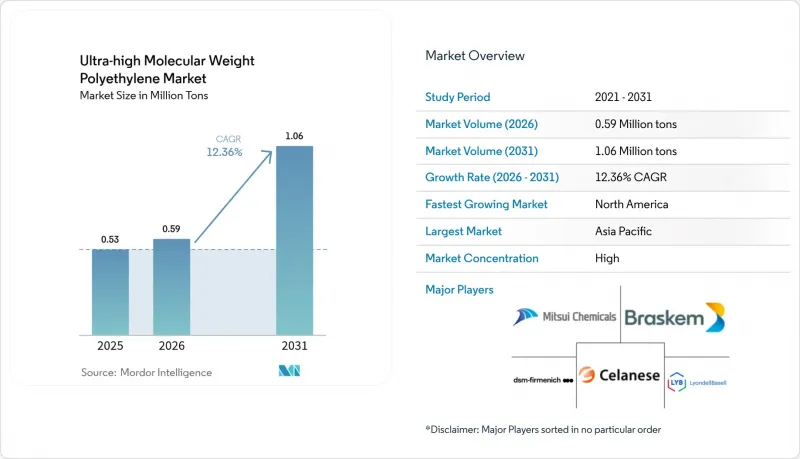
This report is Segmented by Form (Powder, Fibers, Sheets and Films, Rods and Tubes, and Other Forms), End-Use Industry (Automotive, Aerospace and Defense, Medical, Electronics, Chemical, and Other End-User Industries), and Geography (Asia-Pacific, North America, Europe, South America, and Middle-East and Africa). Market Forecasts are Provided in Terms of Volume (Tons).
Global Ultra-high Molecular Weight Polyethylene Market Trends and Insights
High-Performance Polymer Substitution in EV Battery Separators
Cell makers in the lithium-ion sector are increasingly opting for UHMWPE membranes, produced via thermally induced phase separation. This preference stems from the resin's high molecular weight, which ensures robust mechanical performance even at sub-20 µm thickness. In a significant move, Braskem secured an award from the Department of Energy in October 2024. This funding aims to boost separator powder capacity in Texas, fortifying domestic supply chains and creating skilled jobs. Additionally, nanoparticle-modified UHMWPE is enhancing electrolyte wettability, reducing cell impedance, and accommodating the fast-charging profiles sought by vehicle OEMs. As demand for separators surges, there's a noticeable shift of powder away from commodity sheet markets, benefiting producers who are channeling investments into clean-room extrusion and automotive quality systems.
Surge in APAC Shipbuilding and Offshore Rope Demand
In 2023, China added offshore wind capacity. Each gigawatt installation consumed UHMWPE rope, totaling fiber for the year. UHMWPE rope, derived from the polymer, boasts a weight that's significantly lighter than steel wire, yet it offers a tensile strength that's superior, making it ideal for deeper-water turbines. The substitution rate of UHMWPE has risen over the years, with projections suggesting it will continue to grow by 2030. China's new GB/T 21328-2024 standard, set to take effect in October 2024, establishes criteria for breaking-load and abrasion, further hastening regional adoption. Additionally, there's a growing demand for Korean and Japanese LNG carriers, which are now incorporating UHMWPE composite mooring lines.
High Processing-Energy Intensity vs. Bio-Based Alternatives
Producing gel-spun materials requires significantly more energy per tonne compared to traditional polyethylene film extrusion. This heightened energy demand arises from the necessity of dissolving the polymer in hot decalin or paraffin prior to undergoing multi-stage drawing. In 2024, Europe's carbon pricing increased the production costs of UHMWPE. While bio-based polyethylene boasts a lighter carbon footprint, this advantage exerts downward pressure on the prices of commodity sheets and films. Despite the promise of super-critical CO2 solvent trials and waste-heat recovery projects, their capital-intensive nature curtails any immediate financial relief.
Other drivers and restraints analyzed in the detailed report include:
- Growing Use in Medical Wearables and Smart Textiles
- Growing Demand for 3D-Printed UHMWPE Orthopedic Implants
- Low Melting Point Limits High-Load Composite Designs
For complete list of drivers and restraints, kindly check the Table Of Contents.
Segment Analysis
Powder captured 44.65% volume in 2025 and grows at a 12.64% CAGR through 2031. This growth is bolstered by the launch of large-scale gel-spinning lines, notably Jiuzhou Xingji's facility, which came online in 2024. The market size for ultra-high molecular weight polyethylene powder is set to increase during the forecast period. Demand for fiber grades, driven by applications in ballistic armor, offshore ropes, and specialty films, is steering capital investments. Meanwhile, compression-molded sheets and ram-extruded rods are being utilized as wear-resistant liners. In a strategic move, Mitsui Chemicals boosted its HI-ZEX capacity in 2024, ensuring a robust supply of powder for battery separators.
Fibers, holding the second position in the market, are reaping benefits from defense budgets. These budgets prioritize UHMWPE laminates, which can halt rifle rounds at a weight significantly lighter than traditional aramid armor. Sheets and films find their applications in semiconductor wafer carriers, food-handling equipment, and chute liners, where attributes like low friction and chemical inertness are paramount. While rods and tubes have carved out a niche in mechanical components, experimental 3D-printing filaments are grappling with viscosity challenges, despite promising lab demonstrations for medical prototypes.
Complete Report Scope:
- By Form
- Powder
- Fibers
- Sheets and Films
- Rods and Tubes
- Other Forms (3-D Printing Filament, etc.)
- By End-use Industry
- Automotive
- Aerospace and Defense
- Medical
- Electronics
- Chemical
- Other End-user Industries (Oil and Gas, Sports, etc.)
- By Geography
- Asia-Pacific
- China
- Japan
- India
- South Korea
- ASEAN Countries
- Rest of Asia-Pacific
- North America
- United States
- Canada
- Mexico
- Europe
- Germany
- United Kingdom
- France
- Italy
- Russia
- Rest of Europe
- South America
- Brazil
- Argentina
- Rest of South America
- Middle-East and Africa
- Saudi Arabia
- South Africa
- Rest of Middle-East and Africa
- Asia-Pacific
Geography Analysis
Asia-Pacific accounted for 44.57% volume in 2025 and remains the epicenter of the ultra-high molecular weight polyethylene market. China's integrated chain stretches from monomer to finished rope, and its national GB/T 21328-2024 standard streamlines quality assurance for offshore wind contractors. Japan sources powder for surgical sutures and Teijin's medical devices, while South Korea's shipbuilders embed UHMWPE mooring lines in LNG carriers. India and ASEAN grow from a small base as local EV and food-processing sectors scale.
North America posts the fastest regional growth at a 12.99% CAGR through 2031, lifted by the Department of Energy's funding for Braskem's Texas separator plant and by defense spending that prioritizes domestic Spectra fiber supply. FDA regulations maintain high entry barriers, securing powder of consistent molecular weight distribution. Canada uses UHMWPE slurry liners in oil sands, and Mexican auto plants move toward in-house separator lamination. Honeywell's plan to spin off Advanced Materials by early 2026 may unlock new capital sources for regional expansions.
Europe trails by volume yet benefits from the strict Medical Device Regulation that favors UHMWPE's biocompatibility. German premium EV makers pilot separators, and the United Kingdom equips security forces with UHMWPE body armor. DSM and SABIC's recycled Dyneema trial aligns with EU circular-economy incentives. South America and Middle-East and Africa remain small importers; Brazil's mining sector uses sheets, and Saudi Arabia tests UHMWPE pipeline liners for corrosive brine.
- Asahi Kasei Corporation
- Avient Corporation
- Braskem
- Celanese Corporation
- dsm-firmenich
- DuPont
- Honeywell International Inc.
- Korea Petrochemical Ind. Co., LTD.
- LyondellBasell Industries Holdings B.V.
- Mitsui Chemicals Inc.
- Rochling SE & Co. KG
- Shandong Longforce Engineering Material Co., Ltd
- TEIJIN LIMITED
Additional Benefits:
- The market estimate (ME) sheet in Excel format
- 3 months of analyst support
TABLE OF CONTENTS
1 Introduction
- 1.1 Study Assumptions and Market Definition
- 1.2 Scope of the Study
2 Research Methodology
3 Executive Summary
4 Market Landscape
- 4.1 Market Overview
- 4.2 Market Drivers
- 4.2.1 High-performance-polymer substitution in EV battery separators
- 4.2.2 Surge in APAC ship-building and offshore rope demand
- 4.2.3 Growing use in medical wearables and smart textiles
- 4.2.4 Growing demand for 3-D-printed UHMWPE orthopedic implants
- 4.2.5 Closed-loop, medical-grade UHMWPE recycling routes
- 4.3 Market Restraints
- 4.3.1 High processing-energy intensity vs. bio-based alternatives
- 4.3.2 Low melting point limits high-load composite designs
- 4.3.3 Trade-remedy duties on Asian UHMWPE powder exports
- 4.4 Value Chain Analysis
- 4.5 Porter's Five Forces
- 4.5.1 Threat of New Entrants
- 4.5.2 Bargaining Power of Buyers
- 4.5.3 Bargaining Power of Suppliers
- 4.5.4 Threat of Substitutes
- 4.5.5 Degree of Competition
5 Market Size and Growth Forecasts (Volume)
- 5.1 By Form
- 5.1.1 Powder
- 5.1.2 Fibers
- 5.1.3 Sheets and Films
- 5.1.4 Rods and Tubes
- 5.1.5 Other Forms (3-D Printing Filament, etc.)
- 5.2 By End-use Industry
- 5.2.1 Automotive
- 5.2.2 Aerospace and Defense
- 5.2.3 Medical
- 5.2.4 Electronics
- 5.2.5 Chemical
- 5.2.6 Other End-user Industries (Oil and Gas, Sports, etc.)
- 5.3 By Geography
- 5.3.1 Asia-Pacific
- 5.3.1.1 China
- 5.3.1.2 Japan
- 5.3.1.3 India
- 5.3.1.4 South Korea
- 5.3.1.5 ASEAN Countries
- 5.3.1.6 Rest of Asia-Pacific
- 5.3.2 North America
- 5.3.2.1 United States
- 5.3.2.2 Canada
- 5.3.2.3 Mexico
- 5.3.3 Europe
- 5.3.3.1 Germany
- 5.3.3.2 United Kingdom
- 5.3.3.3 France
- 5.3.3.4 Italy
- 5.3.3.5 Russia
- 5.3.3.6 Rest of Europe
- 5.3.4 South America
- 5.3.4.1 Brazil
- 5.3.4.2 Argentina
- 5.3.4.3 Rest of South America
- 5.3.5 Middle-East and Africa
- 5.3.5.1 Saudi Arabia
- 5.3.5.2 South Africa
- 5.3.5.3 Rest of Middle-East and Africa
- 5.3.1 Asia-Pacific
6 Competitive Landscape
- 6.1 Market Concentration
- 6.2 Strategic Moves
- 6.3 Market Share(%)/Ranking Analysis
- 6.4 Company Profiles (includes Global level Overview, Market level overview, Core Segments, Financials as available, Strategic Information, Products and Services, and Recent Developments)
- 6.4.1 Asahi Kasei Corporation
- 6.4.2 Avient Corporation
- 6.4.3 Braskem
- 6.4.4 Celanese Corporation
- 6.4.5 dsm-firmenich
- 6.4.6 DuPont
- 6.4.7 Honeywell International Inc.
- 6.4.8 Korea Petrochemical Ind. Co., LTD.
- 6.4.9 LyondellBasell Industries Holdings B.V.
- 6.4.10 Mitsui Chemicals Inc.
- 6.4.11 Rochling SE & Co. KG
- 6.4.12 Shandong Longforce Engineering Material Co., Ltd
- 6.4.13 TEIJIN LIMITED
7 Market Opportunities and Future Outlook
- 7.1 White-space and Unmet-Need Assessment

