PUBLISHER: Mordor Intelligence | PRODUCT CODE: 2124333

PUBLISHER: Mordor Intelligence | PRODUCT CODE: 2124333
Route Optimization Software - Market Share Analysis, Industry Trends & Statistics, Growth Forecasts (2026 - 2031)
According to Mordor Intelligence, the route optimization software market size was valued at USD 7.92 billion in 2025 and estimated to grow from USD 8.98 billion in 2026 to reach USD 16.78 billion by 2031, at a CAGR of 13.32% during the forecast period (2026-2031).
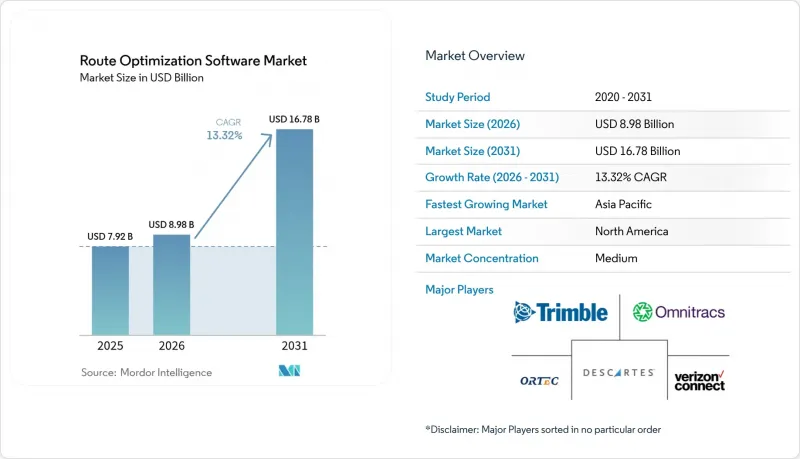
This report is Segmented by Solution Component (Software Platforms and Services), End-User Vertical (On-Demand Food Delivery, Retail and FMCG, and More), Size of Organization (Small and Medium Enterprises and Large Enterprises), Deployment Mode (Cloud and On-Premise), and Geography. The Market Forecasts are Provided in Terms of Value (USD).
Global Route Optimization Software Market Trends and Insights
Explosive Growth in E-commerce Parcel Volume
E-commerce parcels soared to multibillion annual counts, collapsing legacy hub-and-spoke models and forcing software providers to handle millions of dynamic delivery points within tight windows. Amazon alone processed over five billion packages in 2024, underscoring the need for algorithms that juggle inventory proximity, micro-fulfillment center locations, and real-time traffic predictions. High-density urban drops now require machine-learning engines able to pre-optimize routes from historical demand, weather, and driver behavior data. Platforms unable to deliver millisecond-level recalculations lose relevance as retailers scale omnichannel services and same-day promises.
5G-enabled Real-time Optimization for Gig-Economy Fleets
Millisecond latency from 5G and Multi-Access Edge Computing turns batch scheduling into continuous optimization. Food-delivery platforms leverage local network edges to recompute routes instantly when orders surge or traffic bottlenecks emerge. Edge nodes cut round-trip computation times to 1-10 milliseconds, meaning a driver can receive an updated drop sequence before the next traffic light. Coverage is still city-centric, so rural fleets experience fewer gains until national roll-outs mature.
Complex Data Rights in Crowdsourced Driving Datasets
GDPR and similar statutes curtail the volume and granularity of behavioral data available for machine-learning pipelines. Software vendors must embed consent management, data lineage tracking, and selective deletion workflows that inflate compliance overhead. Smaller vendors lacking dedicated legal teams face barriers to cross-border expansion, nudging market concentration upward as well-capitalized players absorb compliance costs.
Other drivers and restraints analyzed in the detailed report include:
- Convergence of Telematics and AI-powered Route Engines
- Dynamic Pricing Models Lowering TCO for SMB Adopters
- Driver Push-back Against Hyper-dense Delivery Schedules
For complete list of drivers and restraints, kindly check the Table Of Contents.
Segment Analysis
Software platforms retained a 62.15% stake in the Route Optimization Software market share during 2025, reflecting their role as the backbone of automated dispatch systems. Consulting and integration services, though smaller in absolute value, are growing at 14.08% CAGR as enterprises grapple with multi-vendor IT landscapes and change-management hurdles. Implementers re-engineer warehouse workflows, transportation management system interfaces, and CRM notifications to unlock software-promised savings. Vendors increasingly bundle advisory engagements, recognizing that platform deployments without process redesign rarely achieve double-digit delivery-cost reductions.
Enterprises also lean on services teams for ongoing model-tuning, benchmarking, and edge-case exception handling, which are critical once fleets scale beyond pilot districts. As a result, recurring optimization-as-a-service contracts are cannibalizing perpetual licenses, smoothing revenue streams for providers. The Route Optimization Software market size allocated to professional services is expected to cross USD 4.72 billion by 2031, signaling a shift toward outcome-based collaboration models.
Retail and FMCG suppliers dominated revenue, yet on-demand food delivery is accelerating with a 15.03% CAGR as 30-minute promise windows become a competitive baseline. The Route Optimization Software market size tied to meal-delivery fleets will exceed USD 2.32 billion by 2031, fueled by dynamic rider pools and perishable payloads that demand real-time recalculations. Algorithms must re-optimize routes every few minutes, balancing heat-loss constraints and kitchen throughput.
Field services, healthcare, and ride-hailing each require tailored constraint libraries, temperature monitoring for pharmaceuticals, technician skill matching, or driver re-positioning models. Such verticalization spurs vendors to release plug-ins rather than one-size-fits-all engines, fragmenting the platform landscape but lifting total addressable value across specialized niches.
Complete Report Scope:
- By Solution Component
- Software Platforms
- Services
- By End-user Vertical
- On-Demand Food Delivery
- Retail and FMCG
- Field Services
- Ride Hailing and Taxi Services
- Healthcare and Pharmaceuticals
- Other End-user Verticals
- By Size of the Organization
- Small and Medium Enterprises
- Large Enterprises
- By Deployment Mode
- Cloud
- On-Premise
- By Geography
- North America
- United States
- Canada
- Mexico
- South America
- Brazil
- Argentina
- Rest of South America
- Europe
- Germany
- United Kingdom
- France
- Italy
- Spain
- Rest of Europe
- Asia-Pacific
- China
- Japan
- South Korea
- India
- Singapore
- Australia
- Rest of Asia-Pacific
- Middle East and Africa
- Middle East
- Saudi Arabia
- United Arab Emirates
- Turkey
- Rest of Middle East
- Africa
- South Africa
- Nigeria
- Egypt
- Rest of Africa
- Middle East
- North America
Geography Analysis
North America commanded 38.05% of 2025 revenue, buoyed by e-commerce maturity and acute driver shortages that make algorithmic mileage savings mission-critical. Amazon's proprietary systems set benchmarks that ripple through competitors, while Canada leverages cross-border modules to synchronize NAFTA corridors. Mexico's manufacturing upswing drives inbound-outbound balancing algorithms that minimize empty miles across industrial clusters. Regional regulatory stances toward data sharing remain comparatively lenient, enabling rapid roll-out of driver-behavior training and fuel-savings dashboards.
Asia-Pacific is the fastest-expanding theatre, clocking a 14.82% CAGR on the back of megacity congestion and state-sponsored digital logistics schemes. India's ULIP ushers standardized data pipes among 500-plus carriers, allowing small fleets to tap shared optimization engines without bespoke integrations. China's 5G-blanketed metros support sub-second recalculations for grocery and parcel delivery swarms, while Japan's "2024 Problem" overtime cap mandates productivity jumps to keep freight flowing despite constrained driver hours. Southeast Asian growth rides on smartphone-first commerce, cloud penetration, and rising export-oriented manufacturing zones requiring synchronized port logistics.
Europe exhibits steady uptake driven by environmental regulation. Low-emission zones across more than 250 cities impose time-window and payload constraints that only AI-enhanced routing can satisfy economically. The EU's Digital Transport and Logistics Forum releases harmonized APIs that trim compliance costs for cross-border consignments. Yet GDPR's stringent consent rules restrain crowdsourced telemetry usage, nudging vendors to pioneer privacy-preserving learning techniques such as federated optimization and differential masking.
- Trimble Inc.
- Verizon Connect Solutions Inc.
- The Descartes Systems Group Inc.
- Omnitracs LLC
- ORTEC B.V.
- ESRI Global Inc.
- Caliper Corporation
- PTV Planung Transport Verkehr GmbH
- Paragon Software Systems PLC
- Microlise Group PLC
- Route4Me LLC
- Routific Solutions Inc.
- InsightGeeks Solutions Pvt. Ltd (TrackoBit)
- WorkWave LLC
- Wise Systems Inc.
- Bringg Delivery Technologies Ltd.
- FarEye Technologies Pvt. Ltd.
- Locus.sh (Marble Automation Pvt. Ltd.)
- OptimoRoute Inc.
- Mapbox Inc.
Additional Benefits:
- The market estimate (ME) sheet in Excel format
- 3 months of analyst support
TABLE OF CONTENTS
1 INTRODUCTION
- 1.1 Study Assumptions and Market Definition
- 1.2 Scope of the Study
2 RESEARCH METHODOLOGY
3 EXECUTIVE SUMMARY
4 MARKET LANDSCAPE
- 4.1 Market Overview
- 4.2 Market Drivers
- 4.2.1 Explosive growth in e-commerce parcel volume
- 4.2.2 Driver-assistance mandates from urban low-emission zones
- 4.2.3 5G-enabled real-time optimization for gig economy fleets
- 4.2.4 Convergence of telematics and AI-powered route engines
- 4.2.5 Dynamic pricing models lowering TCO for SMB adopters
- 4.2.6 National smart-logistics programs (e.g., EU DTLF, India ULIP)
- 4.3 Market Restraints
- 4.3.1 Complex data rights in crowdsourced driving datasets
- 4.3.2 Driver push-back against hyper-dense delivery schedules
- 4.3.3 Limited map accuracy in emerging markets rural networks
- 4.3.4 Fragmented last-mile regulations raising compliance cost
- 4.4 Industry Value Chain Analysis
- 4.5 Impact of Macroeconomic Factors
- 4.6 Regulatory Landscape
- 4.7 Technological Outlook
- 4.8 Porter's Five Forces Analysis
- 4.8.1 Bargaining Power of Suppliers
- 4.8.2 Bargaining Power of Buyers
- 4.8.3 Threat of New Entrants
- 4.8.4 Threat of Substitutes
- 4.8.5 Degree of Competition
5 MARKET SIZE AND GROWTH FORECASTS (VALUES)
- 5.1 By Solution Component
- 5.1.1 Software Platforms
- 5.1.2 Services
- 5.2 By End-user Vertical
- 5.2.1 On-Demand Food Delivery
- 5.2.2 Retail and FMCG
- 5.2.3 Field Services
- 5.2.4 Ride Hailing and Taxi Services
- 5.2.5 Healthcare and Pharmaceuticals
- 5.2.6 Other End-user Verticals
- 5.3 By Size of the Organization
- 5.3.1 Small and Medium Enterprises
- 5.3.2 Large Enterprises
- 5.4 By Deployment Mode
- 5.4.1 Cloud
- 5.4.2 On-Premise
- 5.5 By Geography
- 5.5.1 North America
- 5.5.1.1 United States
- 5.5.1.2 Canada
- 5.5.1.3 Mexico
- 5.5.2 South America
- 5.5.2.1 Brazil
- 5.5.2.2 Argentina
- 5.5.2.3 Rest of South America
- 5.5.3 Europe
- 5.5.3.1 Germany
- 5.5.3.2 United Kingdom
- 5.5.3.3 France
- 5.5.3.4 Italy
- 5.5.3.5 Spain
- 5.5.3.6 Rest of Europe
- 5.5.4 Asia-Pacific
- 5.5.4.1 China
- 5.5.4.2 Japan
- 5.5.4.3 South Korea
- 5.5.4.4 India
- 5.5.4.5 Singapore
- 5.5.4.6 Australia
- 5.5.4.7 Rest of Asia-Pacific
- 5.5.5 Middle East and Africa
- 5.5.5.1 Middle East
- 5.5.5.1.1 Saudi Arabia
- 5.5.5.1.2 United Arab Emirates
- 5.5.5.1.3 Turkey
- 5.5.5.1.4 Rest of Middle East
- 5.5.5.2 Africa
- 5.5.5.2.1 South Africa
- 5.5.5.2.2 Nigeria
- 5.5.5.2.3 Egypt
- 5.5.5.2.4 Rest of Africa
- 5.5.5.1 Middle East
- 5.5.1 North America
6 COMPETITIVE LANDSCAPE
- 6.1 Market Concentration
- 6.2 Strategic Moves
- 6.3 Market Share Analysis
- 6.4 Company Profiles (includes Global level Overview, Market level overview, Core Segments, Financials as available, Strategic Information, Market Rank/Share for key companies, Products and Services, and Recent Developments)
- 6.4.1 Trimble Inc.
- 6.4.2 Verizon Connect Solutions Inc.
- 6.4.3 The Descartes Systems Group Inc.
- 6.4.4 Omnitracs LLC
- 6.4.5 ORTEC B.V.
- 6.4.6 ESRI Global Inc.
- 6.4.7 Caliper Corporation
- 6.4.8 PTV Planung Transport Verkehr GmbH
- 6.4.9 Paragon Software Systems PLC
- 6.4.10 Microlise Group PLC
- 6.4.11 Route4Me LLC
- 6.4.12 Routific Solutions Inc.
- 6.4.13 InsightGeeks Solutions Pvt. Ltd (TrackoBit)
- 6.4.14 WorkWave LLC
- 6.4.15 Wise Systems Inc.
- 6.4.16 Bringg Delivery Technologies Ltd.
- 6.4.17 FarEye Technologies Pvt. Ltd.
- 6.4.18 Locus.sh (Marble Automation Pvt. Ltd.)
- 6.4.19 OptimoRoute Inc.
- 6.4.20 Mapbox Inc.
7 MARKET OPPORTUNITIES AND FUTURE OUTLOOK
- 7.1 White-space and Unmet-need assessment

