PUBLISHER: Mordor Intelligence | PRODUCT CODE: 2124336

PUBLISHER: Mordor Intelligence | PRODUCT CODE: 2124336
Cloud Supply Chain Management - Market Share Analysis, Industry Trends & Statistics, Growth Forecasts (2026 - 2031)
According to Mordor Intelligence, the cloud supply chain management market size is expected to grow from USD 11.95 billion in 2025 to USD 13.98 billion in 2026 and is forecast to reach USD 30.56 billion by 2031 at 16.95% CAGR over 2026-2031.
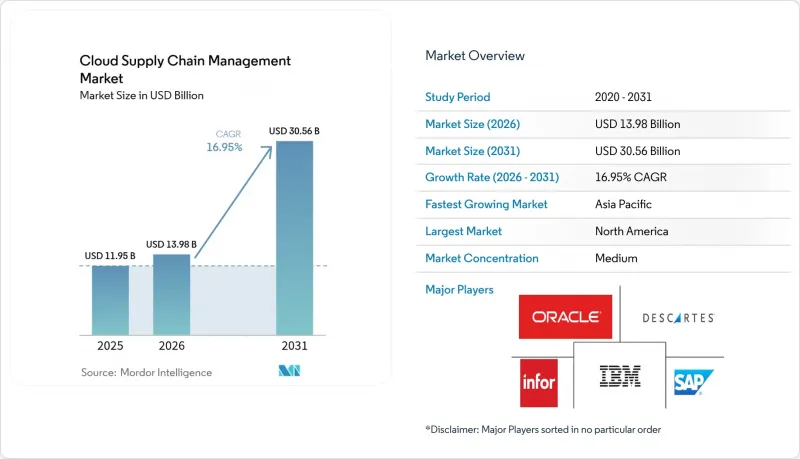
This report is Segmented by Solution (Demand Planning and Forecasting, and More), Deployment Type (Hybrid Cloud, Public Cloud, and Private Cloud), Organization Size (Large Enterprises, and Small and Medium Enterprises), End-User Industry (Retail, Food and Beverage, and More), and Geography (North America, South America, and More). The Market Forecasts are Provided in Terms of Value (USD).
Global Cloud Supply Chain Management Market Trends and Insights
Rapid Adoption of Cloud-Based Solutions for Demand Planning
Organizations replacing spreadsheets with cloud-native forecasting gain hourly demand-signal refreshes, fed by point-of-sale feeds, weather APIs, and social media sentiment. Generative AI now lets planners interrogate forecasts in natural language and simulate promotional lifts. Even minor accuracy gains cut safety stock by double-digit percentages, releasing working capital. Retail and consumer-goods leaders paved the way, but adoption is broadening as cloud data lakes support a secure, tenant-isolated model for machine learning and training.
Expansion of E Commerce Requiring Agile Supply Networks
With e-commerce penetration expected to reach 21% of retail sales by 2024, brands must orchestrate distributed inventory to meet same-day commitments. Cloud supply chain management market platforms route orders to the closest node, minimizing split shipments. Pre-built connectors link fulfillment centers, parcel carriers, and customs brokers, automating landed-cost calculations and returns processing across dozens of jurisdictions. The capability is critical for cross-border sellers managing baskets under USD 50.
Heightened Security and Data Privacy Concerns
Multi-tenant architectures concentrate sensitive pricing, forecast, and shipment data. A 2024 breach at a logistics software provider exposed manifests for 40,000 customers, elevating scrutiny on encryption, access controls, and data-residency compliance. The European Union's GDPR and China's Personal Information Protection Law complicate cross-border transfers, prompting some firms to opt for private regions or customer-managed keys. Added controls increase vendor costs and can slow the deployment of cloud supply chain management.
Other drivers and restraints analyzed in the detailed report include:
- Cost Efficiency and Scalability Driving Migration from On-Premise SCM
- Integration of Digital Twins for Real-Time Supply Chain Simulation
- Complex Legacy Systems Hindering Cloud Migration
For complete list of drivers and restraints, kindly check the Table Of Contents.
Segment Analysis
Transportation and Logistics Management contributed the largest slice of the cloud supply chain management market, holding 27.12% of the revenue in 2025. Shippers rely on real-time estimated arrival times, dynamic route optimization, and carrier performance dashboards to optimize their operations. Electronic logging device mandates in North America and tachograph rules in Europe feed telematics data that elevates predictive ETAs. Digital freight marketplaces interface through open APIs, letting planners benchmark rates across modes without manual tenders. Demand Planning and forecasting are on the rise as retailers integrate external variables, such as weather and social sentiment, to minimize excess stock. Inventory and Warehouse Management now embeds computer vision for cycle counting, reducing labor in high-velocity DCs. Product Lifecycle Management (PLM) modules have expanded into process industries, linking recipe revisions to compliance records. Sales and Operations Planning integrates finance links, allowing volume and revenue forecasts to be reconciled in a single cockpit. Procurement modules inject supplier risk scores that mix financial health, ESG ratings, and geopolitical exposure. Order Management engines orchestrate multichannel fulfillment using fill-rate, margin, and delivery-promise logic. Product Master Data Management increasingly leverages blockchain to build immutable provenance chains.
Digital Twin Enabled Planning, advancing at a 21.25% CAGR, is the fastest-growing solution subsegment. Pharmaceutical, semiconductor, and heavy-industrial firms construct network graphs that simulate disruptions across multi-tier bills of material. Planners can test alternate sourcing or buffer stock moves virtually before committing inventory. Graph databases spotlight single-point-of-failure suppliers, while cloud compute executes thousands of Monte Carlo scenarios hourly. The capability gained prominence after 2024 component shortages halted assembly lines worldwide, prompting firms to adopt scenario-driven operating models.
Public Cloud held 60.58% of the cloud supply chain management market in 2025. Organizations prize the vendor-managed infrastructure and speed of activation, avoiding 6-12 month on-premise projects. Regional data centers spread across more than 30 countries ensure data residency and sub-10 ms latency for operational workflows. Private Cloud persists among defense and energy firms, protecting classified diagrams or seismic data. These environments utilize hypervisor or OpenStack layers to simulate elastic scaling within corporate firewalls.
Hybrid Cloud, projected to grow 19.05% CAGR, balances governance and agility. Pharmaceutical companies store clinical trial protocols and patient data on private nodes validated under Good Clinical Practice, while offloading analytics workloads to public tenants during quarterly S&OP cycles. Offerings such as AWS Outposts and Azure Stack extend managed services on-premise, enabling consistent tooling. The model depends on event-stream integration to synchronize master data without stale reads. Certified controls under ISO 27001 and SOC 2 underpin audit readiness and influence deployment choices.
Complete Report Scope:
- By Solution
- Demand Planning and Forecasting
- Inventory and Warehouse Management
- Product Lifecycle Management
- Transportation and Logistics Management
- Sales and Operations Planning
- Procurement and Sourcing
- Order Management
- Product Master Data Management
- By Deployment Type
- Hybrid Cloud
- Public Cloud
- Private Cloud
- By Organization Size
- Large Enterprises
- Small and Medium Enterprises
- By End-User Industry
- Retail
- Food and Beverage
- Manufacturing
- Automotive
- Oil and Gas
- Healthcare
- Consumer Electronics
- Aerospace and Defense
- Pharmaceuticals
- By Geography
- North America
- United States
- Canada
- Mexico
- South America
- Brazil
- Argentina
- Rest of South America
- Europe
- United Kingdom
- Germany
- France
- Italy
- Spain
- Russia
- Rest of Europe
- Asia Pacific
- China
- Japan
- India
- South Korea
- Australia
- Rest of Asia Pacific
- Middle East
- Saudi Arabia
- United Arab Emirates
- Turkey
- Rest of Middle East
- Africa
- South Africa
- Nigeria
- Egypt
- Rest of Africa
- North America
Geography Analysis
North America delivered 34.41% of 2025 revenue. U.S. Customs and Border Protection's Automated Commercial Environment APIs automate customs entry creation, lowering brokerage costs for importers. Early hyperscaler buildouts ensure low-latency access for time-sensitive control towers and freight visibility dashboards. Canada's Safe Food for Canadians Regulations push agri-food exporters to establish farm-to-fork traceability, spurring cloud investments. Mexico's near-shoring trend has electronics and auto assemblers digitizing supplier collaboration to bypass Pacific shipping risks.
The Asia Pacific is poised for the fastest regional growth, with an 18.05% CAGR. Contract manufacturers in China, India, and Vietnam digitize tier-2 and tier-3 partners to meet just-in-time milestones set by global brands. China's Belt and Road rail corridors heighten the need for multi-modal route optimization. India's fully digital Goods and Services Tax e-invoicing feeds cloud systems that reconcile tax liabilities in real time. Japan's aging driver population fuels the adoption of AI-powered route consolidation, while Australia's commodity exporters automate export documentation to speed vessel bookings.
Europe maintains a significant uptake, owing to the GDPR and the Corporate Sustainability Reporting Directive, which embeds compliance functionality into vendor RFPs. Germany's automotive sector employs constraint-based planning to manage multi-tier capacity. The United Kingdom's post-Brexit rules accelerate the adoption of automated tariff classification. France's luxury segment relies on short seasonal calendars and uses demand sensing to slash markdowns. Russia's data-localization law remains a barrier, steering companies to domestic cloud alternatives that add latency for global partners.
- SAP SE
- Oracle Corporation
- Infor Inc.
- The Descartes Systems Group Inc.
- International Business Machines Corporation
- Blue Yonder Group Inc.
- Manhattan Associates Inc.
- Logility Inc.
- Kinaxis Inc.
- Korber Supply Chain Software GmbH
- CloudLogix Inc.
- Tecsys Inc.
- E2open Parent Holdings Inc.
- One Network Enterprises Inc.
- MercuryGate International Inc.
- Freightos Limited
- Project44 Holdings Inc.
- Llamasoft Inc. (Coupa Software Inc.)
- o9 Solutions Inc.
- Elementum SCM Inc.
- ClearMetal Inc.
- Verusen Inc.
- Cognizant Technology Solutions Corporation
- Amazon Web Services Inc. (AWS Supply Chain)
Additional Benefits:
- The market estimate (ME) sheet in Excel format
- 3 months of analyst support
TABLE OF CONTENTS
1 INTRODUCTION
- 1.1 Study Assumptions and Market Definition
- 1.2 Scope of the Study
2 RESEARCH METHODOLOGY
3 EXECUTIVE SUMMARY
4 MARKET LANDSCAPE
- 4.1 Market Overview
- 4.2 Market Drivers
- 4.2.1 Rapid Adoption of Cloud Based Solutions for Demand Planning
- 4.2.2 Expansion of E Commerce Requiring Agile Supply Networks
- 4.2.3 Cost Efficiency and Scalability Driving Migration from On Premise SCM
- 4.2.4 Integration of Digital Twins for Real Time Supply Chain Simulation
- 4.2.5 Rising Carbon Accounting Mandates Promoting Cloud Visibility Platforms
- 4.2.6 Vendor Transition to Composable Microservices Accelerating Upgrades
- 4.3 Market Restraints
- 4.3.1 Heightened Security and Data Privacy Concerns
- 4.3.2 Complex Legacy Systems Hindering Cloud Migration
- 4.3.3 Shortage of Cloud Native Supply Chain Talent
- 4.3.4 Increasing Sovereign Cloud Requirements Fragmenting Deployments
- 4.4 Impact of Macroeconomic Factors on the Market
- 4.5 Industry Value Chain Analysis
- 4.6 Technological Outlook
- 4.7 Regulatory Landscape
- 4.8 Porter's Five Forces Analysis
- 4.8.1 Bargaining Power of Suppliers
- 4.8.2 Bargaining Power of Consumers
- 4.8.3 Threat of New Entrants
- 4.8.4 Intensity of Competitive Rivalry
- 4.8.5 Threat of Substitutes
- 4.9 Investment Analysis
5 MARKET SIZE AND GROWTH FORECASTS (VALUE)
- 5.1 By Solution
- 5.1.1 Demand Planning and Forecasting
- 5.1.2 Inventory and Warehouse Management
- 5.1.3 Product Lifecycle Management
- 5.1.4 Transportation and Logistics Management
- 5.1.5 Sales and Operations Planning
- 5.1.6 Procurement and Sourcing
- 5.1.7 Order Management
- 5.1.8 Product Master Data Management
- 5.2 By Deployment Type
- 5.2.1 Hybrid Cloud
- 5.2.2 Public Cloud
- 5.2.3 Private Cloud
- 5.3 By Organization Size
- 5.3.1 Large Enterprises
- 5.3.2 Small and Medium Enterprises
- 5.4 By End-User Industry
- 5.4.1 Retail
- 5.4.2 Food and Beverage
- 5.4.3 Manufacturing
- 5.4.4 Automotive
- 5.4.5 Oil and Gas
- 5.4.6 Healthcare
- 5.4.7 Consumer Electronics
- 5.4.8 Aerospace and Defense
- 5.4.9 Pharmaceuticals
- 5.5 By Geography
- 5.5.1 North America
- 5.5.1.1 United States
- 5.5.1.2 Canada
- 5.5.1.3 Mexico
- 5.5.2 South America
- 5.5.2.1 Brazil
- 5.5.2.2 Argentina
- 5.5.2.3 Rest of South America
- 5.5.3 Europe
- 5.5.3.1 United Kingdom
- 5.5.3.2 Germany
- 5.5.3.3 France
- 5.5.3.4 Italy
- 5.5.3.5 Spain
- 5.5.3.6 Russia
- 5.5.3.7 Rest of Europe
- 5.5.4 Asia Pacific
- 5.5.4.1 China
- 5.5.4.2 Japan
- 5.5.4.3 India
- 5.5.4.4 South Korea
- 5.5.4.5 Australia
- 5.5.4.6 Rest of Asia Pacific
- 5.5.5 Middle East
- 5.5.5.1 Saudi Arabia
- 5.5.5.2 United Arab Emirates
- 5.5.5.3 Turkey
- 5.5.5.4 Rest of Middle East
- 5.5.6 Africa
- 5.5.6.1 South Africa
- 5.5.6.2 Nigeria
- 5.5.6.3 Egypt
- 5.5.6.4 Rest of Africa
- 5.5.1 North America
6 COMPETITIVE LANDSCAPE
- 6.1 Market Concentration
- 6.2 Strategic Moves
- 6.3 Market Share Analysis
- 6.4 Company Profiles (includes Global level Overview, Market level overview, Core Segments, Financials as available, Strategic Information, Market Rank/Share for key companies, Products and Services, and Recent Developments)
- 6.4.1 SAP SE
- 6.4.2 Oracle Corporation
- 6.4.3 Infor Inc.
- 6.4.4 The Descartes Systems Group Inc.
- 6.4.5 International Business Machines Corporation
- 6.4.6 Blue Yonder Group Inc.
- 6.4.7 Manhattan Associates Inc.
- 6.4.8 Logility Inc.
- 6.4.9 Kinaxis Inc.
- 6.4.10 Korber Supply Chain Software GmbH
- 6.4.11 CloudLogix Inc.
- 6.4.12 Tecsys Inc.
- 6.4.13 E2open Parent Holdings Inc.
- 6.4.14 One Network Enterprises Inc.
- 6.4.15 MercuryGate International Inc.
- 6.4.16 Freightos Limited
- 6.4.17 Project44 Holdings Inc.
- 6.4.18 Llamasoft Inc. (Coupa Software Inc.)
- 6.4.19 o9 Solutions Inc.
- 6.4.20 Elementum SCM Inc.
- 6.4.21 ClearMetal Inc.
- 6.4.22 Verusen Inc.
- 6.4.23 Cognizant Technology Solutions Corporation
- 6.4.24 Amazon Web Services Inc. (AWS Supply Chain)
7 MARKET OPPORTUNITIES AND FUTURE OUTLOOK
- 7.1 White-space and Unmet-Need Assessment

