PUBLISHER: Mordor Intelligence | PRODUCT CODE: 2124343

PUBLISHER: Mordor Intelligence | PRODUCT CODE: 2124343
India Refrigerator - Market Share Analysis, Industry Trends & Statistics, Growth Forecasts (2026 - 2031)
According to Mordor Intelligence, the India refrigerator market size is expected to grow from USD 5.34 billion in 2025 to USD 5.90 billion in 2026 and is forecast to reach USD 9.26 billion by 2031 at a 9.46% CAGR over 2026-2031.
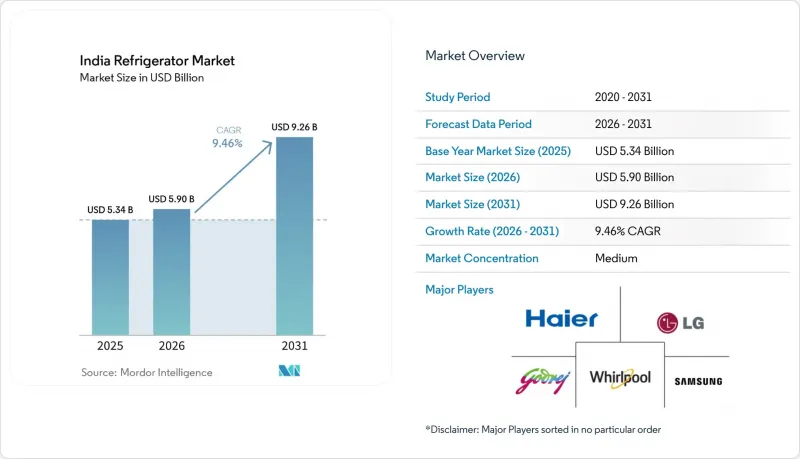
This report is Segmented by Product (Single-Door, Double-Door, and More), Structure (Built-In and Freestanding), Capacity (Less Than 15 Cu. Feet and More Than 15 Cu. Feet), End User (Residential and Commercial), Distribution Channel (B2C/Retail and B2B), and Geography (North India, South India, West India, and East India). The Market Forecasts are Provided in Terms of Value (USD).
India Refrigerator Market Trends and Insights
Rising Disposable Incomes and Enhanced Electrification in Electrification in Tier -⅔ Towns
The India refrigerator market is experiencing strong growth, driven in part by rising disposable incomes and increasing electrification in tier-2 and tier-3 towns. As more households gain access to reliable electricity, demand for modern and energy-efficient refrigerators has expanded beyond traditional urban centers. Consumers in smaller cities are increasingly able to afford mid- to premium-range models, including double-door and multi-door refrigerators. This shift is also fueling the adoption of smart, inverter-based technologies, which offer improved energy efficiency and performance. Retailers and manufacturers are responding by expanding their distribution networks and e-commerce presence in these emerging markets. Overall, tier-2 and tier-3 towns are becoming key growth engines, contributing significantly to the country's overall refrigerator market expansion.
Support From PLI Schemes and 'Make in India' for Compressor Manufacturing
The Indian government's PLI scheme and Make in India initiatives are significantly boosting domestic manufacturing of refrigerator components, particularly compressors. Domestic players increased localization in refrigerators, supported by facility upgrades and new lines, as seen in Haier's Greater Noida expansion and planned capacity investments that deepen component in-sourcing across printed circuit boards and injection molded parts. Similarly, Samsung has announced an investment of around USD 200 million to establish a refrigerator compressor manufacturing plant in Sriperumbudur, Tamil Nadu, and has signed an MoU with the state government to expand the local component ecosystem. The new 22-acre facility will produce compressors for Samsung's India-manufactured refrigerators and for export, strengthening domestic production capacity. These investments not only reduce dependency on imports but also create a robust local component ecosystem, enhancing supply chain resilience and lowering production costs. Smaller manufacturers are also participating, leveraging government incentives to invest in automation, energy-efficient production, and skilled workforce development, which improves quality standards. Collectively, these initiatives are expected to accelerate capacity expansion, promote innovation, and drive competitiveness, supporting the rapid growth of the India refrigerator market across tier-1, tier-2, and tier-3 cities.
Power-Voltage Instability Continues to Affect Semi-Urban Grids
Voltage fluctuations are a persistent challenge in semi-urban and smaller towns across North and East India, especially during peak summer periods. These fluctuations often necessitate the use of stabilizers, which increases the effective purchase cost and limits the availability of stabilizer-free budget models. Load spikes during heat waves can damage compressor components in basic refrigerators, leading to higher warranty claims and affecting brand trust in markets where word-of-mouth strongly influences purchase decisions. While mid-range and premium models increasingly incorporate inverter technology and stabilizer-free operation, these features remain scarce in the affordable segment, slowing adoption among rural and semi-urban households. In addition, sparse after-sales service networks prolong repair times and increase logistical costs, further discouraging consumers in off-grid or underserved regions. Efforts to introduce solar- and battery-compatible refrigerators are underway, but high prices continue to restrict penetration in lower-income segments.
Other drivers and restraints analyzed in the detailed report include:
- Adoption of Inverter Technology and AI-Enabled Compressors
- Increased Demand for Premium Multi-Door and Designer Appliances
- Rural Regions Experience Significant After-Sales Service Deficiencies
For complete list of drivers and restraints, kindly check the Table Of Contents.
Segment Analysis
Double-door refrigerators captured a 39.46% market share in the India refrigerator market in 2025, and side-by-side models are projected to grow the fastest at 11.46% through 2031, as premium adoption accelerates. French-door refrigerators are gaining popularity among families seeking spacious, fresh compartments and convenient lower-positioned freezers. Brands are focusing on features like convertible freezer logic, quick-cool modes, and noise reduction to enhance daily usability and support pre-chill routines for planned grocery purchases. Price tiers in the side-by-side segment allow brands to target both value-conscious buyers and high-end consumers with advanced connectivity and smart display options. Meanwhile, entry-level single-door direct-cool refrigerators remain relevant in smaller towns, although first-time buyers increasingly opt for frost-free double-door units with higher capacities. This shift is further supported by flexible financing options that make larger refrigerators more accessible to emerging urban households.
Refrigerator portfolios in India are being refreshed with emphasis on energy efficiency, smart diagnostics, and faster cooling cycles to meet evolving consumer expectations. French-door designs combine functional capacity with premium aesthetics, offering matte finishes, glass doors, and pantry-style compartments for fresh foods. Side-by-side models continue to appeal to large families and frequent entertainers, particularly in cities with higher disposable incomes and electricity tariffs that favor efficient inverter systems. Designer finishes allow kitchens to be upgraded without structural changes, lowering the barrier for retrofitting high-end models. Premium price bands extend to advanced connected features, while mid-tier refrigerators with inverter compressors remain the most widely adopted. Overall, the market is witnessing a gradual shift from basic entry-level models to feature-rich refrigerators that balance capacity, convenience, and lifestyle preferences.
Freestanding refrigerators held 81.58% of the 2025 market size, while built-in lines are on a 10.84% growth path through 2031, as modular cabinetry spreads beyond large metros within the India refrigerator market. Adoption is strongest among households that prioritize seamless visual continuity and can accommodate installation requirements such as alignment, ventilation, and panel integration. Brands are introducing panel-ready freestanding units that mimic built-in aesthetics, appealing to renters and mobile professionals who cannot modify their kitchen layouts. The growing use of stainless steel, glass, and matte finishes reflects the trend of appliances serving as design elements that complement overall interior schemes. Despite this, higher installation complexity and price premiums limit mass adoption of true built-ins in many smaller cities, keeping freestanding refrigerators in the lead. As modular kitchen concepts spread, consumer interest in built-in-compatible formats is gradually increasing, especially among premium buyers.
Developers, including those offering modular kitchens as standard amenities, are accelerating the purchase cycle for built-in and panel-ready models. Retailers and brand studios now emphasize color panels and design-matched finishes, improving product discovery and reducing consumer uncertainty when planning full kitchen upgrades. Service partners are better equipped for professional installation and precise panel alignment, which minimizes post-installation issues and improves overall satisfaction. Higher localization of components has reduced production costs and strengthened supply stability for premium lines. At the same time, portability, rental patterns, and cost considerations continue to favor freestanding units in most regions. Overall, while built-in refrigerators are gaining a foothold in urban and high-income markets, freestanding formats are expected to remain dominant across India during the forecast period.
Complete Report Scope:
- By Product
- Single-Door Refrigerator
- Double-Door Refrigerator
- Top Freezer
- Bottom Freezer
- Side-By-Side Door Refrigerator
- French-Door Refrigerator
- Other Refrigerators
- By Structure
- Built-In
- Freestanding
- By Capacity
- Less Than 15 cu. Feet
- More Than 15 cu. Feet
- By End user
- Residential
- Commercial
- By Distribution Channel
- B2C/Retail
- Multi-brand Stores
- Exclusive Brand Outlets
- Online
- Other Distribution Channels
- B2B/Directly from the Manufacturers
- B2C/Retail
- By Geography
- North India
- South India
- West India
- East India
List of Companies Covered in this Report:
- Samsung Electronics
- LG Electronics
- Whirlpool Corporation
- Godrej Appliances
- Haier India
- Panasonic Corporation
- Voltas Beko
- Hitachi Global Life Solutions
- Videocon Industries
- BSH Hausgerate GmbH
- Blue Star
- IFB Appliances
- Hisense
- Kelvinator India
- Onida (Mirc Electronics)
- Lloyd (Havells)
- Carrier-Midea
- Croma (Infiniti Retail)
- MarQ (Flipkart Private Label)
- Voltas Beko Home Appliances Pvt. Ltd.
Additional Benefits:
- The market estimate (ME) sheet in Excel format
- 3 months of analyst support
TABLE OF CONTENTS
1 Introduction
- 1.1 Study Assumptions & Market Definition
- 1.2 Scope of the Study
2 Research Methodology
3 Executive Summary
4 Market Landscape
- 4.1 Market Overview
- 4.2 Market Drivers
- 4.2.1 Rising Disposable Incomes and Enhanced Electrification in Electrification in Tier -2/3 Towns
- 4.2.2 Support From PLI Schemes and 'Make in India' for Compressor Manufacturing
- 4.2.3 Adoption of Inverter Technology and AI-Enabled Compressors
- 4.2.4 Increased Demand for Premium Multi-Door and Designer Appliances
- 4.2.5 Focus on Energy-Efficient and BEE-Certified Products
- 4.2.6 Expansion of Organized Retail and E-Commerce Networks
- 4.3 Market Restraints
- 4.3.1 Power-Voltage Instability Continues to Affect Semi-Urban Grids
- 4.3.2 Rural Regions Experience Significant After-Sales Service Deficiencies
- 4.3.3 Smart Metering Infrastructure Adoption Remains Minimal
- 4.3.4 Seasonal Agricultural Loads Drive High Dependency in Certain Areas
- 4.4 Industry Value Chain Analysis
- 4.5 Porter's Five Forces Analysis
- 4.5.1 Threat Of New Entrants
- 4.5.2 Bargaining Power Of Suppliers
- 4.5.3 Bargaining Power Of Buyers
- 4.5.4 Threat Of Substitutes
- 4.5.5 Competitive Rivalry
- 4.6 Insights Into The Latest Trends And Innovations In The Market
- 4.7 Insights On Recent Developments (New Product Launches, Strategic Initiatives, Investments, Partnerships, JVs, Expansion, M&As, Etc.)
5 Market Size & Growth Forecasts (Value)
- 5.1 By Product
- 5.1.1 Single-Door Refrigerator
- 5.1.2 Double-Door Refrigerator
- 5.1.2.1 Top Freezer
- 5.1.2.2 Bottom Freezer
- 5.1.3 Side-By-Side Door Refrigerator
- 5.1.4 French-Door Refrigerator
- 5.1.5 Other Refrigerators
- 5.2 By Structure
- 5.2.1 Built-In
- 5.2.2 Freestanding
- 5.3 By Capacity
- 5.3.1 Less Than 15 cu. Feet
- 5.3.2 More Than 15 cu. Feet
- 5.4 By End user
- 5.4.1 Residential
- 5.4.2 Commercial
- 5.5 By Distribution Channel
- 5.5.1 B2C/Retail
- 5.5.1.1 Multi-brand Stores
- 5.5.1.2 Exclusive Brand Outlets
- 5.5.1.3 Online
- 5.5.1.4 Other Distribution Channels
- 5.5.2 B2B/Directly from the Manufacturers
- 5.5.1 B2C/Retail
- 5.6 By Geography
- 5.6.1 North India
- 5.6.2 South India
- 5.6.3 West India
- 5.6.4 East India
6 Competitive Landscape
- 6.1 Market Concentration
- 6.2 Strategic Moves
- 6.3 Market Share Analysis
- 6.4 Company Profiles (includes Global level Overview, Market level overview, Core Segments, Financials as available, Strategic Information, Market Rank/Share for key companies, Products & Services, and Recent Developments)
- 6.4.1 Samsung Electronics
- 6.4.2 LG Electronics
- 6.4.3 Whirlpool Corporation
- 6.4.4 Godrej Appliances
- 6.4.5 Haier India
- 6.4.6 Panasonic Corporation
- 6.4.7 Voltas Beko
- 6.4.8 Hitachi Global Life Solutions
- 6.4.9 Videocon Industries
- 6.4.10 BSH Hausgerate GmbH
- 6.4.11 Blue Star
- 6.4.12 IFB Appliances
- 6.4.13 Hisense
- 6.4.14 Kelvinator India
- 6.4.15 Onida (Mirc Electronics)
- 6.4.16 Lloyd (Havells)
- 6.4.17 Carrier-Midea
- 6.4.18 Croma (Infiniti Retail)
- 6.4.19 MarQ (Flipkart Private Label)
- 6.4.20 Voltas Beko Home Appliances Pvt. Ltd.
7 Market Opportunities & Future Outlook
- 7.1 Rural Electrification & Affordable Models

