PUBLISHER: Mordor Intelligence | PRODUCT CODE: 2124345

PUBLISHER: Mordor Intelligence | PRODUCT CODE: 2124345
Network Encryption - Market Share Analysis, Industry Trends & Statistics, Growth Forecasts (2026 - 2031)
According to Mordor Intelligence, the network encryption market size is expected to grow from USD 5.24 billion in 2025 to USD 5.67 billion in 2026 and is forecast to reach USD 8.37 billion by 2031 at 8.12% CAGR over 2026-2031.
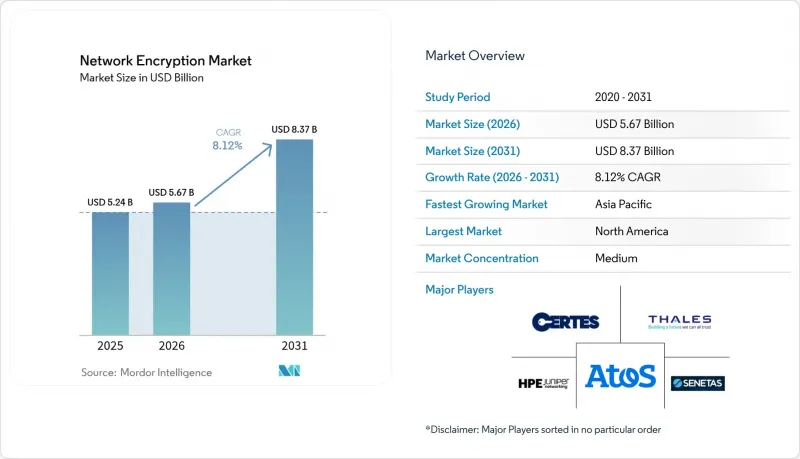
This report is Segmented by Deployment Type (Cloud, On-Premise), Component (Hardware, Solutions and Services), Organization Size (Small and Medium-Sized Enterprises, Large-Sized Enterprises), End-User Industry (Telecom and IT, BFSI, Government, Media and Entertainment, Healthcare, Defence and Aerospace, Other End-User Industries), and Geography. The Market Forecasts are Provided in Terms of Value (USD).
Global Network Encryption Market Trends and Insights
Increasing Number of Network Security Breaches
Ransomware campaigns and state-sponsored intrusions grew in frequency and sophistication during 2024, driving boards to accelerate encryption investments across data-in-motion channels. Breach disclosure laws in the United States, Europe, and several Asia-Pacific jurisdictions impose heavy penalties for unprotected data exposure, prompting enterprises to encrypt internal east-west traffic alongside external communications. Insurance underwriters have tightened policy terms, granting premium discounts only when policyholders can prove ubiquitous encryption coverage. As a result, procurement teams now treat network-level encryption as a baseline control, rather than an optional safeguard, which propels continuous spending even when broader IT budgets are tightened. Vendors able to deliver easy-to-deploy appliances and automated policy engines gain rapid traction.
Accelerating Adoption of Cloud-Based Workloads
Cloud migration places new emphasis on encryption agility, because workloads spin up and down within seconds across multi-cloud footprints. Native cloud networking services now incorporate advanced encryption, enabling security teams to centralize key governance while application owners maintain DevOps velocity. Service mesh frameworks integrate transparent TLS termination, removing the need for developers to code encryption calls. Consumption-based pricing lowers entry barriers for SMEs, enabling them to match the security posture of larger peers without capital purchases. Consequently, cloud-centric encryption platforms experience double-digit growth, driving demand for complementary key management-as-a-service offerings.
High Implementation Cost of Network Encryption Solutions
Comprehensive deployments often require specialized appliances, consulting services, and staff training, driving project outlays from USD 500,000 to well above USD 5 million for mid-sized enterprises. Budget pressure is more acute in emerging economies where local currency fluctuations inflate imported hardware prices. Additionally, legacy switches and routers may lack built-in crypto acceleration, forcing expensive infrastructure refreshes. Managed services do offset capital burdens, but small businesses still struggle with recurring subscription fees. As a result, price-sensitive buyers defer or narrow project scope, limiting near-term penetration in segments outside regulated verticals.
Other drivers and restraints analyzed in the detailed report include:
- Surge in 5G Rollouts Requiring High-Speed Inline Encryption
- Compliance Mandates Such as GDPR and HIPAA
- Performance Overhead and Latency Concerns in High-Speed Networks
For complete list of drivers and restraints, kindly check the Table Of Contents.
Segment Analysis
Cloud implementations are projected to register the fastest 9.87% CAGR through 2031, yet on-premise deployments still represented 56.74% of the network encryption market share in 2025. The large installed base of legacy applications and stringent data sovereignty rules in BFSI and government sectors anchor on-premise demand, while new digital services default to cloud-native encryption offerings. Major providers bundle key lifecycle management and automated certificate rotation, lowering the operational burden for security teams.
Hybrid patterns emerge as organizations retain mission-critical workloads on-site but route development, analytics, and customer-facing services through cloud backbones. This two-speed architecture allows buyers to experiment with consumption-based encryption without abandoning their existing investments. Vendors that supply unified policy engines capable of extending across on-premises gear and virtual appliances in public clouds gain account stickiness. As post-quantum algorithms become mainstream, cloud platforms offer faster upgrade cycles, potentially tilting long-term volume toward hosted encryption models.
Hardware retained 49.01% of the network encryption market share in 2025, as ultrafast links still rely on ASICs and FPGAs to maintain line-rate performance. Yet the solutions and services segment posts a 10.05% CAGR, illustrating the pivot toward flexible, software-controlled security. Enterprises value API-driven orchestration that integrates with infrastructure-as-code workflows, enabling the dynamic creation of tunnels and policy changes within seconds.
Managed security service providers integrate encryption into bundled offerings that combine threat detection, certificate automation, and zero-trust segmentation. Artificial intelligence assists by analyzing key usage patterns and predicting certificate expirations, reducing unplanned outages. Modular licensing also allows customers to scale bandwidth or algorithm suites without forklift upgrades. Over the forecast period, chip-level crypto blocks will become commoditized, while differentiation will shift to software analytics, compliance reporting, and broader integration capabilities.
Complete Report Scope:
- By Deployment Type
- Cloud
- On-premise
- By Component
- Hardware
- Solutions and Services
- By Organization Size
- Small and Medium-Sized Enterprises
- Large-Sized Enterprises
- By End-User Industry
- Telecom and IT
- BFSI
- Government
- Media and Entertainment
- Healthcare
- Defence and Aerospace
- Other End-User Industries
- By Geography
- North America
- United States
- Canada
- Mexico
- Europe
- Germany
- United Kingdom
- France
- Russia
- Rest of Europe
- Asia-Pacific
- China
- Japan
- India
- South Korea
- Australia
- Rest of Asia-Pacific
- Middle East and Africa
- Middle East
- Saudi Arabia
- United Arab Emirates
- Rest of Middle East
- Africa
- South Africa
- Egypt
- Rest of Africa
- Middle East
- South America
- Brazil
- Argentina
- Rest of South America
- North America
Geography Analysis
North America accounted for 33.45% of the revenue in 2025, underpinned by early zero-trust adoption, rich cyber budgets, and proximity to most leading encryption vendors. Federal mandates requiring quantum-resistant migration by 2026 further accelerate domestic upgrades. U.S. carriers likewise bundle inline encryption into nationwide 5G programs, stimulating equipment refresh cycles.
The Asia Pacific is projected to deliver the fastest 8.86% CAGR through 2031, driven by significant cloud investments in China, India, and Southeast Asia. Regional regulators tighten data residency rules, prompting enterprises to deploy locally managed key stores. Governments channel stimulus funds toward quantum research and 5G infrastructure, indirectly subsidizing encryption-capable hardware. Japanese financial institutions are piloting dual-algorithm schemes that combine classical and lattice-based ciphers, signaling an upcoming wave of post-quantum transitions.
Europe remains a pivotal market, as GDPR fines motivate ongoing spending on encryption. The forthcoming Cyber Resilience Act extends mandatory security controls to connected products, indirectly broadening the scope of encrypted channels. Telecom operators in Germany and France are integrating traffic-layer encryption into their Open RAN rollouts, while Scandinavian countries are leading early trials of quantum key distribution backbones. The Middle East and Africa, as well as South America, show rising adoption, although skills shortages and budget constraints push customers toward managed services and cloud deployment models.
- Thales Trusted Cyber Technologies
- Juniper Networks Inc.
- Atos SE
- Certes Networks Inc.
- Senetas Corporation Limited
- Viasat Inc.
- Raytheon Technologies Corporation
- Securosys SA
- PacketLight Networks Ltd.
- Rohde and Schwarz Cybersecurity GmbH
- Colt Technology Services Group Limited
- Ciena Corporation
- Cisco Systems Inc.
- Huawei Technologies Co. Ltd.
- Nokia Corporation
- ADVA Optical Networking SE
- Arista Networks Inc.
- Fortinet Inc.
- Palo Alto Networks Inc.
- Microchip Technology Inc.
Additional Benefits:
- The market estimate (ME) sheet in Excel format
- 3 months of analyst support
TABLE OF CONTENTS
1 INTRODUCTION
- 1.1 Study Assumptions and Market Definition
- 1.2 Scope of the Study
2 RESEARCH METHODOLOGY
3 EXECUTIVE SUMMARY
4 MARKET LANDSCAPE
- 4.1 Market Overview
- 4.2 Impact of Macroeconomic Factors
- 4.3 Market Drivers
- 4.3.1 Increasing Number of Network Security Breaches
- 4.3.2 Accelerating Adoption of Cloud-Based Workloads
- 4.3.3 Surge in 5G Rollouts Requiring High-Speed Inline Encryption
- 4.3.4 Compliance Mandates such as GDPR and HIPAA Driving Encryption Adoption
- 4.3.5 Growing Concern Over Quantum Computing Threats to Classical Cryptography
- 4.3.6 Rising Adoption of Zero Trust Architectures at Data Transport Layer
- 4.4 Market Restraints
- 4.4.1 High Implementation Cost of Network Encryption Solutions
- 4.4.2 Performance Overhead and Latency Concerns in High-Speed Networks
- 4.4.3 Interoperability Issues Across Multi-Vendor Environments
- 4.4.4 Shortage of Skilled Cryptography Professionals
- 4.5 Industry Value Chain Analysis
- 4.6 Regulatory Landscape
- 4.7 Technological Outlook
- 4.8 Porter's Five Forces Analysis
- 4.8.1 Bargaining Power of Suppliers
- 4.8.2 Bargaining Power of Buyers
- 4.8.3 Threat of New Entrants
- 4.8.4 Threat of Substitute Products
- 4.8.5 Intensity of Competitive Rivalry
5 MARKET SIZE AND GROWTH FORECASTS (VALUE)
- 5.1 By Deployment Type
- 5.1.1 Cloud
- 5.1.2 On-premise
- 5.2 By Component
- 5.2.1 Hardware
- 5.2.2 Solutions and Services
- 5.3 By Organization Size
- 5.3.1 Small and Medium-Sized Enterprises
- 5.3.2 Large-Sized Enterprises
- 5.4 By End-User Industry
- 5.4.1 Telecom and IT
- 5.4.2 BFSI
- 5.4.3 Government
- 5.4.4 Media and Entertainment
- 5.4.5 Healthcare
- 5.4.6 Defence and Aerospace
- 5.4.7 Other End-User Industries
- 5.5 By Geography
- 5.5.1 North America
- 5.5.1.1 United States
- 5.5.1.2 Canada
- 5.5.1.3 Mexico
- 5.5.2 Europe
- 5.5.2.1 Germany
- 5.5.2.2 United Kingdom
- 5.5.2.3 France
- 5.5.2.4 Russia
- 5.5.2.5 Rest of Europe
- 5.5.3 Asia-Pacific
- 5.5.3.1 China
- 5.5.3.2 Japan
- 5.5.3.3 India
- 5.5.3.4 South Korea
- 5.5.3.5 Australia
- 5.5.3.6 Rest of Asia-Pacific
- 5.5.4 Middle East and Africa
- 5.5.4.1 Middle East
- 5.5.4.1.1 Saudi Arabia
- 5.5.4.1.2 United Arab Emirates
- 5.5.4.1.3 Rest of Middle East
- 5.5.4.2 Africa
- 5.5.4.2.1 South Africa
- 5.5.4.2.2 Egypt
- 5.5.4.2.3 Rest of Africa
- 5.5.4.1 Middle East
- 5.5.5 South America
- 5.5.5.1 Brazil
- 5.5.5.2 Argentina
- 5.5.5.3 Rest of South America
- 5.5.1 North America
6 COMPETITIVE LANDSCAPE
- 6.1 Market Concentration
- 6.2 Strategic Moves
- 6.3 Market Share Analysis
- 6.4 Company Profiles (includes Global Level Overview, Market Level Overview, Core Segments, Financials as Available, Strategic Information, Market Rank/Share for Key Companies, Products and Services, and Recent Developments)
- 6.4.1 Thales Trusted Cyber Technologies
- 6.4.2 Juniper Networks Inc.
- 6.4.3 Atos SE
- 6.4.4 Certes Networks Inc.
- 6.4.5 Senetas Corporation Limited
- 6.4.6 Viasat Inc.
- 6.4.7 Raytheon Technologies Corporation
- 6.4.8 Securosys SA
- 6.4.9 PacketLight Networks Ltd.
- 6.4.10 Rohde and Schwarz Cybersecurity GmbH
- 6.4.11 Colt Technology Services Group Limited
- 6.4.12 Ciena Corporation
- 6.4.13 Cisco Systems Inc.
- 6.4.14 Huawei Technologies Co. Ltd.
- 6.4.15 Nokia Corporation
- 6.4.16 ADVA Optical Networking SE
- 6.4.17 Arista Networks Inc.
- 6.4.18 Fortinet Inc.
- 6.4.19 Palo Alto Networks Inc.
- 6.4.20 Microchip Technology Inc.
7 MARKET OPPORTUNITIES AND FUTURE OUTLOOK
- 7.1 White-Space and Unmet-Need Assessment
8 INVESTMENT ANALYSIS

