PUBLISHER: Mordor Intelligence | PRODUCT CODE: 2124367

PUBLISHER: Mordor Intelligence | PRODUCT CODE: 2124367
Data Discovery - Market Share Analysis, Industry Trends & Statistics, Growth Forecasts (2026 - 2031)
According to Mordor Intelligence, the data discovery market size is expected to grow from USD 16.1 billion in 2025 to USD 18.82 billion in 2026 and is forecast to reach USD 41.07 billion by 2031 at 16.92% CAGR over 2026-2031.
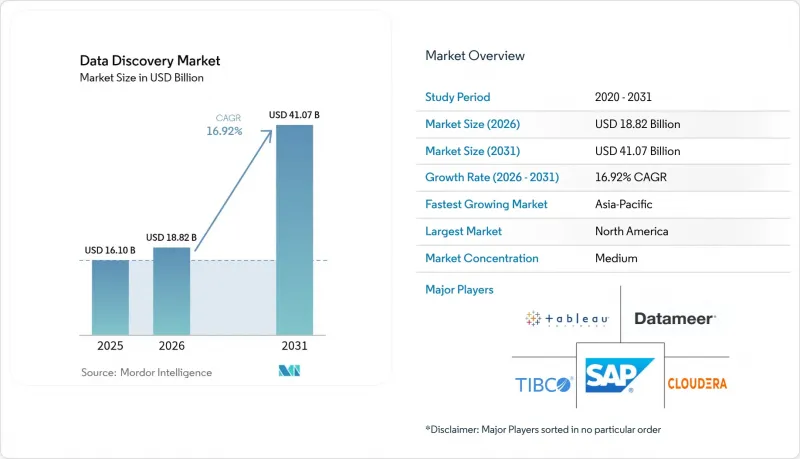
This report Segments the Industry Into by Component (Software, Services), Enterprise Size (Small- and Mid-Sized Enterprises, Large Enterprises), Deployment Mode (On-Premise, Cloud, Hybrid), Application (Risk and Compliance Management, Sales and Marketing Optimization and More), Industry Vertical (Banking, Financial Services, and Insurance (BFSI), Telecommunications and IT and More), and Geography.
Global Data Discovery Market Trends and Insights
Proliferation of Multi-Structured Data Sources
Enterprises now ingest streams from IoT sensors, social feeds, documents, and edge devices, forcing platforms to unify diverse formats without preprocessing. Vendors embed natural-language processing to auto-catalog assets, reducing the time analysts spend curating data. Edge rollouts amplify this need, and shortages in semiconductors have made cloud elasticity more attractive for scaling discovery workloads. Organizations are concluding that legacy warehouses alone cannot accommodate today's data velocity, thereby accelerating migrations to cloud-native discovery solutions.
Enterprise Push for Data-Driven Decision-Making
Executive mandates have reframed discovery platforms as strategic assets. HP's rollout of a conversational BI layer on Databricks enables supply-chain teams to surface anomalies through simple queries instead of heavy engineering efforts. Transparent lineage functions also satisfy auditors, especially in financial services, and successful deployments pair technology rollouts with cultural shifts that place data insights at the heart of day-to-day decisions.
Data Security and Privacy Concerns
Nearly half of global cyberattacks in 2024 involved data or credential theft, with APAC bearing one-third of incidents. Manufacturers are prime ransomware targets, and broader data access raises regulator scrutiny. Privacy-enhancing technologies exist, yet adoption is hampered by performance trade-offs and cost. Enterprises now demand granular access controls and immutable audit logs that lengthen implementation cycles and inflate budgets.
Other drivers and restraints analyzed in the detailed report include:
- Rapid Uptake of Self-Service Analytics Platforms
- Governance and Compliance Mandates
- Shortage of Data-Engineering and Stewardship Talent
For complete list of drivers and restraints, kindly check the Table Of Contents.
Segment Analysis
Software still dominated the data discovery market size with a 64.72% revenue share in 2025. However, services are growing fastest at a 23.12% CAGR as businesses realise successful rollouts require integration, governance, and change-management expertise. Consulting engagements tackle architecture modernisation, while managed services appeal to SMEs lacking internal resources. Over the forecast horizon, services are expected to capture a larger slice of incremental spending as platform complexity rises and talent bottlenecks persist. The shift underscores the transition from tool-centric purchases to outcome-oriented contracts that bundle software with measurable business impact.
Software vendors continue to refine subscription models and embed low-code configuration to curb heavy customisation. Yet enterprise clients frequently augment licences with specialised partners for data onboarding, taxonomy design, and lineage validation. This hybrid buying behaviour aligns with broader market maturation trends in which value is measured by decision-speed improvements rather than feature lists.
On-premise installations retained 54.30% of the data discovery market share in 2025, owing chiefly to banking and public-sector data-localisation mandates. Cloud deployments, however, are projected to climb at a 24.62% CAGR as cost-optimised warehouses and sovereign-cloud frameworks alleviate risk perceptions. Firms now mix local storage for sensitive records with cloud compute for analytical bursts, creating demand for unified control planes that mask underlying complexity.
Fujitsu's sovereign-cloud launch powered by Oracle Alloy typifies regional responses to localisation rules while still delivering elastic cloud scale. As more regulators publish cloud-security benchmarks, cross-industry confidence grows, and enterprises shift capex toward opex-based consumption models that reduce upgrade cycles.
Complete Report Scope:
- By Component
- Software
- Services
- By Deployment Mode
- On-Premise
- Cloud
- Hybrid
- By Enterprise Size
- Small and Mid-Sized Enterprises
- Large Enterprises
- By Industry Vertical
- Banking, Financial Services and Insurance (BFSI)
- Telecommunications and IT
- Retail and E-Commerce
- Manufacturing
- Energy and Utilities
- Healthcare and Life Sciences
- Government and Public Sector
- Other Verticals
- By Application
- Risk and Compliance Management
- Sales and Marketing Optimization
- Customer Experience and Personalization
- Operations and Supply-Chain Analytics
- Asset and Performance Management
- Other Applications
- By Geography
- North America
- United States
- Canada
- Mexico
- South America
- Brazil
- Argentina
- Rest of South America
- Europe
- United Kingdom
- Germany
- France
- Spain
- Italy
- Rest of Europe
- Asia-Pacific
- China
- Japan
- India
- South Korea
- Australia and New Zealand
- Rest of Asia-Pacific
- Middle East
- Israel
- Saudi Arabia
- United Arab Emirates
- Turkey
- Rest of Middle East
- Africa
- South Africa
- Egypt
- Nigeria
- Rest of Africa
- North America
Geography Analysis
North America retained 39.60% of 2025 revenue, supported by mature governance frameworks, deep cloud penetration, and robust partner ecosystems. Financial-services regulations continue to drive discovery platform renewals, and the U.S. intelligence community's 2023-2025 data strategy underlines federal commitment to interoperable architectures. Technology-sector RandD labs further expand platform footprints to power AI product development.
APAC is forecast to be the fastest-growing region with an 18.27% CAGR. National digital-government programs and sovereign-AI roadmaps accelerate demand for localised yet scalable discovery environments. Japan exemplifies this trajectory through public-sector shifts to Oracle Cloud Infrastructure, while rising data-centre capacity investments across Southeast Asia lay physical foundations for broader adoption.
Europe posts steady gains, underpinned by GDPR and the Data Act's stringent data-sharing and lineage obligations. Banks must align with the European Central Bank's risk-data guidance, stimulating fresh platform upgrades. Elsewhere, South America and the Middle East and Africa are moving from pilot phases toward enterprise-wide deployments, though infrastructure gaps and talent shortages temper near-term expansion.
- Microsoft Corp.
- Tableau Software LLC (Salesforce)
- SAP SE
- QlikTech International AB
- IBM Corp.
- Oracle Corp.
- Amazon Web Services Inc.
- Google LLC (Looker)
- Altair Engineering Inc.
- SAS Institute Inc.
- MicroStrategy Inc.
- Alteryx Inc.
- Datameer Inc.
- Cloudera Inc.
- Talend SA
- Informatica Inc.
- Collibra NV
- Alation Inc.
- Snowflake Inc.
- Tibco Software Inc.
Additional Benefits:
- The market estimate (ME) sheet in Excel format
- 3 months of analyst support
TABLE OF CONTENTS
1 INTRODUCTION
- 1.1 Study Assumptions and Market Definition
- 1.2 Scope of the Study
2 RESEARCH METHODOLOGY
3 EXECUTIVE SUMMARY
4 MARKET LANDSCAPE
- 4.1 Market Overview
- 4.2 Market Drivers
- 4.2.1 Proliferation of multi-structured data sources
- 4.2.2 Enterprise push for data-driven decision-making
- 4.2.3 Rapid uptake of self-service analytics platforms
- 4.2.4 Regulatory mandates for data governance and compliance
- 4.2.5 Generative-AI copilots embedded in discovery workflows
- 4.2.6 Falling cost of columnar cloud data warehouses
- 4.3 Market Restraints
- 4.3.1 Data security and privacy concerns
- 4.3.2 Shortage of data-engineering and stewardship talent
- 4.3.3 Legacy-system integration complexity
- 4.3.4 Sovereign-cloud data-localization rules
- 4.4 Regulatory Landscape
- 4.5 Technological Outlook
- 4.6 Porter's Five Forces Analysis
- 4.6.1 Bargaining Power of Suppliers
- 4.6.2 Bargaining Power of Buyers
- 4.6.3 Threat of New Entrants
- 4.6.4 Threat of Substitutes
- 4.6.5 Intensity of Competitive Rivalry
5 MARKET SIZE AND GROWTH FORECASTS (VALUE)
- 5.1 By Component
- 5.1.1 Software
- 5.1.2 Services
- 5.2 By Deployment Mode
- 5.2.1 On-Premise
- 5.2.2 Cloud
- 5.2.3 Hybrid
- 5.3 By Enterprise Size
- 5.3.1 Small and Mid-Sized Enterprises
- 5.3.2 Large Enterprises
- 5.4 By Industry Vertical
- 5.4.1 Banking, Financial Services and Insurance (BFSI)
- 5.4.2 Telecommunications and IT
- 5.4.3 Retail and E-Commerce
- 5.4.4 Manufacturing
- 5.4.5 Energy and Utilities
- 5.4.6 Healthcare and Life Sciences
- 5.4.7 Government and Public Sector
- 5.4.8 Other Verticals
- 5.5 By Application
- 5.5.1 Risk and Compliance Management
- 5.5.2 Sales and Marketing Optimization
- 5.5.3 Customer Experience and Personalization
- 5.5.4 Operations and Supply-Chain Analytics
- 5.5.5 Asset and Performance Management
- 5.5.6 Other Applications
- 5.6 By Geography
- 5.6.1 North America
- 5.6.1.1 United States
- 5.6.1.2 Canada
- 5.6.1.3 Mexico
- 5.6.2 South America
- 5.6.2.1 Brazil
- 5.6.2.2 Argentina
- 5.6.2.3 Rest of South America
- 5.6.3 Europe
- 5.6.3.1 United Kingdom
- 5.6.3.2 Germany
- 5.6.3.3 France
- 5.6.3.4 Spain
- 5.6.3.5 Italy
- 5.6.3.6 Rest of Europe
- 5.6.4 Asia-Pacific
- 5.6.4.1 China
- 5.6.4.2 Japan
- 5.6.4.3 India
- 5.6.4.4 South Korea
- 5.6.4.5 Australia and New Zealand
- 5.6.4.6 Rest of Asia-Pacific
- 5.6.5 Middle East
- 5.6.5.1 Israel
- 5.6.5.2 Saudi Arabia
- 5.6.5.3 United Arab Emirates
- 5.6.5.4 Turkey
- 5.6.5.5 Rest of Middle East
- 5.6.6 Africa
- 5.6.6.1 South Africa
- 5.6.6.2 Egypt
- 5.6.6.3 Nigeria
- 5.6.6.4 Rest of Africa
- 5.6.1 North America
6 COMPETITIVE LANDSCAPE
- 6.1 Market Concentration
- 6.2 Strategic Moves
- 6.3 Market Share Analysis
- 6.4 Company Profiles (includes Global level Overview, Market level overview, Core Segments, Financials as available, Strategic Information, Market Rank/Share, Products and Services, Recent Developments)
- 6.4.1 Microsoft Corp.
- 6.4.2 Tableau Software LLC (Salesforce)
- 6.4.3 SAP SE
- 6.4.4 QlikTech International AB
- 6.4.5 IBM Corp.
- 6.4.6 Oracle Corp.
- 6.4.7 Amazon Web Services Inc.
- 6.4.8 Google LLC (Looker)
- 6.4.9 Altair Engineering Inc.
- 6.4.10 SAS Institute Inc.
- 6.4.11 MicroStrategy Inc.
- 6.4.12 Alteryx Inc.
- 6.4.13 Datameer Inc.
- 6.4.14 Cloudera Inc.
- 6.4.15 Talend SA
- 6.4.16 Informatica Inc.
- 6.4.17 Collibra NV
- 6.4.18 Alation Inc.
- 6.4.19 Snowflake Inc.
- 6.4.20 Tibco Software Inc.
7 MARKET OPPORTUNITIES AND FUTURE OUTLOOK
- 7.1 White-Space and Unmet-Need Assessment

