PUBLISHER: Mordor Intelligence | PRODUCT CODE: 2124369

PUBLISHER: Mordor Intelligence | PRODUCT CODE: 2124369
Anti-Money Laundering Solutions - Market Share Analysis, Industry Trends & Statistics, Growth Forecasts (2026 - 2031)
According to Mordor Intelligence, the anti-money laundering solutions market size is expected to grow from USD 3.32 billion in 2025 to USD 4.05 billion in 2026 and is forecast to reach USD 9.27 billion by 2031 at an 18.01% CAGR over 2026-2031.
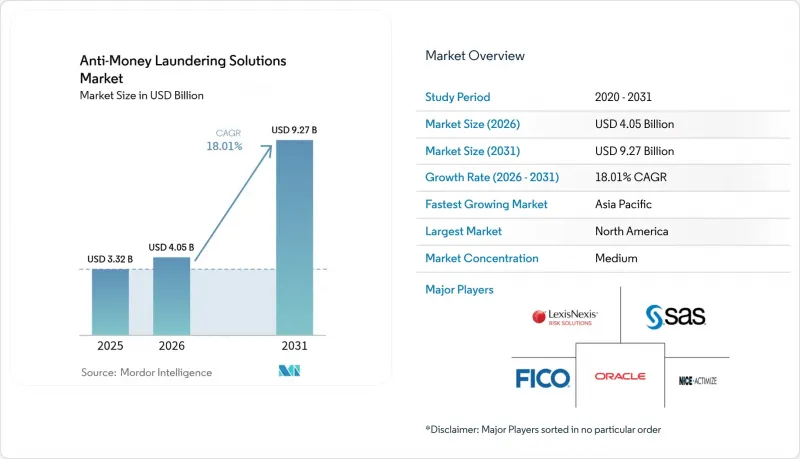
This report is Segmented by Solution (Transaction Monitoring Systems, Know-Your-Customer and Customer Due Diligence, and More), Component (Software, and Services), Deployment Model (On-Premise, and More), Organization Size (Large Enterprises, and More), End-User Industry (Banking, Insurance, and More), and Geography. The Market Forecasts are Provided in Terms of Value (USD).
Global Anti-Money Laundering Solutions Market Trends and Insights
Real-Time Compliance Mandates Under EU AMLR 2023
The European Union's Anti-Money Laundering Regulation, published in 2024, obliges firms to screen transactions before funds leave the institution, replacing overnight batch reviews. Lowered customer-due-diligence thresholds intensify data-collection demands, and a board-level compliance manager role ensures executive accountability. Because more than 80% of surveyed European banks remain in early preparation, vendors have a multi-year runway to supply real-time analytics, centralized beneficial-ownership checks, and harmonized suspicious-activity-report templates. The regulation's extraterritorial reach forces United Kingdom and Middle East institutions operating in the bloc to adopt identical standards, turning the anti-money laundering solutions market into a compliance technology arms race.
Expansion of Instant Payment Schemes Lifting Monitoring Volumes
FedNow, SEPA Instant, and India's Unified Payments Interface settle transactions in seconds, compressing alert-decision windows and multiplying monitoring volumes. Banks report alert spikes of up to 40% after onboarding instant rails, exposing rule-based systems that lack latency-optimized scoring. The European Central Bank processed 14.6 billion instant transactions in 2024, forcing adoption of in-memory analytics. Vendors such as NICE Actimize now offer cross-institution intelligence feeds that surface counterparty risk in milliseconds, a capability that accelerates cloud migration and pushes the anti-money laundering solutions market ahead of broader regtech spending.
High False-Positive Investigation Costs for Tier-2 Banks
Alert conversion rates below 5% mean community banks burn budget on investigations that rarely yield suspicious-activity reports. The Office of the Comptroller of the Currency now allows examiners to carry forward satisfactory findings to ease pressure, yet institutions still face USD 500-plus costs per false alert. Managed-service providers offering per-alert pricing appeal to these banks, but regulatory expectations for oversight keep adoption cautious, slowing the anti-money laundering solutions market among smaller depository institutions.
Other drivers and restraints analyzed in the detailed report include:
- Cryptocurrency Exchange Licensing in Asia-Pacific Fuelling Blockchain-Analytics Spend
- FinCEN Rule Extending to SEC-Registered Investment Advisers
- Data-Residency Laws in ASEAN Limiting Cloud AML Adoption
For complete list of drivers and restraints, kindly check the Table Of Contents.
Segment Analysis
Trade-based analytics is forecast to be the fastest-growing slice of the anti-money laundering solutions market, expanding at an 18.91% CAGR through 2031. Traditional monitoring engines held 42.51% of 2025 revenue, yet they lack visibility into invoices, manifests, and commodity pricing. Multinational banks now feed customs data into blockchain-enabled analytics to flag over- and under-invoicing.
The anti-money laundering solutions market size tied to transaction monitoring still dominates, but niche vendors that bridge physical-goods data with payment flows are capturing new budgets. Continuous know-your-customer screening blurs with monitoring as vendors trigger re-verification when adverse media or sanctions hits appear. Case-management systems add agentic AI that drafts narratives, shrinking investigation times. Market entrants that package trade-risk models into modular APIs stand to influence the anti-money laundering solutions market share as mid-tier banks join global supply chains.
Software represented 63.59% of revenue in 2025, reflecting decades of rules-based engines deployed on-premises. Services, however, are projected to grow 18.84% per year, making them the fastest-expanding component of the anti-money laundering solutions industry. Enforcement actions signal regulators tolerate outsourcing if governance is tight, pushing institutions to contract 24/7 alert triage, sanctions screening, and suspicious-activity report drafting.
The anti-money laundering solutions market size related to professional services rises as vendors bundle model tuning and explainability documentation. Managed-service providers differentiate through typology depth: some target crypto-mixing, others trade finance or gaming patterns. This specialization shifts fixed cost into pay-per-transaction models, allowing small firms to access enterprise-grade protection.
Complete Report Scope:
- By Solution
- Transaction Monitoring Systems
- Know-Your-Customer / Customer Due Diligence (KYC/CDD)
- Sanctions and PEP Screening
- Case and Alert Management
- Currency Transaction and Regulatory Reporting
- Trade-Based AML Analytics
- By Component
- Software
- Services (Managed, Professional)
- By Deployment Model
- On-Premise
- Cloud
- Hybrid
- By Organization Size
- Large Enterprises
- Small and Medium-sized Enterprises
- By End-User Industry
- Banking
- Insurance
- FinTech and Payment Service Providers
- Wealth and Asset Management / Investment Advisers
- Gaming and Gambling Operators
- Cryptocurrency Exchanges and Virtual-Asset Service Providers
- Government and Public Sector
- By Geography
- North America
- United States
- Canada
- Mexico
- South America
- Brazil
- Argentina
- Rest of South America
- Europe
- United Kingdom
- Germany
- France
- Spain
- Nordics
- Rest of Europe
- Asia-Pacific
- China
- Japan
- India
- Southeast Asia
- Australia
- New Zealand
- Rest of Asia-Pacific
- Middle East
- GCC Countries
- Turkey
- Rest of Middle East
- Africa
- South Africa
- Nigeria
- Rest of Africa
- North America
Geography Analysis
North America generated 43.09% of revenue in 2025 on the back of stringent enforcement and high per-institution budgets. FinCEN's USD 1.3 billion penalty against TD Bank reinforced the expectation that underinvestment in technology will be punished, prompting multi-year platform replacement programs.
Europe follows closely, with direct supervision by the new European Anti-Money Laundering Authority starting 2028 driving real-time system upgrades. Asia-Pacific, however, is the growth engine, forecast to advance at 19.31% through 2031. Licensing of virtual-asset providers, rapid instant-payment adoption, and Financial Action Task Force grey-listing pressures create an urgent need for modern surveillance across banks, fintechs, and public agencies.
South America and Africa remain smaller but strategically important, as correspondent banking retrenchment forces local institutions to modernize controls or lose access to dollar clearing. The Middle East leverages anti-money laundering modernization to attract fintech sandboxes and cross-border payment corridors, adding incremental demand for the anti-money laundering solutions market.
- SAS Institute Inc.
- NICE Actimize (NICE Ltd)
- Oracle Corporation
- Refinitiv Ltd (LSEG)
- LexisNexis Risk Solutions
- Fair Isaac Corporation (FICO)
- ACI Worldwide Inc.
- Fiserv Inc.
- BAE Systems plc
- Tata Consultancy Services Ltd
- Temenos AG
- Nasdaq Inc.
- Experian Information Solutions Inc.
- Moody's Analytics, Inc.
- Wolters Kluwer NV
- Intellect Design Arena Ltd
- Jumio Corporation
- Trulioo Information Services Inc.
- Accenture plc
- IBM Corporation
Additional Benefits:
- The market estimate (ME) sheet in Excel format
- 3 months of analyst support
TABLE OF CONTENTS
1 INTRODUCTION
- 1.1 Study Assumptions and Market Definition
- 1.2 Scope of the Study
2 RESEARCH METHODOLOGY
3 EXECUTIVE SUMMARY
4 MARKET LANDSCAPE
- 4.1 Market Overview
- 4.2 Market Drivers
- 4.2.1 Real-Time Compliance Mandates under EU AMLR 2023
- 4.2.2 Expansion of Instant Payment Schemes Lifting Monitoring Volumes
- 4.2.3 Cryptocurrency Exchange Licensing in Asia-Pacific Fuelling Blockchain-Analytics Spend
- 4.2.4 FinCEN Rule Extending to SEC-Registered Investment Advisers
- 4.2.5 FATF Grey-Listing Pressure Accelerating Upgrades in High-Risk Economies
- 4.2.6 Convergence of Digital Identity and eKYC Platforms with AML Stacks
- 4.3 Market Restraints
- 4.3.1 High False-Positive Investigation Costs for Tier-2 Banks
- 4.3.2 Data-Residency Laws in ASEAN Limiting Cloud AML Adoption
- 4.3.3 Lack of Explainable-AI Models Hindering Regulator Approval
- 4.3.4 Shrinking Correspondent Banking Lines in Africa Curtailing Addressable Market
- 4.4 Impact of Macroeconomic Factors on the Market
- 4.5 Industry Value-Chain Analysis
- 4.6 Regulatory Landscape
- 4.7 Technological Outlook
- 4.8 Porter's Five Forces Analysis
- 4.8.1 Bargaining Power of Suppliers
- 4.8.2 Bargaining Power of Buyers
- 4.8.3 Threat of New Entrants
- 4.8.4 Threat of Substitutes
- 4.8.5 Intensity of Competitive Rivalry
5 MARKET SIZE AND GROWTH FORECASTS (VALUE)
- 5.1 By Solution
- 5.1.1 Transaction Monitoring Systems
- 5.1.2 Know-Your-Customer / Customer Due Diligence (KYC/CDD)
- 5.1.3 Sanctions and PEP Screening
- 5.1.4 Case and Alert Management
- 5.1.5 Currency Transaction and Regulatory Reporting
- 5.1.6 Trade-Based AML Analytics
- 5.2 By Component
- 5.2.1 Software
- 5.2.2 Services (Managed, Professional)
- 5.3 By Deployment Model
- 5.3.1 On-Premise
- 5.3.2 Cloud
- 5.3.3 Hybrid
- 5.4 By Organization Size
- 5.4.1 Large Enterprises
- 5.4.2 Small and Medium-sized Enterprises
- 5.5 By End-User Industry
- 5.5.1 Banking
- 5.5.2 Insurance
- 5.5.3 FinTech and Payment Service Providers
- 5.5.4 Wealth and Asset Management / Investment Advisers
- 5.5.5 Gaming and Gambling Operators
- 5.5.6 Cryptocurrency Exchanges and Virtual-Asset Service Providers
- 5.5.7 Government and Public Sector
- 5.6 By Geography
- 5.6.1 North America
- 5.6.1.1 United States
- 5.6.1.2 Canada
- 5.6.1.3 Mexico
- 5.6.2 South America
- 5.6.2.1 Brazil
- 5.6.2.2 Argentina
- 5.6.2.3 Rest of South America
- 5.6.3 Europe
- 5.6.3.1 United Kingdom
- 5.6.3.2 Germany
- 5.6.3.3 France
- 5.6.3.4 Spain
- 5.6.3.5 Nordics
- 5.6.3.6 Rest of Europe
- 5.6.4 Asia-Pacific
- 5.6.4.1 China
- 5.6.4.2 Japan
- 5.6.4.3 India
- 5.6.4.4 Southeast Asia
- 5.6.4.5 Australia
- 5.6.4.6 New Zealand
- 5.6.4.7 Rest of Asia-Pacific
- 5.6.5 Middle East
- 5.6.5.1 GCC Countries
- 5.6.5.2 Turkey
- 5.6.5.3 Rest of Middle East
- 5.6.6 Africa
- 5.6.6.1 South Africa
- 5.6.6.2 Nigeria
- 5.6.6.3 Rest of Africa
- 5.6.1 North America
6 COMPETITIVE LANDSCAPE
- 6.1 Market Concentration
- 6.2 Strategic Moves
- 6.3 Market Share Analysis
- 6.4 Company Profiles (includes Global Level Overview, Market Level Overview, Core Segments, Financials as available, Strategic Information, Market Rank/Share, Products and Services, Recent Developments)
- 6.4.1 SAS Institute Inc.
- 6.4.2 NICE Actimize (NICE Ltd)
- 6.4.3 Oracle Corporation
- 6.4.4 Refinitiv Ltd (LSEG)
- 6.4.5 LexisNexis Risk Solutions
- 6.4.6 Fair Isaac Corporation (FICO)
- 6.4.7 ACI Worldwide Inc.
- 6.4.8 Fiserv Inc.
- 6.4.9 BAE Systems plc
- 6.4.10 Tata Consultancy Services Ltd
- 6.4.11 Temenos AG
- 6.4.12 Nasdaq Inc.
- 6.4.13 Experian Information Solutions Inc.
- 6.4.14 Moody's Analytics, Inc.
- 6.4.15 Wolters Kluwer NV
- 6.4.16 Intellect Design Arena Ltd
- 6.4.17 Jumio Corporation
- 6.4.18 Trulioo Information Services Inc.
- 6.4.19 Accenture plc
- 6.4.20 IBM Corporation
7 MARKET OPPORTUNITIES AND FUTURE OUTLOOK
- 7.1 White-Space and Unmet-Need Assessment

