PUBLISHER: Mordor Intelligence | PRODUCT CODE: 2124379

PUBLISHER: Mordor Intelligence | PRODUCT CODE: 2124379
Cruciate Ligament Repair Procedures - Market Share Analysis, Industry Trends & Statistics, Growth Forecasts (2026 - 2031)
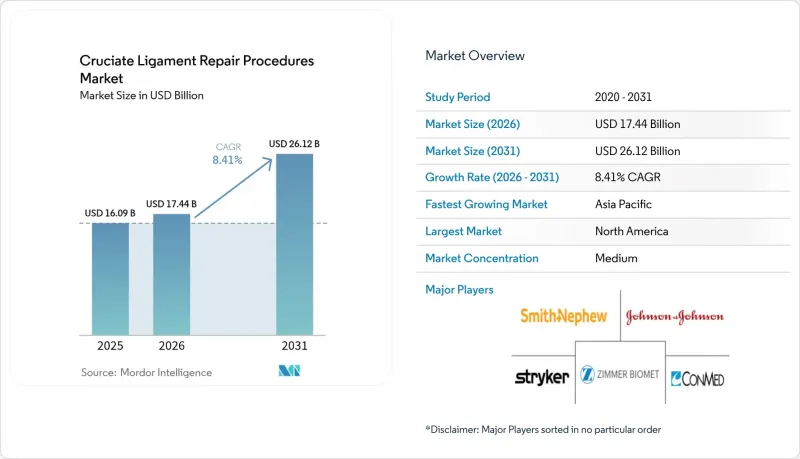
According to Mordor Intelligence, the cruciate ligament repair procedures market size is projected to expand from USD 16.09 billion in 2025 and USD 17.44 billion in 2026 to USD 26.12 billion by 2031, registering a CAGR of 8.41% between 2026 to 2031.
This report is Segmented by Procedure (ACL Repair, and More), Graft Type (Autograft, and More), Fixation Device (Interference Screws, and More), End User (Hospitals, Ambulatory Surgical Centers, and More), and Geography (North America, Europe, Asia-Pacific, Middle East & Africa, and South America). The Market Forecasts are Provided in Terms of Value (USD).
Global Cruciate Ligament Repair Procedures Market Trends and Insights
Increasing Incidence of Knee Ligament Injuries
ACL tears occur at a rate of 75.19 per 100,000 person-years in the United States, resulting in 100,000-200,000 new cases annually. Female athletes experience rupture rates two- to eight-fold higher than males because of anatomic and hormonal factors, while the 16-to-39-year bracket sees the most trauma. Although annual injury counts eased after 2010, surgical reconstruction volumes continued to climb by 2.15% per year as payers expanded reimbursement and patients demanded quicker return-to-sport timelines. The shift is most visible in North America and Western Europe, where third-party coverage for arthroscopy encourages early surgical decision-making.
Rising Preference for Minimally Invasive Orthopedic Procedures
All-inside arthroscopic techniques now dominate because they avoid tibial tunnel exit points and reduce postoperative pain. European surveys show transtibial drilling fell from 14.3% to 3.6% of high-volume surgeons between 2016 and 2023, while anteromedial and all-inside portals increased. Quadriceps-tendon harvests, which spare the patellar tendon, further improve donor-site morbidity. Arthrex extended its TightRope adjustable-loop button to pediatric ACL reconstruction in 2023, allowing all-epiphyseal fixation that protects the growth plate.
Elevated Total Procedure Cost and Limited Payer Coverage
Uninsured U.S. patients face bills of USD 20,000-50,000, while insured patients often pay USD 2,000-6,000 out of pocket. Adolescent charges climbed 70% between 2010 and 2022, prompting stricter prior-authorization guidelines. Medicare's allowable for CPT 27429 is USD 1,172, which many ambulatory centers consider below cost. Cigna's August 2024 policy still classifies primary ACL repair as investigational, curbing reimbursement for the BEAR scaffold.
Other drivers and restraints analyzed in the detailed report include:
- Advancements In Biologic and Synthetic Graft Technologies
- Integration of Artificial Intelligence into Surgical Planning & Navigation
- Risk of Surgical Failure and Need for Revision Procedures
For complete list of drivers and restraints, kindly check the Table Of Contents.
Segment Analysis
ACL reconstruction maintained a 54.84% share of the cruciate ligament repair procedures market in 2025. However, ACL repair is forecast to grow at a 10.53% CAGR through 2031 as the BEAR scaffold expands indications. More than 5,000 BEAR procedures have been performed since March 2025, with early data showing a 15% two-year re-tear rate comparable to that of autograft. As a result, repair could capture 15%-20% of primary cases by 2031, especially in younger cohorts that value hamstring preservation and faster rehabilitation. Posterior cruciate ligament (PCL) work accounts for less than 10% of volume because PCL injuries represent only 3%-5% of knee trauma. Revision reconstruction is a stable but growing niche, driven by aging grafts and repeat injuries.
Autograft tissue generated 46.76% revenue in 2025, supported by bone-patellar tendon-bone and hamstring grafts, which show a 9.6% failure rate under 25 years. Quadriceps-tendon options, commercialized with Smith & Nephew's QUADTRAC guide, deliver the lowest 2.4% one-year reoperation rate. Allografts remain preferred for older or revision cases despite their 25% failure in young athletes, partly because they shave 15-20 minutes off operating time. Biologic scaffolds, the fastest-growing segment at 10.87% CAGR, are riding the BEAR implant's expanded clearances and Stryker's synthetic integrations. Next-generation synthetic grafts may reach a 5%-8% share by 2031 if their durability matches that of autografts.
Complete Report Scope:
- By Procedure
- ACL Repair
- ACL Reconstruction
- PCL Repair
- PCL Reconstruction
- Revision Procedures
- By Graft Type
- Autograft
- Allograft
- Synthetic Graft
- Biologic Scaffolds
- By Fixation Device
- Interference Screws
- Cortical Buttons
- Suture Anchors
- Other Fixation Devices
- By End User
- Hospitals
- Ambulatory Surgical Centers
- Orthopedic & Sports Medicine Clinics
- Geography
- North America
- United States
- Canada
- Mexico
- Europe
- Germany
- United Kingdom
- France
- Italy
- Spain
- Rest of Europe
- Asia-Pacific
- China
- Japan
- India
- Australia
- South Korea
- Rest of Asia-Pacific
- Middle East & Africa
- GCC
- South Africa
- Rest of Middle East & Africa
- South America
- Brazil
- Argentina
- Rest of South America
- North America
Geography Analysis
North America retained 42.65% of global revenue in 2025, performing 100,000-200,000 ACL procedures annually, but growth is moderating as incidence declines while intervention rates plateau. Europe held roughly one-quarter of revenue, transitioning to anatomic tunnel placement and lateral extra-articular augmentation. Asia-Pacific is set to grow 9.54% through 2031, lifted by China's 82% price cuts that widened rural access even as they pressured supplier margins. Japan and South Korea leverage high bed density to maintain leading procedure rates, whereas India's fragmented coverage restrains uptake. The Middle East & Africa and South America share about 12%-15% of revenue; investment in Gulf sports medicine and Brazil's faster device approvals support incremental gains.
- Acuitive Technologies (Arthrosurface)
- Arthrex
- Bioretec
- Cayenne Medical
- Conmed
- Enovis (Mathys)
- Exactech
- Integra LifeSciences
- Johnson & Johnson
- Karl Storz
- Medtronic
- Miach Orthopaedics
- Orthocell
- Parcus Medical
- RTI Surgical
- Smiths Group
- Stryker
- Tissue Regenix
- Xiros Ltd (Neoligaments)
- Zimmer Biomet
Additional Benefits:
- The market estimate (ME) sheet in Excel format
- 3 months of analyst support
TABLE OF CONTENTS
1 Introduction
- 1.1 Study Assumptions & Market Definition
- 1.2 Scope Of The Study
2 Research Methodology
3 Executive Summary
4 Market Landscape
- 4.1 Market Overview
- 4.2 Market Drivers
- 4.2.1 Increasing Incidence of Knee Ligament Injuries
- 4.2.2 Rising Preference for Minimally Invasive Orthopedic Procedures
- 4.2.3 Growing Availability of Outpatient Ambulatory Surgery Centers
- 4.2.4 Advancements in Biologic and Synthetic Graft Technologies
- 4.2.5 Expanding Sports Medicine Physician Workforce in Emerging Markets
- 4.2.6 Integration of Artificial Intelligence into Surgical Planning & Navigation
- 4.3 Market Restraints
- 4.3.1 Elevated Total Procedure Cost and Limited Payer Coverage
- 4.3.2 Risk of Surgical Failure and Need For Revision Procedures
- 4.3.3 Stringent Regulatory Pathways for Novel Biologic Implants
- 4.3.4 Skill Gap Among Surgeons in Emerging Economies
- 4.4 Technological Outlook
- 4.5 Porter's Five Forces Analysis
- 4.5.1 Bargaining Power Of Buyers/Consumers
- 4.5.2 Bargaining Power Of Suppliers
- 4.5.3 Threat Of New Entrants
- 4.5.4 Threat Of Substitute Products
- 4.5.5 Intensity Of Competitive Rivalry
- 4.6 Value / Supply-Chain Analysis
- 4.7 Regulatory Landscape
5 Market Size & Growth Forecasts (Value, USD)
- 5.1 By Procedure
- 5.1.1 ACL Repair
- 5.1.2 ACL Reconstruction
- 5.1.3 PCL Repair
- 5.1.4 PCL Reconstruction
- 5.1.5 Revision Procedures
- 5.2 By Graft Type
- 5.2.1 Autograft
- 5.2.2 Allograft
- 5.2.3 Synthetic Graft
- 5.2.4 Biologic Scaffolds
- 5.3 By Fixation Device
- 5.3.1 Interference Screws
- 5.3.2 Cortical Buttons
- 5.3.3 Suture Anchors
- 5.3.4 Other Fixation Devices
- 5.4 By End User
- 5.4.1 Hospitals
- 5.4.2 Ambulatory Surgical Centers
- 5.4.3 Orthopedic & Sports Medicine Clinics
- 5.5 Geography
- 5.5.1 North America
- 5.5.1.1 United States
- 5.5.1.2 Canada
- 5.5.1.3 Mexico
- 5.5.2 Europe
- 5.5.2.1 Germany
- 5.5.2.2 United Kingdom
- 5.5.2.3 France
- 5.5.2.4 Italy
- 5.5.2.5 Spain
- 5.5.2.6 Rest of Europe
- 5.5.3 Asia-Pacific
- 5.5.3.1 China
- 5.5.3.2 Japan
- 5.5.3.3 India
- 5.5.3.4 Australia
- 5.5.3.5 South Korea
- 5.5.3.6 Rest of Asia-Pacific
- 5.5.4 Middle East & Africa
- 5.5.4.1 GCC
- 5.5.4.2 South Africa
- 5.5.4.3 Rest of Middle East & Africa
- 5.5.5 South America
- 5.5.5.1 Brazil
- 5.5.5.2 Argentina
- 5.5.5.3 Rest of South America
- 5.5.1 North America
6 Competitive Landscape
- 6.1 Market Concentration
- 6.2 Market Share Analysis
- 6.3 Company Profiles {(Includes Global Level Overview, Market Level Overview, Core Segments, Financials as Available, Strategic Information, Market Rank/Share for Key Companies, Products & Services, and Recent Developments)}
- 6.3.1 Acuitive Technologies (Arthrosurface)
- 6.3.2 Arthrex
- 6.3.3 Bioretec
- 6.3.4 Cayenne Medical
- 6.3.5 CONMED Corporation
- 6.3.6 Enovis (Mathys)
- 6.3.7 Exactech
- 6.3.8 Integra LifeSciences
- 6.3.9 Johnson & Johnson (DePuy Synthes)
- 6.3.10 Karl Storz SE & Co. KG
- 6.3.11 Medtronic
- 6.3.12 Miach Orthopaedics
- 6.3.13 Orthocell
- 6.3.14 Parcus Medical
- 6.3.15 RTI Surgical
- 6.3.16 Smith & Nephew
- 6.3.17 Stryker Corporation
- 6.3.18 Tissue Regenix
- 6.3.19 Xiros Ltd (Neoligaments)
- 6.3.20 Zimmer Biomet
7 Market Opportunities & Future Outlook
- 7.1 White-Space & Unmet-Need Assessment

